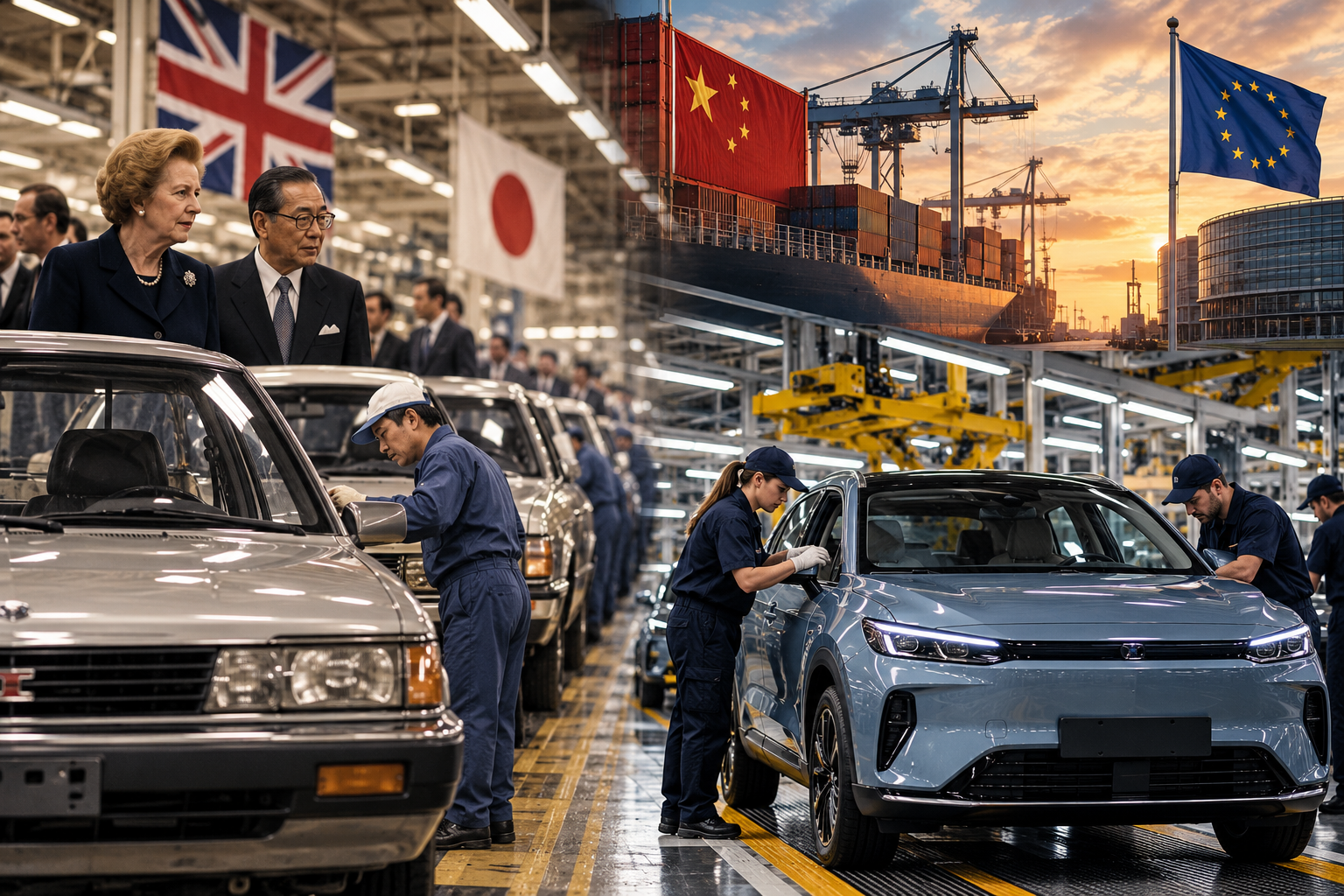
The first Nissans to leave Sunderland arrived in boxes. From July 1986 the plant in the north-east of England assembled the Bluebird from kits shipped in from Japan, and on 8 September Margaret Thatcher came to open it with Nissan's president, Yutaka Kume. Her speech promised two things. The cars would carry "large amounts of local content." And Nissan would become "a major exporter of cars into Europe."
Both promises mattered because of a wall. Since the mid-1970s British and Japanese industry had kept an understanding that held Japanese cars to roughly a tenth of the British market. A written answer in the House of Commons in January 1981 put the Japanese share at between 9 and 11 percent in every year from 1975 to 1979. Britain's position was that a car built in Sunderland stood on the other side of that line. Whether it did was not settled by the ribbon. In 1989 France was still arguing that a Sunderland Bluebird counted as Japanese unless at least 80 percent of its components came from the European Community.
Forty years later the same plant built 273,174 cars in 2025, on a theoretical capacity of about 600,000. In May 2026 Nissan said it would move all production onto Line Two. On 3 June it signed a non-binding memorandum with Chery International UK to build Chery passenger cars on the idled Line One from fiscal 2027.
That memorandum may never become a contract. In September Nissan announced a new model for Sunderland, the Kicks e-POWER, with £170 million of investment, and the announcement did not mention Chery. But the shape of the possibility is already on the table. A factory that once carried a Japanese carmaker into the European market could become the factory that brings a Chinese carmaker into it. Britain has no extra tariff on Chinese electric cars, though in October it was reported to be considering one, and cars built in China already pay the ordinary British car duty. For now the empty Line One looks like the bigger draw.
On the continent the same pattern has moved past the memorandum stage, and there the wall is real.
59 Percent: The Number Behind the Wall
The European plants of the established carmakers ran at 59 percent of their capacity in 2025. That is the Boston Consulting Group's figure, built on S&P Global Mobility data and published in June 2026. The industry's rule of thumb is that a plant needs to run at around 80 percent to pay its way. Behind the average the spread is wider than most readers would guess: carmakers averaged between 44 and 76 percent, and individual plants ranged from 23 percent to above full capacity. AlixPartners put the European figure below 60 percent and estimated that some 2.5 million vehicles a year of capacity could be made available. One example in the Financial Times, in August, made the abstraction concrete. Stellantis's plant at Cassino, in Italy, built 6,700 cars in the first half of 2026. Its annual capacity is 300,000.
A half-empty car plant is not a neutral object. It has a payroll, a paint shop, a stamping line, a supplier park and a regional government that remembers how many jobs it carries. Its fixed costs run whether it builds cars or not. Every carmaker with such a plant has three choices: close it, fill it with its own models, or fill it with someone else's.
Stellantis has said in writing which of the three it intends to use. On 21 May 2026 it announced that it would take more than 800,000 units out of its European capacity and lift utilisation from 60 to 80 percent by 2030. Among the means it named were shared capacity with Leapmotor "at the Madrid and Zaragoza (Spain) plants" and with Dongfeng at Rennes.
The two Spanish plants in the Leapmotor plan are different cases. Figueruelas is one of Stellantis's busiest European plants. Inovev, an industry analyst, lists Villaverde in Madrid among the Stellantis plants with significant overcapacity, alongside Rennes, Cassino and Eisenach.
Increasingly, the new customer for an empty European factory is a Chinese carmaker.
The Wall, 30 October 2024
The European Commission's countervailing duties on battery electric cars made in China took effect on 30 October 2024, for five years. They were set company by company, on top of the ordinary 10 percent car tariff: 17.0 percent for BYD, 18.8 percent for Geely, 35.3 percent for SAIC, and 20.7 percent for other carmakers that cooperated with the investigation. Leapmotor is in that last group, listed in the annex as Leapmotor Automobile Co., Ltd. Range-extender cars fall inside the scope.
The stated purpose was to offset subsidies that the Commission found were injuring the European industry. In January 2026 Brussels opened a second door beside the first. A Chinese-made model could escape the duty if its maker committed to a minimum import price, and the Commission's guidance on such undertakings listed investment in the EU among the elements it would weigh. The first car through that door was not Chinese-branded at all. In February 2026 the Commission accepted an undertaking for the Cupra Tavascan, which Volkswagen builds in Anhui.
Leapmotor did not take the door. In June 2025, when a minimum price of around 35,000 euros was being discussed, the company said publicly that such a floor was incompatible with its pricing. The arithmetic is easy to follow. A car that starts at 27,900 euros in Spain cannot be sold above 35,000 without ceasing to be the car it is. For a maker in that position the undertaking route narrows, and two routes remain: pay the 30.7 percent at the border, or build the car somewhere the duty does not reach.
Meanwhile the brands the duties were aimed at kept growing. Chinese carmakers took 11.7 percent of European registrations in August 2026, a record, according to Dataforce.
So the wall has a price and it has a door, and the door rewards investment inside the house. That is the setting in which a Spanish plant began building a Chinese car this month.
Figueruelas, October 2026
Stellantis's factory at Figueruelas, outside Zaragoza, builds the Opel Corsa, the Peugeot 208 and the Lancia Ypsilon. In mid-October 2026 it began series production of a fourth car, the Leapmotor B10, a compact electric SUV from Leapmotor of Hangzhou. The launch was announced on 16 October in the presence of the president of Aragon and Spain's secretary of state for industry. The plan is about 40,000 cars a year.
The B10 does not arrive in boxes, or not entirely. Spanish reporting describes stamping, welding, painting and final assembly at Figueruelas, with chassis parts from a supplier in Borja, a few kilometres away. A provisional figure reported in November 2025 put the mix at about 60 percent European and 40 percent Chinese parts. The battery modules are assembled at Mallén, also in the province of Zaragoza. The cells inside them, according to Spanish and Latin American reporting, still come from CATL in China.
Until the line started, every B10 sold in Spain was built in Jinhua, in Zhejiang province, and paid 30.7 percent at the border: the 10 percent car tariff plus Leapmotor's 20.7 percent. In Spain the car starts at 27,900 euros before promotions. About 400 people were hired to build it, with 100 more expected.
A B10 built in Figueruelas and sold in Spain never crosses the European Union's outer border as a finished car, so the duty on Chinese-made cars does not reach it. The parts that come in from China do cross that border, under their own tariffs. What I could not establish is what origin the finished car is given, which matters when it is exported or labelled, and whether the Commission regards the operation as substantial. Neither Stellantis nor Leapmotor has said. That question comes back below.
Stellantis, Leapmotor and the 51 Percent
The usual picture of this trade dispute has two sides. There is a European industry that the duties protect, and there are Chinese carmakers that the duties hold back. Stellantis does not fit on either side.
In October 2023 Stellantis paid about 1.5 billion euros for roughly 21 percent of Leapmotor. After the Chinese state carmaker FAW bought in at the end of 2025, exchange filings put the Stellantis stake at about 19 percent. The two companies also set up Leapmotor International, owned 51 percent by Stellantis and 49 percent by Leapmotor, which holds the exclusive right to sell and manufacture Leapmotor cars outside Greater China. Stellantis's annual report for 2025 calls it a Stellantis-controlled company. Since 2024 it has sold Leapmotors in Europe through dealers of existing Stellantis brands, a network that passed 1,000 outlets in September 2026, with financing from BNP Paribas and Santander, and it shipped more than 40,000 cars in Europe in 2025.
So when a Leapmotor built in China crossed into the European Union, the business selling it was majority-owned by one of the European carmakers the duty was meant to protect. How the margin on each car is divided between Stellantis and Leapmotor has not been published, and Stellantis does not report Leapmotor International's results separately. Its own European figures leave Leapmotor volumes out.
Stellantis is, toward Leapmotor, at once a manufacturer, a distributor, a shareholder and a competitor. Its own brands sell against the B10 in the same showrooms where the B10 is sold. Nobody hid this; it is printed in the company's filings and press releases. But it changes what the word "protection" can mean. A duty that makes Chinese-built Leapmotors more expensive also makes it more attractive for a Stellantis-controlled company to build them in a Stellantis plant that needs the volume.
That raises a question the filings do not answer. A carmaker with a plant below the level at which it pays its way needs volume, and a Chinese brand with a growing range and several European plants to choose from can supply it. Who needs the other more, the company that owns the factory or the company that can fill it? The answer is not in the public record, and it may differ from plant to plant. In the plants Stellantis has named, keeping the lines busy now relies in part on the competitor the duties were meant to slow down. Whether Stellantis has other ways to fill them is not something the public record shows.
The next step was announced on 8 May 2026. Stellantis said the ownership of its Villaverde plant in Madrid was "under discussion for potential transfer" to the Spanish subsidiary of Leapmotor International, with Leapmotor production from the first half of 2028. Production of the next-generation Citroën C4 is going to Kénitra in Morocco. As of this month no transfer has been signed, and the terms have not been disclosed.
Why a Filled Line Beats an Empty Field
A car plant built from nothing takes years to reach full production, while one that already has a paint shop, a workforce and a supplier base can be turned to a new model far faster. Chinese carmakers have started to say this out loud.
In May 2026 BYD's executive vice president Stella Li said at a conference in London that BYD was talking to Stellantis and other carmakers about underused European plants. A month later, as Reuters reported, she was plainer: "We would prefer to take over an existing plant." Alfredo Altavilla, a former Fiat Chrysler executive who advises BYD in Europe, put the reason more bluntly: "There is no time to start a greenfield plant today."
The examples are piling up across Spain. Ford's Almussafes plant near Valencia has a capacity of 450,000 vehicles and was running at less than a quarter of it in the summer of 2026; Geely agreed in July to build cars on an idle line there. In Barcelona, Chery's local partnership with Ebro began inside the factory that Nissan closed, "as a response to Nissan's closure," in the words of an EsadeGeo study, with assembly from kits and Chery as the main supplier of components. And Stellantis has put Zaragoza and Madrid in its own plan.
The strongest counter-example is BYD's own new plant at Szeged, in Hungary, built on open ground. Hungary voted against the duties and its government courted the investment. A greenfield plant shows that an empty European factory is not a precondition for a Chinese carmaker to build in Europe. What the brownfield deals show is narrower and easier to defend: where an empty line exists, it shortens the road from a tariff to a factory gate, and the companies involved say that speed is the point.
The tariff makes building in Europe more attractive. The empty line helps decide where.
Tychy, 31 March 2025
Capacity is not the only thing that decides where. Before Zaragoza, Stellantis had built a Leapmotor in Poland. Production of the small T03 began at its Tychy plant in June 2024 and stopped after 31 March 2025. Stellantis gave no reason and said it was evaluating different production options. The B10, originally reported for Poland, went to Spain.
There is a documented backdrop that may or may not explain it. On 30 October 2024 Reuters reported that China's Ministry of Commerce had told Chinese carmakers on 10 October to suspend "heavy-asset investments" in European countries that had supported the duties. Reuters named France, Poland and Italy. Spain abstained in the vote. Nobody has shown that Tychy closed because of Beijing's instruction rather than because of Stellantis's own calculations, and this piece does not claim it. But the instruction itself is on the record, and much of what followed fits it: the Leapmotor lines are in Spain, Chery's European assembly is in Spain, and BYD's car plant is in Hungary. The pattern is not clean. Stellantis's own plan also puts Dongfeng at Rennes, in France, which voted for the duties, and other Chinese brands have used contract assembly at Magna in Austria.
So there are at least two filters on a Chinese carmaker's map of Europe. One is industrial: where is there an empty line, a trained workforce and a willing partner? The other is political: which governments voted for the wall, and which did not? In the projects examined here, the Leapmotor line moved from Poland, which voted for the duties, to Spain, which abstained. That is an observed shift in a handful of cases, not a measured comparison of the two countries.
The 80 Percent Argument, 1989
Sunderland's first cars arrived as kits because that is how transplant factories begin. Production moves in stages, from assembling parts made elsewhere toward making the parts locally, and each stage raises the same question for the governments on the receiving end: at what point does a car stop being foreign?
France answered that question for itself in 1989. Its own quota held Japanese cars to about 3 percent of the French market, and a Bluebird from Sunderland would count against it unless at least 80 percent of its components came from the European Community, the Christian Science Monitor reported that March. Britain's position was that a car built in Britain was British. Thatcher had promised local content, but in 1989 the definition of "European" was a negotiation between governments, conducted over one Japanese car built in one English town.
Building a car in Europe and making it legally European are not necessarily the same thing. Thirty-seven years later the European Union has a binding general test in its customs code: goods made in more than one country take the origin of the place where they underwent their last substantial, economically justified processing. For passenger cars, heading 8703, the Commission has not added a binding product-specific rule. It publishes a non-binding guideline of 45 percent value added, with a fallback that points to the country where most of the materials came from, and applies the general test case by case. A car whose shell is stamped, welded and painted in Spain is more likely to count as European than one assembled from a kit. What origin the B10 is given is, as far as the public record goes, unanswered.
The European Union does have a sharp rule for assembly operations that undermine trade defence. It sits in the anti-dumping regulation, which treats assembly as circumvention when parts from the targeted country make up 60 percent or more of the value and the assembly adds no more than 25 percent of the manufacturing cost. The duties on Chinese electric cars, though, are anti-subsidy duties, and the corresponding article in the anti-subsidy regulation contains no such test, though its open-ended wording does not rule out a case. In November 2025 analysts at the Rhodium Group proposed extending the duties to "low-value assembly operations by Chinese automakers seeking to circumvent tariffs." As of October 2026 no circumvention investigation into Chinese electric cars has been found. Economists at Bruegel came at the problem from the other side in January 2026: they warned that price undertakings could come with "local content obligations" and induced technology transfer, and concluded that "the proposed price undertaking should be scrapped." The argument over what a European car is has become an argument over which instrument should decide it.
The France of 1989 at least knew which number it was arguing about.
The Battery Stays CATL's
The next layer of the car is moving to Spain as well. In November 2025 CATL and Stellantis began building a 4.1 billion euro battery plant at Figueruelas, next to the car factory, as a 50:50 joint venture. About 300 million euros comes from public aid. In the summer of 2026 some 172 CATL engineers, technicians and managers were on site, with a planned peak of 1,700 during construction. Module production is expected in 2027.
The terms of that venture show how location and control can come apart. According to a July 2026 case study by EsadeGeo, CATL licenses the intellectual property to manufacture cells and modules, the IP for the core battery technology "will remain the property of CATL," and new IP developed by the venture will be owned jointly. Industry press reported an expected European content of more than 70 percent at full capacity, with "no binding local sourcing obligations."
None of that is unusual for a technology licence, and none of it is hidden. But it gives the story its third dimension. Production control can sit with Stellantis, in a Stellantis building with a Spanish workforce. Commercial control can sit with Leapmotor International, 51 percent Stellantis. Technological control over the platform, the software and the chemistry of the cells can sit with Leapmotor and CATL. A single car leaving Figueruelas can carry all three, and each can belong to someone different.
Behind those three sits a fourth kind of control that no filing describes: the power to decide. Who can decide that a model will no longer be built in a given plant, end a licence, or develop the next platform somewhere else? Legal ownership of the building does not settle that. A factory can be European, staffed by Europeans and busy, while the decision about its next model is taken elsewhere.
The Strongest Case for the Tariff
The strongest counterargument to this reading does not dispute any of the facts above. It accepts that Chinese carmakers are moving into empty European plants and argues that this is exactly what the duties were for. Economists have a name for it: tariff-jumping investment. Japan's carmakers did it in the 1980s. The voluntary restraint that Washington negotiated in May 1981 capped Japanese exports to the United States at 1.68 million cars a year, and within a few years Japanese firms were building assembly plants in the United States. Brussels has written the same incentive into its own undertakings, by weighing future investment in the EU. On this view the policy has worked. The 400 jobs in Figueruelas and the supplier in Borja are real. A plant that might have closed is building cars, and the Chinese carmaker pays European wages and European taxes to do it.
This counterargument is structurally serious, and on its own terms it may well be right. The reading offered here does not claim that the duties failed, or that European workers lose. It claims something narrower. A trade measure can serve five different interests: jobs, factories, European brands, European technology and the people who buy the cars. The evidence so far suggests the duties are serving the first two through Chinese investment, while leaving open whether they serve the next two, and every car that is still shipped in from China carries the duty, which someone in the chain, often the buyer, ends up paying. There is one difference with the 1980s. Japan's carmakers mostly built new plants, Nissan on a former airfield outside Sunderland, Honda in Ohio, Nissan again in Tennessee, with NUMMI in General Motors' closed Fremont plant as the notable exception. The Chinese wave in Europe is so far moving into lines that already exist. Sunderland is the long-run reminder. It became a successful British factory and stayed a Japanese company's British factory for forty years. The Japanese precedent also shows who paid for that outcome. Estimates summarised in City Journal put the cost of the American restraint to car buyers at about 5.1 billion dollars, with prices of Japanese cars rising sharply while the cap held, and credit it with some 26,600 new assembly jobs in the American South and Midwest. Protection bought factories and charged the bill to the people who bought the cars. A measure can succeed for employment, remain ambiguous for technological autonomy and cost consumers money, all at once, and those are different verdicts on the same policy.
Line One
Back in Sunderland, Line One stands idle while Nissan and Chery talk. In the House of Commons record of 1981 the Japanese share of the British market sits between 9 and 11 percent through the late 1970s and reaches 11.9 percent in 1980. In 1986 a prime minister promised local content and exports to Europe, and the kits came in from Japan. In 2026 a Chinese carmaker has signed a memorandum to use one of the same plant's two lines, in a country that has so far put no extra tariff on its cars.
Europe built its wall to keep factories working, and the factories are working, or will be. The tariff protected the building. Who owns what is built inside it is a separate question. What the wall did not decide, and was never designed to decide, is whose cars they build, whose cells go into them and whose engineers hold the drawings. Those decisions are being made one line at a time, in plants that were waiting for volume, and the people who will drive the cars are not part of any of the agreements.
Evidence Map
Facts, interpretations, forecasts, and disconfirming signals.
Core claim. Two linked hypotheses. A, location: the EU's countervailing duties make local production in Europe more attractive for Chinese carmakers, and spare capacity in European plants, together with the political stance of the host country, helps decide where that production lands; Stellantis has named shared capacity with Leapmotor and Dongfeng as a means to lift its European utilisation from 60 to 80 percent. B, control: production in Europe does not by itself make the strategic technology and decision-making European; protecting production capacity and protecting industrial control are different goals.
Evidence level. Facts, high: duty rates and dates, Stellantis's capacity plan and its 51 percent of Leapmotor International, the B10 at Figueruelas, 59 percent utilisation in the established carmakers' European plants (BCG), the Nissan-Chery memorandum, the UK's absence of an extra tariff, the Hansard and 1989 records. Interpretation, medium: that idle capacity is a location factor alongside politics. Open: the customs origin of the B10, the margin split within Leapmotor International, and whether Chery's Sunderland plan becomes a contract.
What would confirm this. For A: more transfers or shared-line deals between European carmakers and Chinese brands in plants below 60 percent utilisation; a binding Nissan-Chery agreement; Villaverde's transfer signed; Chinese assembly continuing to concentrate in countries that did not vote for the duties. For B: licences, platform and cell IP staying with the Chinese partner as volumes grow; model and location decisions announced from outside Europe.
What would disprove this. For A: Chinese carmakers choosing mainly greenfield sites while idle European plants stay empty; Chinese assembly growing fastest in countries that voted for the duties. For B: evidence that EU-built Chinese-brand cars become predominantly European in value, design, technology and decision rights, for instance through transferred IP or European-led development.
Watchlist. Villaverde (signature expected before 2028 production); Sunderland Line One; any Commission circumvention or origin decision on EU-assembled Chinese EVs; a UK tariff package on Chinese EVs; Stellantis's reporting on Leapmotor International.
Sources. European Commission, countervailing duties on BEVs from China and the French customs notice reproducing the annex of Regulation 2024/2754; Stellantis on its capacity plan of 21 May 2026 and its partnership with Leapmotor; BCG, Europe's automotive overcapacity; Hansard, Japanese motor vehicles, 19 January 1981; Margaret Thatcher Foundation, speech opening the Nissan plant; Christian Science Monitor, on the 1989 dispute; EsadeGeo, three case studies; Commission, non-preferential rules of origin and its list rules for chapters 86 to 89.
Related from The Manifest Archive
- Everyone Is Watching Chinese Cars Win Europe. Nobody Is Asking What Any Maker Can Still Switch Off.
- NATO 3.0 Named the Dependency. The Metrics Measure Spending.
- Everyone Is Watching the American Century. Nobody Is Watching the Machine It Inherited from the Reich.
- More Than One in Five New Cars in Europe Is Electric. 92 Percent of Its New Trucks Are Diesel.
Jerry van der Laan writes The Manifest Archive, Forensic Narrative Intelligence Writing on the systems beneath power, money, and history. He traces the structures beneath them.
The questions, the editorial judgments and the responsibility for every published claim are mine. AI assists with the research, the drafting and the source checks.