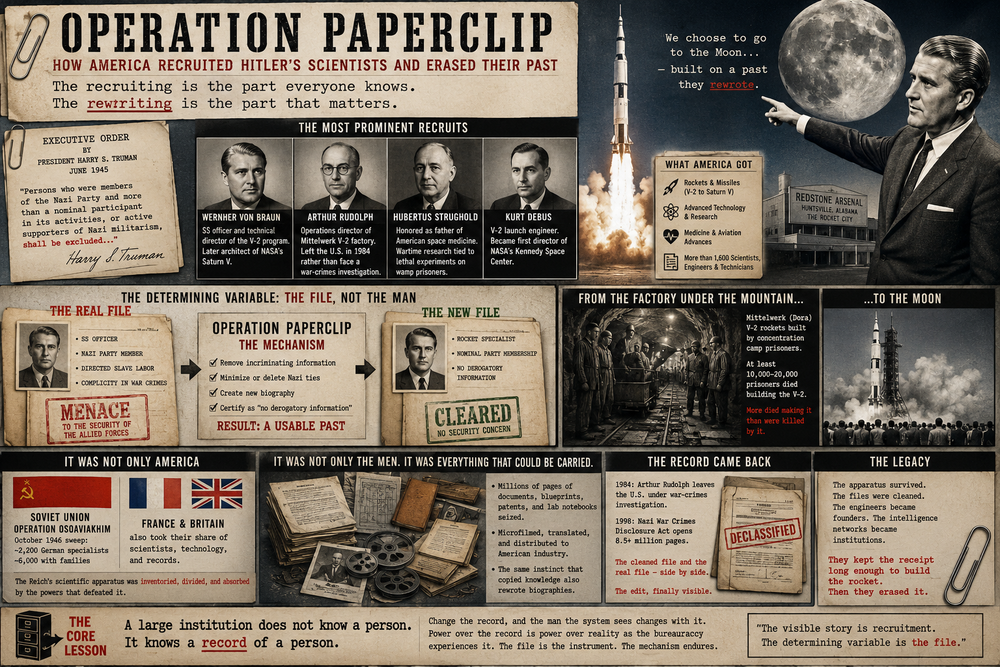
A man stands in 1969 as the celebrated architect of the rocket that has just carried Americans to the Moon, the hero of the age of progress, the face on the magazine cover. The same man, a generation earlier, designed the ballistic missile that struck London and Antwerp, and that missile was assembled in a tunnel complex by concentration-camp prisoners, more of whom died building it than were ever killed by it. Wernher von Braun built the V-2 for the Third Reich and the Saturn V for the United States, and between those two machines lies the whole hidden architecture of how American power was actually made.
We tell the story of the postwar United States as a story of triumph followed by ingenuity: the arsenal of democracy won the war, and then American science, American freedom, and American enterprise won the peace, the space race, the Cold War. That story is not false. It is incomplete in the one place that matters. A great deal of what became the engine of American dominance after 1945 did not grow from American soil. It was imported, absorbed, and renamed, taken from the wreckage of the regimes the war destroyed, and the act of taking was deliberately made invisible. The victor does not only defeat the enemy. It inherits the enemy's machine, and erases the receipt.
The program that contradicted its own government
Begin with the documented core, because it is sharper than the legend and it is not in dispute. Between 1945 and 1959, under Operation Paperclip and its sibling programs, the United States brought roughly sixteen hundred German and Austrian scientists, engineers, and technicians, with their families, to work in American laboratories, arsenals, and agencies. Many of them had been members of the Nazi party, the SS, or both, and a number had been close to war crimes. President Truman's 1946 directive barred anyone who had been more than a nominal participant in the Nazi party or an active supporter of Nazi militarism. The directive was bypassed from inside. The Joint Intelligence Objectives Agency, the body running the program, sanitized the files, expunging or whitewashing the incriminating evidence, so that men whose records should have barred them could be admitted as clean.
Hold the shape of that, because it is the whole pattern in miniature. The same government that was conducting the Nuremberg trials and proclaiming denazification was, through a different office, importing the personnel of the regime it was prosecuting, and editing their pasts to do it. The public face was anti-fascist justice. The operational hand was recruitment. The two ran at the same time, in the same government, and the contradiction was managed by making one of them secret. This is not an interpretation laid over the facts. It is what the agency, created to run the program, ended up doing: making the absorption deniable.
None of this is inference or rumor. The reason it can be stated plainly is that the receipt was, decades later, recovered from the archive itself. The concealment did not hold forever. In 1998 the United States passed the Nazi War Crimes Disclosure Act, and an interagency working group spent years prying open the files, opening more than eight million pages from the FBI, the CIA, and Army intelligence: among them more than three thousand pages of Army counterintelligence files on the spymaster Reinhard Gehlen, and CIA name files on nearly eight hundred individuals and subjects. The paper trail of the absorption, the thing the recruiting agency had sanitized at the source, was reassembled from the archive at the other end. And the government's own reckoning was itself buried: a roughly six-hundred-page internal Justice Department history, written by its Nazi-hunting unit and completed in 2006, concluded that the country had become a safe haven for Hitler's men, and it was withheld as a mere draft until a lawsuit forced a redacted version into the open in 2010, while the full text was leaked to the New York Times. The story is documented twice over, once in the records that were declassified and once in the report about those records that someone tried to keep buried. The receipt was erased at the source and recovered from the archive, and the erasure is now part of the record it tried to prevent.
What was actually absorbed
The men were the visible part. What they carried was the point. Von Braun and roughly a hundred and twenty of his Peenemünde rocket team formed the core of what became the Marshall Space Flight Center, and von Braun became its director and the chief architect of the Saturn V, the launch vehicle that put Americans on the Moon. The American space program did not merely employ a few German experts. It was built around the intact transplanted nucleus of the most advanced rocketry program on earth, the one the war had matured under the swastika, now relabeled as American achievement and sold to the public as the fruit of the free world. The flag changed. The team did not.
And it was not only rockets. The same logic ran through chemical and biological weapons research at Edgewood Arsenal and Camp Detrick, through aviation medicine, through the laboratories where German capability was the seed of American programs. The machine did not cross the Atlantic in a single shipment. It crossed in pieces: engineers, intelligence files, laboratories, doctrines, and institutions, each piece absorbed where the defeated regime had built something the victor wanted and had not built itself. America did not just win the war's territory; it harvested the war's knowledge and planted it at home.
The machine that came with no uniform
The starkest case is not the scientists but the spies, because there the entire apparatus was taken whole. Reinhard Gehlen had run the German army's military intelligence on the Eastern Front, the section that watched the Soviet Union. At the war's end he offered his organization, his files, and his networks to the Americans, and they took it. The Gehlen Organization, the intelligence machine built to serve Hitler's war against the Soviet Union, became, almost without interruption, the United States' principal instrument for watching the same Soviet Union, and later the core of West Germany's federal intelligence service. The enemy's eyes were repointed and kept open. The Cold War's German intelligence apparatus on the Western side was, in substantial part, the Eastern Front's apparatus with a new paymaster.
This is the absorption in its purest form. The United States did not need to build a Soviet-intelligence network from nothing, because one already existed, ready-made, in the hands of the defeated, and it could be acquired faster than it could be created. The same calculation that drove Paperclip drove this: the loser's machine was cheaper to inherit than to reinvent, and so it was inherited, and its origins were buried under the language of necessity. The fastest way to build an apparatus is to take one that already works from someone who has just lost.
There is a reason this keeps happening, and it is the deepest thing the story has to teach. Regimes are mortal and their machines are not. A government falls, a flag comes down, a capital surrenders, but the rocket program, the intelligence network, the laboratory, the trained cadre, these survive the collapse intact, because they are knowledge and structure rather than sovereignty, and knowledge and structure can change owners without dying. Apparatus survives defeat better than nations do, which is why the machine outlives the regime and serves whoever takes it next.
It absorbed the method, not only the machine
The hardware and the spies were the visible inheritance. There was a subtler one, and it is the part that should unsettle most, though here the claim moves from documented fact into interpretation and must be marked as such. The regimes the war destroyed had a common operational flaw: they exercised power visibly, through open repression, and open repression generates resistance faster than a state can absorb it. That was the ceiling the Third Reich and, in its own way, the Soviet system kept hitting. The postwar American order, built in the same years as the absorption, solved that problem differently, not by making power more brutal but by making it less visible: prosperity and consumption as the binding of loyalty, culture as diplomacy, the dollar as a quiet anchor, an alliance that felt like a gift, elections as a release valve.
Some of the transfer here is documented and concrete. American propaganda doctrine drew on Edward Bernays, whose techniques, by his own account, were studied even in Goebbels's ministry. Operation Bloodstone recruited former Nazi propagandists directly into American psychological-warfare work. The wartime intelligence service studied the German experiment closely, employing emigre analysts of the Frankfurt School to understand how a modern society had been captured. That the United States learned from the mechanisms of the regimes it defeated is not speculation; the recruitment and the study are on the record. What is interpretation, and held as such, is the larger reading: that this amounted to an upgrade of power itself into a form whose costs of visibility were lower. The political theorist Sheldon Wolin gave that a scholarly and contested name, inverted totalitarianism. It is a lens, not a proven fact, and the honest claim is narrower: the victor absorbed not only the loser's machines but lessons about how power fails when it is seen, and built accordingly. The deepest thing a victor can inherit is not the enemy's weapon but the knowledge of why the enemy's method broke.
Four years of architecture
Step back from the individual programs and a larger shape appears. Here the claim has to be marked carefully, because this is interpretation built on the documented record rather than a single document. In the four years between the German surrender in 1945 and the founding of NATO in 1949, an entire postwar order was assembled: the absorption of German scientific and intelligence capability, the Bretton Woods system agreed in 1944 put into operation with the dollar at its center, a Western alliance constructed, and the pivot from fighting Germany to containing the Soviet Union. Whoever looks only at the decades of execution that followed sees a natural, organic postwar settlement. Whoever looks at the compressed four years of construction sees something that behaves like a design.
The speed of the pivot is documented in a single, startling artifact. In May 1945, the same month Germany surrendered, Churchill had his planners draw up Operation Unthinkable, a contingency for attacking the Soviet Union, using rearmed German divisions among the attacking force. It was judged militarily unfeasible and shelved, and it stayed secret until the British archives released it in 1998. But its mere existence shows something: the thought of turning from anti-German to anti-Soviet was already on paper in the month of victory, almost a year before the public heard of the Iron Curtain. The enemy of one month was the asset of the next, on paper, in a war ministry, before the ink on the surrender was dry. The pivot the public experienced as a gradual cooling had already happened inside the apparatus.
That word, design, is where discipline is required. That the components were assembled in those years is documented. That they served a coherent strategic outcome, the replacement of the exhausted British empire by an American hegemony built partly on absorbed German substrate, is a strong and defensible reading of the record. But whether all of it was directed from a single coordinating center, consciously planned by one apex of decision, or whether it emerged from many overlapping interests and a shared strategic education converging on the same result, is an open question the public record does not settle. The documented layer supports the pattern, the instruments, and the shared frame. A single hidden hand directing the whole is a hypothesis, not an established fact, and it should be held as one. The honest position is that the architecture is real and visible; the architect, if there was a single one, is not.
The coordination needs no cabal
This is the place where the analysis must do its hardest work, because the natural next thought, the one that ruins so much writing on this subject, is that such coherence requires a hidden directing hand. It does not, and the reason it does not is itself documented. The men who assembled the postwar order were drawn from a remarkably narrow formation: a transatlantic elite educated, for a couple of generations, in the same classical curriculum, the same handful of schools and universities, the same shared reading of Thucydides and the strategy of managed transitions. People trained in the same frame, facing the same situation, reach the same moves without needing to be told, because the frame is doing the coordinating.
That is the disciplined explanation, and it is stronger than the conspiracy precisely because it requires no secret meeting. A shared strategic education is enough to produce a shared strategic response: absorb the useful enemy, replace the exhausted ally, contain the new rival, and narrate all of it as defense and necessity. Whether, in addition to this shared substrate, there was also an explicit coordinating center, a single apex consciously directing the whole, is the open question the record does not close, and it should stay open rather than be asserted. The substrate explains the coordination at the level the evidence supports; the apex remains a hypothesis. Crucially, the existence of the shared frame neither proves nor disproves a directing center, and an honest analysis holds the documented layer firmly and the speculative one lightly. A common education can choreograph a thousand decisions without a single conductor, which is why the absence of a plot is not the absence of a pattern.
The empire that changed hands inside the war
The absorption of Germany was one half of the transformation. The other was the quiet transfer of the imperial role itself. In 1939 Britain governed roughly a quarter of the world, ran the reserve currency, and policed the sea lanes. By 1945 Britain was effectively bankrupt. It had taken some thirty-one billion dollars in American Lend-Lease aid, it owed billions of pounds across its empire, and in 1946 it needed a further American loan of 3.75 billion dollars just to keep paying for imports. Its industrial base was battered and its dollar earnings were gone. The United States ended the war producing, by widely cited estimates, around half of the world's manufacturing output, holding the atomic monopoly, and having secured the dollar as the global anchor at Bretton Woods a year before the fighting stopped. The instruments of the handover are documented and concrete. Lend-Lease and the destroyers-for-bases deal bound Britain financially before the war was won. Bretton Woods in 1944 made the dollar the center. The postwar Anglo-American loan of 1946 came with a condition, the forced convertibility of sterling, that triggered a run on the pound within weeks of taking effect. And Suez in 1956 was the moment Britain learned it could no longer act as a world power without American permission.
So the Second World War, among everything else it was, was also the instrument through which the imperial baton passed from London to Washington. The war that destroyed the German bid for continental Europe also dissolved the British capacity to remain the global power, and the United States stepped into both vacancies at once: it absorbed the loser's knowledge and it inherited the older partner's position. The defeat of Germany and the eclipse of Britain were not two separate stories. They were the two sides of how America became the center. The same war that ended one empire's enemy ended its primacy, and the survivor took both.
What this is not
The discipline of this analysis depends on what it refuses to become, and the refusals matter as much as the claims. This is not the argument that America was secretly Nazi, or that the Holocaust is relativized by noting that its perpetrators' colleagues were later employed. The Third Reich produced the Holocaust. Nothing in the absorption of its engineers changes the singular horror of that, and the four regimes that move through this story are not morally equivalent in what they did: the Reich's industrial murder, the Soviet Gulag and famine, the British empire's colonial famines and repressions, and the American postwar order's wars and coups are different in kind and in scale, and flattening them into a single indictment would be its own dishonesty.
Nor is this a claim that a cabal ran history. The strongest version of the apex-coordination hypothesis is explicitly held open, not asserted. What is being claimed is narrower, harder, and documented: that American postwar power was built in significant part by absorbing the scientific and intelligence machinery of the regime it defeated, that this absorption was deliberately concealed against its own government's stated policy, and that it ran in parallel with the inheritance of the British imperial position. Those are not speculations. They are the record, read without the comforting narration.
The dead under the moon rocket
Put the human cost where the legend hides it, because the legend is built on an erasure and the erasure has a body count. The V-2 that von Braun designed was assembled at the Mittelwerk, an underground factory worked by prisoners from the Mittelbau-Dora concentration camp. Conditions were so lethal that at least ten thousand of them died producing the rocket, and some twenty thousand died across the Mittelbau camp system. The weapon itself killed about five thousand people when it fell on cities. Those deaths are the foundation under the celebrated Saturn V, and they were edited out of the file along with the party memberships, so that the man who oversaw the program could become, in the American story, simply the genius who reached the Moon.
That editing is the whole mechanism in one image. To make the inheritance usable, the past attached to it had to be removed, and what was removed was not only paperwork but the record of the people who died inside the thing being inherited. The clean story America told itself about its own triumph required that the dead under the rocket stay invisible, the same way the program required that the files stay sanitized. A nation can inherit a machine, but it cannot inherit a clean conscience; it can only delete the receipt and call the result its own.
The law that outlives the case
This is not, finally, a story confined to 1945, which is why it matters now and not only to historians. The mechanism it exposes is general: when a regime falls, its apparatus does not fall with it, and whoever is positioned to take the apparatus inherits a capability it did not have to build. The pattern repeats wherever a power collapses with its machinery intact. When the Soviet Union dissolved, its security and scientific apparatus did not evaporate; much of it was absorbed, repurposed, and carried forward by the successor state and by others who reached for the pieces. The same logic governs the quieter transfers of the present, where institutions, datasets, and trained cadres outlast the governments that built them and pass to whoever can use them next.
That is the reason the Paperclip story is worth telling beyond its own horror and its own drama. It is the clearest case of a law that is still running: nations are mortal and visible, and their machines are durable and quiet, so the machines keep migrating from the defeated to the ascendant while the public watches the flags change and assumes the substance changed with them. It did not. The flag is the part that surrenders. The machine is the part that gets a new owner.
The windfall beneath the boom
The famous men are the visible edge of something much larger and far less discussed: the wholesale transfer of German technical knowledge into American industry. Alongside the scientists, Allied technical-intelligence teams stripped the defeated Reich of its blueprints, patents, prototypes, and laboratory records, millions of pages in all, microfilmed and distributed to American firms in the late 1940s. Whole fields absorbed the haul at once. German leadership in synthetic fuels and synthetic rubber, in chemistry and dye-stuffs, in jet propulsion and aerodynamics and magnetic recording, was not matched by the United States so much as inherited by it, transferred in a few short years from the laboratories that developed it to the corporations that would commercialize it.
This is the part the phrase "the American Century" is built to keep out of view. The postwar American boom is remembered as a pure flowering of free enterprise and homegrown genius, and much of it was. But its technological base was seeded, at a decisive moment, by a one-time windfall taken from a conquered rival, a windfall of knowledge that American industry did not pay to develop and did not always credit. The jet airliner, the space rocket, and a shelf of chemical and material processes that ran through the consumer economy of the 1950s all trace part of their lineage to that transfer. The Century was real. So was the inheritance underneath it, and the inheritance is the part that left no monument.
The strongest case against reading it this way
The honest objection is that this is simply what every victor has always done, and dressing it as a hidden architecture overstates an ordinary truth. The Soviet Union also seized German scientists, by the thousands, and ran them in its own programs. Spoils of war include talent; a rational state that has just defeated an enemy uses what the enemy built rather than letting a rival take it. On this reading there is no special American story here, only the universal pragmatism of power, and the moralizing about erased files mistakes standard wartime intelligence practice for a unique sin.
The objection is correct that the practice was not unique, and wrong that this makes it trivial, which is the part that matters. Yes, the Soviets did the same; yes, using the loser's talent is ancient. But three things lift the American case above mere pragmatism into the structural claim. The scale was vast and systematic, an entire knowledge base transplanted rather than a few prizes seized. The concealment was active and aimed at the program's own government, files altered to defeat a presidential directive, which is a different act from simply employing a captured expert. And the absorption ran in lockstep with the monetary and imperial transition that made the United States the center of the world, so that the inheritance of German capability and the inheritance of British position were parts of one passage. The scoped claim is not that America alone took spoils, nor that it was therefore evil, but that its postwar dominance was, to a degree the triumphal story omits, a built thing assembled from absorbed and concealed parts. If the documentary record showed that the German scientific and intelligence apparatus made no material difference, that American power would have been identical without it, the reading would fail. The record shows the opposite: the rocket that reached the Moon and the network that watched the Soviets were, at their core, inherited.
Keep the asset, erase the ledger
Strip the case to its mechanism and a rule emerges that is not about Germans or rockets at all. When an institution acquires something valuable by means it cannot defend, it does not refuse the thing and it does not defend the means. It keeps the asset and erases the ledger. The capability is retained, named, budgeted, and celebrated; the record of how it was obtained is reclassified, softened, or simply allowed to fall out of the story, until the achievement stands alone in public memory with its origin removed. The Saturn V is remembered; the slave labor under the mountain and the rewritten files are not, unless someone goes looking.
That separation, asset kept in the light and ledger moved into the dark, is the determining variable behind the comfortable version of the American Century, and it is not unique to 1945. It is what powerful institutions do whenever the value of a thing and the legitimacy of its acquisition point in opposite directions. The Reich's machine is the clearest case because the ledger, unusually, survived alongside the asset and was eventually published, so the two can be read together. Most of the time only the asset reaches the public, gleaming and origin-free, and the ledger never surfaces at all. The finding is not that America is uniquely guilty. It is that the gleaming version of any great power's rise is, reliably, the version with the ledger removed.
What American power was really built from
The story of the American century will keep being told as a story of what America made: the assembly lines, the laboratories, the free institutions, the reach for the Moon. Watch the inheritance under the invention. A meaningful part of what the United States became after 1945 was not invented at home but absorbed from abroad, taken from the defeated and the eclipsed, and then renamed as native genius, with the origins filed away so completely that the renaming itself disappeared.
The rocket on the launch pad was a German design built on prisoners' deaths. The eyes on the Soviet Union were a Wehrmacht general's network. The dollar at the center of the world was a position vacated by a bankrupt ally. None of this erases what America also genuinely built, and none of it makes the regimes of the century morally equal. What it does is correct the picture. The defeat of the Third Reich was not only the end of an enemy. It was, for the United States, the largest acquisition in its history, of people, of knowledge, of machinery, of position, and the genius of the postwar American story was not only in what it created but in how completely it absorbed what others had made and called the result its own. The war did not just produce a victor. It produced an heir, and the heir kept the inheritance and burned the will. A nation can lose its war and keep its machine; a machine can lose its nation and keep its war.
Evidence Map
Facts, interpretations, forecasts, and disconfirming signals.
Core claim. The American postwar century was built in significant part on a concealed inheritance, the absorbed scientific and intelligence apparatus of the defeated Reich and the eclipsed British empire, renamed as native achievement.
Evidence level. Facts: high (the Paperclip personnel transfer, file-sanitizing against Truman's ban, the Gehlen absorption, the British-to-American transition via Bretton Woods). Interpretation: medium (the 1945-1949 window read as a coherent design). Forecast: speculative; a single directing apex is explicitly not asserted.
What would confirm this. Continued declassification (NARA, the DOJ OSI audit, BND historical-commission releases) surfacing the gap between the anti-fascist posture of 1945-1949 and the recruitment beneath it; substantial prosopographic overlap between Paperclip, Bretton Woods, and NATO architects; the absorb-and-rename pattern recurring in later transitions.
What would disprove this. Declassified records showing the absorbed apparatus made no material difference to American capability; the file-sanitizing proving marginal rather than systematic; the 1945-1949 components proving disconnected rather than mutually reinforcing.
Watchlist. Evergreen and structural, with live tracking of NARA, OSI, and BND-commission declassifications.
Jerry van der Laan writes The Manifest Archive, a continuous investigation into how institutions, language, and systems shape what people are permitted to see as reality. He does not report events. He traces the structures beneath them.
Correction, 12 October 2026: this piece has been corrected. Britain did not owe the United States twenty-one billion dollars in 1945; Lend-Lease was largely written off, and the debt that followed was the 1946 loan of 3.75 billion dollars. About twenty thousand prisoners died across the Mittelbau camp system; at least ten thousand died in V-2 production itself. Also corrected: the scale of the IWG releases (more than eight million pages); the OSI report, withheld as a draft rather than classified; the date of Bretton Woods (1944); Operation Unthinkable, a contingency study rather than an operational turn; the wording of Truman's directive; the US share of world output; and Bernays's influence on Goebbels, which rests on Bernays's own account. The corrections log is at themanifestarchive.com/standards.
Related from The Manifest Archive
- Hitler Lost the War. Von Braun, Gehlen and Dulles Won the Peace.
- The Reich After the Reich
- Reinhard Gehlen Surrendered in 1945. American Intelligence Hired Him in 1946.
- Everyone Is Watching NATO's Troops. Nobody Is Watching the Railway to the Baltics.
- Operation Paperclip: How America Recruited Hitler's Scientists
- After the Führer
- Tesla's Papers Were Declared Worthless in 1943.
- Peteano 1972: The Gladio Explosive Hidden for Twelve Years