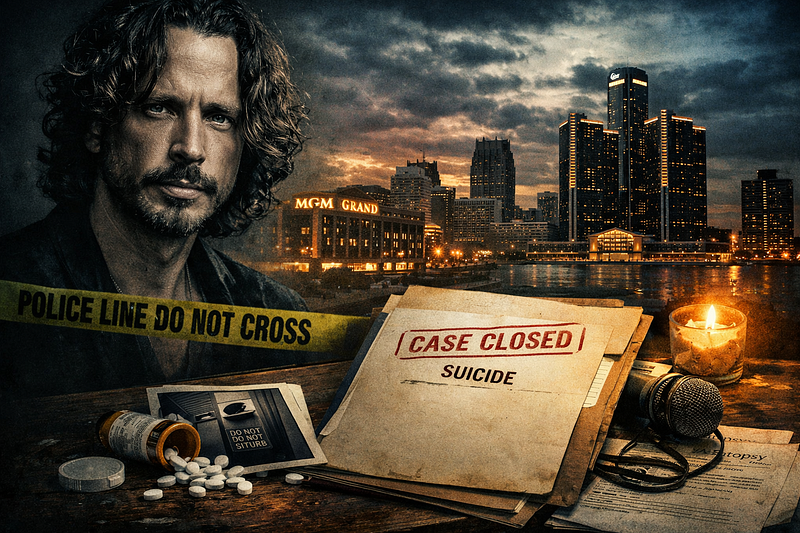
The voice a generation used to carry its grief, and a culture that built no way to carry his.
In March 1990 a singer named Andrew Wood died of a heroin overdose in Seattle, days before his band Mother Love Bone was to release the album that would have made it famous. He was twenty-four. The scene that would soon be called grunge had lost one of its first voices before the world had heard it. What happened next set a pattern that would define the decade and, in a sense, end it. Wood's roommate, a singer in another local band, wrote two songs to grieve him, gathered some friends, and recorded a tribute album. The roommate was Chris Cornell. The album was Temple of the Dog. The friends would shortly become Pearl Jam.
Cornell's defining work, in other words, began as an act of public mourning. Before he was a star he was the one who found the words for a loss the others could not speak, and that turned out to be the role he would play, in one form or another, for the rest of his life. He was the voice a generation used to metabolize its grief. The story of his death, twenty-seven years later, is the story of what happens to such a voice when the culture that needs it has built no structure to carry the weight back the other way.
The Voice of a Scene
Chris Cornell was the voice of Soundgarden, not symbolically but materially, an instrument capable of carrying the full emotional weight of a feeling without simplifying it. Soundgarden stood at the foundation of the Seattle movement alongside Nirvana, Pearl Jam, and Alice in Chains, and that movement was not a genre engineered for export. It was a posture shaped by alienation and a refusal to make light of what felt heavy. Grunge was not rebellion with raised fists. It was refusal, the insistence on taking seriously the things a glossier culture wanted treated as a phase.
Within that world Cornell stood apart through seriousness. He had the appearance of a rock star and sang without pose, with a range that became famous and a precision that was the real source of its power. He could scream without bravado and sing softly without weakness, and in a scene that often confused rawness with self-destruction, he brought control. His band made music that resisted comfort, dense and dissonant and sometimes unsettling, not a soundtrack for escape but for confrontation. His lyrics did not celebrate rebellion as a style. They explored disorientation as a condition, the feeling of being trapped inside systems that offer no language for what is actually wrong.
Audioslave followed, and a successful solo career, and the visibility expanded while the position held. Cornell kept giving form to tension without exploiting it. He understood the thing that made his work matter, which is that pain is not compelling because it is extreme but because it is so often ignored. That understanding is also the clue to his function. A voice that can hold other people's unspoken pain becomes, whether it intends to or not, the place a culture sends its grief.
The Instrument
It is worth being concrete about the gift, because the function depended on it. Cornell's voice spanned close to four octaves by most accounts, but range is the least interesting thing about it. The power was in the control, the ability to move from a near-whisper to a full scream without the scream ever sounding like loss of command, and to place a melody of genuine beauty on top of music built from dread. Black Hole Sun, the song that carried Soundgarden to the mainstream in 1994, is the clearest example, a sweet, almost lullaby melody draped over a lyric of dissolving reality and a video of suburban faces melting into grotesquerie. The beauty and the horror are not in tension in his delivery. They are the same gesture.
That combination is rarer than a wide range and harder to fake, and it is precisely what made him usable as a vessel for other people's feeling. A voice that only screams can carry rage. A voice that only soothes can carry comfort. A voice that can do both at once, and hold them together without resolving them, can carry the actual texture of grief, which is never pure. Years later, on the Audioslave song Like a Stone, the same instrument carried longing and resignation in a single line. People did not return to that voice for virtuosity. They returned because it sounded like someone who had been where they were and had found, somehow, the composure to describe it. The instrument was the precondition for the role, and the role was the thing that consumed him.
The Designated Mourner
There is a role that no institution creates and no contract names, and yet every culture fills it. Someone has to carry the collective grief, to stand at the front and feel in public what the rest feel privately and cannot express. In the Seattle scene, more than anyone, that someone was Chris Cornell, and the role was visible from the very beginning in Temple of the Dog.
The two songs he wrote for Andrew Wood, Reach Down and Say Hello 2 Heaven, were not commercial calculations. They were the sound of one person doing the work of mourning on behalf of many, and they established the register that would run through his entire catalog, elegiac, searching, addressed as often to the dead as to the living. As the decade went on, the role only deepened, because the scene kept producing occasions for it. The grief was not abstract. It had names.
This is the uninstitutional function that places Cornell among the voices a system cannot own and cannot replace. The market could sell his records and book his tours, but it could not manufacture the thing people actually came to him for, which was the sense that someone was carrying what they could not. A culture outsources its hardest emotional labor to a small number of people with the rare capacity to bear it in public. What it does not do, what it has never built, is any mechanism to carry the cost of that labor back to the person performing it. The designated mourner is left to mourn alone.
The Role Is Older Than the Industry
The function Cornell performed is not a modern invention, and seeing how old it is clarifies what modernity did to it. Every culture has had its designated carriers of grief. The bard who sang the dead into memory, the keener hired to wail at the graveside, the blues singer who turned private suffering into a form the whole community could inhabit, the cantor and the griot. The role is ancient because the need is permanent. A community cannot metabolize its losses alone, and so it has always appointed someone to feel out loud on its behalf.
What is different now is not the role but the conditions around it. In the older forms, the mourner was held by the very community he served. The keener went home to the village. The cantor stood inside a congregation that knew him and bore some of the weight in return. The grief was channeled through the carrier but it was not deposited on him alone, because the structure that asked for the service also sustained the person who provided it. The modern entertainment industry kept the demand and dismantled the support. It found people with the rare capacity to carry collective feeling, amplified that capacity to a scale no village bard ever faced, broadcast it to millions who would never know the carrier as a person, and then returned him at the end of the night to a hotel room. The role that was once embedded in a community of care became a product extracted from an isolated individual. This is the deepest version of the determining variable, and it is not about the music business at all. It is about what happens to an ancient and necessary human function when it is industrialized, scaled, and stripped of the reciprocity that once made it survivable.
The Generation That Kept Burying Its Own
The reason the role mattered so much is that the scene kept needing it, and the toll of that is the part the music history tends to file as a string of separate tragedies rather than a pattern.
Andrew Wood in 1990. Kurt Cobain in 1994. Layne Staley of Alice in Chains, who spent years in withdrawal from the world before his death in 2002. Scott Weiland later, and others less famous. An extraordinary number of the voices that had defined a single city and a single moment did not survive it, and the survivors carried each loss while continuing to produce the music that the loss kept deepening. Cornell was both a survivor and the one who repeatedly gave the grief its form, which is a double exposure few people could sustain.
It would be a mistake, and a cruelty, to romanticize this as the price of art, because that framing is exactly the one that lets the structure off the hook. The deaths were not the cost of genius. They were, in large part, the cost of addiction, isolation, and a business that knew how to extract emotional intensity and had no interest in maintaining the people who supplied it. The same machinery examined elsewhere in these pages, the one optimized for continuation with no authority to stop, ran through this scene as it runs through every other, and it found in grunge a generation whose entire artistic value was its willingness to feel everything out loud. A culture that prizes raw emotional honesty above all and provides no care for the people who deliver it has built a machine for consuming exactly the kind of person it claims to love.
When Refusal Became a Product
There is a bitter structural irony underneath the whole grunge story, and Cornell lived at the center of it. The music was, at its root, a refusal of exactly the machine that would make it enormous. It was suspicious of polish, of celebrity, of the conversion of feeling into merchandise, and within a few years it had become one of the most profitable products the recording industry had ever sold, its discomfort packaged into flannel, its alienation printed on posters, its refusal made into a marketing category with its own aisle. The thing that made these voices valuable was their authenticity, and the market's response to authenticity is always the same. It does not destroy it. It reproduces it, sells it, and in the reproduction empties it.
Cornell navigated this with more integrity than most, which is part of why the role fell to him, but no amount of personal integrity changes the structural position. An artist whose entire worth to the industry is that he means it cannot stop meaning it without losing his value, and meaning it, in public, continuously, for decades, is not a posture a human being can sustain without cost. The scene was built on the promise that the feeling was real, and the business model required that the realest feelers keep producing the feeling on schedule. This is the deeper machine beneath the individual deaths, the one that selects for emotional honesty and then provides no shelter from the exposure that honesty demands. The market did not consume grunge despite its authenticity. It consumed grunge because of it, and it consumed the people who supplied the authenticity most completely.
The Night in Detroit
On May 17, 2017, Soundgarden played the Fox Theatre in Detroit on a reunion tour that had been running for months. The concert ended without incident. The setlists and recordings and audience accounts show no deviation from previous nights. Cornell interacted with the crowd, completed the show, and left the stage without visible distress, and witnesses described a solid performance by a functioning band, the posture of continuation rather than finality.
He returned to room 1136 at the MGM Grand Detroit. By publicly available accounts he spoke with his wife by phone, and plans were discussed, the coming days referenced, with no reported language of farewell or closure. In the early hours of May 18 his bodyguard, sent to check on him, forced his way into the room and found him unresponsive on the bathroom floor with an exercise band around his neck. Prescription medications were in the room, including the anti-anxiety drug lorazepam, sold as Ativan. He was pronounced dead there. The death was ruled a suicide by hanging.
These are the documented facts, and they are where care begins, because this is the point at which a story like this can go wrong in either of two directions. One direction asserts a hidden hand and turns a death into a thriller. The other accepts the official seal so completely that it stops asking what the death reveals. The Manifest takes neither. The ruling is treated as what it is, a procedural determination reached within a framework, and the friction around it is treated as what it is, a documented fact, not a theory.
The Drug in the Room
The lorazepam matters enough to be specific about, because it is the documented fact on which the family's dissent rests, and treating it carefully is the difference between analysis and rumor. Lorazepam, marketed as Ativan, is a benzodiazepine prescribed for anxiety. It is not an exotic substance. It is one of the most commonly prescribed drugs of its class, and its known effects, listed on its own labeling, include sedation, confusion, impaired judgment, and disinhibition, with documented paradoxical reactions in some patients and explicit warnings about worsening depression and suicidal thinking. None of that is fringe pharmacology. It is the standard, manufacturer-acknowledged risk profile of the drug.
Vicky Cornell's argument was built on exactly this. She did not claim her husband was killed. She argued that a man with a history of addiction, given a drug with these documented effects, may have acted in a state he would not otherwise have entered, and that the suicide ruling issued the day after his death had reached its conclusion faster than the question deserved. The medical examiner's final report, released in early June after the full toxicology, addressed the drugs directly and concluded that they did not contribute to the death. That is the actual shape of the dispute, and it is worth stating precisely. The question was not ignored. It was answered, quickly and in the negative, and the family considered that answer unwarranted given the same pharmacology, and the answer did not move.
This is a coherent and serious disagreement, and it is also unresolvable in either direction, which is the point. A drug can lower the barrier to an act without being the sole author of it, and whether it did so here cannot be established with certainty by anyone. The Manifest does not assert that the drug caused his death, and it does not assert the examiner was wrong. It observes something narrower and more durable, that a genuine documented question was settled at speed and stayed settled over the on-record objection of the people closest to him, and that the settling, not any particular answer, is the thing worth examining.
A Determination Is Not a Proof
A forensic determination is a decision reached within a framework, based on the scene as discovered, the toxicology, and medical interpretation. It is procedurally valid and administratively complete, and it is not the same thing as absolute proof. This distinction is not an accusation. It is simply how procedural systems work. Every framework narrows the field of possibility, and every conclusion quietly excludes the alternatives it did not pursue.
In Cornell's case the friction appeared within days, and not from anonymous corners of the internet but from the people closest to him. His wife stated publicly that the conclusion did not align with what she knew of her husband, that they had discussed the future hours earlier, and that the lorazepam in his system, a drug known to affect cognition and impulse control, may have altered his state in ways she felt the quick ruling had not adequately accounted for. She did not claim to know an alternative cause. She questioned the speed and the certainty. Members of the band expressed a similar dissonance, confusion rather than accusation. These statements were on the record, and no public reopening, independent reassessment, or transparent accounting of how the drug interaction had been weighed followed from them.
This proves nothing about the cause of death, and it is important to say so plainly. It is entirely possible the ruling is exactly right. What the episode demonstrates is something narrower and, for the Manifest, more useful. It shows the difference between an explanation treated as a hypothesis to be tested against others and an explanation treated as a sufficient reason to stop. Suicide was not weighed against the drug-impairment question until the matter was exhausted. It was reached quickly and sealed, and the objections of the people with the most direct knowledge did not alter the procedural outcome.
Suicide as Closure
The real distinction in this story is not between suicide and homicide, a binary that narrows understanding and invites the worst kind of speculation. The real distinction is between a hypothesis and an endpoint, and it is structural rather than personal.
At the point where credible objections were raised by direct observers, several ordinary procedural options existed. A reclassification pending review. An independent forensic reassessment. Expanded interviews with those in contact during the final hours. A transparent account of how the medication interaction was factored into the finding. None of these was publicly undertaken, and their availability combined with their non-use does not establish a different cause. It establishes a preference, the preference for finality over the discomfort of an open question.
This is how closure maintains itself, and it requires no malice to operate, only momentum. A plausible explanation is established. Speed follows. Speed creates order. Order reduces institutional exposure. From that point every further question functions not as inquiry but as disruption, not because it is wrong but because it threatens a stability that has already been restored. The system stops asking whether an alternative explanation is possible and asks only whether it is necessary, and once necessity disappears, so does the will to look. What remains unresolved is not denied. It is simply made irrelevant. Speed is not evidence of error. But speed reveals need, and the need on display in Detroit was the need for a death that could be placed without generating questions about anything larger than one man.
What the Memory Left Out
There was another dimension to Chris Cornell, and its near-total disappearance from his public memory is itself an example of how legacies are managed. Alongside the music he had become, quietly, a serious voice on the subject of trauma and the abuse of children, not through campaigns or slogans but through sustained support for organizations helping survivors, work he carried on with his wife through the foundation that bears their names. He spoke about abuse as something that thrives inside environments built on trust, the families and institutions and industries where protection is presumed and therefore never examined, and he spoke about it in a register free of theatrical outrage, about patterns rather than monsters, about the way systems protect themselves by reducing harm to individual failure.
After his death this dimension faded from the commemorations almost entirely, which focused, understandably and not wrongly, on his voice and his music and his private struggle. But the omission followed a familiar shape. Legacies are curated toward comfort. What consoles is kept and what unsettles is quietly set down, and it requires no coordination, only the ordinary gravitational pull toward a version of the dead that asks nothing further of the living. His engagement with structural harm was not disputed. It was simply allowed to slip out of the picture, and a man remembered only for the beauty of his voice and the depth of his pain is a man made safe, an icon stripped of the part of him that made demands. This is the same machinery of curated memory that operates on every figure large enough to require it. It does not lie about the dead. It edits them.
Someone Has to Sing the Elegy
There is a scene that contains the whole argument, and it is documented, so it can be told without invention. At Chris Cornell's funeral, held at the Hollywood Forever Cemetery in late May 2017, his friend Chester Bennington stood and sang Leonard Cohen's Hallelujah. Bennington was the singer of Linkin Park, one of the most successful bands of its generation, and he had built his own career on the public performance of pain, his songs a continuous broadcast of an inner life that millions of young listeners recognized as their own. He stood at the grave of the man who had spent his life voicing other people's grief, and he did the same office for Cornell that Cornell had once done for Andrew Wood. He found the words for a loss the rest could not speak.
Two months later, on July 20, 2017, which would have been Cornell's birthday, Bennington took his own life in the same manner. The designated mourner had sung the elegy for the designated mourner, and then he too was gone, and the role passed on with no one having built anything to interrupt its passage. It would be obscene to call this poetic, and it is not coincidence either. It is the pattern arriving on schedule, the same exposure and the same isolation and the same missing structure of care, claiming the next person who had been carrying more than a person can carry. The image of Bennington at that grave, singing Hallelujah for a friend whose place he would occupy within the season, is the entire thesis rendered in a single afternoon. Someone always has to sing the elegy. The machine has never once asked who sings it for the singer.
The Audience That Needed Him
The role is sustained from the other side, by the people it serves, and this is the part that implicates all of us. The relationship between a designated mourner and his audience is intimate in a way that has no name, because the audience genuinely needs what he provides and has nowhere else to get it. People carried Cornell's voice through their own losses, played Say Hello 2 Heaven at funerals, found in his recordings a companion for grief that their own lives gave them no other language for. That is a real gift and a real service, and there is nothing cynical in the need.
But a need that real becomes a demand, and the demand has no off position. The audience requires the mourner to keep feeling, publicly and on tour, because his continued feeling is the proof that the comfort is genuine, and a mourner who declared himself healed and at peace would, in the strange economy of the role, have less to offer. We do not mean to ask this of such people. We simply do, by returning to them precisely for the pain they make bearable, and in returning we keep the pain in circulation. The parasocial intimacy of the modern audience, which mistakes deep familiarity with a voice for knowledge of the person, completes the trap. We felt we knew him because he had carried us, and our knowing was a kind of weight we never thought to count, one more demand on a man already carrying the grief of a generation with no one assigned to carry his.
The Honest Objection
The strongest case against this entire reading is that it over-reads an individual tragedy. Musicians, and especially those who struggle with addiction and depression, die by suicide at rates far above the general population. Cornell had a documented history of substance dependence and had been prescribed a drug with known psychiatric effects. The simplest explanation, on this account, is the true one, a relapse or a medication interaction producing a catastrophic, isolated act, and to read a cultural role or a structural failure into it is to impose meaning on what was simply a sick man's terrible night.
This objection is serious and it should not be brushed aside, because the impulse to find a larger pattern in a private death can itself become a way of refusing the plainness of grief. The answer is to hold the reading to its actual claim, which is not that Cornell's death was caused by his cultural function, but that his life illuminated one. The structural point does not depend on the cause of his death at all. It depends on the documented facts of the decades before it, the role he repeatedly played as the one who voiced the scene's grief, the chain of deaths that role required him to absorb, and the complete absence of any structure designed to bear the weight of that work back toward the people who did it. The objection explains, plausibly, why one man died on one night. It does not explain why the same scene produced the same ending so many times, or why a culture that depends on such voices has built nothing to sustain them. The individual account has to treat the recurrence as a series of coincidences. The structural one expects it.
The Position Is Still Open
The temptation is to read all of this as belonging to a vanished era, the dark side of a grunge moment long since packaged into nostalgia. That would be a mistake. The function has not disappeared. It has only changed venues. The culture still designates certain voices to carry its grief and its disorientation, and it now demands that emotional labor more continuously than ever, from artists expected to be perpetually available, to perform their vulnerability as content, to turn their pain into a feed that never closes. The openness about mental health that the culture now celebrates is real and largely good, and it has not been matched by any structure that actually carries the weight off the people producing it. The question Cornell's life leaves is not what happened in that hotel room. It is who is carrying the grief now, in public, for all of us, and whether anyone has yet built the thing that was missing every time before, which is a way to carry it back.
Evidence Map
Facts, interpretations, forecasts, and disconfirming signals.
Core claim. Chris Cornell occupied an uninstitutional cultural function, the voice through which the Seattle scene metabolized its grief (beginning with Temple of the Dog for Andrew Wood), and the culture that depends on such voices builds no mechanism to sustain them; his death was processed through a documented preference for closure over open inquiry, and the role and its uncared-for cost, not the cause of any single death, is the finding.
Evidence level. Facts (high): Andrew Wood's 1990 death and Temple of the Dog as Cornell's tribute; Cornell's role in Soundgarden, Audioslave, and the Seattle scene; the May 18, 2017 death at the MGM Grand Detroit after a Fox Theatre show, ruled suicide by hanging, with lorazepam among medications present; Vicky Cornell's on-record dispute of the ruling's speed and her citing of the drug's effects; Chester Bennington's death on July 20, 2017; Cornell's documented advocacy on child abuse through his foundation. Interpretation (medium, marked): the designated-mourner function; closure-over-inquiry as the processing mechanism; curated memory editing his legacy. The piece explicitly does NOT allege homicide and treats the suicide ruling as procedurally valid.
What would confirm this. Continued recurrence of the pattern (emotionally exposed performers carrying collective grief, dying isolated, with no care structure) in later musical generations; persistence of curated-memory editing of difficult figures.
What would disprove this. Evidence that robust structures of care for such artists existed and were used; or that the cluster of scene deaths is statistically unremarkable for any large cohort of substance-dependent young men, with no role-specific exposure.
Watchlist. Mental-health provisions, if any, written into touring and label structures for emotionally exposed artists; how the next generation of grief-carrying performers fares.