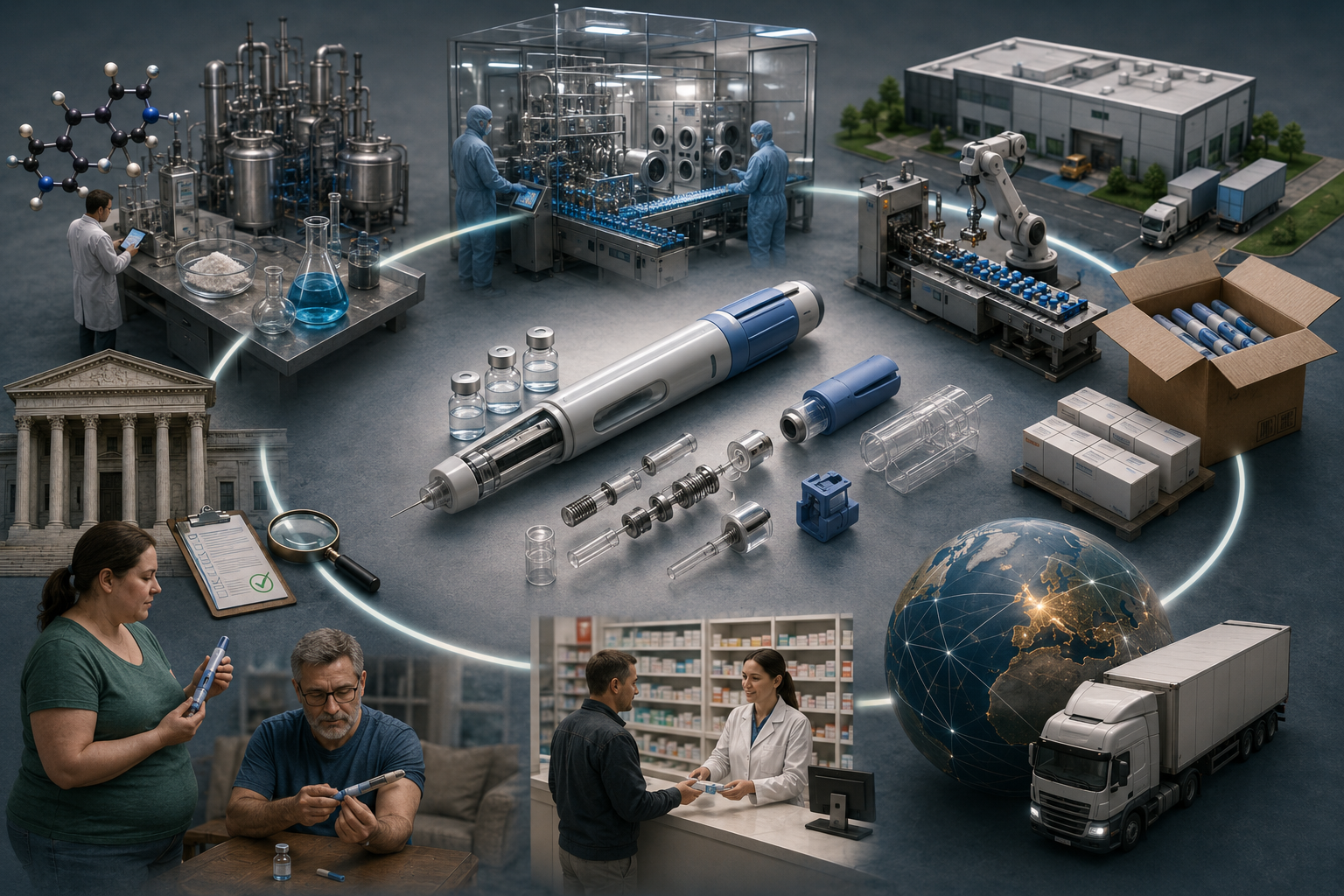
For two years the most sought-after drugs on earth were rationed, and almost everyone misread what was being rationed. The story was told as a shortage of a miracle: not enough Ozempic, not enough Wegovy, not enough of the molecule that quiets appetite and is rewriting the economics of obesity. Pharmacies ran dry. Patients hunted across state lines. A gray market of copies bloomed to fill the gap. And through all of it the thing that was actually scarce was not the drug.
It was the pen. The small, single-use injector that delivers the dose, and the specialized factory lines that fill those pens one sterile unit at a time, were the bottleneck the whole time. The companies had the medicine. What they could not do, fast enough, was put it into the device that lets you take it. The shortage everyone watched was a shortage of plastic and precision, not of chemistry, and the proof is in what the manufacturers did to escape it.
This is not a story about diet drugs. The same step that rationed Ozempic is the step that rationed the COVID vaccines, and is the step that would ration the next one. Fill-finish is the narrow end of nearly every injectable medicine a country can deploy in a hurry, which means it is also the narrow end of pandemic response, of insulin, of the biologics a health system leans on when something goes wrong at scale. The weight-loss shortage was a live, public stress test of that capacity, run on the most-demanded drug in the world, and the system failed it for two years. The question underneath the diet drug is whether the West can actually deliver an injectable medicine to its population when it matters, and the honest answer the pens just gave is: not as fast as it thinks.
The molecule was never the floor
Begin with the thing that sounds like a quibble and turns out to be the entire mechanism. A finished injectable drug is two separate problems wearing one label. There is the active ingredient, the molecule, made in bulk by chemical synthesis. And there is what the industry calls fill-finish: taking that bulk drug and filling it, under sterile conditions, into the exact device a patient will use, the prefilled pen, then assembling, inspecting, and packaging it. The molecule is one factory. The pen is another, and a far more constrained one.
Aseptic fill-finish is among the hardest, slowest steps in all of pharmaceutical manufacturing. Every unit is filled in a sterile environment to a precision that cannot fail, because a contaminated injectable kills. The injector pen itself is a small precision machine, multiple molded and metal parts assembled to fire a fixed dose reliably in a shaking hand. The lines that do this work are few, expensive, and slow to build, and a new one is not running the day it is funded. It must be built, validated, and qualified, a process measured in years, because the failure mode is a sterile-injectable recall.
So a drug can be abundant at the molecule and scarce at the pen at the same time, and to the patient at the counter the two are indistinguishable. The shelf is empty either way. A drug you can synthesize but cannot fill into its device is not a supply. It is an inventory you cannot ship.
The proof is the vial
If the shortage had been a shortage of the drug, there would have been no way around it but to make more drug, which takes the time it takes. But that is not what happened. Eli Lilly, facing the same constraint on its tirzepatide products, did something that gives the whole mechanism away. It started selling the drug in plain single-dose vials, the same medicine, FDA-approved, not compounded, but without the auto-injector pen. The patient draws it with an ordinary syringe instead.
Read what that move proves. If the molecule were the scarce thing, you could not suddenly ship more of it by putting it in a vial; a vial holds the same drug a pen holds. The only thing a vial removes from the equation is the pen, and the assembly line that fills the pen. Lilly expanded supply by subtracting the device. That is only possible if the device, not the drug, was the limit. The vial is the counterfactual run in public, by the manufacturer, on the record. They proved the pen was the bottleneck by selling the drug without it.
You do not spend sixteen billion dollars to buy more molecule
The other proof is the price tag, and it is enormous. In 2024 Novo Holdings, the parent of Novo Nordisk, acquired the contract manufacturer Catalent for 16.5 billion dollars, and Novo Nordisk then took three of Catalent's plants, in Indiana, in Brussels, and in Anagni, Italy, for 11 billion more. Those three sites are fill-finish operations. They specialize in exactly the step that was constrained, and they were already filling Novo's pens. The company's stated purpose was to increase its filling capacity, beginning in 2026.
Look at where the money went. Not into chemical synthesis, not into more molecule, but into the machines that put the molecule into the device. You do not spend sixteen and a half billion dollars buying a fill-finish company because you are short of an ingredient. You spend it because the ingredient is fine and the bottleneck is downstream, at the pen, and the only way to widen the bottleneck is to own more of the rare thing that fills it. The largest pharmaceutical manufacturing deal of its year was, in plain terms, a company buying its way past a plastic injector. The constraint is named most clearly not by analysts but by where the capital runs, and the capital ran to fill-finish.
The few factories that fill the world's pens
To see why the pen is so hard to scale, look at the world that makes it, because it is far smaller than the world that makes the drug. Bulk drug synthesis is spread across many plants and many countries; the chemistry is mature and licensable. Sterile fill-finish and device assembly are not. They are concentrated in a relatively small set of specialized contract manufacturers, the ones the industry calls CDMOs, and in a handful of device makers whose names almost no patient knows, firms like Ypsomed and Phillips-Medisize that design and assemble the injectors the brands put their labels on. The drug company on the box is often not the company that fills the pen.
That concentration is the quiet structure under the shortage. When demand for an injectable explodes, every brand competes for time on the same scarce fill-finish lines, because there are not many of them and a new one cannot be conjured. The drugmaker can flood its own synthesis as fast as it likes and still wait in a queue for the step that puts the drug into the device. The bottleneck is not the molecule and not even the pen. It is the small number of places on earth that can fill the pen to standard, and there is no app for building another one fast.
The qualification wall
A fill-finish line is not a thing you switch on. It is a thing you qualify, and qualification is the wall that makes the chokepoint so durable. A new sterile-filling line must be built, then validated, then qualified against regulatory standards that exist because a contaminated injectable is lethal, and only then can it ship a single commercial unit. The process runs for years, not months, and it cannot be rushed without inviting the exact catastrophe it guards against, a sterility failure and a recall.
So the lead time on relief is structural and long. When Novo says its new Catalent capacity will increase filling beginning in 2026, that date is not caution, it is physics and regulation: the line announced and bought today produces qualified pens years later. This is why money is a weak and slow lever here. It compresses the decision to nearly zero and barely touches the qualification. You can buy a fill-finish company in an afternoon, as Novo did, and still wait years for the pens to flow, because the binding constraint was never capital. It was qualified sterile capacity, and that has a clock money cannot reset. The cheque clears in a day. The line clears in years.
The asymmetry, held up to the light
Now set the two halves of the story side by side, because the gap between them is the point. On one side, a drug phenomenon at civilizational scale: a class of medicines reshaping how a society eats, moves, and spends, generating tens of billions in sales, with Ozempic up a quarter and Wegovy up nearly eighty percent in a single recent quarter, reordering food companies and insurers and the idea of obesity itself. On the other side, the thing that decided how much of it reached people: a single-use injector and the sterile lines that fill it.
That is the inversion. The visible story is a revolution in medicine. The determining variable is a piece of molded plastic the size of a marker and the handful of specialized factories that can fill it to standard. A technology that is changing the shape of human bodies was rationed by the throughput of a device you hold for three seconds and throw away. The molecule cured the appetite. The pen decided who got the cure. What chemistry makes abundant, the pen makes scarce; and what the pen makes scarce, no chemistry can release. The most consequential medicine of the decade was gated by its own packaging.
What the bottleneck rationed
A constraint this tight does not just slow supply. It allocates, and the allocation has consequences that outlive the shortage. While the pens were short, demand did not wait. It poured into a parallel market of compounded copies, mixed by pharmacies under a regulatory exception that applies during official shortages. For a while a whole shadow industry of telehealth prescriptions and compounded semaglutide and tirzepatide grew in the space the pen bottleneck had opened, and it carried real risk: the FDA logged hundreds of adverse-event reports tied to the compounded versions, with more than 500 linked to compounded semaglutide and over 400 to compounded tirzepatide by spring 2025.
That parallel market was not small. An entire telehealth industry grew inside the gap the pen had opened, prescribing compounded semaglutide and tirzepatide by the million, mixed by pharmacies operating under two regulatory categories, the state-licensed 503A compounders and the larger 503B outsourcing facilities, both permitted to copy a drug only while it sits on the official shortage list. For a stretch of two years, a meaningful share of the people taking these medicines were taking a version no brand made, sold through a channel that existed solely because the pens could not be filled fast enough.
Then the bottleneck eased, and the easing rewrote the rules again. Once the manufacturers had filled enough pens and vials, the FDA declared the shortages resolved, tirzepatide in December 2024 and semaglutide in February 2025, and the compounding exception closed behind it, with enforcement discretion ending for 503A pharmacies in February 2025 and for 503B facilities in March, followed by court fights as compounders resisted the cutoff. The same constraint that created the gray market then erased it, on the manufacturers' timeline, because the compounding was permitted only while the official supply could not meet demand, and official supply was a function of fill-finish capacity. The pen did not only decide how much drug existed. It decided who was allowed to make it, and when they had to stop.
And the gray market carried a cost the shortage hid. By spring 2025 the FDA had logged more than 500 adverse-event reports tied to compounded semaglutide and over 400 tied to compounded tirzepatide, with hundreds of cases of serious harm and at least seventeen deaths associated with compounded versions of the drugs, the predictable result of pushing demand off the regulated pen and into a channel the bottleneck had improvised. The harms were not a side effect of the drug. They were a side effect of the constraint, of millions of people routed around a device-filling shortage into a less controlled supply. The pen's limit did not only ration the medicine. It shaped the safety of how people got it.
The molecule is almost never the limit
This is not a quirk of one drug class. It is the general shape of how modern medicine reaches a body, and once you see it in the pens you see it everywhere. The EpiPen shortages that left allergic patients hunting for their rescue device were never a shortage of epinephrine, a cheap and ancient drug; they were a shortage of the autoinjector, the same device-assembly choke. The constraint on the COVID vaccines, once the formula existed, was fill-finish, the vials and the filling lines, not the science. Insulin, biologics, vaccines, the new obesity drugs: in case after case the molecule is the part that scales and the delivery device is the part that does not.
The EpiPen case is the cleanest precedent, because the molecule there is almost free. Epinephrine has been off patent for generations and costs pennies; what was scarce, when allergic families could not find their rescue injectors, was the autoinjector itself, a device dependent on a single dominant assembler whose line problems rippled into a national shortage of a life-saving product whose drug was never short. The COVID vaccines told the same story from the other direction: once the formula was proven, the global bottleneck was fill-finish, the vials and the filling lines, and nations competed for slots on the world's limited sterile-filling capacity while the recipe sat ready. The recipe was the easy part. Putting it into something a nurse could pick up was the wall.
The reason is structural. Synthesis is chemistry and chemistry industrializes; sterile device-filling is a precision craft with few qualified lines and long build times, concentrated in a small number of contract manufacturers whose names patients never hear. And the trend runs one way: medicine is shifting steadily from pills toward injectable biologics, the drugs that must be filled into devices, which means the fill-finish chokepoint does not shrink with progress. It grows with it. So the last mile of medicine, the step that turns a substance into something you can actually take, is a chokepoint by construction, and it is the chokepoint that decides, again and again, who gets treated. The discovery makes the headline. The fill-finish line makes the medicine.
The next wave is already being decided by the device
Look at where the obesity-drug race is heading and the mechanism predicts the move before it happens. The companies are racing to develop oral versions, GLP-1 medicines in a pill rather than an injection, and the loudest reason given is patient preference. The deeper reason is the pen. A pill needs no aseptic fill-finish, no autoinjector, no sterile device line. It bypasses the entire chokepoint this essay is about. Whichever company can deliver an effective oral version escapes the constraint that has rationed the injectables for two years, and that escape, not any difference in the molecule, may decide who wins the largest drug market in history.
This is the mechanism's final tell. When the binding constraint is the device, the most valuable innovation is not a better drug but a delivery form that needs no device. The race to the pill is the race to leave the pen behind. When the bottleneck is the last mile, the prize goes to whoever finds a route that skips it.
The size of the want against the size of the line
To feel the bottleneck you have to hold two numbers in the same hand. On one side is the want, and the want is enormous. Obesity affects a large share of adults across the wealthy world and a growing share everywhere else, which means the addressable population for these drugs is not measured in the millions of a typical blockbuster but in the hundreds of millions, a market analysts began describing as potentially the largest in pharmaceutical history. On the other side is the line, and the line is small: a finite number of qualified fill-finish suites, each filling pens at a fixed rate that cannot be improvised upward, shared across every injectable a manufacturer sells.
Lay the want against the line and the shortage stops being a surprise and becomes an arithmetic certainty. When demand is counted in hundreds of millions and the constraint is counted in a handful of sterile suites, there is no price and no urgency that closes the gap quickly, because the gap is not a matter of will but of qualified throughput. This is why the shortage lasted years rather than months, and why it eased only as new capacity slowly came online rather than the moment the companies decided to sell more. The demand arrived all at once, the way demand does. The capacity arrives on the qualification clock, the way capacity must. A want that scales in a year cannot be met by a line that scales in five, and the distance between those two speeds is the shortage.
And the mismatch is not temporary, because the want keeps growing and the line keeps being hard. Every new indication for these drugs, every expansion into heart disease or sleep apnea or the next condition the molecule turns out to help, enlarges the want again, while the filling capacity grows only as fast as sterile lines can be built and qualified. The bottleneck is not a phase the industry passes through on the way to abundance. It is the steady state of a medicine whose demand is universal and whose delivery is artisanal.
Who the pen left waiting
Translate the bottleneck into people and it stops being a supply-chain abstraction. For two years, getting one of these medicines was a lottery run by fill-finish capacity. Patients with a genuine medical need rationed their own doses, skipped weeks, switched molecules when their pen vanished from the pharmacy, or paid out of pocket for a compounded copy of uncertain quality. Diabetics who had used the same injectable for years found it diverted to the weight-loss demand the same pen lines could not also serve. The shortage did not fall evenly. It fell on whoever had the least ability to chase supply across pharmacies and states, which is the usual signature of a rationed good: it is rationed first away from the people with the fewest options.
None of this was visible as a device story. It was experienced as luck, as a pharmacy saying yes or no, as a price. But the luck had a cause, and the cause was upstream, in how many pens the world could fill that month. The shortage was lived as a personal misfortune and produced as an industrial constraint, and the distance between those two facts is exactly where the mechanism hides.
The pen is also a moat
There is a second face to the device, and it is worth naming because it complicates the innocent reading. The injector pen is not only a constraint the manufacturers fought to widen. It is also an asset they have reason to keep. A proprietary pen ties the patient to the brand, makes switching harder, carries the trademark and the dosing and the user experience, and turns a molecule that will one day go generic into a device-and-drug system that is harder to copy. The same object that bottlenecked supply also fortifies the franchise.
This does not mean the shortage was manufactured; the fill-finish constraint was real, and the companies plainly wanted to sell every pen they could. But it does mean the device sits at a point where a genuine production limit and a genuine commercial advantage coincide, and that coincidence is worth seeing clearly. The pen is the wall the maker climbs over to reach the patient, and it is also the wall that keeps the next maker out. A constraint that also defends the incumbent is a particular kind of chokepoint, the kind that no one is in a hurry to dissolve completely.
When the shared bottleneck gets an owner
There is a detail in the Catalent deal that turns the chokepoint from a fact of nature into a question of control. Catalent was not a captive supplier. It was a contract manufacturer, one of the neutral CDMOs that fill drugs for many companies at once, including, by various accounts, work touching rivals in the same drug class. When the deal was structured so that Novo Holdings, the investment arm tied to the foundation that controls Novo Nordisk, bought Catalent and then sold three of its fill-finish plants onward to Novo Nordisk, a piece of the industry's shared filling capacity passed from a neutral party to one tied to a single competitor in the hottest drug market on earth.
That is a different thing from a company building its own lines. It is a company acquiring a chunk of the commons. When the scarce step is owned by a neutral filler, every brand queues on equal terms; when it is owned by a player in the race, the queue has a landlord with a stake in who moves. Regulators looked at exactly this, and the parties offered the usual assurances that existing customer contracts would be honored. But the structural fact remains: a chokepoint that everyone depended on now sits, in part, inside one of the competitors who depend on it. A bottleneck is a fact of physics until someone buys it, and then it is a position. This is the private-governance layer made literal, the rare physical step that gates a flow of medicine passing into private hands that also sell into the flow.
The geography of who gets filled
The chokepoint also has a map, and the map decides who gets treated worldwide. Sterile fill-finish capacity is concentrated in a handful of wealthy countries, the same United States and Europe where Novo and Lilly placed the plants they bought and built. When a device-limited drug is rationed, it is rationed outward from where the pens are filled, which means the rich markets are served first and the rest of the world waits, not because the molecule is unavailable but because the filling lines are somewhere else. A medicine with global demand reaches people in the order their countries sit from the fill-finish plant. The discovery belongs to humanity. The pen belongs to a postal code.
The same law in a different industry
Step back from medicine and the pattern is older than any drug. The binding constraint on a powerful new thing is almost never the idea. It is the capacity to make the idea at scale, and that capacity hides in an unglamorous step somewhere downstream of the breakthrough. In the Second World War the Allies did not lack aircraft designs; they were rationed by the machine tools and the trained labor that turned designs into airframes. In the chip war the contest is not over who can design a processor but over the few plants and the single Dutch lithography machine that can actually print one. In ammunition, as the Manifest has traced, the wall is not the shell but the explosive fill and the small number of lines that load it. The molecule, the blueprint, the design: these are the parts that travel and copy and scale. The last physical step, the one that needs a qualified line and years to build, is the part that does not, and so it is the part that decides.
The pens are this law in pharmaceutical form, and naming the law is the point of telling the story. A society that measures progress by discovery will keep being surprised by shortages, because it is watching the half of the system that makes headlines and ignoring the half that makes the product. The discovery is necessary and it is not sufficient. Between the breakthrough and the body there is always a narrow physical step, and whoever controls that step controls the pace, the price, and the reach of the thing everyone is celebrating. Invention is what gets announced. Production is what gets rationed.
The strongest case against reading it this way
The honest objection is that this is just the normal ramp of a blockbuster, and that calling the pen the constraint is a distinction without a difference. A brand-new drug with explosive demand will always be short at first; the companies scaled as fast as anyone could; the pen and the molecule are both simply parts of making a drug, and singling out the device is a semantic trick that dresses an ordinary supply ramp as a hidden mechanism. On this reading there is no chokepoint worth naming, only a popular product catching up to its own demand.
The semantic objection fails on the one fact it cannot absorb, which is the vial. If the pen and the molecule were interchangeable parts of one undifferentiated problem, you could not relieve the shortage by removing the pen, because removing one half of an indivisible thing does nothing. But Lilly relieved it precisely by removing the pen and shipping the drug in a vial, and Novo spent sixteen billion dollars buying the capacity to fill more pens, not to make more molecule. Two companies, facing the same wall, both acted on the device and not on the chemistry, and their actions are the experiment. When the people with the most information and the most money all move on the same variable, that variable was the constraint. The ramp was real. The thing the ramp was waiting on was the pen.
The reading has a boundary, and it is worth stating plainly. Where a future injectable is genuinely limited by the inability to synthesize its molecule at scale, the pen is not the story and this analysis does not apply; the claim here is specific to the case where synthesis is solved and the device is not, which is what the vial and the sixteen billion dollars demonstrate for the GLP-1 drugs. The argument is that fill-finish was the binding constraint for these medicines, not that it is the binding constraint for every medicine.
What the boom was really limited by
The weight-loss drugs will keep being narrated as a story about a molecule, a medical and cultural revolution measured in waistlines and stock prices and the anxieties of the food industry. Watch the device under the drug. The pace at which this revolution reached people was set, and for the next wave of injectable medicines will again be set, not by the brilliance of the chemistry but by the throughput of sterile fill-finish and the supply of a small plastic injector that most patients never give a second look.
Everyone watched the drug. The drug was on every magazine cover and every earnings call and every conversation about the shape of the future. The thing that decided whether the drug in the headline became the drug in your hand was a pen, and the few quiet factories that fill it, and a manufacturing step so unglamorous it has a name only the industry uses. The shortage was never a shortage of the cure. It was a shortage of the last three seconds between the cure and the patient, and those three seconds were owned by a device.
Evidence Map
Facts, interpretations, forecasts, and disconfirming signals.
Core claim. The weight-loss-drug shortage is governed not by the molecule but by the injector pen and the fill-finish capacity that fills it, the same capacity that decides who gets the next vaccine.
Evidence level. Facts: high (Lilly relieving its shortage by shipping the drug in plain vials, Novo's 16.5-billion-dollar fill-finish acquisition). Interpretation: medium (the device, not the molecule, as the binding constraint). Forecast: speculative (the next-launch timing).
What would confirm this. The next injectable blockbuster being supply-limited at fill-finish and device assembly, not synthesis; continued investment in fill-finish capacity and contract device makers over bulk drug; shortages resolving on the timeline of new filling lines, not chemistry.
What would disprove this. A future injectable shortage driven by genuine inability to synthesize the molecule at scale; supply expansion not tracking fill-finish and device capacity; or vials and alternative delivery failing to relieve a pen-limited shortage.
Watchlist. The supply ramp of the next major GLP-1 or injectable launch, with an interim read at 6 to 12 months on whether fill-finish, not synthesis, paces availability.
Jerry van der Laan writes The Manifest Archive, a continuous investigation into how institutions, language, and systems shape what people are permitted to see as reality. He does not report events. He traces the structures beneath them.
Related from The Manifest Archive
- Everyone Is Watching the AI Boom. Nobody Is Watching the Transformer That Can't Be Built in Time.
- Everyone Is Watching the Ukraine Aid Vote. Nobody Is Watching the Shell Lines.
- Everyone Is Watching NATO's Troops. Nobody Is Watching the Railway to the Baltics.
- BlackRock, Vanguard & State Street: The Perfected Monopoly