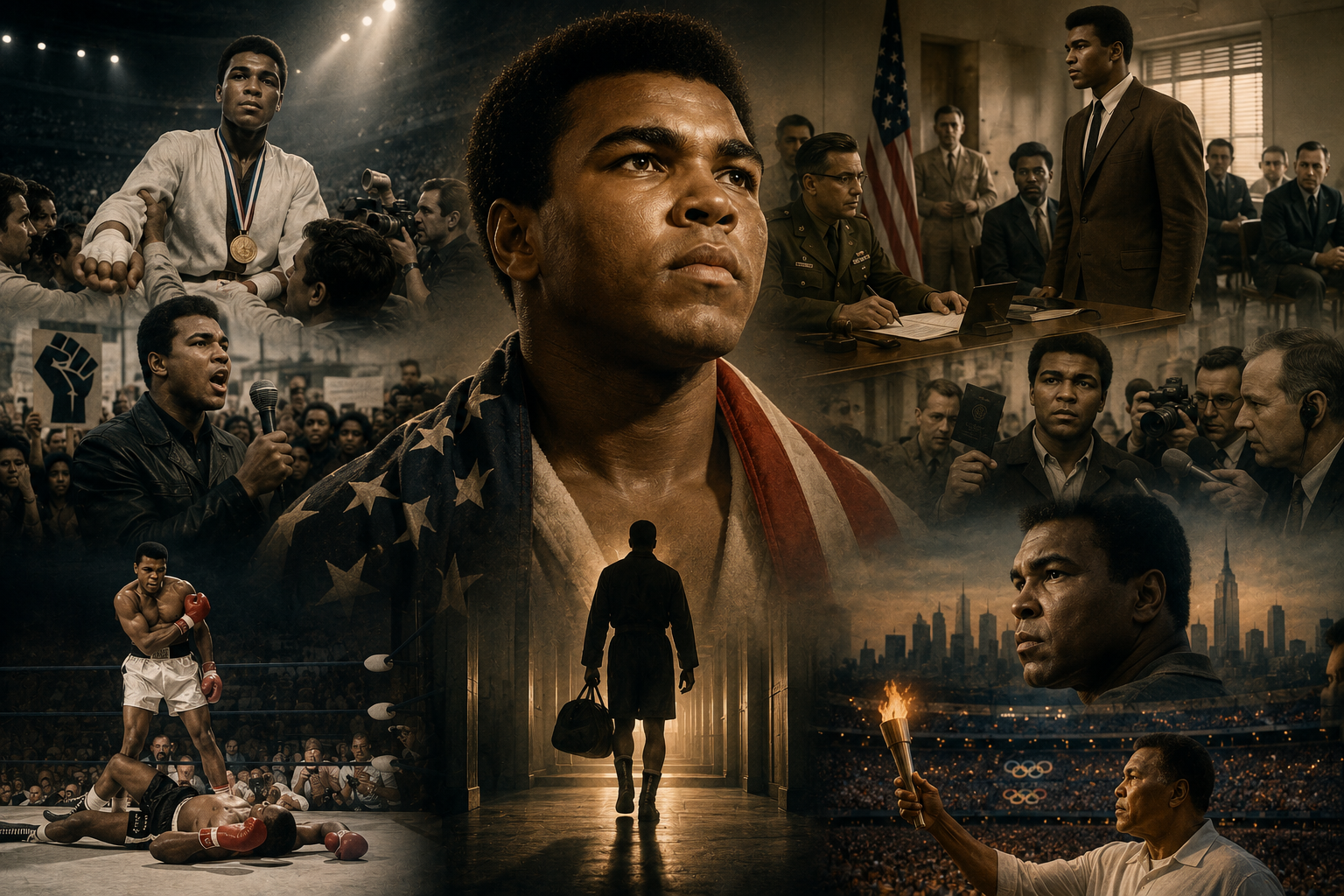
On the morning of April 28, 1967, in a military induction center in Houston, an officer called out a name. Cassius Marcellus Clay. The most famous athlete on earth, the heavyweight champion of the world, stood in a room with other young men and did not step forward. The name was called again. He did not move. A third time, with a warning that refusing was a felony carrying five years in prison. He stood still. Within hours, before he had been charged with anything, before any court had heard a word, the New York commission suspended his boxing license and the sport's governing bodies stripped him of his title. The reigning champion was unmade between breakfast and lunch, by men who held no court and needed none.
That is the scene usually remembered as an act of conscience, and it was. But it is more useful as the opening of a case study in how power handles a particular kind of threat, because what happened to Muhammad Ali over the next decade, and then again over the three decades after that, is one of the clearest demonstrations on record of a mechanism this archive keeps finding under other names. A man had something the state could not control and could not buy, and the state set out, by entirely visible means, first to take it from him, and later, when he was no longer dangerous, to claim it for itself.
The thing he had was legitimacy. Not fame, which is common and harmless, and not talent, which threatens no one. He had moral authority, the standing to make millions of people feel that his refusal was righteous, and he had it across the exact lines the system relied on to keep people divided: across race, across faith, across the generation gap, across the line between sports and politics that athletes were expected never to cross. He was an unowned source of legitimacy, and that is among the most dangerous things a person can be to an order that runs on the management of consent.
The boy from Louisville
He did not begin as a threat to anything. He began as a twelve-year-old in Louisville, Kentucky, born in 1942 into a segregated city, who took up boxing, by the often-told account, after his bicycle was stolen and he announced he wanted to beat up whoever took it. He was disciplined, obsessive, and fast in a way the sport had not quite seen, and at eighteen, in 1960, he won the Olympic gold medal in Rome. He came home a champion, a credit to his country, exactly the kind of exceptional young Black athlete America knew how to celebrate.
What he did with that homecoming is the first sign of the man to come. In his later telling, he threw the gold medal into the Ohio River, in disgust, after he was refused service at a whites-only restaurant in his own city despite the medal around his neck. The story is disputed; friends doubted it, and he was given a replacement decades later. But whether he threw it or merely lost it, the meaning he attached to it is the point: the highest honor his country could give an athlete was worth nothing if the country would still not serve him a meal. He had grasped, young, the distinction that would define his life, between the legitimacy a system grants you and the dignity it withholds, and he had decided which one mattered.
He turned professional, and within four years he had taken the heavyweight title from Sonny Liston in one of the great upsets in the sport's history, talking the entire time, predicting rounds, narrating his own greatness in verse. The mouth was part of the threat. A Black champion was permitted to be dominant. He was not permitted to be that loud about it, that certain, that uninterested in the gratitude expected of him. Before he had said a political word, the shape of the problem was already visible. He did not perform the humility that made Black excellence palatable, and that refusal, more than any punch, was what made the establishment uneasy from the start.
Why Ali changed his name
To understand why the state treated a boxer as a national-security problem, you have to see what he had already refused before he ever refused the draft. In 1964, days after winning the title as the brash young Cassius Clay, he announced that he had joined the Nation of Islam and was discarding what he called his slave name. He became Muhammad Ali. In a country still segregated in living memory, a young Black champion had publicly rejected the name his country gave him, rejected its dominant religion, and aligned himself with a Black separatist movement the FBI considered subversive and watched closely.
This was the first and in some ways the deeper refusal, because it broke a contract that American culture offered its Black stars: be exceptional, be grateful, be unthreatening, and you will be celebrated. Ali tore that contract up. He was exceptional and conspicuously ungrateful, loud where he was supposed to be humble, proud in a way that frightened white America and electrified Black America. The press largely refused to use his new name for years, a small daily act of trying to deny the transformation. He insisted on it, in the ring and out, and made the insistence itself a kind of victory. There is a famous fight from 1967, against Ernie Terrell, who had pointedly kept calling him Clay in the buildup; Ali punished him round after round, demanding between blows that Terrell say his name, turning a title defense into a public lesson about who has the authority to name a man. The episode reads now as the whole struggle in miniature. The right to define yourself, rather than accept the definition handed down, was the thing he would never concede, in a ring or before a draft board, and it was the thing the system could least forgive, because a population that insists on naming itself is a population that has stopped accepting the names assigned to it. Before he ever said a word about Vietnam, he had already declared that his legitimacy was his own and not on loan from the people who had always granted and revoked it. The draft refusal was not a departure from that. It was its logical end.
The mentor and the movement
The transformation did not happen in isolation, and naming its source explains why the establishment found it so alarming. The young champion's guide into the Nation of Islam was Malcolm X, then the movement's most electrifying minister, who befriended Clay before the Liston fight and helped shape the man who emerged from it. For a moment the two were close, the most famous Black athlete in the world and the most feared Black orator in it, and that pairing was precisely the kind of convergence the FBI's domestic programs of the era existed to prevent: a figure of mass cultural reach joining hands with a figure of radical political articulation.
It did not last, and the way it ended is part of the tragedy. When Malcolm X broke with the Nation of Islam in 1964, Ali sided with the movement's leadership and against his mentor, and the two were estranged when Malcolm X was assassinated in early 1965. Ali later expressed deep regret for turning his back on the man who had helped make him. But the episode shows what the young Ali represented: not a safe, apolitical sports hero but a man moving in the most radical currents of Black America, mentored by the era's most radical voice, at the exact moment the security state regarded those currents as the principal domestic threat. He was not drifting into controversy. He had walked into the center of it on purpose, and the establishment understood the company he kept better than the sportswriters did.
Why Ali refused Vietnam
When the refusal came, it came in a sentence that traveled faster than any of his punches. Explaining why he would not fight in Vietnam, he said he had no quarrel with the Viet Cong, and added, in various forms, that no one in that country had ever called him by the racial slur he had grown up hearing in his own. In a single line he fused the antiwar argument with the civil-rights argument and aimed both at the same target: a country asking a Black man to cross the world to kill poor people of color on behalf of a government that would not treat him as equal at home. It was not a complicated position. It was devastating precisely because it was simple, and because the man saying it could not be dismissed as a marginal radical. He was the champion of the world.
It became, almost instantly, the most famous act of draft refusal in American history, and it handed the antiwar movement something it had lacked: not an argument, which it had in abundance, but a champion, in the literal sense, a man at the absolute summit of physical achievement who was willing to lose everything rather than comply. A student burning a draft card was one thing. The heavyweight champion of the world refusing induction and accepting ruin for it was another, because it could not be dismissed as the gesture of someone with nothing to lose. He had everything to lose, and he lost it on purpose, and that made the refusal impossible to wave away.
The reaction was ferocious. Much of the press turned on him, sportswriters who had tolerated the mouth could not abide the politics, and he was widely condemned as a coward and a traitor, the precise inversion of what he was doing, which required uncommon courage. The cost was immediate and enormous, and it was meant to be. In June 1967 he was convicted of refusing induction and given the maximum, five years in prison and a ten-thousand-dollar fine. He remained free while he appealed, but the appeal would take four years, and during those years he could not get a license to box anywhere in the United States. He was stripped of his title and barred from his trade from 1967 to 1970, which were, for a heavyweight, the prime athletic years of his life, his middle and late twenties, the years that do not come back. He had been, by wide agreement, one of the greatest fighters ever to live, and the state took the heart of his career and let it expire on the shelf.
The genius of not jailing him
Here is the part that reveals the mechanism most clearly, and it is easy to miss because it looks like leniency. The government did not put Muhammad Ali in a cell. For all the years of the case, he was free, convicted but at liberty, fighting his sentence in the courts. And the freedom was not mercy. It was method.
A champion in a prison cell is a martyr, a photograph, a rallying point, a man the movement can organize around and the world can see suffering for his beliefs. A champion who is free but cannot fight is something far less useful to his own cause: not a martyr but a has-been, a former great reduced to giving speeches on college campuses for appearance fees because the one thing he was born to do has been administratively denied him. The state did not need to imprison Ali to neutralize him. It only needed to take away the platform that made him dangerous, the ring, and let the years pass. He could say whatever he liked. He simply could not be the heavyweight champion of the world while he said it, and it was that role, not his opinions, that gave his legitimacy its reach.
This is the same logic seen across these cases at a different setting. The instrument of neutralization is rarely the dramatic one. It is the quiet removal of the platform, the livelihood, the standing, while the person is left technically free and slowly diminished. Take the ring from the fighter, the visa from the singer, the license from the broadcaster, and you do not create a victim the public will rally to. You create a fading figure managing his own decline, and time finishes what the state began.
The exile that made him larger
There is a paradox in the exile years that the state did not anticipate, and it complicates the neat story of neutralization in a way worth facing honestly. Taking the ring from Ali removed his platform, but it did not remove his voice, and in the vacuum he became something he might never have become as a mere champion: a full-time political and moral figure. Unable to fight, he supported himself on the college lecture circuit, speaking to packed halls of students against the war and for Black pride, delivering addresses with titles like Black Is Best to thousands at a time. The young men being drafted heard, from the man who had given up everything rather than go, a permission to refuse that no professor or politician could grant.
In those years his legitimacy did not shrink. It deepened and broadened, because sacrifice is the one thing that converts fame into moral authority, and Ali had sacrificed the most visible career in the world on principle, in public, with the cameras watching. The boxer had been famous. The exile was revered. By giving up the title rather than the belief, he proved the belief was real, and a proven belief is worth more than any belt. This is the part the mechanism cannot fully control: suppression that stops short of martyrdom can still manufacture a saint of a different kind, the living witness who paid and did not break. The state had taken his platform and inadvertently handed him a larger one, the pulpit of the man who walked away from everything. It is why the eventual strategy could not simply be suppression. Something that grows under pressure has to be dealt with another way, in the end, than by pressing harder.
He won, and it did not matter as much as it should have
In June 1971 the Supreme Court of the United States reversed Muhammad Ali's conviction. The ruling was unanimous among the justices who heard it, and it turned, in the end, on a technicality in how his conscientious-objector claim had been handled, a narrow legal off-ramp that let the Court free him without fully vindicating the principle. He was, after four years, a free man with his record cleared.
But notice what the victory could not return. The years from 1967 to 1970 were gone. The fighter who came back was older, slower, and had to climb back through brutal fights to reclaim a title he had never lost in the ring. He returned to boxing in 1970, and in March 1971, in the fight billed as the Fight of the Century, he lost to Joe Frazier over fifteen rounds, his first professional defeat, a loss that might not have happened to the untouchable fighter of 1967. He had to earn his way back the hard way. It took until October 1974, in Kinshasa, in the fight remembered as the Rumble in the Jungle, for him to knock out George Foreman and reclaim the heavyweight title, seven years after it had been taken from him not in the ring but in an office. He had to win back with his fists what had been removed with a pen, and the body that did it was no longer the one the pen had idled. The fights that reclaimed and then defended the title were some of the most punishing in the sport's history, the third bout with Frazier in Manila in 1975 a near-death ordeal for both men, and Ali kept fighting years past the point of wisdom, absorbing damage a younger, un-exiled champion might have avoided by retiring earlier on top. It is at least plausible, though it cannot be proven, that the prime years stolen by the state, by forcing him to rebuild and overstay, contributed to the toll that left him, by his forties, visibly diminished. The pen that idled him in 1967 did not only cost him titles. It may have helped shape the long physical decline that the world would later weep over, mistaking for tragedy what was in part a consequence. The case had not needed to send him to prison or even, in the end, to convict him. It had needed only to last long enough to cost him the irreplaceable years, and it had. This is the pattern that recurs whenever the state moves against an unowned figure through the courts rather than the jail: the proceeding does not have to win. It has to endure, to consume the dangerous years in hearings and appeals and uncertainty, so that by the time the verdict clears the person, the window in which they were most dangerous has already closed. Ali won his case and lost the years that made the case necessary, and from the system's point of view that was not a defeat. It was the design working as intended.
The slow canonization
What happened next is the part of the story least examined and most revealing, because it is where the mechanism completes itself, not with a punishment but with an embrace. Over the following decades, Muhammad Ali was transformed from the most divisive athlete in America into perhaps its most beloved, a process so gradual that almost no one marked the moment it happened. The man who had been called a traitor, a draft dodger, a danger to the country, became a national treasure, a global humanitarian, a saint with gloves.
The image of that transformation is fixed forever in a single moment. At the opening ceremony of the 1996 Olympic Games in Atlanta, a trembling figure stepped from the shadows to light the cauldron, his body shaking with Parkinson's disease, and the stadium and the watching world wept. It was, by common agreement, one of the most moving moments in the history of the Games. It was also, seen clearly, the establishment of the United States taking the man who had refused it and folding him, at last, into its own story. The country that had stripped and prosecuted him now handed him its highest ceremonial honor, on global television, as a symbol of American greatness. The honors accumulated until they buried the original offense completely. He was given a replacement for the Olympic medal he had thrown away in disgust, handed back to him on the same night he lit the cauldron, the circle of the rejected honor and the bestowed honor closed in a single ceremony. In 2005, the President of the United States, the son of one establishment and the head of another, awarded him the Presidential Medal of Freedom, the nation's highest civilian honor, draped around the neck of the man it had once prosecuted for refusing its war. When he died in 2016, he was eulogized by presidents and mourned as a hero by the same institutions that had once tried to destroy him, his funeral a national event, his defiance recast as the very essence of the American spirit he had once refused to die for.
None of this was insincere, and that is exactly what makes it worth examining. The love was real. The courage being honored was real. But the timing is the tell. Ali was embraced as a saint only once he was safe, only once age and illness had taken the danger out of him, only once the war he had refused was long lost and his position on it had become the conventional wisdom rather than a threat. The establishment did not honor the Ali of 1967, the one who was actually dangerous, the Nation of Islam member who said he had no quarrel with the Viet Cong. It honored a later, gentler, silenced-by-illness Ali, and in honoring him it quietly performed a substitution, claiming his moral authority while leaving behind the specific, uncomfortable content that had made it dangerous in the first place.
Rehabilitation as the final containment
This is the move that completes the mechanism, and it is subtler than a bullet or a ban, which is why it works so well. When a system cannot defeat a source of legitimacy and cannot forever suppress it, it has a third option, the most effective of all: it can absorb it. It can wait until the figure is no longer a threat, and then claim him, honor him, teach him in schools and quote him in speeches, and in doing so take his moral authority for its own, draining it of the particular meaning that once made it an attack.
Muhammad Ali is the clearest case of this absorption in American life. The man who refused America became a symbol of America. His defiance was reframed as a kind of patriotism, his rejection of the war folded into a national story of conscience and progress, his Blackness and his faith and his radicalism sanded down until what remained was a safe, universal figure of courage that anyone could celebrate without having to agree with a single thing he actually said. The rehabilitation did not contradict the original persecution. It completed it. The persecution removed the dangerous Ali from the stage; the canonization replaced him with a harmless one and called it honor. By the end, schoolchildren could be taught to admire a man for a defiance whose actual content, the refusal to fight, the rejection of the country's name and religion, would still be treated as scandalous if a champion said it today.
You can watch the meaning being removed in the way he is now invoked. Ali is quoted on classroom walls and in corporate advertisements, held up to schoolchildren as a model of believing in yourself, his name attached to floats, stamps, and sponsorship deals. Almost none of it carries the content. The lines that survive are the universal, unthreatening ones about confidence and greatness; the lines that made him dangerous, the refusal to fight, the embrace of a separatist faith, the indictment of a country that would draft a man it would not serve, are quietly left out. An advertiser will put his face on a campaign about overcoming obstacles. None will quote the sentence about the Viet Cong. The image is licensed; the argument is dropped.
That is the final form of containment, and it is the gentlest and most complete. What power cannot defeat, and cannot indefinitely suppress, it learns to canonize, because a saint makes no demands, takes no positions, and threatens no one. The statue does not refuse induction. The quote on the wall has had its meaning removed. The man is honored precisely to the degree that he can no longer do the thing he was honored for.
The variable was legitimacy
Strip the case to its mechanism and one variable governs the rest. It was not Ali's talent, which threatened no one and was in fact what the system wanted to celebrate. It was not even his opinions, which many people held without consequence. It was his legitimacy: the rare standing to make a refusal feel righteous to millions, to convert a personal stand into a permission other people acted on, and to do it across the dividing lines, race, faith, class, generation, that the order depended on keeping separate. A draft refusal by an unknown is a court case. A draft refusal by the heavyweight champion of the world, delivered in a sentence that fused race and war into one indictment, is a crisis of legitimacy, because it tells millions of people that the righteous choice and the legal choice are not the same.
That is the portable law under the Ali case, and it reaches well beyond boxing or Vietnam. Power built on consent can survive opposition, which it can answer, and can survive even radical opinion, which it can marginalize. What it cannot easily survive is a figure who holds independent legitimacy, the capacity to make large numbers of people feel that defiance is honorable, because legitimacy is the very currency such power runs on, and it cannot tolerate a rival mint. The response, when the figure cannot be bought or argued down, runs in a sequence: first take the platform, then let time and attrition diminish the man, and finally, when he is safe, mint his legitimacy into the system's own coin by honoring him. The deepest threat is never the punch or even the position. It is the unowned authority to make a refusal look right.
The pattern, not the exception
Ali is not alone, only unusually legible, and the same shape recurs around figures whose influence the system could not own. An antiwar musician is surveilled and nearly deported while alive and then, after his death, has his anthem played at the ceremonies of the institutions he opposed. A unifying singer is shot and then sold back as a brand of peace. A civil-rights leader is wiretapped and harassed and then, once safely dead, given a national holiday. The specific form of influence differs in each case, legitimacy, reach, unity, moral authority, but the arc is the same: dangerous while active, honored once safe, the honor functioning as the final and most thorough way of removing the danger. It would be an error to flatten these into a single plot; what recurs is not a conspiracy but a structural response, the predictable way an order built on managed consent handles a person who generates the real thing outside its control.
What sets Ali apart within that company, and makes his case the clearest of all, is that he is the rare figure neutralized while alive and then canonized while still alive. Lennon's anthem was defanged after he was murdered; Marley was sold as a brand after he died; the civil-rights leader got his holiday once he was safely gone. The absorption, in those cases, happened over the grave. Ali lived to stand on the stage of his own canonization. He was there, shaking, holding the torch, as the country that had prosecuted him folded him into its story in real time, which means the full cycle, danger, neutralization, and absorption, can be watched in a single life, performed in front of the man it was performed upon. He is the one who got to see the machine finish its work on him, and to be thanked for it.
The honest objection
The strongest case against this reading deserves full statement, because it is largely true. The simplest explanation for Ali's rehabilitation is not containment but sincere change. The country's view of the Vietnam War genuinely soured, and as it did, a man who had refused that war early looked less like a traitor and more like someone who had been right before everyone else. Attitudes on race genuinely shifted. Ali himself softened with age, moved away from the Nation of Islam's sharper separatism toward a more universal humanitarianism, and became, by all accounts, a gentle and generous man. On this view, the late embrace was not a cynical absorption but an honest reckoning, a country catching up to a courage it had failed to recognize at the time, which is a thing that genuinely happens and is to be welcomed, not sneered at.
That objection is right about the sincerity and wrong only about what sincerity proves, and conceding it sharpens the point. The argument here is not that anyone conspired to neutralize Ali through praise, or that the millions who wept in 1996 were dupes. It is that the structure produces this outcome regardless of anyone's intentions, and that the sincerity is part of how it works rather than evidence against it. A containment that required bad faith would be fragile; one that operates through genuine, heartfelt honor is unbreakable, because no one involved experiences it as containment at all. The country could afford to love Ali precisely when loving him cost it nothing, when his danger was spent, when honoring his courage no longer meant having to honor the specific refusals that courage had taken. That the love was real does not change what it accomplished. It made a safe saint out of a dangerous man, and it did so all the more effectively for meaning every word.
What he actually refused
Strip away both the villain of 1967 and the saint of 1996, and the figure in between is the one worth recovering, because he is the one with something to teach. Muhammad Ali understood, and acted on, a truth most famous people spend their lives avoiding: that legitimacy granted by a system can be revoked by it, and that the only legitimacy worth having is the kind you hold independent of the people who would prefer to lend it to you on conditions. He refused the conditions. He gave up the title, the prime years, the easy path to being the acceptable champion, in order to keep the one thing that was actually his, the right to mean what he said.
The lesson of his case is the one this archive keeps finding. Power built on consent is not most threatened by opponents, who can be answered, but by anyone who generates legitimacy it cannot grant or withdraw, and its deepest response to such a figure is not the prison, which makes martyrs, nor even the ban, which can be survived, but the eventual embrace, which dissolves the threat by absorbing the man. They take the dangerous years while he is at his peak. They give back the honor once the danger is gone. And the question Ali's life leaves is not really about 1967 or 1996 at all. It is about now: who, today, holds a legitimacy that no institution granted and none can revoke, and is therefore being handled, somewhere, by one of the three responses, the quiet removal of the platform, the patient legal attrition, or the warm embrace that waits for the danger to pass. The names change. The machine that turns dangerous men into harmless statues does not, and it is running on someone at this moment, while we are still calling the last one a hero.
Evidence Map
Facts, interpretations, forecasts, and disconfirming signals.
Core claim. Muhammad Ali generated legitimacy, moral authority across race, faith, and politics, that the American system could not grant, control, or buy. While he wielded it against the state, he was neutralized by the documented removal of his platform: stripped of his title and barred from boxing for his prime years (1967-1970) after refusing the draft, free but unable to fight while his case ran. After he was no longer a threat, the same establishment absorbed his legitimacy by canonizing him, the 1996 Olympic torch, the national-hero status, completing the neutralization through embrace rather than suppression. The determining variable is unowned legitimacy; the resolution is rehabilitation-as-containment.
Evidence level. Facts (high): Ali joined the Nation of Islam and took his name in 1964; refused induction on April 28, 1967; was convicted on June 20, 1967 (five years and a $10,000 fine) and stripped of his title and license; was barred from boxing roughly 1967-1970; the Supreme Court unanimously reversed his conviction in Clay v. United States (1971) on a procedural ground; the FBI surveilled him; he lit the cauldron at the 1996 Atlanta Olympics while visibly affected by Parkinson's; he was honored as a national hero at his 2016 death. Interpretation (marked): reading the late embrace as the completion of the neutralization, an absorption of his legitimacy once it was safe, is analytical interpretation grounded in those facts, not a claim that anyone orchestrated the honor.
What would confirm this. The recurring pattern of dangerous figures honored only once their danger has passed; the persistent gap between the celebrated Ali and the still-uncomfortable content of his actual 1967 positions.
What would disprove this. Evidence that the establishment honored Ali at the height of his danger rather than after it; evidence that his prime-year ban was incidental rather than a consequence of his refusal; an account in which his rehabilitation carried forward, rather than drained, the specific radical content of his stand.
Watchlist. How Ali is taught and invoked, and whether the invocations preserve or omit the draft refusal, the Nation of Islam, and the racial argument that made him dangerous.
Jerry van der Laan writes The Manifest Archive, where he examines power, culture, and institutions. He traces the structures beneath them.