The determining variable in this phase of the artificial-intelligence race was never the chip. In 2026 the largest technology companies on earth committed something on the order of 650 billion dollars to building out AI, and the coverage followed the parts that move fast and photograph well: the models, the GPUs, the data centers rising out of the desert. Then much of the United States data-center capacity planned for the year stalled. Of roughly sixteen gigawatts of capacity announced for 2026, only about five were actually under construction, and analysts at Sightline Climate, reported by Bloomberg, estimated that 30 to 50 percent of the pipeline would be delayed or cancelled, citing power constraints and shortages of transformers and switchgear. Not for lack of money. Not for lack of chips. The buildout stalled on the least glamorous object in the entire supply chain, a large power transformer, and on the multi-year wait to get one.
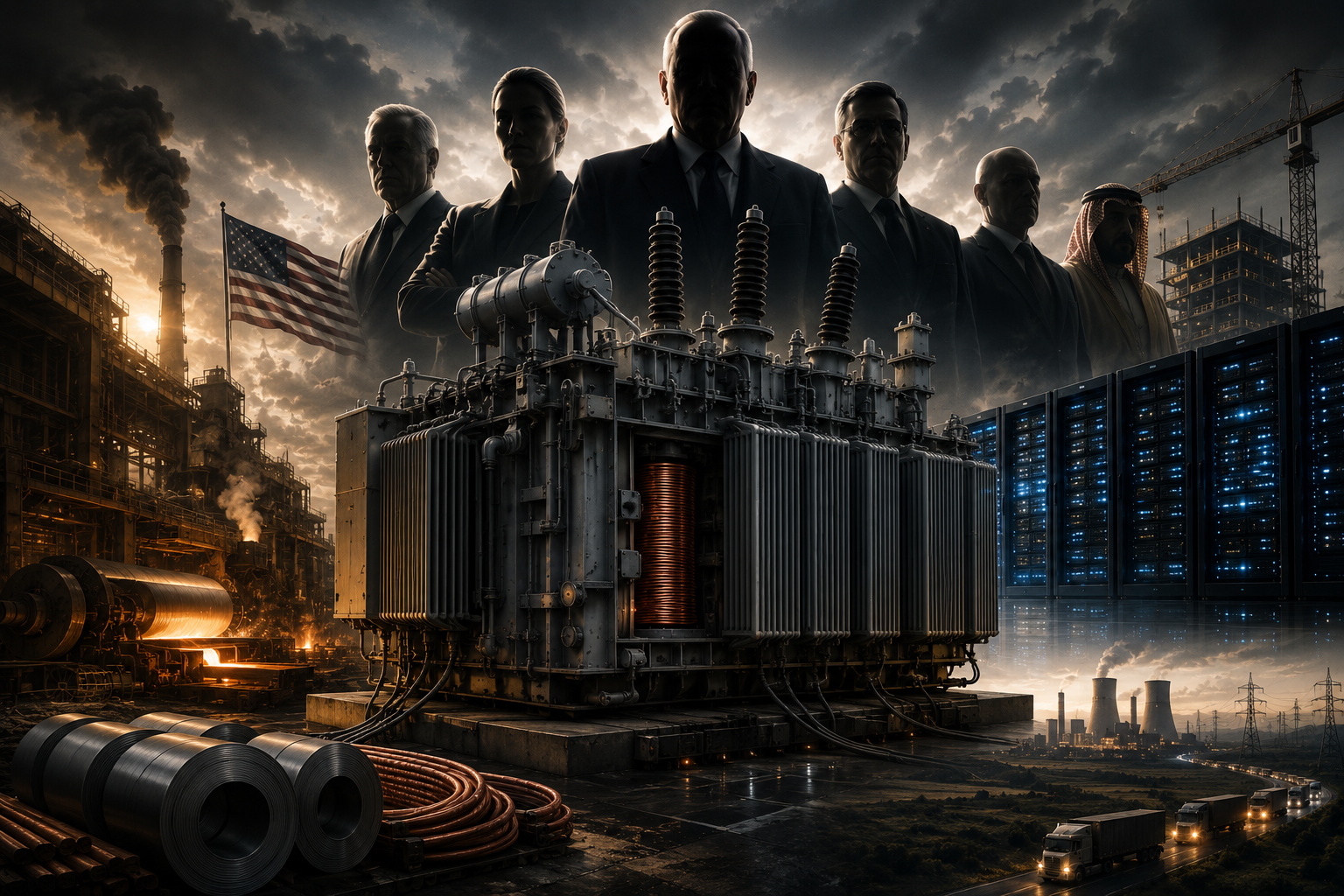
A transformer is a box of copper windings and laminated electrical steel that steps voltage up or down so electricity can travel and be used. It is the most boring object in the system and the one that decides whether any of the rest of it runs. Without it the chip is a space heater. The plant has no power. The capex is a number on a slide. And the world cannot make them fast enough, because the thing that gates the transformer is not assembly but lead time, and lead time is the one input no amount of capital can compress to zero.
Two clocks that do not match
Start with the mismatch, because the mismatch is the whole mechanism. Information technology runs on a fast clock. A chip design iterates in months; a data hall of servers can be ordered and stood up inside a year to eighteen months; software ships in an afternoon. Electrical equipment runs on a slow clock. A large power transformer is built to order, wound by hand and machine, cured, tested, and shipped on a schedule measured in years. By 2025 power transformers were averaging around 128 weeks of lead time and generator step-up units around 144 weeks, with high-capacity units quoted as far out as four to five years. Before 2020 the same equipment took roughly two years or less.
So the AI buildout is two clocks bolted together, and they do not match. The compute side can scale at the speed of software. The power side can only scale at the speed of steel. Money can buy more of the fast clock instantly. It cannot make the slow clock tick faster, because the slow clock is set by the physical time it takes to build and qualify a piece of heavy electrical equipment that fails catastrophically if it is rushed. Compute scales at the speed of software. Power scales at the speed of steel. And the buildout can only move at the speed of its slower clock. What the fast clock builds, the slow clock must power; and what the slow clock cannot power, the fast clock cannot run.
This is the layer the AI coverage never reaches. The cameras follow the model and the GPU, the parts on the fast clock. The variable that actually decides when the data center turns on sits one level down, on the slow clock, in a transformer order placed years before the building exists.
What you cannot rush
A large power transformer cannot be mass-produced in the way a chip can, and the reasons are physical, not organizational. Each unit is often bespoke, specified to a particular substation, a particular voltage, a particular site. It is enormous, weighing hundreds of tons, too heavy for ordinary transport and dependent on specialized rail cars and routes that are themselves scarce. It is wound from large volumes of copper and from a specialized magnetic steel, assembled, dried of every trace of moisture, immersed in insulating oil, and put through extensive factory testing, because a transformer that fails in service can take out a substation and a slab of the grid with it.
None of that compresses. You can pour capital into a transformer factory and you will still wait years for the output, because the binding constraints are qualified production slots, skilled winders, the specialized inputs, and the testing time that exists precisely so the unit does not fail. The global industry was carrying a two-to-three-year manufacturing backlog, and prices told the same story: power transformers up around 77 percent since 2019, distribution transformers up 78 to 95 percent. Those are not the numbers of a market with slack. They are the numbers of a market where demand has hit a wall that capital is bouncing off. A transformer is not manufactured on the timescale of the thing that needs it, and that gap is the shortage.
The proof is in what the builders are doing
If the transformer and the grid connection were not the true constraint, the AI builders would simply be waiting in the ordinary way for utility power. They are not. They are doing something revealing instead. Faced with grid-interconnection queues that stretch for years and transformers that cannot be had in time, the largest data-center developers are increasingly building their own power on site, gas turbines, dedicated generation, anything that lets them bypass the wait for the grid entirely.
That move is the tell, the same kind of tell as a drugmaker shipping its medicine without the pen. You only build your own power plant next to your data center if the thing you cannot get is the connection to someone else's. The behavior of the people with the most money and the most information points at the variable that is actually binding, and they are pointing at power delivery, not at compute. They have the chips on order. What they cannot secure is the transformer and the interconnection that turn a building full of chips into a running machine. When the richest buyers in a market start building around a component instead of buying it, that component is the constraint.
One mill in Pennsylvania
Now follow the transformer down to the thing inside it, because the bottleneck has a bottleneck, and it is tighter than almost anyone watching the AI story knows. The magnetic core of a power transformer is made of grain-oriented electrical steel, a specialized high-silicon steel engineered so that magnetic fields pass through it with minimal loss. It is not ordinary steel and not many places in the world can make it. In the United States it is made in exactly one place: Cleveland-Cliffs' Butler Works in Butler, Pennsylvania, the only domestic producer of grain-oriented electrical steel, and the only domestic source of the high-permeability grade used in power transformers.
Hold the scale of that. A 650-billion-dollar industrial buildout, the defining technological race of the decade, ultimately rests on the magnetic steel wound into its transformers, and the entire domestic supply of that steel comes from a single mill. Everything not made there must be imported, which means the country's ability to electrify its own AI ambition runs through one factory in western Pennsylvania and a set of foreign suppliers. A 170-million-dollar expansion of that mill, partly funded by a federal grant, is not due to come online until 2028. The constraint on the most modern industry in the world is a piece of mid-twentieth-century heavy industry that exists, domestically, in one location. The cloud has a single point of failure, and it is a steel mill.
This is the asymmetry the headlines invert, and it is severe. On one side, the largest pool of capital ever aimed at a single technology, the most advanced chips ever fabricated, the rhetoric of a new industrial age. On the other side, one mill making the steel, a handful of factories winding the transformers, and a lead time measured in years. Remove the steel and the transformer and the entire edifice does not power on. The chip is the breakthrough. The transformer is the bottleneck, and the steel is the bottleneck inside the bottleneck.
Why you cannot just build another line
The natural response is to say: then build more electrical-steel capacity. The reason that does not happen quickly is the same reason the steel is scarce in the first place. Grain-oriented electrical steel is one of the most difficult industrial products to make. It depends on precise control of silicon content, on a grain structure aligned so that magnetism flows along one direction with minimal loss, and on a sequence of rolling, annealing, and coating steps refined over decades inside specific mills. The know-how is not in a manual you can buy. It is embedded in particular plants and particular workforces, accumulated over generations, which is why the number of facilities on earth that can make the high-permeability grades is small and does not grow on the timescale of a demand spike.
Globally the capability is concentrated in a few national champions: Japanese producers, a Korean steelmaker, Chinese mills that have scaled aggressively, a handful of European and Russian mills, and in the United States the single Butler works. Opening a genuinely new line is a multi-year, capital-heavy project with a steep qualification curve, and the firms that could do it carry the same memory of past gluts that keeps transformer makers cautious. So the steel cannot surge for the same structural reason the transformer cannot: the capability is rare, slow to build, and held by firms with every incentive not to overcommit. The deepest bottlenecks are made of know-how, and know-how is the one input that cannot be ordered, only grown.
And the copper, too
The electrical steel is the sharpest constraint, but not the only material on a slow clock. A large transformer is also tons of copper, and copper is its own multi-decade bottleneck, gated by mines that take ten to twenty years to move from discovery to production. You cannot order a copper mine the way you order servers. So the transformer sits at the convergence of two slow inputs, a magnetic steel made in few places and a base metal that takes decades to dig out, and the AI buildout competes for both against the entire rest of the electrifying economy. The shortage is not a single scarce thing. It is a stack of scarce things, each on its own long clock.
The spare that does not exist
There is a feature of this equipment that sharpens the fragility, and almost no one outside the utility world knows it. Large power transformers are largely bespoke, so utilities cannot simply keep a shelf of spares the way one stocks fuses. A transformer is specified for its site, and a unit that fails in service often cannot be replaced from inventory, because the right inventory does not exist. The replacement has to be built, or pulled from a thin pool of shared spares, on the same multi-year clock as everything else.
Hold what that means for a grid carrying a historic new load. The system is being asked to absorb the largest demand surge in a generation at exactly the moment its most critical component cannot be quickly replaced when it fails. A failed transformer at a key substation is not a same-week fix. It can be a year or more of waiting, with a piece of the grid degraded in the meantime. The AI buildout is piling load onto an apparatus whose failure mode is slow by construction, and the slowness is not negligence. It is the physics of the machine. A grid whose key part cannot be stocked is a grid that fails on a long clock, and the long clock is now meeting a short-clock surge.
The second wall, after the transformer
Suppose a developer secures its transformers. It still meets a second wall, because getting a project connected to the grid is its own multi-year queue. Across the United States, more than two terawatts of proposed generation and storage have sat in interconnection queues in recent years, far more than the system can study in time, waiting on engineering studies and approvals that routinely take several years. The transformer is the physical chokepoint; the interconnection queue is the procedural one. A project can have its building, its chips, and even its transformers and still wait years for permission to draw power at scale, and a project that cannot connect in time can become a stranded asset, capital sunk into a site that cannot yet earn.
This is why on-site generation has become the escape hatch. It is an attempt to climb over both walls at once, the equipment wall and the queue wall, by not touching the public grid at all. That a trillion-dollar industry would rather build private power plants than wait for the grid is the clearest possible measure of how binding the grid constraint has become. The slow clock is not one component. It is the entire physical and procedural apparatus of moving electricity, and the AI boom has run straight into it.
The bypass hits its own wall
Here the mechanism does something elegant and a little merciless: the escape route runs into the same kind of wall it was meant to escape. The favored bypass is the gas turbine, and the gas turbine is now its own multi-year bottleneck. The major makers' order books have swelled to historic size, with GE Vernova's gas turbine backlog and slot reservations around 100 gigawatts and growing, Siemens Energy carrying its largest backlog ever, and delivery slots for new heavy-duty turbines reportedly stretching roughly five years and in some cases as long as seven, sold well into the next decade. Data centers are now a structural share of that backlog.
So the attempt to dodge the transformer and the interconnection queue lands the developer in a turbine queue measured in the same years. The bottleneck did not disappear when the buyer routed around it. It migrated to the next slow-clock component, because the entire apparatus of generating and moving large amounts of power, transformers, turbines, switchgear, the steel inside all of it, runs on the same long clock. You cannot bypass a slow clock by buying a different slow clock. The constraint is the clock itself.
Why nobody built ahead
The obvious question is why the industry did not see this coming and build transformer capacity in advance. The answer is not stupidity. It is incentives, and they are worth naming because they explain why the shortage was structurally likely rather than accidental. Transformer manufacturing is a feast-and-famine business with long cycles. Building a new transformer line, or expanding electrical-steel capacity, is a capital commitment that pays off over decades, made by firms that remember previous gluts when demand evaporated and the new capacity sat idle. No manufacturer adds years of expensive capacity on the strength of a demand spike that might reverse, because the downside of overbuilding is ruin and the downside of underbuilding is merely a queue that the customer pays for in waiting.
So the capacity was rational to withhold, each firm following its own incentive, and the sum of those rational decisions is a system that cannot surge when a surge arrives. The grid equipment industry optimized for steady demand and got a step change, and the lead times are what a step change looks like when it hits a sector built for steadiness. No one decided to starve the grid. A thousand reasonable decisions not to overbuild added up to the same thing.
The warning, for the record, was not hidden. For years before the AI surge, grid reliability bodies and energy-department reviews flagged the lengthening lead times for large power transformers and the strategic exposure of a domestic supply that depended on a single mill for grain-oriented electrical steel. The transformer shortage that arrived with the data-center boom was not a surprise sprung on an unprepared system. It was a known vulnerability that demand finally pressed on. The sequence matters: the slow clock was visible and documented well before the fast clock arrived to test it, which is what separates a genuine shock from a foreseeable one met without slack.
The dependency under the dependency
There is a geopolitical layer, and it can be stated without reaching for a villain. The United States and its allies do not only depend on a single domestic steel mill; they depend on imports for transformers, for the steel, and for the broader category of grid equipment, and a large share of that supply chain runs through China, which remains the dominant producer of much of the world's electrical gear. A country racing to build the infrastructure of artificial intelligence is doing so on a power-equipment supply chain it does not control, at lead times it cannot compress, using a magnetic steel it can make domestically in only one place.
That is not a conspiracy. It is a structural exposure, the kind that becomes visible only when demand surges and the slack is gone. In calm times the dependency is invisible because the equipment arrives. Under a buildout of this size the dependency becomes the story, because every actor is now competing for the same scarce slots on the same constrained lines fed by the same narrow supply of steel. The strategic vulnerability was always there. The AI boom is simply the load that revealed it.
What the bottleneck rations
A constraint this tight does not only slow the AI buildout. It allocates scarce power equipment across everyone who needs it, and the allocation has consequences far beyond data centers. The same transformers and the same electrical steel are what the broader electrification of society runs on: connecting new housing, electrifying transport and heating, hooking up renewable generation, hardening the grid against extreme weather. Every transformer wound for a hyperscaler is a transformer not wound for a utility upgrading a neighborhood or a wind farm waiting to connect. When deep-pocketed AI developers enter the queue, they do not just wait in it. They reshape it, bidding for scarce slots that ordinary grid maintenance and the energy transition also need.
So the AI boom quietly competes with the climate buildout for the same physical chokepoint, and the competition is invisible because it happens upstream, in order books and lead times, not on any screen. The visible story is artificial intelligence racing ahead. The unwatched consequence is that the infrastructure for everything else electric is being rationed by the same shortage, on the same slow clock, in favor of whoever can pay to jump the line. The transformer shortage does not only decide how fast AI arrives. It decides what else has to wait for the grid, and who.
The race that is actually being run
Reframe the whole contest through this layer and a different race appears than the one on the screens. The AI competition is narrated as a contest of models and chips, of who has the best frontier system and the most GPUs. But if power equipment is the binding constraint, the real contest is industrial: which firms and which countries can secure transformers, turbines, and the electrical steel and copper inside them, on a multi-year clock, faster than their rivals. The winner may not be whoever trains the best model. It may be whoever can energize the most compute, which is a question of heavy industry, not software.
And the lead time locks the standings in. A transformer ordered today, against a four-year wait, energizes a data center in the back half of the decade, which means the AI map of 2030, which company runs the most compute and which country hosts it, is being drawn now, in transformer orders and turbine reservations and interconnection filings placed years before the buildings open. The decisions that look like procurement are the decisions that set the standings, made quietly in order books while the public argues about models. By the time the shortage is obvious to everyone, the orders that resolve it have already been placed by someone else.
That has a geopolitical edge, and it can be stated without a villain. China is the dominant manufacturer of much of the world's grid equipment and has scaled its electrical-steel and transformer capacity aggressively, which lets it electrify its own buildout faster than countries that must import the gear or wait on a single domestic mill. A nation can lead in chip design and model research and still be throttled by its inability to build the unglamorous equipment that turns those advantages into running machines. The AI race will be won at the speed of the loser's slowest factory, and the slowest factory is rarely the one making chips.
The same law, one industry over
This is not, at bottom, a story about artificial intelligence. It is the same law the Manifest has traced through other industries, surfacing again in the domain that happens to dominate attention right now. In pharmaceuticals the molecule was abundant and the fill-finish line was the bottleneck. In artillery the design was known and the explosive fill was the bottleneck. In semiconductors the chip design was not the constraint, the lithography was. Now in computing the chip is not the constraint, the transformer and the electrical steel are. Each time, the visible breakthrough scales and copies, and the last physical step that turns the breakthrough into something usable does not.
The pattern is reproducible because it is structural. The breakthrough lives on the fast clock and gets the attention. The bottleneck lives on the slow clock and decides the outcome. A society that measures progress by its breakthroughs will keep being ambushed by its bottlenecks, because it is watching the half of the system that accelerates and ignoring the half that cannot. Invention runs on the fast clock. Production runs on the slow one. And the slow clock always wins, because you cannot run the invention until the production catches up.
The strongest case against reading it this way
The strongest objection is not that the shortage is imaginary but that it resolves faster than this reading assumes. Suppose the supply side moves harder than expected: small modular reactors arrive on schedule, dedicated on-site generation scales quickly, gas turbine and transformer lines expand aggressively under the pull of unprecedented demand, the Butler mill's expansion lands on time and others follow, and the interconnection process is reformed. On that view the bottleneck is real but short-lived, the market and the policy response close it within a few years, and calling power equipment a determining variable mistakes a transition cost for a structural law.
That is the objection that has to be answered, and the answer is that every element of the optimistic case is itself on the slow clock. Small modular reactors are years from scaled deployment and largely unproven commercially; gas turbines already carry five-to-seven-year backlogs; transformer and electrical-steel capacity expand on the multi-year, qualification-bound timeline this essay describes, the Butler expansion itself not due until 2028. The supply response is not wrong, it is slow, and its slowness is the mechanism, not an exception to it. So the claim is deliberately scoped: not that transformers are scarce forever, but that through the buildout window that decides who hosts the dominant AI infrastructure, the binding constraint is power equipment on a multi-year clock, and the winners will be set by who secured the slow-clock inputs early. The boundary is worth stating plainly, and it is the genuine falsifier: if SMRs, on-site generation, and transformer and electrical-steel capacity scale on the timescale of chips and capital rather than the timescale of heavy industry, the constraint stops binding and this reading does not apply. The whole argument rests on the claim that they cannot, and the day they do is the day it is wrong.
What the boom is really limited by
The AI race will keep being narrated as a contest of models and chips and capital, a story of software eating the world. Watch the transformer under the data center. The pace at which artificial intelligence actually arrives, the question of which company and which country can convert capital into running compute, is being set not by the brilliance of the chips but by the throughput of heavy electrical equipment and the narrow supply of the magnetic steel at its core.
Everyone is watching the boom. The boom is on every screen, in every earnings call, at the center of every argument about the future. The thing that decides whether the boom becomes electricity flowing into a running machine is a box of copper and steel that takes years to build, a queue to connect it, and one mill in Pennsylvania that makes the steel. The shortage is not a shortage of intelligence or of money. It is a shortage of the unglamorous middle step between the idea and the power, and that step runs on a clock no amount of capital can reset.
Evidence Map
Facts, interpretations, forecasts, and disconfirming signals.
Core claim. The AI buildout is paced not by chips or capital but by the large power transformer, its multi-year lead time, and the single domestic source of the electrical steel inside it.
Evidence level. Facts: high (128-to-144-week transformer lead times, the interconnection queue, Cleveland-Cliffs Butler Works as the domestic high-permeability steel mill, the delayed or cancelled 2026 pipeline per Sightline Climate via Bloomberg, developers building on-site generation). Interpretation: medium (power delivery as the binding constraint). Forecast: speculative (the buildout-window timing).
What would confirm this. Data-center activation tracking transformer lead times and interconnection-queue clearance more than chip availability; on-site and behind-the-meter generation growing as a bypass; transformer and electrical-steel prices and lead times staying elevated into 2027 and beyond.
What would disprove this. Activation tracking chip supply while transformers stay ample; lead times collapsing to pre-2020 levels within the window; the binding constraint proving to be capital or compute; or supply (SMRs, on-site generation, new transformer and electrical-steel capacity) outrunning the slow clock.
Watchlist. Transformer lead times, interconnection-queue clearance, and grain-oriented electrical-steel capacity through 2027.
Jerry van der Laan writes The Manifest Archive, a continuous investigation into how institutions, language, and systems shape what people are permitted to see as reality. He does not report events. He traces the structures beneath them.
Related from The Manifest Archive