This is a Decertified Reality investigation. The series audits official certainties that shaped major decisions, wars, policies, or public beliefs. The question is not whether an institution was right or wrong. The question is whether the certainty itself was certifiable at the time it was presented. Each investigation applies the same test: was the claim stable, independently supported, open to disconfirmation, and verifiable? This series does not replace one certainty with another. It audits how certainty was produced.
A reward of fifty million dollars, the largest the United States has ever placed on a foreign head of state, was offered for a man on the charge that he led a drug cartel. He was captured. And then, once the case reached a courtroom, the government stopped describing the cartel as a cartel. The reward, the terrorist designation, the whole legal machinery that had turned a sitting president into a fugitive, had been built on an organization the prosecution would no longer, in its own filings, call a structured organization at all. Before a single fact about the man is weighed, that sequence is already a certification problem.
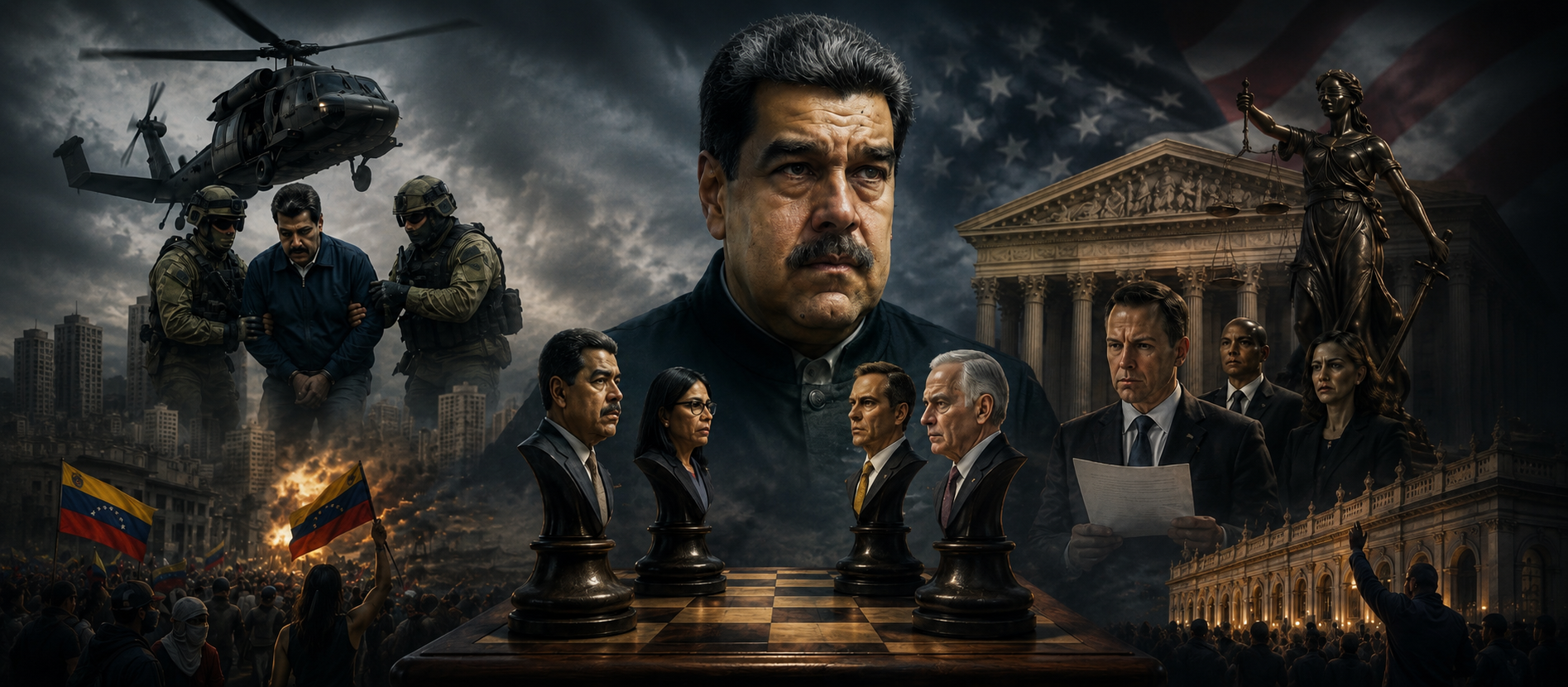
The man was Nicolás Maduro, seized by American special forces from Caracas on the third of January 2026, flown to New York, and booked into a federal detention center in Brooklyn to await trial. Almost everything about him invites a verdict before the evidence is in. He had ruled for over a decade through repression, jailed his opponents, and clung to an office most of the world believed he had lost at the ballot box. The temptation, watching the helicopters, is to skip straight to relief or to outrage and call the matter settled.
This series exists to resist exactly that temptation. The question here is not whether Maduro was a good man or a bad one, which is not in serious doubt, and not whether Venezuelans are better or worse off, which is a real and open question. The question is narrower and harder, and it is the only one an audit can answer: which of the certainties stacked on top of this operation could actually be certified at the time they were asserted? Run them through the gate one by one and something strange appears. Two of the load-bearing certificates in this story collapse, and they collapse in opposite directions. One belonged to Maduro. The other belonged to the government that took him.
The certificate that fails against Maduro
Begin where the audit is easiest, because honesty requires conceding the strong case before testing the weak one. The claim that Maduro was the legitimate, elected president of Venezuela does not survive contact with the record, and it fails on documentation, not on suspicion.
In the presidential election of July 2024, Venezuela's own National Electoral Council declared Maduro the winner with 51.2 percent of the vote and then did something an electoral authority does only when it has something to hide: it never released the detailed precinct-level counts that every prior contest had produced. The opposition did the opposite. It collected the printed tally sheets from more than eighty percent of the country's voting machines and published them online, where anyone could check the arithmetic, and they showed the opposition candidate Edmundo González winning by more than two to one. United Nations electoral experts and the Carter Center, both invited into the country by Maduro's own government to observe, examined the published tallies and judged them authentic, and the Carter Center stated plainly that the election could not be considered democratic. The candidate the opposition had actually chosen, María Corina Machado, had been barred from running at all by a court ruling, so González stood in her place.
Lay that beside the gate. A certifiable election result is one that is independently verifiable, stable, and open to checking. Maduro's was none of these: the issuing body withheld the evidence, the counter-evidence was public and checkable, and the independent observers his own government invited rejected the official number. By the standards an election is supposed to meet, the certificate reading "President Maduro, re-elected 2024" was already void before any American helicopter appeared. The audit decertifies it without hesitation and without needing a single fact from Washington. This matters, because it is what keeps the rest of the analysis from being mistaken for a defense of the man. It is not. He had no certifiable claim to the office he held.
The certificate that fails for Washington
Now turn the same instrument on the other side, and watch a second certificate fall.
The legal foundation for treating Maduro as a fugitive criminal, rather than as a head of state, was a 2020 indictment from the United States Department of Justice charging him with narco-terrorism, and the centerpiece of that charge was that he led a drug-trafficking organization called the Cártel de los Soles, the Cartel of the Suns, named for the insignia on Venezuelan generals' uniforms. On the strength of that charge the State Department put a bounty on him, fifteen million dollars in 2020, raised to twenty-five million in early 2025 and then to fifty million later that year, the largest reward the United States has ever offered for a foreign head of state. In the months before the operation, the Treasury and State Departments formally designated the Cartel de los Soles a foreign terrorist organization. The entire architecture of the capture, the bounty, the terrorist label, the narco-terrorism frame that turned an arrest into a counterterrorism act, rested on the existence of that cartel.
Here is the part that an audit cannot let pass, and it has to be stated as narrowly as the record allows, because the whole analysis leans on it. After the operation, the prosecution ceased to maintain the core of the charge. In the indictment it filed once the case reached court, it no longer described the Cartel de los Soles as an actual structured organization, and characterized instead a loose patronage network, which is what critics had argued for years it always was. The government did not declare itself wrong; it simply stopped relying on the organized cartel it had originally invoked. But that is enough for the audit, because the justification that carried a fifty-million-dollar bounty and a foreign-terrorist designation no longer rested, in the government's own later filings, on the structured organization that had given those instruments their meaning. The certifier quietly stopped standing behind its own certificate, once the certificate had already done its work.
Mark the claim precisely, because the discipline of this series lives in the marking. This does not establish that Maduro never profited from or protected drug trafficking; the indictment contains other allegations, and that broader question is genuinely open and not settled here. What it establishes is narrower and harder to wave away: the specific certificate that did the heaviest lifting, "Maduro is the kingpin of the terrorist Cartel of the Suns," was decertified by the prosecution itself, after it had already served its purpose. A certainty that is allowed to quietly collapse only once it is no longer needed is the signature of a frame, not a finding.
The legality no one could produce
Above those two failed certificates sits a third, and it is the one that should worry a reader regardless of what they think of Maduro or of Washington. It is the claim that the operation itself, the seizure of a sitting head of state on the soil of his own country by the military of another, had a basis in international law.
That certificate has not been produced, and the bodies whose job is to assess such things say it cannot be. Chatham House and a range of international legal scholars concluded that the capture had no justification in international law, and speakers at the United Nations Security Council framed the action as a threat to the sovereignty of states as such, while the neutral briefing literature, such as the House of Commons Library, lays out the legal debate without resolving it in Washington's favor. There is no neutral tribunal that has validated the operation, no legal finding that licenses one state to extract another's head of government and try him abroad. There is an assertion, backed by power, and there is the absence of any independent body able to certify it. That absence is the whole point. A claim that no independent party can verify, and that the relevant independent parties actively reject, is not certified. It is asserted.
When a certainty cannot be checked by any party independent of the actor making it, the honest verdict is not that the certainty is false but that it cannot be granted settled status at all. The legality of the capture is not certified true and is not declared false. It is non-certifiable on the evidence available, and it was non-certifiable at the moment it was asserted.
The government that replaced the government
The fourth certificate is the quietest and in some ways the most revealing. With Maduro gone, who legitimately governs Venezuela?
The answer the new order gave was Delcy Rodríguez, Maduro's vice president, who was sworn in as acting president on the fifth of January under a ninety-day interim mandate granted by the Constitutional Chamber of the Venezuelan Supreme Tribunal. That mandate expired on the fifth of April 2026, and she has remained in the office past it, with no election called. The trouble runs deeper than the expired clock, because Venezuela's own constitution did not point to her in the first place. Its succession article directs that, on the absolute absence of the president, the office passes not to the vice president but to the president of the National Assembly, with an election to follow within thirty days. The court that installed Rodríguez, and then let her stay past her own deadline, set aside the document it exists to defend, which is precisely the move that had made Maduro's own rule uncertifiable. And there is a deeper irony the audit is obliged to name: if the 2024 tally sheets are authentic, the person with the strongest documented claim to the Venezuelan presidency is neither Maduro nor Rodríguez but Edmundo González, who governs nothing. The office changed hands twice, by capture and by court order, and at no point did it pass to the person the evidence suggests the voters actually chose.
So the new government's constitutional legitimacy fails the same test Maduro's electoral legitimacy failed, administered by the same institution, the Supreme Tribunal, bending the same constitution. The apparatus that certified Maduro's illegitimate continuity certified his successor's irregular ascent. The chair changed occupants. The machine that issues the certificates did not.
The template: Panama, 1989
This is not the first time, and the precedent is the reason it should be read as a procedure rather than an episode. In December 1989 the United States invaded Panama, and in early 1990 it captured Manuel Noriega, the country's de facto head of state, flew him to Florida, and tried him in a Miami federal court on drug-trafficking charges, convicting him in 1992. Noriega, like Maduro, had been indicted by an American court, had once been an American asset, and had become an American enemy. The mechanism is identical across thirty-six years: an indictment in a United States court converts a foreign head of state into a fugitive, a designation converts a sovereign act into law enforcement, and the seizure is presented not as a war between states but as an arrest. The point of naming Panama is not to relitigate it but to observe that Venezuela ran the same template with the same instruments, which is what turns a single operation into a standing capability. A method that has a precedent is not an exception. It is a procedure, and a procedure that lets the strongest state designate, indict, and seize the leaders of weaker ones, with the target's own unpopularity supplying the justification, will be used again, and the next target will not be chosen by a court.
The discipline: an illegitimate ruler does not certify a lawful removal
Here the analysis has to hold its hard line, because this is the case where the temptation to collapse the certificates is strongest. Almost everyone who looks at Venezuela wants the illegitimacy of Maduro to settle the legitimacy of his removal. The two reflexes are mirror images. One says: he stole an election and jailed his people, so whatever removed him was justified, stop asking. The other says: a sovereign government was overthrown from abroad, so the man must have been the victim, stop asking. Both make the same error in opposite directions. They let one certificate stand in for another.
The audit refuses both, and the refusal is the entire method. That Maduro's claim to the presidency was uncertifiable does not certify that his removal was lawful. That the removal's legality was uncertifiable does not restore Maduro's claim to the presidency. These are separate certificates with separate burdens of proof, and the failure of one carries no weight for the other. You can hold, at the same time and without contradiction, that Maduro had no legitimate title to power and that the operation which took him cannot be certified as lawful and that the government installed in his place rests on a bent constitution. All three can be true, because they are answers to three different questions, and the instinct to make one answer the other two is the exact instinct this series was built to interrupt.
What the case actually certifies
Strip away what cannot be certified and a small, hard residue remains, and it is worth stating because it is the part that travels. What is documented is a sequence: a government whose mandate failed independent verification was removed by a foreign power whose legal authority to do so also failed independent verification, and replaced by a successor government whose constitutional authority failed the same test, on the strength of a criminal certification the prosecuting government itself later abandoned. Every layer of the story carries a certificate, and almost every certificate is void. The one thing the case certifies cleanly is the mechanism: that the illegitimacy of a target is being used, here and increasingly elsewhere, as if it were a warrant for the legality of the method, when the two have nothing to do with each other.
That is the portable finding, and it is larger than Venezuela. A bad government is not a blank check. The case against a ruler, however strong, certifies a verdict about the ruler and nothing about the lawfulness of who removes him or how. Hold those apart and you keep the ability to say the hardest and most honest sentence in the whole affair: this man should not have been governing, and this is not how it is supposed to be done, and both halves of that sentence are true at once.
The strongest objection
The strongest case against this entire audit is not that any of its facts are wrong. It is that the audit is a luxury. A real tyrant, the objection runs, was strangling a real nation; he had stolen an election in the open, filled prisons with his opponents, and presided over the collapse of a once-rich country into hunger and exodus. When the man was taken, the new government released hundreds of political prisoners and began dismantling a torture center. To stand at a distance and grade the paperwork of his removal, on this view, is to value the procedural dignity of a dictator over the freedom of the people he crushed. International law did not feed a Venezuelan child; the end of Maduro might.
This objection deserves its full weight, and the audit concedes everything in it that is factual. Maduro's rule was a catastrophe for Venezuelans; the prisoner releases are real and are good; a people freed from a repressive state has gained something an essay cannot weigh against a legal abstraction. But notice what the objection asks you to accept in exchange. It asks that a good outcome retroactively certify the method that produced it, and that is the one trade this series cannot make, because it is the trade that licenses everything that comes after. If the illegitimacy of the target certifies the legality of the seizure, then the precedent is not Maduro; the precedent is that any state powerful enough to call another's leader a criminal may take him, and the next target will be chosen by power, not by law. The audit does not deny that Venezuelans may be better off. It denies that being better off settles the question of whether the thing was certifiable, and it insists, against the pull of a happy ending, that those remain two different questions.
The verdict the helicopters hid
The image the world was handed in January was an ending: the strongman in custody, the bounty collected, the bad chapter closed. An ending is a certificate too, the most seductive kind, because it asks you to stop counting. Count anyway, and the ending dissolves into a stack of claims that mostly do not hold. The election that justified his rule does not hold. The cartel that justified his capture does not hold. The law that justified the operation was never produced. The constitution that justified his successor was set aside. What is left is not a clean story of justice done or of sovereignty violated, but the older and more uncomfortable thing this series keeps finding underneath the dramatic picture: a great deal of certainty resting on very little that can be certified.
Maduro had no certifiable right to the chair. The men who took it from him have produced no certifiable right to have done so. Both of those are true, and the space between them, the space where an illegitimate ruler and an uncertifiable removal sit side by side, is exactly the space official stories are built to make you skip.
The essay ends here. What follows is the testable record: the verdict, the evidence map, and the portable tests this series carries on every case.
Audit Verdict
Layered, and deliberately split, because the case carries several certificates that must not be merged. Maduro's 2024 electoral mandate: Decertified (the issuing council withheld the counts; independent observers his own government invited validated the opposition tallies showing he lost). The Cartel de los Soles justification for the capture: Decertified by the issuer (prosecutors later conceded in court that it is not a real organization), with the broader drug allegations left open and unjudged. The legality of the extraterritorial capture itself: Non-Certifiable (no independent legal body has validated it; the relevant ones reject it). The new government's constitutional legitimacy: Non-Certifiable (the Supreme Tribunal set aside the constitution's succession rule). The audit takes no position on whether Maduro is guilty of the underlying drug offenses, on whether Venezuelans are better off, or on what should happen next.
Failure mode: Verification Capture (the load-bearing justification rested on a certification the issuer itself withdrew, and on a legality no independent party could or did validate), with a secondary Frame Capture (the target's documented illegitimacy used as if it were a warrant for the method's legality).
Evidence Map
Facts, interpretations, forecasts, and disconfirming signals.
Core claim. The removal of Maduro stacked several certificates that fail independently and in opposite directions: his own claim to power was uncertifiable, and so were the criminal justification, the legality, and the constitutional succession used to take and replace him. The portable finding is that the illegitimacy of a target does not certify the lawfulness of the method that removes it; these are separate certificates with separate burdens.
Evidence level. Facts (high): the July 2024 election (CNE's 51.2% claim without precinct counts; the opposition's published tally sheets from more than 80% of machines, with the Carter Center reviewing about 81.7% and finding González won roughly 2:1; the UN Panel of Experts and Carter Center finding the result lacked transparency and was not democratic; Machado's ban and González's substitution); the 2020 US narco-terrorism indictment and the Cartel de los Soles charge; the bounty rising from $15M (2020) to $25M (early 2025) to $50M (2025); the foreign-terrorist-organization designation; the January 3 2026 capture and transfer to the federal detention center in Brooklyn; Delcy Rodríguez sworn in January 5 under a 90-day interim mandate that expired 5 April 2026 and which she has continued past without an election; the international-law assessments (Chatham House and international legal scholars; the UN Security Council debate) that the capture lacked a legal basis; the political-prisoner releases and El Helicoide's dismantling; Rodríguez's May 2026 ICJ appearance over Guyana. Interpretation (medium, marked): the reading of each layer as a distinct certificate; the prosecution's post-capture retreat from the Cartel de los Soles claim read as the issuer decertifying its own certificate; the constitutional-succession reading (the National Assembly president, not the vice president). Explicitly NOT claimed: that Maduro is innocent or guilty of the underlying drug allegations; that the US action was morally right or wrong; that Venezuelans are better or worse off; adjudication of who should govern now.
What would confirm this. Production, after the fact, of an independent legal basis for the capture that the relevant bodies accept; or a documented, checkable account showing the Cartel de los Soles was a structured organization as originally charged. Neither has appeared.
What would disprove this. A neutral tribunal validating the operation's legality, or the prosecution sustaining rather than abandoning the Cartel de los Soles charge, would move those certificates from Non-Certifiable or Decertified toward Certified.
Watchlist. The Maduro trial and his motion to dismiss; whether the US indicts the new acting president; whether any election is held in Venezuela and whether its counts are released; whether an independent legal justification for the capture is ever produced.
The Decertified Reality Instruments
Every investigation in this series runs the same four tests. They are portable: learn one and you can run it yourself, on a certainty this series never examined.
The Start-Date Test. For any "who started it" claim: find where the account begins, ask what happened the day before, and ask who chose to leave it out. Whoever owns the start date owns the blame.
The Deadline Reset Test. For any "imminent" or "about to" claim: has this deadline been set before, passed, and quietly reset? A forecast that keeps renewing its own expiry without admitting it is a posture, not a prediction.
The Internal Dissent Test. Did the certifier's own experts contradict the public claim, and was that dissent buried? When the classified file and the podium disagree, the podium is making a choice, not reporting a finding.
The Inspector Test. Was there an independent party who could verify this, and what happened to them? A claim insulated from any possible inspection cannot be certified, only asserted.
One question runs beneath all four: how independent was the certification from the outcome it certified? That is the line between a finding and a frame.
Jerry van der Laan writes The Manifest Archive, a continuous investigation into how institutions, language, and systems shape what people are permitted to see as reality. He does not report events. He traces the structures beneath them.
Related from The Manifest Archive
- Decertified Reality: Is Iran the Aggressor? The CIA, 1953, and the Power to Set the Clock
- The Iraq WMD Files: How a "High-Confidence" Certainty Became Decertified Reality
- Decertified Reality: Netanyahu, Iran, and the Bomb That Has Been One Year Away for Thirty Years
- The NSA Proved the Gulf of Tonkin Attack Never Happened. It Classified the Finding for 41 Years.