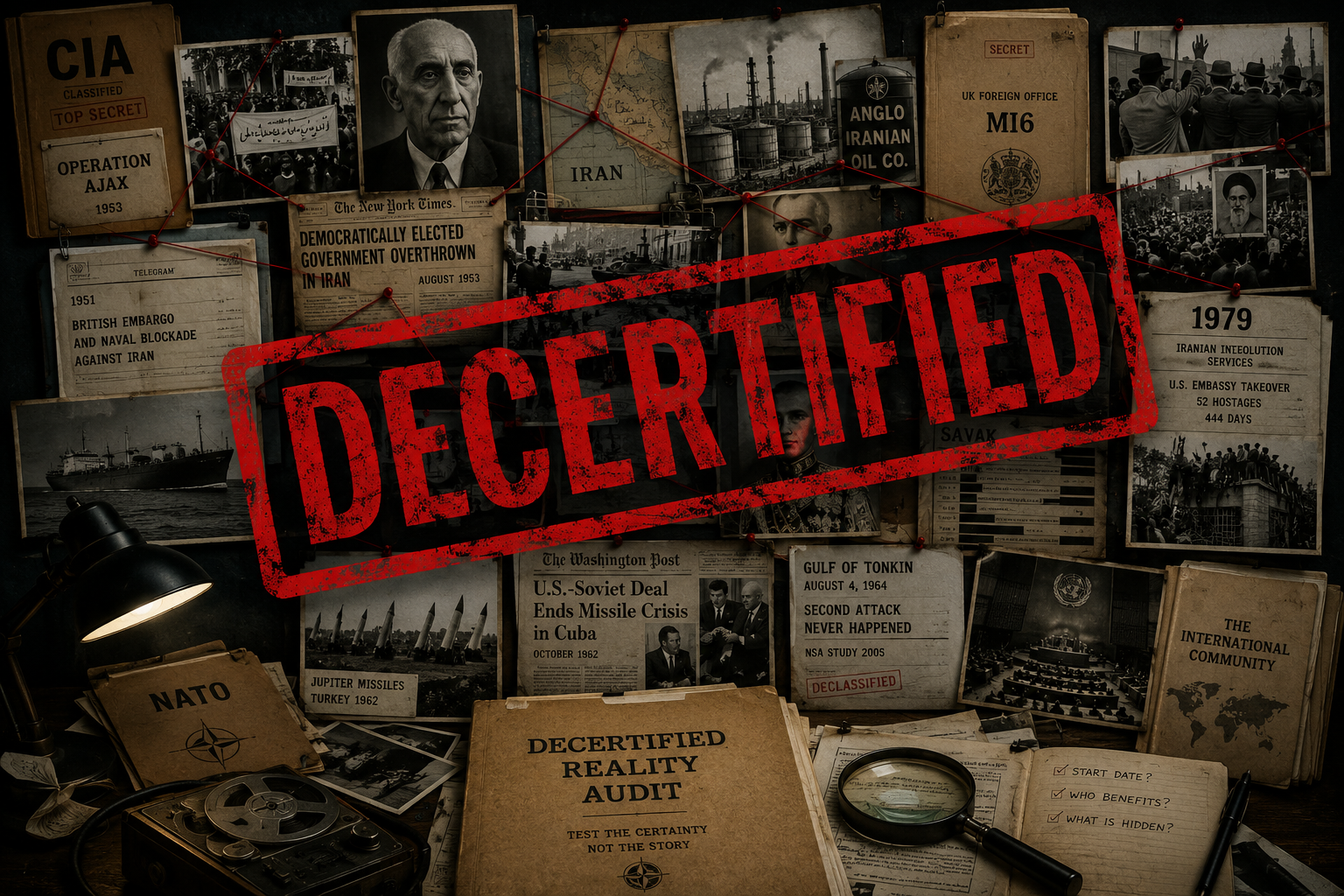
A Decertified Reality investigation audits official certainties that shaped major decisions, wars, policies, or public beliefs. The question is not whether an institution was right or wrong. The question is whether the certainty itself was certifiable at the time it was presented. Each investigation applies the same test: was the claim stable, independently supported, open to disconfirmation, and verifiable? This series does not replace one certainty with another. It audits how certainty was produced.
Most of this series audits a claim about a thing: a stockpile, a weapon, a vault, a collapsed building. This one audits a claim hidden inside a single word. The word is "aggressor," and it is one of the most powerful certifications in public life, because it does in one syllable what an argument would need a thousand words to do. To call a state the aggressor is to certify, instantly and without showing your work, who began the wrong, who is owed and who owes, whose violence is defense and whose is crime. It is a verdict wearing the costume of a description. And like every certification in this series, it can be tested. The test, this time, produces a strange and revealing result: the word changes its meaning depending on nothing about the parties at all, and everything about a single hidden choice. The choice of when the story starts.
Take the case that makes it sharpest, because it is the one where the documentation is total and the official record contradicts the popular one.
The story that starts in 1979
The familiar story of Iran and the West begins on a date. In November 1979 a crowd of students stormed the United States embassy in Tehran and held fifty-two Americans hostage for four hundred and forty-four days. From that image the modern certification was built: Iran the aggressor, the revolutionary regime that seizes diplomats and chants against the Great Satan, the original rogue state. Everything that followed, the sanctions, the "axis of evil," the decades of confrontation, rests on that starting point. Begin the clock in 1979 and the verdict writes itself. Iran struck first.
The trouble is that 1979 was not the beginning. It was a reply.
The act the clock is set to hide
Twenty-six years earlier, in 1953, Iran had a democratically elected prime minister, Mohammad Mossadegh, and he did something a sovereign government is entitled to do. For half a century Iran's oil had been pumped under a concession first granted in 1901 and operated by the Anglo-Iranian Oil Company, the firm that would later become BP. The terms were not a partnership; they were a tribute. Under the renegotiated 1933 agreement Iran received twenty percent of the company's net profit, and only above a guaranteed dividend, which in practice left it with considerably less than half of what its own oil earned. It was not permitted to audit the company's books, so it could not even confirm what it was owed. Iranians were largely barred from the senior ranks of the company that ran their single greatest asset, and the refinery at Abadan, the largest in the world at the time, was a British enclave on Iranian soil.
The injustice was not only moral; by 1950 it was visibly out of step. In December of that year Aramco signed a fifty-fifty profit split with Saudi Arabia, the first of its kind in the region, and overnight every other producer's terms looked like a relic. Iran was now receiving a fraction of what its neighbor across the Gulf would get for the same commodity. When Mossadegh's government nationalized the oil in 1951, it was not seizing something exotic. It was claiming a sovereign right that the law of the day recognized, after decades of a deal it had never been allowed to see the inside of.
Britain, having lost its single most valuable overseas asset, responded first not with a coup but with coercion. It withdrew its technicians, organized a global boycott of Iranian oil, and imposed a naval blockade that strangled the country's economy. That embargo is itself worth marking, because it was the first cross-border act of force in the modern quarrel, and it came from London, not Tehran. Only when the embargo failed to topple Mossadegh did the operation escalate. It was run by the CIA and Britain's MI6, code-named TPAJAX, directed on the ground by Kermit Roosevelt, and built out of paid crowds, bribed officers, and a planted press campaign. In August 1953 it overthrew the elected government, installed General Zahedi, and restored the Shah, who had briefly fled, as an absolute monarch. He ruled for twenty-five years with a secret police, the SAVAK, trained in part by his Western sponsors, and the repression of those years is the soil from which the 1979 revolution grew.
This is not a loose association; it is a causal chain that the participants themselves drew. A generation of Iranians came of age knowing that their one experiment in elected government had been destroyed from abroad to protect a foreign oil company, and that the dictatorship which replaced it was armed, funded, and shielded by the same powers. When that dictatorship finally fell in 1979, the revolutionaries did not invent their hostility to the United States out of nothing; they pointed directly at 1953, at the embassy from which the coup had been run, and called it the den of spies. The hostage-takers were wrong to do what they did, and they were not confused about why they were doing it. The reply was aimed at a specific, remembered act.
None of this is contested or hidden any longer. The CIA formally acknowledged its role in the 1953 coup in 2013, and the United States government's own official history, the Foreign Relations of the United States series, published a retrospective Iran volume in 2017 that incorporated declassified material on the operation. The foundational act in the modern relationship between Iran and the West, the first time one party reached across a border to bend the other to its will, was not committed in Tehran in 1979 but in London and Washington at the start of the decade before. The hostage crisis was many things, and excusable is not one of them, but it was not the opening move. It happened to a generation that had grown up under a dictatorship installed by foreign powers who had erased their democracy to keep their oil.
So who is the aggressor? Start the clock in 1979 and it is Iran. Start it in 1953 and it is the West. The facts do not change. The parties do not change. Only the date you are allowed to begin counting from changes, and with it the entire moral verdict flips. That is not a quirk of this one case. That is the mechanism.
The clock is the weapon
Here is what the audit actually reveals, and it is bigger than Iran. The word "aggressor" is a certification of moral and causal priority, and its load-bearing input is not evidence about the parties. It is the start date. Whoever owns the start date owns the blame, because "who started it" is meaningless until you have decided when "it" started. Set the clock late, after your own first move and before your opponent's reply, and your opponent is the aggressor. Set it early, to include your own first move, and you are. The label is downstream of the calendar.
This is why the certification fails the gate so completely. A claim is certifiable only if it is stable, independently grounded, and verifiable, and "aggressor," as applied to a long relationship, is none of these. It is not stable: it inverts the moment you move the starting line, and nothing about the world had to change for it to invert. It is not independently grounded: the start date is almost always chosen by the party that benefits from where it lands, which is the purest form of self-certification, the actor selecting the frame that grades it innocent. And it is not verifiable, because there is no neutral fact of the matter about when a seventy-year cycle of intervention and reply "really" began; every candidate start date is itself a move in the argument. The word does the work that the evidence cannot, and it does it by smuggling in a premise, the start date, that is never stated and never defended.
The everyday version of this is the phrase "the cycle of violence," and the way it is used reveals the trick in miniature. Each side in a long conflict sets its clock to the other's most recent attack, so that its own next blow is always a response and never an opening. Both are telling the truth about the day they have chosen to begin, and both have chosen a different day, and the disagreement that looks like a disagreement about facts is really a disagreement about start dates. A reporter who opens the story with "in retaliation for" has, in three words, certified who the aggressor is, by certifying which blow counts as the first. Move the opening clause one event earlier and the same paragraph assigns the guilt to the other party. The facts in the sentence do not change. The first word does all the work.
This is the same mechanism the Manifest has found elsewhere wearing other clothes. It is sequence control, the power to shape an outcome by choosing the order and the boundaries of the story rather than by changing any fact within it, applied now to moral judgment instead of to policy. And it is the deepest layer of the architecture of visibility, because it operates on memory: whoever owns the start date owns the blame, and owning the start date means controlling where the public's clock begins, which is a question of what gets remembered and what is allowed to fall off the front of the record. The 1979 story is not a lie. Every fact in it is true. It is simply a clock set to begin after the West's turn and before Iran's, and the setting of that clock is the whole certification.
A cleaner clock: Cuba, 1962
Iran is the sharpest case because the record is total, but it is not the easiest to see clearly, because the modern quarrel is still warm. So test the mechanism on a case that is cold, fully documented, and involves different parties entirely. If the clock-trick is real, it should appear there too, run by a different government, in the opposite ideological direction.
The Cuban Missile Crisis is remembered as the textbook act of Soviet aggression: in October 1962 Moscow was caught smuggling nuclear missiles into Cuba, ninety miles from Florida, and a resolute American president forced their removal. Start the clock in October 1962 and the verdict is automatic. The Soviets moved first.
But the missiles in Cuba were not the first nuclear weapons placed on a superpower's doorstep. By March 1962, months earlier, the United States had fifteen Jupiter missiles operational in Turkey, on the Soviet land border, capable of reaching Moscow, with more in Italy. Khrushchev's deployment to Cuba was, by his own account and by the logic of the map, a reply to a threat already standing on his frontier. And the proof that Washington itself understood the symmetry is buried in how the crisis ended. The public settlement was that the Soviets withdrew and got nothing. The actual settlement, kept secret for decades, was a trade: the United States quietly agreed to pull the Jupiters out of Turkey, which it did the following spring. The deal was concealed precisely so that the American clock could stay set to October, so that the story could remain one of Soviet aggression met by firmness rather than one of two reciprocal deployments quietly cancelled. The concealment was not incidental. It was the maintenance of a start date.
Here is the same finding as in Iran, produced by an opposite government against an opposite adversary. The facts are not in dispute. The Jupiters in Turkey are documented; the secret trade is documented. Move the clock back six months, from October to March, and the clean story of Soviet aggression becomes a story of mutual escalation in which the West moved first. Nothing about the parties changed. Only the permitted start date changed. That two great powers on opposite sides of the century's central rivalry both reached for the same instrument, the chosen start date, is the strongest evidence that the instrument is structural and not partisan. It is not that one side lies and the other tells the truth. It is that the calendar is where the lying happens, on every side.
The discipline: a flipped label is not a verdict
Here the analysis has to hold a hard line, in both directions, or it becomes the very thing it audits. Showing that the "aggressor" label flips when you move the clock does not crown Iran the victim or the West the sole villain. That would just be running the same trick in reverse, choosing the start date that grades the other side guilty and calling it truth.
The honest finding is narrower and stronger. The 1953 coup is a documented act of aggression by the West. The 1979 hostage-taking is a documented act of aggression by Iran. So is the Islamic Republic's long record since: the support for proxy forces, the violence exported around its region, and above all the repression of its own people, which needs no Western framing to be real. Both columns of the ledger are full. What the audit decertifies is not either side's specific acts; it is the single word that pretends to sum a seventy-year feedback loop into one party's guilt. And the scope of that verdict has to be stated precisely, because it is the whole discipline: "aggressor" is uncertifiable in long, recursive conflicts, the ones where each side has struck and replied across decades so that every blow is both a provocation and a retaliation depending on where you cut in. It is not uncertifiable everywhere. In this kind of conflict it cannot be earned, not because no one ever struck, but because both did, repeatedly, each reply becoming the next side's grievance, and the word can only be made to point one way by hiding half the record behind a chosen date. The cycle is real. The clean villain is manufactured, and the manufacturing tool is the calendar.
The strongest objection
The serious counterargument to all of this is not that the facts are wrong. It is that the method proves too much. If you can always reach for an earlier grievance, the critic says, then no one is ever the aggressor, every invader can plead a prior wound, and the audit collapses into the oldest sophistry there is, the moral equivalence that launders every dictator's war as a response to something. Push the clock back far enough and Hitler had Versailles, Putin had NATO, every aggressor had a yesterday. A test that excuses everyone has judged nothing.
This objection is correct about a danger and wrong about the method, and the difference is the whole point. The audit does not say that an earlier grievance always exists, therefore no one is ever guilty. It says something testable: a true aggressor label survives every reasonable reset of the clock, and a manufactured one does not. That is a discriminating test, not a universal solvent. It draws a line, and the line is exactly where the moral-equivalence trap is avoided. When you move the start date back through all the available grievances and the verdict still does not flip, the label is earned and the audit returns Certified. When the verdict inverts the moment you include the accuser's own prior move, the label was a frame. The Iran relationship inverts on the first honest reset, from 1979 to 1953. Some relationships do not invert no matter how far back you honestly go. The next section is about those, because a test that could never clear anyone would be measuring nothing at all.
The control case: when the word is earned
A test that always returns the same answer is measuring nothing, so the audit has to show where "aggressor" is in fact certifiable, because sometimes it plainly is. Consider Iraq's invasion of Kuwait in August 1990, or Germany's invasion of Poland in September 1939. In both there were prior grievances available to anyone who wanted to move the clock: Iraq claimed Kuwait as a historic nineteenth province and accused it of slant-drilling into Iraqi oil and depressing prices; Germany had real grievances over Versailles and the status of Danzig. Move the clock back through all of them, as far as honesty allows, and the verdict still does not flip. There remains a clear, dated, documented first crossing of a border by a force with no proportionate provocation in any reasonable frame, and no earlier starting point that reverses it.
The Polish case proves the test from the inside, because the aggressor himself tried to run the clock-trick and could not make it hold. On the night before the invasion, Nazi operatives staged the Gleiwitz incident, dressing as Polish soldiers and faking an attack on a German radio station, precisely so that the start date could be set one day later and Poland could be named the aggressor. The fabrication did not survive contact with the record; the documented German crossing the next morning was the first real act, and history certified the label against the very party that had tried to manufacture it. That is the gate working. The word is not always propaganda. Sometimes it is earned, and the test can tell the difference between a label that survives every reasonable reset of the clock and one that needs a particular start date, or a staged incident, to stand. The first is a finding. The second is a frame.
The Gleiwitz fraud also names a second, harder version of the trick, the one that does not just choose a start date but manufactures one. Two decades later the United States produced its own example. The Gulf of Tonkin episode of August 1964, the reported North Vietnamese attack on American destroyers that Congress used to authorize the Vietnam War, included a second engagement on the fourth of August that, by the National Security Agency's own later study, declassified in 2005, did not happen. The radar contacts were false echoes; the reports that reached Congress were filtered to support a clock set to that night. A staged or phantom incident is the start-date trick at its most aggressive: not finding the convenient first blow but inventing it, so that the war can be certified as a response. The control cases and the manufactured ones are the two ends of the same instrument. At one end the start date survives every test. At the other it has to be fabricated to exist at all.
The family of words
Once you see it in "aggressor" you see it in a whole family of words that do the same job, each a certification of priority or virtue that was never independently established, only repeated. "Rogue state" certifies that a country stands outside a legitimate order, while quietly exempting from the same standard the states that coined the term. "The free world" certifies an entire bloc as the side of freedom, regardless of what any member did in any given decade. "The international community" certifies that a particular set of governments speaks for humanity, when it usually names a much smaller and more interested group. Each of these is a verdict compressed into a phrase, asserted by repetition, and each rests, like "aggressor," on a hidden frame: a chosen membership, a chosen standard, a chosen date.
You can watch the same clock-trick run inside these phrases. "The War on Terror" sets its clock at September 2001 and seals off everything before it, so that two decades of prior intervention vanish from the frame and the whole campaign reads as a response to an opening blow. "The rules-based order" certifies that there are neutral rules and a community that keeps them, without ever saying who wrote the rules or who is quietly exempt from them. "The axis of evil" sorts three unrelated countries into a single enemy by naming, not by evidence. None of these is argued. Each is asserted, and then repeated until the assertion feels like a description.
This is old craft, and it was named long ago. Walter Lippmann argued a century ago that public opinion is governed less by events than by the "pictures in our heads," the simplified frames through which events are made to mean something, and that whoever supplies the picture shapes the verdict. George Orwell, in his essay on political language, showed how a vocabulary of ready-made phrases lets a speaker reach a conclusion without ever passing through an argument, the words doing the thinking so the listener does not have to. "Aggressor," "rogue state," "the free world" are exactly such phrases: they are not the output of a judgment, they are a substitute for one. They are stamps, and the test for all of them is the same one this series always applies. Who certified this, were they independent of the verdict, and what would it take for the word to point the other way.
Who sets the clock, in practice
It would be comforting to imagine that the start date is chosen once, by some particular propagandist, in some particular room. The more uncomfortable finding is that no one needs to choose it, because by the time the public meets a conflict the clock has usually already been set, and set so long ago that it now feels like simple chronology rather than a choice anyone made. This is where the audit touches its deepest layer, the one that asks not who hid the earlier date but why the chosen one came to feel self-evident.
Consider how a start date hardens into common sense. A textbook gives the Iran chapter a heading and the heading begins in 1979, because that is where the trouble with America began, and the student who reads it is not told that a chapter could have begun in 1953; the earlier date is not refuted, it is simply not where the chapter starts. A wire service writes "in retaliation for" because the desk needs a clean opening and the most recent blow is the one in the news cycle, and the framing is reproduced ten thousand times until the sequence it encodes looks like the natural order of events. An anniversary is commemorated, which means a particular date is marked as the beginning of grief, and the dates before it quietly recede. None of this requires a conspirator. It requires only repetition, and repetition is how a chosen frame becomes the picture in everyone's head, exactly as Lippmann said. The start date is not usually imposed by a liar. It is inherited by everyone, including the journalists and teachers who pass it on in good faith, which is what makes it so much more durable than a lie. A lie can be exposed. A start date that everyone already takes for granted does not even present itself as a claim, and a claim that never presents itself as a claim can never be checked. That is the quiet engine beneath the loud word.
Who owns the clock
Historians know this trick well enough to have built an entire argument around it, which is the best evidence that it is real and not a rhetorical complaint. The decades-long scholarly fight over who started the Cold War divided into camps defined almost entirely by where they set the clock. An orthodox school, writing in the 1950s, began the story with Soviet expansion after 1945 and blamed Moscow. A revisionist school, opened by William Appleman Williams at the end of that decade, began earlier, with a longer history of Western intervention and the economic shape of American power, and shifted the blame westward. And a post-revisionist position, pioneered by John Lewis Gaddis in the 1970s, made its name by holding out as long as possible from assigning blame at all, which was in effect a recognition that the question "who started it" was the trap, that each camp was correct about its own starting point and that the starting point, not the evidence, was doing the moral work. Professional historians, in other words, eventually decertified the aggressor question in the Cold War not by answering it but by noticing that it could not be answered without first smuggling in a date. The clock-trick is not a Manifest coinage. It is a problem the discipline of history had to teach itself to see.
And it is being run right now, on the same country this series examined a piece ago. The argument that Iran is the aggressor and the argument that Iran is about to have a bomb are two certificates issued about one nation, and both are produced the same way, by choosing where to begin counting. The bomb has been one year away since whichever year you start from; the aggression began in whichever year the speaker prefers. In both the facts are real and the verdict is manufactured by the framing, and in both the manufactured verdict has helped justify a war. The blame-clock and the bomb-clock are the same instrument, set to the same convenient hour.
The cost, and who is spared it
A certificate is only as honest as the exposure of the body that issues it, and this is where the aggressor label does its quietest damage, because the people who set the clock are almost never the people who pay when it is set wrong. The party that chooses the start date, a government, a ministry, a broadcaster, sells a war or a sanctions regime on the strength of a clean verdict, and if the verdict was a frame the cost does not return to the desk that wrote it. It falls on the conscripts sent to a border, on the civilians under the bombing that the word "aggressor" licensed, on a generation in the targeted country who will in turn inherit a fresh grievance and a start date of their own. The certifier keeps its budget and its credibility. The cost lands somewhere else, and arrives later.
This asymmetry is not incidental to the trick. It is what keeps the trick running. A claim whose author bears the consequences of being wrong gets corrected quickly, because the pain finds the source. A claim whose author is insulated from the consequences can be wrong for decades, because nothing pushes back on it. The aggressor certificate is durable precisely because the distance between the hand that sets the clock and the body that bears the cost is so large. Iran's own history is that loop closing in plain sight: the cost of 1953 was paid by Iranians for twenty-five years under a secret police, and the bill it generated, 1979, was then presented to a new American generation that had never been told a clock had been set on its behalf a quarter century earlier. The unpaid certificate did not disappear. It became the next certificate's grievance.
So the question to put to any aggressor verdict is not only where the clock was started and who benefits, but who is spared if it turns out wrong. The wider the gap between the one who sets the clock and the one who pays for it, the longer the frame will stand, because the people with the power to set the start date are standing outside the blast radius of their own mistake.
The instrument
The point of the audit is not to settle who the aggressor in any conflict really is. It is to show that the word, by itself, settles nothing, and that its appearance of settling everything is an effect of a choice it never reveals. When a state, a broadcaster, or a textbook tells you who the aggressor is, the live question is not whether they are lying about the events. Usually they are not. The live question is where they started the clock, and who benefits from it starting there.
Call it the start-date test, and it is small enough to carry and run yourself, on the next conflict you are told you already understand. Find the date the story begins. Ask what happened the day before. Ask who chose to leave it out. Three steps, and the third is the one that matters most, because it turns a question about chronology into a question about interest: a start date is not neutral when the party that chose it is the party it absolves. The test does not tell you who is good. It tells you whether the word you were handed was a finding or a frame, and that is a different and more durable kind of knowledge than a verdict, because it survives the case it was learned on. It is one of a small family of such instruments this series carries, each a way of asking whether a certainty's own clock, deadline, dissenters, or inspectors were ever allowed to threaten it. Once you are holding the start-date one you cannot put it down, because the start date is hiding in almost every account of a conflict you will ever be given, doing the moral work in silence.
The label did not record who started it. It recorded who got to choose when "it" started. Whoever sets the clock writes the crime.
The essay ends here. What follows is the testable record: the verdict, the evidence map, and the portable tests this series carries on every case.
Audit Verdict
Non-Certifiable as a final label for a long, recursive conflict (Iran and the West). The word inverts when the start date moves and is set by the party that benefits, so it cannot be granted "settled" status here. The control cases return the opposite verdict: Poland 1939 and Kuwait 1990 are Certified, because a dated first crossing survives any reasonable reset of the clock. The finding is "not certifiable as an end-label," not "false," and not a claim that either party is innocent.
Failure mode: Frame Capture (the verdict is set by the chosen start date, not by the evidence about the parties).
Evidence Map
Facts, interpretations, forecasts, and disconfirming signals.
Core claim. "Aggressor" is a certification of moral and causal priority whose load-bearing input is the chosen start date, not evidence about the parties. In LONG, RECURSIVE conflicts (decades of mutual strike-and-reply, like Iran and the West), the verdict inverts when the start date moves, is set by the party that benefits, and rests on no neutral fact about when the cycle "began," so the label is uncertifiable. It remains genuinely certifiable in single-act cases with a clear, dated first crossing that survives any reasonable reset of the clock (the control cases). The scope limit is the discipline: the claim is not "aggressor is always uncertifiable," it is "aggressor is uncertifiable in long recursive conflicts." The audit decertifies the word in that setting, not either party's documented acts. The portable instrument is the start-date test: find where the account begins, ask what happened the day before, ask who chose to leave it out.
Evidence level. Facts (high): the lopsided Anglo-Iranian oil concession (the 1933 terms giving Iran roughly a fifth of net profit with no right to audit the books, against the 1950 Aramco fifty-fifty split); the 1951 nationalization and the British embargo and blockade; the 1953 CIA/MI6 coup (Operation Ajax) overthrowing the elected government of Mohammad Mossadegh, the installation of the Shah and the SAVAK era; the 1979 revolution and embassy hostage crisis (444 days); the CIA's 2013 acknowledgment of its role and the 2017 Foreign Relations of the United States documentation; the Cuban control-of-clock case (US Jupiter missiles operational in Turkey by March 1962, the October 1962 Soviet deployment, the secret Jupiter withdrawal); the Gulf of Tonkin phantom second attack of 4 August 1964 (NSA study declassified 2005); the documented later acts of the Islamic Republic (proxy support, regional violence, internal repression); the control cases (Iraq's 1990 invasion of Kuwait; Germany's 1939 invasion of Poland and the staged Gleiwitz incident). Interpretation (medium, marked): the reading of "aggressor" as a start-date-dependent certification; the clock as the operative variable; the institutionalization of start dates through textbooks, wire-service framing, and commemoration; the analysis of "rogue state," "the free world," and "the international community" as the same kind of word. Explicitly NOT claimed: that Iran is a victim or the West the sole aggressor; that any party's documented acts are excused; adjudication of currently live conflicts is deliberately avoided.
What would confirm this. Other "aggressor" verdicts that invert cleanly when the start date is moved while the facts stay fixed; official narratives whose moral force depends on an unstated and self-serving choice of when the story begins.
What would disprove this. A relationship in which the "aggressor" label held stable across every reasonable starting point, grounded in evidence independent of the chosen frame, would show the word was certifiable there, as the control cases show it sometimes is.
Watchlist. The start dates embedded in official accounts of live conflicts; the phrase "who started it" and what day it silently assumes; the load-bearing words ("rogue state," "the international community") that carry verdicts without arguments.
The Decertified Reality Instruments
Every investigation in this series runs the same four tests. They are portable: learn one and you can run it yourself, on a certainty this series never examined.
The Start-Date Test. For any "who started it" claim: find where the account begins, ask what happened the day before, and ask who chose to leave it out. Whoever owns the start date owns the blame.
The Deadline Reset Test. For any "imminent" or "about to" claim: has this deadline been set before, passed, and quietly reset? A forecast that keeps renewing its own expiry without admitting it is a posture, not a prediction.
The Internal Dissent Test. Did the certifier's own experts contradict the public claim, and was that dissent buried? When the classified file and the podium disagree, the podium is making a choice, not reporting a finding.
The Inspector Test. Was there an independent party who could verify this, and what happened to them? A claim insulated from any possible inspection cannot be certified, only asserted.
One question runs beneath all four: how independent was the certification from the outcome it certified? That is the line between a finding and a frame.
Jerry van der Laan writes The Manifest Archive, a continuous investigation into how institutions, language, and systems shape what people are permitted to see as reality. He does not report events. He traces the structures beneath them.