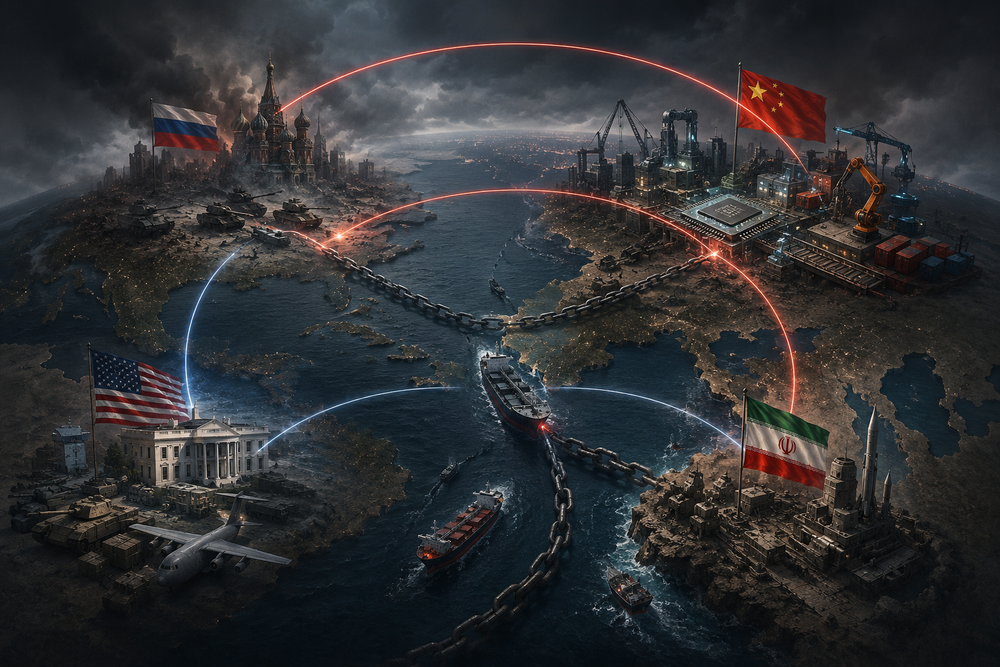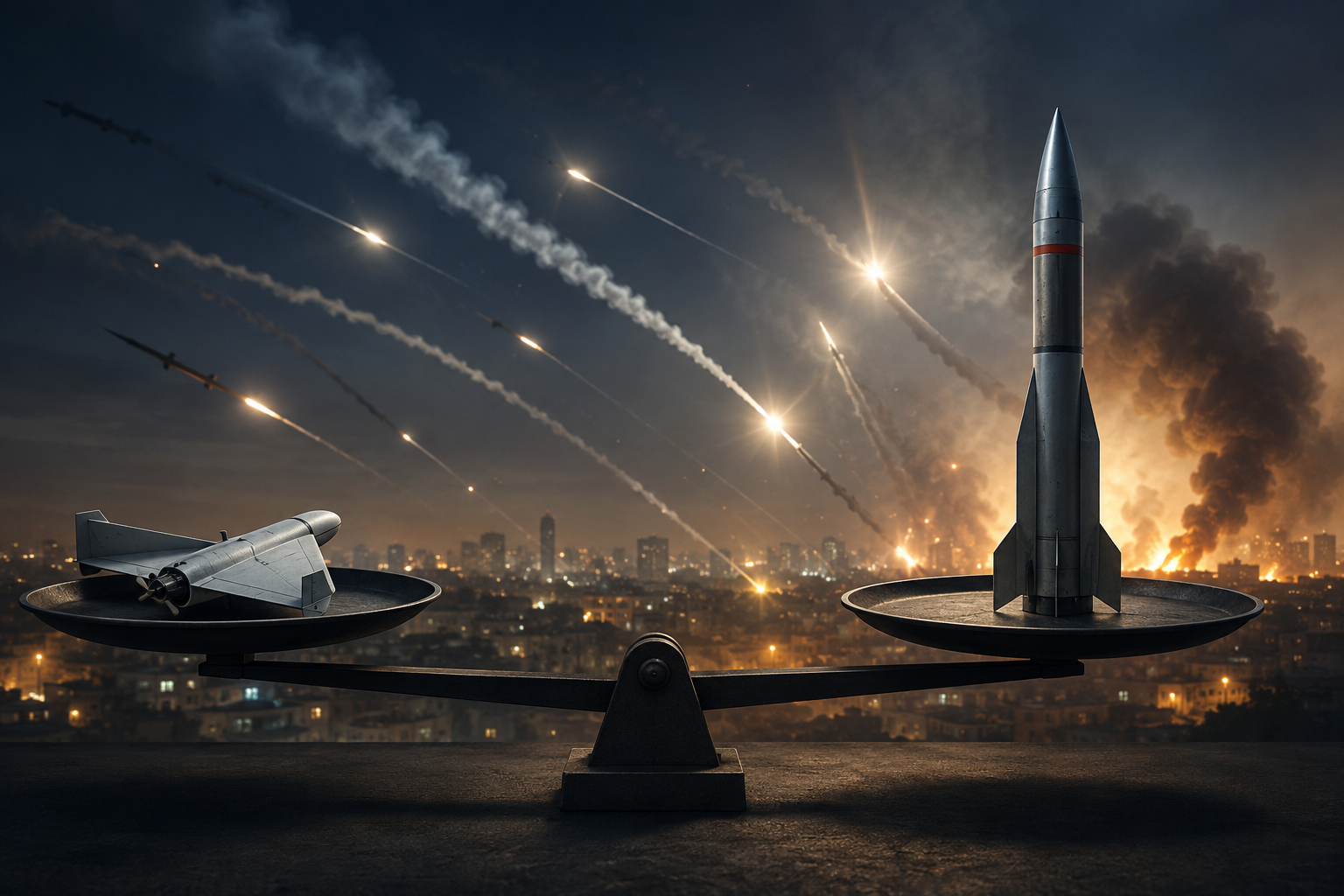
A Shahed drone is not an impressive machine. It is a lawnmower engine bolted to a delta wing, a warhead, and a cheap navigation chip. It flies low, slow, and loud. You can hear it coming. In money, it costs about the same as a modest family car, somewhere between twenty and eighty thousand dollars depending on how it is built, and a factory in Russia now turns out roughly one hundred and sixty of them a day.
When one of those drones crosses into defended airspace, something rises to meet it. A good air defense tries to answer cheap with cheap, a gun, a jammer, a drone of its own. But send enough at once, or hide a missile among them, and the cheap answers run short, and the thing that rises is a Patriot interceptor: a precision missile, guided, fast, built to a standard that can stop a ballistic warhead falling out of the sky. One Patriot PAC-3 costs about four point two million dollars. In its export version, more than six.
Hold those two numbers next to each other for a moment, because everything that follows lives in the gap between them. A weapon worth a used car is being answered by a weapon worth a small apartment block. The drone does not have to hit anything. It does not have to get through. It only has to be answered. Every time the cheap answers run short and the expensive one goes up, the side defending the city spends a hundred times what the side attacking it spent. Do that a few hundred times in a night, a few thousand times in a month, and you are no longer watching a battle between two armies. You are watching one side go broke faster than the other.
That is the war almost nobody is reporting. The cameras follow the missiles, the diplomacy, the ceasefire that holds or breaks. The thing that actually decides how long any of it can continue is quieter and far less photogenic. It is a number on a spreadsheet, the price of stopping a weapon, and right now that number is moving against the people who thought they were winning.
The arithmetic that decides the war
Start with the simplest version, the one a child could check.
Picture the cartoon version first, because the correction is where the truth lives. An attacker sends fifty cheap drones at a city. Each costs about twenty thousand dollars, so the attack costs a million. If the defender answered every one with a multimillion-dollar interceptor, a flawless night, every drone down, would still cost him two hundred million dollars against the million spent on him.
No competent commander fights that way, and it is the first thing a soldier will tell you. You do not send a four-million-dollar missile after a lawnmower engine if you can help it. You meet the drone with a gun, a jammer, a cheaper interceptor, a drone of your own. Fifty Patriots for fifty Shaheds is not how it is done.
But the attacker knows that too, and it does not save the defender. It only moves the cost. Mix those fifty cheap drones with a few ballistic missiles, and the arithmetic comes back with no way out, because against a ballistic warhead there is no cheap answer. The only thing that stops it is an Arrow or a THAAD, two to thirteen million dollars each, and the attacker, not the defender, decides how many to send. The cheap drones force you to switch on your radars and spend your cheap defenses. The expensive missile, arriving into that opened, half-drained sky, forces you to spend the one thing you cannot quickly replace. You do not get to answer cheap with cheap when the thing falling on the city can only be caught by the most expensive missile you own.
Run that exchange night after night and you understand the trap without any military training at all. The side that wins every fight is the side that runs out of money, and out of missiles, first.
Soldiers have a blunter name for the second half of this problem. They call it magazine depth. A ship, a battery, a country can only hold so many interceptors at once. When they are gone, they are gone, and the next missile to arrive meets nothing. The attacker has the opposite condition, which the analysts call industrial depth: the ability to keep building cheap weapons in small workshops faster than the defender can build expensive ones in a handful of specialized plants.
The numbers underneath the trap are not in dispute. A THAAD interceptor, the kind the United States uses to stop longer-range missiles, costs about twelve point seven million dollars each. An Israeli Arrow runs somewhere around two to three million. Even the cheapest serious interceptor, the small Tamir missile inside Israel's Iron Dome, costs forty to fifty thousand dollars, which is to say, more than the drone it is sent up to destroy. On the other side of the ledger, an Iranian ballistic missile runs from a few hundred thousand dollars for a simpler model to several million for an advanced one, the Emad estimated at around a quarter of a million and the heavier Ghadr and Khorramshahr types in the millions, while a drone, as we have seen, costs less than a car.
Every interception, even a perfect one, runs the trade the wrong way. This is not a weapons race. It is an accounting race. The side that loses is the side that can no longer afford its own success.
The uncomfortable part is that none of this is new physics or secret intelligence. A defense analyst in Tel Aviv put it in one plain line that survived into the newspapers: defense is more expensive than offense. That sentence is the whole war. Everything else is detail.
What ran out in the spring
For a long time this was a problem on paper, the kind of thing think tanks war-gamed and budget officers worried about quietly. In the spring of 2026 it stopped being on paper.
By March, Israel was telling the United States, privately, that it was running critically low on the interceptors that stop ballistic missiles. Not low on bullets or fuel. Low on the one thing that keeps Iranian warheads from landing on its cities. One British research institute estimated that Israel could burn through its entire stock of Arrow interceptors, its primary shield against the longest-range missiles, within a matter of days, and warned that rebuilding that stock would take years, not weeks.
The Americans were not in better shape. The THAAD batteries sent to protect Gulf allies were heavily depleted. In the first five days of the fighting, the United States is believed to have fired around two point four billion dollars worth of Patriot interceptors. The war was costing something close to a billion dollars a day, and a large part of that was not bombs dropped on the enemy. It was the price of catching what the enemy threw back.
Iran understood the arithmetic perfectly and pressed exactly where it hurt. It fitted some of its missiles with cluster warheads, a choice with one obvious purpose: to make each incoming threat split into more pieces, force more interceptors into the air, and drain the defender's magazine faster.
The attacker was no longer just trying to hit the city. The attacker was trying to make the shield expensive enough to empty.
The swarm is not designed to overwhelm the target. It is designed to overwhelm the economics of defending it.
Officially, everyone denied the danger. Israel's military said it was ready for any scenario and rejected the reports that its stockpile was critically low. But governments do not approve emergency procurement funding for a problem that does not exist, and the emergency funding was approved. The denial and the funding cannot both be true. The funding is the truth.
This is the moment the abstract law became visible. A country with one of the most advanced air defenses ever built, backed by the United States, found itself counting interceptors like a household counting the last notes in a wallet at the end of the month. Not because the shield failed. Because the shield worked, and working is what bankrupts it. A country can win every interception and still lose the war, one interceptor at a time.
Why Russia chose the cheap weapon
If the cheap weapon is so powerful, why did it take so long for anyone to lean into it? The answer is that one side did, deliberately, and built an entire war machine around the insight.
Russia did not stumble into cheap mass. It chose it. At a single industrial site, the Alabuga zone, Russia scaled production of its Geran drones, the domestic copy of the Iranian Shahed, to a reported five and a half thousand units a month. In May of 2026 alone it launched somewhere over five thousand of them at Ukraine, an average of more than a hundred and sixty every day. Alongside the drones it leaned on glide bombs, ordinary heavy bombs strapped with cheap guidance kits that turn a dumb weapon into a precise one for a few tens of thousands of dollars. None of these things are elegant. All of them are cheap, and all of them are made to be made by the thousand.
Behind the economics sits something older, and this is the part most coverage misses. Russia's preference for affordable offensive mass is not only a calculation about 2026 budgets. It is the latest expression of a doctrine that is nearly a century old. Soviet military thinking, going back to the deep-battle school of the 1930s, always favored mass fires over careful defense, the idea that you win by overwhelming the enemy with volume rather than by perfecting your shield. The cost curve of modern drone warfare now rewards, almost exactly, what Russian doctrine prescribed long before anyone had heard of a Shahed.
That is the deeper layer. The cheap drone is not a clever trick that happened to work. It is a hundred-year-old idea that finally found its perfect weapon. The doctrine did not adapt to the technology. The technology arrived to serve the doctrine.
So when you watch Russian drones grind across Ukrainian skies night after night, you are not watching improvisation. You are watching a country that decided, on purpose, that it would rather build ten thousand things that cost nothing than ten things that cost everything. It is losing many of those drones. That is the plan. The losses are affordable by design, and affordability, not precision, became the decisive advantage.
Why the defender's weapons got so expensive
Here the question turns around, and this is where the real determining variable hides. We keep saying the interceptor is expensive, as if that were a law of nature. It is not. An interceptor costs four million dollars for reasons that have very little to do with physics and a great deal to do with who builds it and what they are trying to maximize.
For Russia, weapons production is an optimized war machine. The single goal is the exchange on the battlefield: more units, cheaper, good enough, replaceable. For the United States and much of the West, it is also an industry with a life of its own, and an industry survives by delivering the most capable system, not the cheapest shot.
Look at how the American system is actually built. Its weapons are designed to be exquisite, packed with capability, and produced in small numbers at a handful of specialized plants, because that is what the buyer has always asked for and what keeps a narrow industrial base alive between wars. A military that prizes precision, reliability, and the survival of its own crews will pay for the best, and the firms that supply it live on a few large programs rather than on mass output. The whole apparatus is wrapped in a political economy where the factories are spread across as many congressional districts as possible, because a weapon that supports jobs in forty states is a weapon that is very hard to cancel. None of this requires anyone to be corrupt or to want the war to drag on. It only requires each player to pursue their own incentive. The contractor builds what is ordered. The general orders the best. The legislator protects the jobs. The sum of those rational choices is a defensive weapon that costs a hundred times what the threat it stops costs to build.
President Eisenhower, who had commanded the largest army in history before he ran the country, named this sixty-five years ago and warned where it led. He called it the military-industrial complex, and his warning was not about villains. It was about a structure that, once built, optimizes itself. The expense is not a flaw in the system. The expense is the system working as designed, for a goal that was never winning the cost war.
This is the variable beneath the variable. The cost-exchange ratio decides the war. But the cost-exchange ratio itself is decided by something further down: whether the side defending built its weapons to win the exchange or for the many other things a military also asks of them. Russia optimized for battlefield exchange ratios. Western procurement optimized for capability, reliability, survivability and political sustainability. Modern drone warfare rewards the first logic more than the second. And then both sides walked into the same war.
The power that armed for offense left its own back door open
There is a second proof of all this, and it runs in the opposite direction, which is what makes it forensically strong rather than just a clever framing.
The power that perfected the cheap-offense logic is now its most exposed victim.
Russia spent its money on attack and comparatively little on defending its own rear. So when Ukraine learned the same lesson Russia had taught the world, the consequences traveled straight back to Russian soil. Ukrainian long-range drones, cheap machines built in workshops, reach deep into Russia and set oil terminals and refineries on fire, including in St Petersburg, hundreds of kilometers from the front. A drone that costs perhaps fifty thousand dollars disables an installation worth hundreds of millions. The exact trade Russia ran against Ukrainian cities now runs against Russian energy infrastructure, and Russia, having built for offense, does not have the dense, affordable shield to stop it. It cannot, because no one has yet found a cheap way to stop cheap drones, and Russia least of all.
Iran demonstrated the same vulnerability from the other side. Iran is the original architect of offensive saturation: missiles, drones, proxies, an entire strategy built on throwing volume at an enemy it could never match in the air. And when Israel struck Iran directly, Iran could not defend itself. The country that taught a generation how to overwhelm a defense had almost no defense of its own to overwhelm.
This is the pattern that makes the whole analysis hold, because it appears twice, independently, in two different wars, against two different powers. The side that chooses offense does not just gain a weapon. It accepts a wound. Whoever bets everything on the cheap attack leaves his own door open to the same cheap attack, because the logic that makes offense cheap is the same logic that makes defense unaffordable, and it does not care which flag is flying over the refinery.
The formula carries its own punishment inside it. That is not a weakness in the argument. That is the argument proving itself in a second language.
The race to flip the curve
If the cost curve is the thing that decides the war, then the only real escape is to flip the curve, to make defense cheap enough that the math finally runs the other way. Everyone now understands this. Watching them try is the most revealing part of the whole story, because it shows you which systems can change and which are trapped.
The United States launched an initiative called Replicator, an open attempt to build thousands of its own cheap, expendable drones and to break out of its expensive-and-few habit. It is the Pentagon admitting, in public, that the cost structure is the problem. And the result so far is the lesson. Replicator missed its first major delivery target by an order of magnitude. Where it had promised thousands of systems, it produced hundreds, and the effort was restructured under a new name. The richest military in the world announced that it would learn to build cheap, and then could not, quickly, build cheap. Not because the engineering is hard. A garage in Ukraine can do the engineering. Because the industrial base, the contracting model, and the political economy are all built to produce the opposite, and a system optimized for expensive few does not become a system of cheap many by being told to. The machine has not yet made itself cheaper at scale, even when its own commander orders it to. There are counter-currents, cheaper interceptors like the Coyote, the thirty-thousand-dollar APKWS rocket pressed into air defense, new firms built from the start around mass production. They matter, and they are still the exception fighting the structure rather than the structure itself. That gap between the order and the output is not a side note. It is the lock-in, visible in real time.
Then there is the other escape route, the one that might actually work: the laser. Israel's Iron Beam, a one-hundred-kilowatt directed-energy weapon, became operational in 2026 and made its first reported combat interception in March, against a projectile fired from Lebanon. Its promise is the number that breaks the whole trap. A shot from Iron Beam costs roughly two to five dollars. Not two million. Two. It is electricity and cooling, nothing more. Against a forty-thousand-dollar drone, a two-dollar shot finally inverts the arithmetic that has been bleeding the defenders dry.
But notice the caution buried in the same facts. The laser works to a range of only seven to ten kilometers. It struggles in cloud and dust. It cannot yet reach the high, fast, long-range ballistic missiles that are the most dangerous and most expensive things to stop. It is the beginning of an answer, not the answer. And until lasers are everywhere, reliable, and cheap to field as well as cheap to fire, the old curve still rules, and the old curve still favors the side with the cheap weapon and the deep factory.
The strongest case against this, and why it still holds
The strongest objection to everything above is that the contrast is too flattering to the cheap side, and it comes in three versions. The first: Russia's weapons are cheap partly because they are built to lower standards, with hidden state subsidy, with conscript labor, and with a tolerance for losses a Western democracy would never accept. The second, and the more serious: Russia and Iran are not cheap powers at all. They hold a high-end tier as well, Russian hypersonics like the Oreshnik that flew on Dnipro without being intercepted, Iranian missiles that cost millions each, and they keep most of it in reserve, shown once as a signal and then withdrawn. What we are measuring is the layer they choose to let us see. The third: the expensive Western interceptor is not waste. Its price buys precision, it buys the ability to defend a city without killing the people in it, it buys far lower casualties among the crews who operate it, and a defender may rationally pay four million dollars to keep a single warhead off a single hospital. If the laser then arrives at scale, the whole trap could close within a few years, and this analysis would read like a snapshot of one passing imbalance.
All of that is true, and the architecture still holds, because none of it changes the one thing that decides the exchange while the exchange is happening: who gets to choose the price of each engagement. The attacker chooses. He leads with the cheap tier because the math rewards it, and keeps the expensive tier in reserve for a moment of his own choosing. The defender chooses nothing. He must answer whatever arrives, with whatever can catch it, and against a ballistic warhead that means the most expensive missile he owns. That a Shahed may really cost seventy or eighty thousand dollars rather than twenty changes none of this, because seventy thousand against four million is the same catastrophe with a smaller exponent. The point was never that the shield is wasteful. A shield that keeps a warhead off a city is worth almost any single price. The point is that it is unsustainable at the price the attacker can force, night after night, while holding most of his real strength back. The cost trap is not a claim about which side is morally or technically superior. It is a claim about who sets the limit, and the spring of 2026 answered that in public, with real numbers, when a superpower and its most advanced ally found themselves days from running out. The laser may yet close the trap. Until it does, the trap is open, the bill is real, and it comes due every single night.
What the spreadsheet does not have a line for
Go back to the drone in the first paragraph. The lawnmower engine, the delta wing, the sound you can hear coming. It crosses the line, and something worth a hundred times as much rises to meet it, and the city is safe for one more night, and the people in the city sleep, and almost none of them know that the price of their safe night was a number on a budget that cannot be paid forever.
That is the war nobody is watching. Not the strikes, which everyone sees. Not the diplomacy, which everyone covers. The slow, invisible draining of the one resource that has no headline, the stock of expensive answers to cheap questions. Israel learned the number in the spring. Russia is learning it now, at its own refineries. The United States is trying, and failing, to build its way out of it.
The accounting holds for every actor in this story. The attacker, who sets the price. The defender, who decides how long he can pay it. The contractor, who profits from the price being high. The general, who needs the shield to work. Every one of them has a place in the arithmetic, and the arithmetic explains every one of them.
Except the person under the drone, who never appears in the math at all, and whose only role is to hope the magazine is not yet empty.
Evidence Map
Facts, interpretations, forecasts, and disconfirming signals.
Core claim. The decisive variable in the current drone-and-missile wars is not the weapon but the cost of stopping it. When a cheap attacking munition forces an expensive interceptor in reply, the defender loses the war of attrition even while winning every interception, and the side that builds its weapons for industrial margin rather than for the battlefield exchange funds its own exhaustion.
Evidence level. Facts (high confidence, documented): interceptor costs (Patriot PAC-3 ~$4.2M, THAAD ~$12.7M, Arrow ~$2-3M, Iron Dome Tamir ~$40-50k) against attack costs (Shahed/Geran ~$20-80k, Iranian ballistic missiles ~$250k to several million); Russian Geran output of roughly 5,500/month at Alabuga; the spring 2026 interceptor shortage, ~$2.4B in Patriots fired in five days, emergency procurement approved; Replicator missing its 2025 target by an order of magnitude; Iron Beam operational in 2026 at ~$2-5 per shot. Interpretation (marked): that Western interceptor cost is driven primarily by an industrial and political structure that rewards capability over cost-per-shot rather than by physics, and that Russian cheapness reflects a deliberate doctrinal choice. Forecast (speculative): that directed-energy defense will determine whether the cost trap closes.
What would confirm this. Continued public evidence of interceptor-stock depletion forcing operational or political decisions; defenders restricting what they will intercept on cost grounds; further deep strikes on the offensive powers' own undefended rear.
What would disprove this. Directed-energy or low-cost interception reaching the range, reliability and scale needed to intercept saturation attacks for dollars per shot, flipping the exchange ratio; or a defender sustaining indefinite interception without stock or budget strain. Either would show that price was not the binding limit.
Watchlist. Iron Beam-M and longer-range laser fielding through 2026; Replicator's successor program output; the cost-per-kill figures cited in any future Gulf or Ukraine escalation.
Related from The Manifest Archive
- Everyone Is Watching the Front in Ukraine. Nobody Is Watching the Factories in Europe.
- Everyone Is Watching the AI Boom. Nobody Is Watching the Transformer That Can't Be Built in Time
- Everyone Is Watching Iran Close Hormuz. Nobody Is Watching the Sanction It Forces Open
- Current Wars in the World 2026: The Expanding Conflict Map
Jerry van der Laan writes The Manifest Archive, a daily investigation into the structures beneath power, language, and institutions. He traces the structures beneath them.