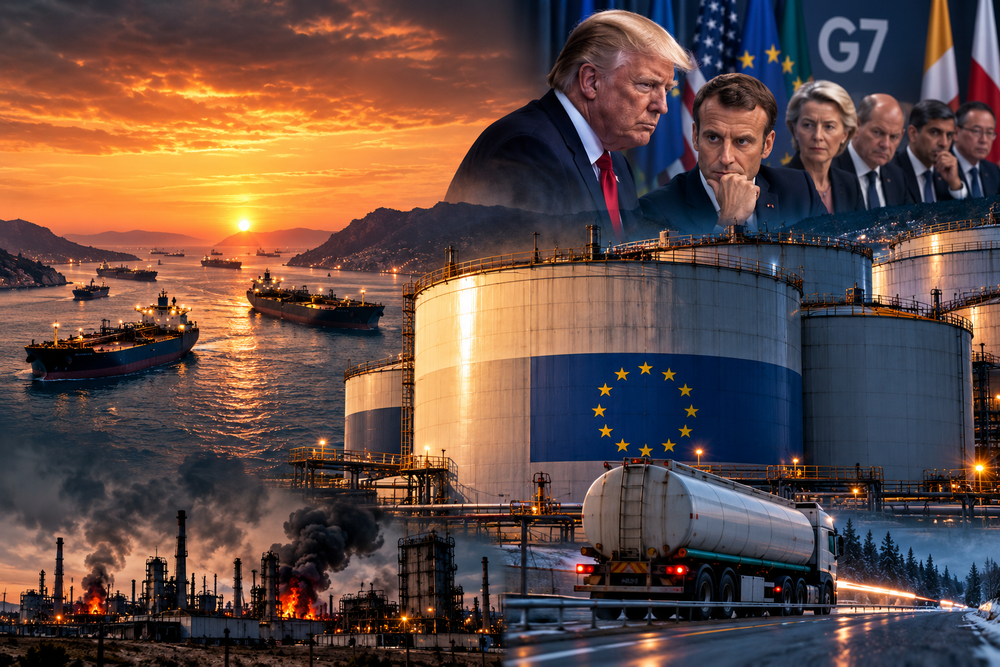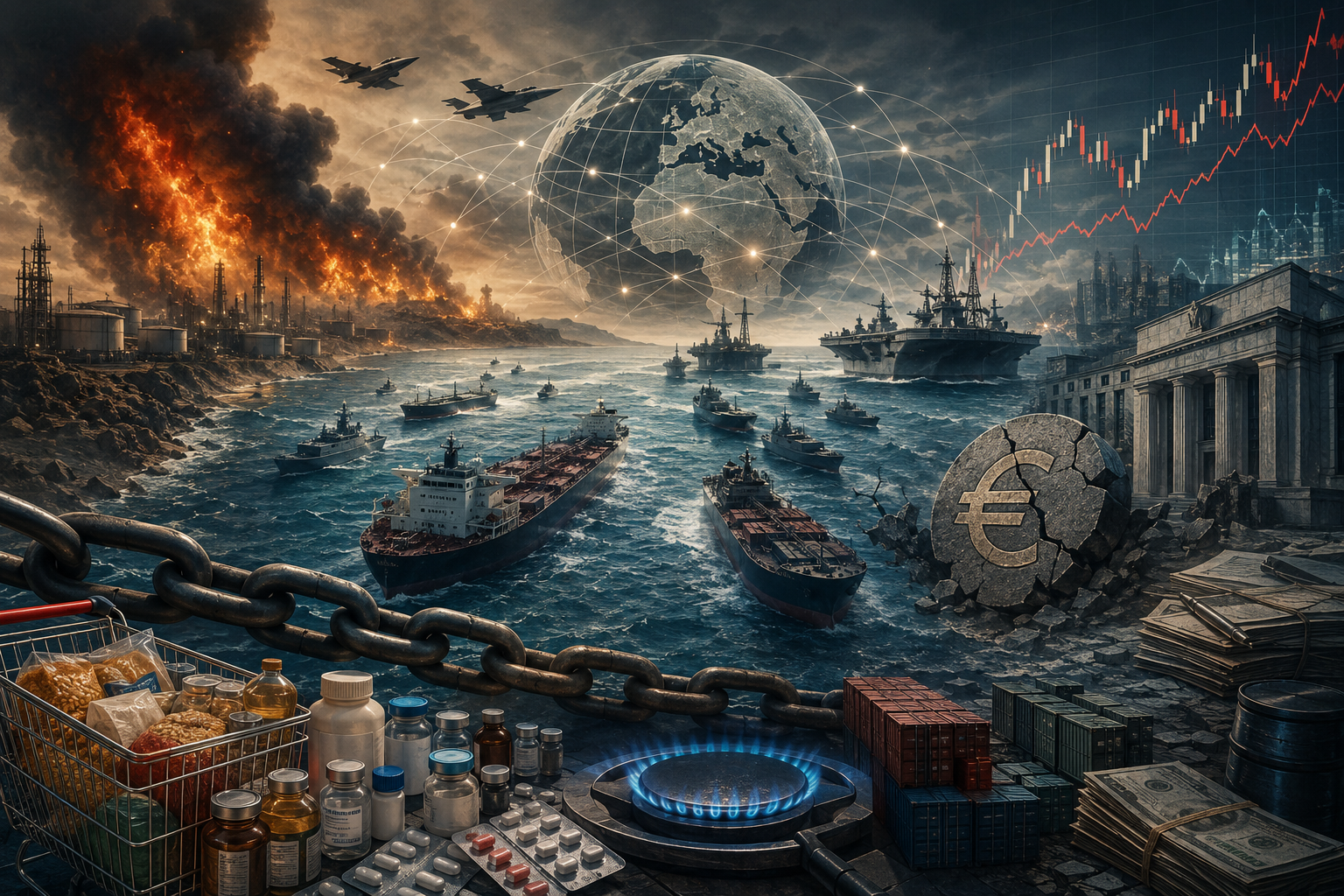
The Hormuz war is the most watched military conflict on any screen in 2026. Carrier strike groups. Strike packages. Ceasefire declarations. Diplomatic reversals. Every development is documented, analyzed, and distributed within hours. The visibility is total.
That is not where the damage will be counted.
It will be counted in cancelled production shifts, unavailable medicines, depleted gas storage, shortened credit lines, food subsidies that no longer cover the import price, and emergency decisions taken by governments after the private buffers have already disappeared. By the time these consequences appear, they will be reported as separate domestic problems. They are not separate. They are the delayed account of the same disruption.
The Timeline So Far
The strait has been commercially disrupted since February 28, 2026. A three-week ceasefire signed June 17 collapsed July 8 and 9. By July 13, Iran had struck two tankers in Hormuz. By July 16, Reuters reported that Tehran had instructed the Houthis to prepare operations against Bab al-Mandab. On July 17 and 18, desalination and energy infrastructure in Kuwait was struck. On July 18, Hormuz was running at approximately 10 ships per day against a pre-war baseline of 88. Brent crude stood at $88.10.
Nine transmission channels are now active simultaneously. Six operational systems are under stress, two institutional architectures under test, and one escalation variable whose trajectory could accelerate all of them. The critical variable is no longer the size of individual buffers. It is the relationship between depletion rates and replenishment capacity across multiple systems operating simultaneously. If combined depletion rates exceed combined replenishment capacity over the September–November window, the cascade accelerates. None of this appears in a single published institutional model.
The claim here is not that all nine failures will materialize. The claim is that they are each running, each documented, and the convergence has no map.
The Nine Systems
Six transmission systems under simultaneous stress:
- Shipping logistics
- Pharmaceutical supply
- Winter gas storage
- European banking and sovereign finance
- Trade finance
- Food imports and regional stability
Two institutional architectures now under test:
- Dollar settlement architecture
- Commercial chokepoint doctrine
One escalation variable:
- Nuclear enrichment timeline
None of the transmission systems operates independently. Maritime logistics determine the speed of pharmaceutical delivery. Shipping delays constrain LNG arrivals at European terminals. Energy prices affect sovereign borrowing costs. Sovereign stress feeds bank balance sheets. Banking conditions determine trade finance availability. Each system supplies or constrains another. The institutional architectures shape how these transmission systems interact: dollar pricing determines the magnitude of import cost shocks; chokepoint doctrine determines whether market responses lock in disruption. The escalation variable changes the calculation for every actor.
What appears as nine separate pressures is one network under distributed stress, whose architecture is being tested by conditions none of the institutions governing it expected to encounter simultaneously.
The convergence this analysis maps runs September through November 2026, under conditions unchanged from July 18. That is not a forecast. It is a structural interval: the period when combined depletion rates across multiple documented systems are likely to exceed combined replenishment capacity. Each of the nine systems has been assessed against its current documented state. The timeline follows from measured depletion rates and structural dependencies, not from assumptions about geopolitical intent. If Hormuz traffic recovers materially, or if European pharmaceutical inventories are confirmed as intact, the scenario shifts accordingly. What remains constant is the network architecture: nine systems sharing infrastructure, insurance markets, and political attention, tested simultaneously.
What the Bypass Routes Cannot Bypass
On July 17 and 18, multiple production units at Kuwaiti desalination and energy facilities were struck. AP reported that the affected infrastructure supplied both electricity and drinking water, with several production units offline. Kuwait derives approximately 90 percent of its freshwater from desalination. Saudi Arabia's proportion is approximately 70 percent.
The significance is not the scale of water loss at a single facility. It is what water and electricity represent in the architecture of oil production itself.
Desalination is energy-intensive. According to World Bank analysis, the water sector consumes approximately 20 percent of electricity in the UAE, 7 percent in Saudi Arabia, and 8 percent in Kuwait and Bahrain. The coupling runs in both directions: no power means no desalination; no water means operational pressure on refineries, staff, and the industrial processes that oil production requires. An attack on one complex can disable both outputs simultaneously.
The Saudi East-West Pipeline and the UAE's Habshan-Fujairah line are the bypass routes designed to move oil without transiting Hormuz. Together they offer an estimated 3.5 to 5.5 million barrels per day of alternative capacity, against roughly 20 million barrels per day that moved through the strait before the war. Both pipelines require functional electricity for pumping stations. Both require processing capacity upstream. Both require export terminals at the far end.
Those terminals are part of the same water and electricity infrastructure now entering the target set.
The bypass routes do not sit outside the war. They depend on the same infrastructure that is now being struck.
Maritime disruption delays exports. An infrastructure campaign reduces the ability to produce, process, pump, and load them at all. Strategic reserves can cover temporarily missing barrels. They cannot compensate for a Gulf production system being degraded faster than it can be repaired.
The nine-system cascade analyzed in this article is a structural hypothesis tested against a maritime disruption that makes export difficult. It was not modeled against a sustained infrastructure campaign that makes production itself contingent. The July 17 and 18 strikes do not confirm that such a campaign is the strategic objective. They document that the threshold has been crossed at least once.
The September Threshold
Somewhere between September and October 2026, under conditions unchanged from July 18 and assuming current maritime disruption persists, certain cargo will stop moving. Not because moving it is expensive. Because there is no available slot.
The Cape of Good Hope rerouting that began when Houthi attacks disrupted Red Sea shipping has been absorbing Hormuz overflow since February. An estimated 5 to 7 percent of global container fleet capacity is now running extended voyages, removing 1.3 to 1.8 million TEU of effective supply from the market. Cape Town and Durban, sized for regional and passage traffic, are operating above designed throughput. Singapore vessel waiting times reached seven days in June with 450,000 TEUs queued, declined briefly during the ceasefire window, and are rebuilding since July 9.
The distinction between rerouting and formal service withdrawal is categorical, not technical. Rerouting means a ship takes the longer route. Service withdrawal means a shipping line announces that a route will not be served for a period. Cargo owners lose their scheduled option. For time-sensitive supply chains, that is the difference between expensive and unavailable.
European automotive supply chains run on just-in-time delivery from component manufacturers in Japan, South Korea, and China. When Cape route queues produce unpredictable dwell times rather than extended but calculable ones, production scheduling becomes impossible.
The production stop is not a disruption event. It is a scheduling problem that resolves itself by removing the schedule.
The Pharmacy Gap
Approximately 40 percent of finished pharmaceutical products used in European medicine cabinets contain active ingredients manufactured in India and China, arriving via maritime supply chains. India's own pharmaceutical manufacturing, despite being the world's largest supplier of finished generic medicines, imports 70 to 72 percent of its own active ingredient requirements from China. This creates an indirect structural dependency: Europe depends on India, which depends on China. This figure does not appear on most screens carrying the Hormuz war. It determines what appears on hospital formularies in the autumn.
The categories most exposed include active ingredients for antibiotics, contrast media used in diagnostic imaging, and insulin precursors, all manufactured predominantly in India and China. When India's API import pipeline experiences delays, European pharmacies feel the pressure through their own supply chains, not because they import directly from Hormuz, but because the structural link has already been broken upstream.
Pharmaceutical supply chains carry longer inventory buffers than consumer goods, if those buffers have not already been drawn down. Hospital systems maintain strategic stocks, if Red Sea disruption since February has not consumed them. The assumption that these buffers still exist at documented levels is not itself documented. The lag between maritime disruption and visible formulary gaps runs at six to twelve weeks under normal inventory assumptions. But normal inventory assumptions broke in February.
That lag means the second phase of Hormuz disruption, which began July 8 and 9, could begin producing visible gaps in September and October, in the same period that Cape saturation is also reaching its limit.
The pharmacy shelf is not on any screen carrying the Hormuz war. The mechanism that governs both is the same one.
The Winter Account
Europe's natural gas storage infrastructure operates on an annual fill cycle. Gas injected during spring and summer is drawn down during winter heating demand. European policy established a 90 percent storage target by November 1 as a central security benchmark following Russia's 2022 pipeline cuts. For the 2026–2027 winter, ACER flexibility provisions have adjusted the practical threshold to 80 percent. Storage below the 80 percent target does not itself produce an emergency. It reduces the system's ability to absorb a cold winter, delayed LNG arrivals, or unexpected industrial demand. The risk is not the storage level; it is the inability to absorb variance once storage is depleted.
LNG tankers are the marginal supply source that fills the gap left by the Russian pipeline reduction since 2022. LNG tankers compete within the same extended maritime system: longer voyages, constrained vessel availability, bunkering capacity, insurance, financing, and already pressured destination terminals. If that system remains under stress through August and September, LNG tankers with scheduled European deliveries face the same delays as every other category of cargo.
The energy account for winter 2026–2027 is being filled right now. The port queues are the accounting system.
If European gas storage enters November below the 80 percent target, the political response is not a policy discussion. It is an emergency that produces immediate and unpredictable government decisions in an EU political environment where nationalist parties are governing or leading opposition in six member states.
The physical limits were set by the engineers who designed the storage system. The political benchmark was set by governments that assumed the supply chain would remain available.
The Bank Balance Sheet
European banks carry exposure to three categories of asset that Hormuz disruption is now stressing simultaneously: energy company balance sheets, maritime financing, and sovereign debt of energy-importing economies.
Commodity traders, LNG importers, and utilities that took leveraged positions on commodity price movements during 2024 and 2025 face margin calls and refinancing decisions in an environment of sustained price volatility. Shipping companies that expanded fleet capacity on post-pandemic normalization assumptions carry debt priced for shorter routes and standard insurance premiums. Neither balance sheet was structured for a five-month disruption, a failed ceasefire, and a second acute phase.
The corporate debt wall is separate but concurrent. Companies across retail, automotive manufacturing, and commercial real estate that refinanced in 2020–2022 at historically low rates face maturity in 2025–2027. Energy price pressure on consumers, combined with higher central bank rates, reduces the refinancing capacity of exactly the sector profile carrying the largest near-term maturity exposure.
Italian government bonds tracked against German Bunds have been widening since May. As of July 2026, the BTP/Bund spread stands at 77 to 81 basis points, below the 250+ basis point level that historically triggers ECB policy intervention. This is a watchpoint, not a current state. If an energy-driven inflation shock materializes, the ECB faces a choice between inflation control and fragmentation risk in sovereign debt markets, two objectives that may point in opposite directions. That choice becomes urgent if the spread widens 150+ basis points from current levels.
The bank balance sheet does not record the Hormuz war. It records what the war costs, at the firms and sovereigns that borrowed against assumptions the war has now invalidated.
The Invisible Layer
When cargo cannot be financed, it does not move regardless of whether ships are available. Letters of credit remain especially important where counterparties, routes, or sovereign risks are elevated, and are issued by banks against commercial risk assessments.
When banks reassess risk in an environment of elevated maritime insurance premiums, route uncertainty, and sovereign debt stress, the terms on which they issue letters of credit change. Tenor shortens. Margin requirements increase. Exposure limits on individual counterparties tighten.
The categories directly exposed include commodity traders financing raw material purchases, utilities securing LNG cargoes for forward delivery, and importers in Egypt, Pakistan, and Bangladesh whose sovereign credit ratings constrain their trade finance access. When trade finance tightens, goods that could physically move often do not.
Credit terms and financing tenors structured around a normal voyage may no longer cover a substantially longer Cape-rerouted transit. A ship can be on the water, the cargo can exist, the buyer can need it, and none of it moves because the letter of credit required to initiate the transaction has not been issued.
Trade finance does not appear in maritime casualty reports. It appears in the gap between ships that are available and goods that do not move.
The Bread Line
Egypt imports approximately 85 percent of its wheat by volume, sourced primarily from Russia and Ukraine via the Black Sea, not through Hormuz directly. However, Egypt's vulnerability is structural, not routing-dependent. Energy price shocks from Hormuz disruption increase the dollar cost of all imports. Simultaneously, the Suez Canal, operated by Egypt and heavily dependent on oil tanker revenue, loses transit income if Hormuz-bound traffic remains suppressed. The double hit is: higher energy-driven import costs plus lower Suez revenue. Pakistan imports the majority of its edible oil and a significant share of its fuel, exposed to direct Hormuz routing and energy prices. Bangladesh imports fuel, fertilizer, and industrial inputs that determine the operational capacity of its garment sector, also routed through and priced off Hormuz disruption.
All three face compressed trade finance access in the immediate term and structural vulnerability to dollar-denominated import cost inflation in the longer term.
Egypt's foreign exchange reserves have been under documented stress since 2022. A sustained increase in import costs, denominated in dollars, against a currency that has already depreciated significantly, produces food subsidy costs that the Egyptian government cannot fully absorb without external financing. The IMF program currently in place was not modeled for a five-month maritime disruption with no published resolution timeline.
The 2010–2011 Arab Spring was triggered in part by food price spikes and contained by IMF programs, external financing, and foreign exchange reserves. In Egypt, Pakistan, and Bangladesh in July 2026, none of those mechanisms operate with comparable capacity. Higher base debt limits fiscal space. Lower reserve cushions provide no buffer for import-cost spikes. Compressed trade finance access prevents the private sector from financing around government constraints. The disruption is structural rather than weather-driven. It will not reverse on a rainfall cycle.
The food system does not fail suddenly. It fails subsidy by subsidy, reserve by reserve, until the import payment cannot be made.
The Dollar Architecture
During 1974 and 1975, the United States and Saudi Arabia deepened a financial and security relationship that reinforced dollar-denominated oil trade and recycled a significant share of Gulf oil revenues into US financial assets, including Treasury securities. The arrangement with other OPEC members through 1975 established dollar pricing as the dominant convention in global energy trade for more than fifty years.
That architecture was built for a world in which the United States could keep Hormuz commercially open. Three carrier strike groups are currently deployed in and near the Gulf. Commercial traffic through Hormuz remains dramatically below its pre-war baseline. The carrier groups have not restored normal commercial traffic. Saudi Arabia, Qatar, and the UAE are watching this. China, which now purchases more Gulf oil than the United States, is also watching.
The yuan-settlement infrastructure that Beijing has been building through bilateral energy agreements and the mBridge cross-border payment platform since 2021 provides the technical alternative. Hormuz disruption provides the political argument for using it.
The transition away from dollar oil settlement does not require a geopolitical declaration. It requires a routing decision, made by each producer and purchaser individually, accelerated by the demonstrated inability of the US-backed Gulf security architecture to restore normal commercial traffic through its primary chokepoint. Whether producers actually change settlement currency depends on liquidity management, reserve accumulation, and political alignment. Hormuz changes the incentive structure, not the technical feasibility. But incentives matter.
The petrodollar architecture was not built to survive its own chokepoint failing.
The Threshold That Has No Model
Iran has continued enriching uranium during the war. IAEA monitoring access has been restricted. Public reporting, including assessments from the Institute for Science and International Security, has indicated that the gap between Iran's current enrichment level and weapons-grade material may now be measured in weeks rather than months.
Producing sufficient weapons-grade material is not the same as assembling and deploying a usable nuclear device. But the shortening enrichment timeline changes the escalation calculations of every actor involved.
President Trump, on July 14, threatened to strike Iranian power infrastructure. If US strikes expand to include Iranian nuclear facilities, which Trump has threatened and Israeli officials have discussed explicitly, the scenario is no longer a regional war affecting maritime trade. It is a nuclear-threshold event in a region where nuclear-capable actors are directly engaged.
This scenario does not appear in the IMF's severe case, the IEA's emergency framework, or any central bank stress test. The reason is not that the institutions do not know the risk exists. A scenario involving nuclear threshold events in an active war cannot be published without being treated as an assessment of probability rather than precautionary analysis. Institutions cannot publish nuclear-threshold scenarios without those publications being read as signals.
The threshold exists. The model does not. That distinction is not a technical gap. It is a disclosure calculation made in advance.
The Doctrine That Was Demonstrated
Before February 28, 2026, the commercial closure of a major maritime chokepoint without a physical naval blockade was a theoretical risk. Analysts had described the mechanism. The 2023–2024 Houthi campaign against Red Sea shipping had demonstrated elements of it. But Hormuz, the most significant maritime chokepoint in the world by petroleum volume, had never been commercially disrupted at sustained scale.
It has been now. Five months, one failed ceasefire, and a second acute phase. The doctrine has been field-tested.
The Strait of Malacca carries approximately 40 percent of global trade by volume. It connects the Indian Ocean to the South China Sea and serves as the primary maritime route for energy imports to China, Japan, and South Korea. The Bosphorus connects the Black Sea to the Mediterranean under Turkish jurisdiction via the Montreux Convention. Both passages are governed by actors with documented strategic interests in what moves through them.
Commercial closure is achievable without physical closure. It requires insurance markets to reprice risk above the routing alternative, charter markets to follow, and shipping lines to announce service suspensions. No single actor needs to execute a naval blockade. The market infrastructure does the work.
The principle has been proved in the world's most watched chokepoint.
Every other strait knows what Hormuz just demonstrated.
The Order of Arrival
The nine systems under pressure do not become visible at the same speed. Each has its own transmission lag between the maritime disruption and the moment the pressure reaches households, factories, or government balance sheets. The cascade has a sequence, even when it has no fixed date.
The first signal is a price. The second is a delay. The third is an absence.
Markets price transmission before households experience it. Options markets register tail-risk before physical shortages emerge, translating geopolitical uncertainty into implied volatility long before it appears in official statistics. Professional financial actors see the cascade forming before governments do.
The following sequence assumes conditions unchanged from July 18, 2026. It describes a structural trajectory, not a fixed schedule.
August registers primarily as cost. Freight rates and insurance premiums have already repriced. Trade finance has already tightened. The immediate effect appears as price increases on imported goods that carry no attached explanation. Higher fuel costs, delayed electronics, surcharges that retailers absorb for a time and then pass forward. No individual price movement arrives with a label identifying Hormuz as its source.
September and October are when inventories give way. Many European automotive manufacturers may be approaching the limit of the inventory buffers extended when Red Sea disruption began. Some hospital pharmacy managers may be placing emergency orders into a supply chain that is itself constrained. Industrial users dependent on Asian-manufactured components will be receiving logistics notifications instead of delivery dates. The weakest-buffered production lines begin reaching the limit of their extensions.
November converts maritime delay into political emergency. Gas storage exists because heating is not optional. Nationalism prevents coordination on trade policy and fiscal transfers. But survival-level needs override nationalist opposition. If European storage enters winter below threshold, governments will implement emergency measures: gas rationing, industrial production cuts, public heating mandates. What nationalism prevents is smooth response. What it forces is hard response: rationing without notice, price controls without planning, industrial shutdown without consent. The measures enacted will be described as temporary. Some will not be.
The sovereign and banking reckoning arrives last, because it absorbs what the private sector already could not. Companies unable to refinance on original terms return to lenders who have tightened. Sovereigns whose import costs exceeded their program assumptions return to institutions whose models did not include this disruption. The interventions that follow will be presented as national decisions. They are the terminal account of a maritime disruption that began in February.
For households, the first signal will not be a map of the Gulf. It will be a price. Then a delay. Then an absence.
Fuel rises first because it reprices continuously. Food and medicines follow through different inventory cycles: food contracts absorb part of the initial shock, while pharmaceutical stocks delay visible shortages until replenishment fails. Employment follows when manufacturers cannot reliably schedule production. Government intervention arrives last, after the private buffers have already been consumed.
The same disruption is moving toward ordinary life through nine transmission channels simultaneously. Most people will not recognize the common source until the buffers are already gone.
The Strongest Counterargument
The most structurally serious objection does not dispute the documented facts. It accepts that Hormuz traffic is at 10 ships/day, that nine systems are under simultaneous stress, that the July IMF update modeled a ceasefire that collapsed four days later. It disputes the framing: cascade analysis overestimates speed and simultaneity of failure.
But this counterargument contains a hidden premise. It argues that buffers are resilient because they have absorbed shocks before. It cites strategic reserves drawn down and rebuilt, the Cape route handling previous spikes, insurance markets absorbing worse conditions. This assumes that resilience is a property that persists across different types of shocks. The problem: this thesis is that this shock is precisely the type that reveals buffers to be fragile, not resilient. If buffers absorb this disruption, the counterargument is correct. If they do not, the counterargument was testing resilience under conditions that do not apply.
On precedent: the counterargument points to 2008 and 2020. Both were eventually contained through coordinated central bank intervention. But that coordination required institutional health and political alignment. The current EU political environment, with nationalist parties governing or leading opposition in six member states, has removed that precondition. The precedents assume the infrastructure for crisis response that the cascade hypothesis suggests no longer exists.
On market pricing: if professional markets have already priced Hormuz disruption into spreads, rates, and forwards, then shock amplitude is smaller. But "priced in" should be observable: CDS spreads on Italian and Spanish sovereigns would be elevated; currency forwards on the euro would show structural weakness; equity volatility in energy-dependent sectors would be elevated relative to energy-independent sectors. If they are not moving as the cascade thesis predicts, then markets have not priced this in as a cascade trigger. They have priced in Hormuz disruption as a normal shock.
On demand destruction: price increases from Hormuz disruption will destroy enough demand to prevent physical shortage. Economic contraction absorbs the shock. This objection is correct in mechanism but misses its own implication. Demand destruction is the cascade. It is not the alternative to failure; it is what failure looks like at the household level. When people cannot afford medicine at the new price, that is not market efficiency. That is rationing by poverty. When factories close because energy costs exceed revenue, that is not resilience. That is deindustrialization. Demand destruction admits the thesis; it only argues about the label.
The reading offered here does not claim all nine systems fail simultaneously. It claims: the nine systems are under documented simultaneous stress, their thresholds converge on the same window, no institutional model that governs them collectively has been published, and the precedents for handling such convergence assumed coordination conditions that no longer hold.
Whether the cascade materializes depends on decisions not yet made. The claim is documentation of structural conditions, not prediction. Demand destruction, resilience, and crisis response are all possible outcomes. Each one will look like administration, but to different populations, at different costs, with different distributional consequences.
What the Screens Do Not Show
By September, if current conditions hold, several independent thresholds begin to overlap. The Cape route queues will have been rebuilding for months. The pharmaceutical buffer stocks will have depleted toward the six-to-twelve-week lag threshold. The LNG cargoes exposed to longer voyages, financing constraints, and terminal pressure are the same cargoes Europe needs for winter storage. The bank balance sheets will be recording what commodity trader and LNG importer debt costs when it meets a rate environment priced for a different world. Egypt will be making import calculations against a foreign exchange position with no good options. And somewhere in the enrichment facilities that IAEA monitors are not fully accessing, a technical timeline is running that no institutional model has been built to describe.
The war has nine shadows. The screens show one of them.
Modern governments were designed around ministries because complex societies could no longer be governed centrally. A ministry of energy manages energy. A ministry of finance manages banking. A ministry of trade manages logistics. The Hormuz disruption does not overwhelm one ministry. It activates all of them simultaneously, in a cascade that no single institutional mandate was designed to coordinate. The institutions were built to govern each system. No system was built to govern the institutions.
The coming damage will not look like collapse. It will look like administration. A rationing rule. A revised delivery date. A temporary surcharge. A shortened credit line. A cancelled shift. An emergency subsidy. A medicine replaced by a less suitable alternative. Each decision will appear manageable in isolation. Together, they will describe a world becoming materially poorer, politically harsher, and less governable.
The architecture assigns a role to every actor. Shipping companies reroute or withdraw. Insurers reprice. Central banks hold rates against a constraint monetary policy cannot resolve. Ports manage overflow they were never designed to absorb. Governments calculate what they can explain to voters about winter heating. The IMF publishes on an institutional calendar that moves more slowly than the crisis.
Every institution has a contingency plan for the system it governs. None governs the convergence of all nine.
The actor without a designed response is the one watching the Hormuz war on a screen and not seeing what it breaks.
Evidence Map
Core claim. Nine independently documented systems are under simultaneous stress with thresholds converging on the same six-month window (September–November 2026), under conditions unchanged from July 18, 2026. None of the institutional models that govern these systems individually has published a model of their convergence. This convergence will transmit as separate domestic crises (pharmaceutical shortages, energy rationing, bank stress, employment loss) rather than as a single geopolitical shock, masking the common source.
Evidence structure.
Observed conditions (high confidence, direct measurement): Hormuz traffic at 10 ships/day vs. 88 pre-war baseline (July 18, 2026, multiple sources). Cape Town and Durban operating above designed throughput; Singapore waiting times at 7 days with 450,000 TEUs queued (June 2026). BTP/Bund spread at 77–81 basis points as of July 2026 (market data). Iran enrichment timeline measured in weeks, not months (Institute for Science and International Security reports). Trump's July 14 threat to strike Iranian power infrastructure (public statement).
Documented structural dependencies (medium-high confidence, systemic couplings): European pharmaceutical supply: 40 percent of active ingredients from India/China arriving via maritime routes; India imports 70–72 percent of its own API requirements from China. European winter gas storage: 90 percent long-term EU target; 80 percent is 2026–2027 practical threshold per ACER provisions. World Bank analysis of water/electricity coupling in Gulf (7–20 percent of electricity consumed by water sector). Bypass pipeline operations depend on same water/electricity infrastructure now under attack.
Analytical inferences (medium confidence, requires interpretation): Maritime disruption is transmitting through nine linked systems rather than remaining isolated to shipping. Bypass routes depend on the same infrastructure now being struck. Trade finance tightening is invisible in shipping data but load-bearing in payment systems. The timing convergence (September–November pharmaceutical lag + winter storage fill + financial maturity wall) is structural, not coincidental.
Conditional forecasts (medium confidence, testable by September 2026, scenario under unchanged conditions): By September 2026, Cape route saturation will constrain automotive production in Europe. Pharmaceutical inventory depletion will produce visible gaps in hospital formularies. LNG deliveries for winter storage will face unpredictable delays. Trade finance will have tightened enough to stop goods despite available ships. By November, if European gas storage enters winter below 80 percent, political emergency will force decisions constrained by nationalist opposition in six EU member states.
Escalation contingency (low probability, high impact): If US strikes expand to Iranian nuclear facilities, the scenario transforms from regional maritime disruption to nuclear-threshold event with implications beyond economic transmission.
What would confirm this. Cape route service withdrawals announced by shipping lines; pharmaceutical emergency orders into constrained supply chains; LNG tanker diversion or delay announcements; European gas storage entering November below 85 percent; trade finance terms measurably tighter than pre-disruption baseline; manufacturing production cuts announced as "supply chain uncertainty"; government emergency subsidies for food or energy enacted without prior parliamentary debate.
What would disprove this. Hormuz returning to 60+ ships/day before September; Cape route expanding berth capacity by August; European pharmaceutical formularies unchanged within 5 percent of baseline in September–October; European gas storage reaching 92+ percent by October 31; trade finance terms loosening month-on-month; automotive and pharmaceutical production lines maintaining within 10 percent of July 2026 baseline capacity through November; food price inflation declining month-on-month after August.
Watchlist. Port queue lengths at Singapore, Cape Town, Durban (weekly). Hormuz traffic counts (monthly). Hospital pharmacy emergency order volumes (lagged indicator, 6–12 week lag). European gas storage fill rate (weekly). BTP/Bund spread and ECB intervention signals (market plumbing). LNG cargo differentials and freight curves. Implied volatility in energy markets and the VIX. Trade finance instrument pricing: letter of credit tenor, margin requirements, exposure limits. Turkish Straits traffic. Yuan vs. dollar settlement in Gulf energy contracts.
Confidence assessment.
- Maritime disruption: High confidence (documented)
- Timing convergence (September–November): Medium confidence (based on independently verified cycles)
- Institutional interaction (nine systems linked): Medium-High confidence (structural analysis)
- Cascade synchronization: Working hypothesis (testable by August–September 2026 indicators)
Related from The Manifest Archive
- The Iran War Triggered the Largest IEA Reserve Release in History. The Buffer Runs Out in July.
- Everyone Is Watching the Iran War. Nobody Sees Why It Cannot End.
- Epic Fury Ended May 5. Hormuz Was Still Closed May 6.
Jerry van der Laan writes The Manifest Archive, forensic analysis of the institutional structures that shape geopolitics, history, and power.
Related from The Manifest Archive
- Decertified Reality: Netanyahu, Iran, and the Bomb That Has Been One Year Away for Thirty Years
- Everyone Is Watching Trump and Iran. Nobody Is Watching Your Fuel Bill.
- The War of Two Blockades: How the Strait of Hormuz Became a War Over the Tanker
- The Iran War Drained the Largest Oil Reserve in History to Keep One Price Calm. In July, It Ran Dry.