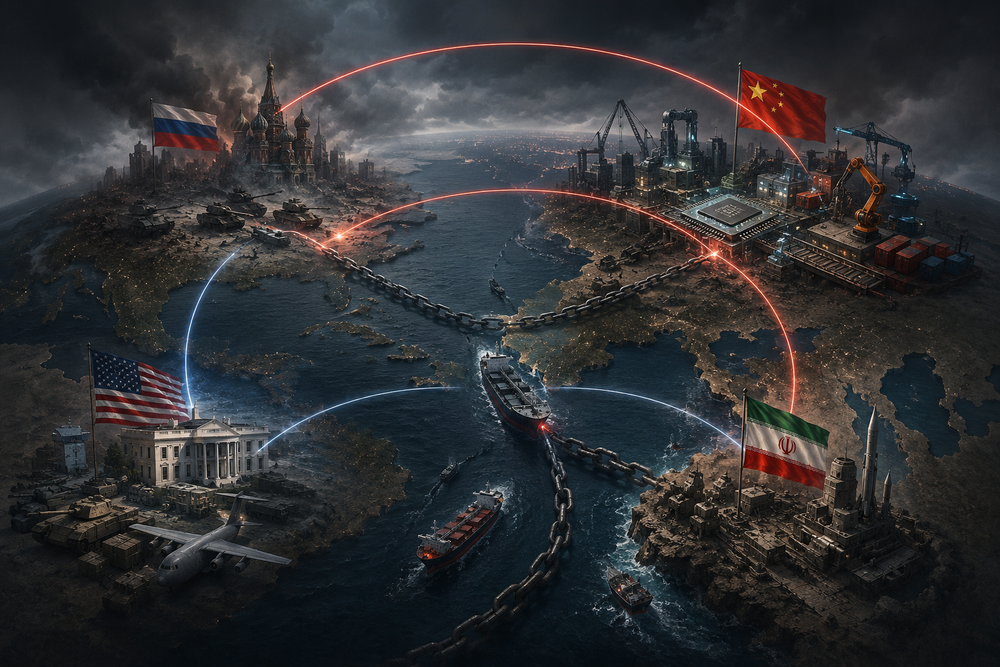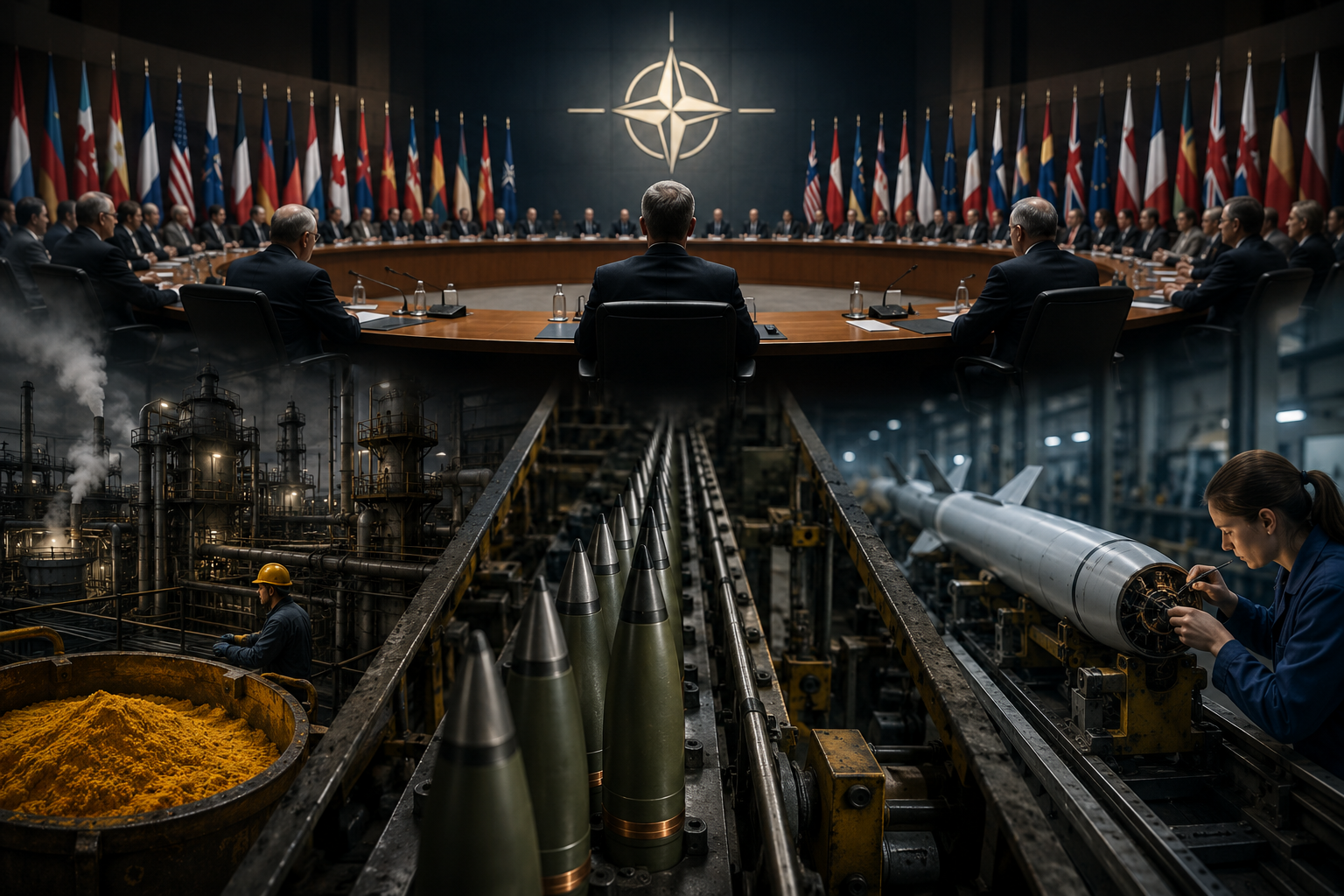
The most important number at this week's NATO summit was not in the declaration. The declaration, signed in Ankara on 8 July 2026, is built around numbers that sound like power: more than $139 billion in new core defence investment by European allies and Canada in 2025, more than $50 billion in new procurements announced at the summit itself, €70 billion pledged to Ukraine for 2026, $40 billion for a new drone initiative over five years, and behind all of it the master figure agreed at The Hague a year earlier, 5 percent of GDP by 2035. Those numbers describe money. The number that decides whether the money ever becomes deterrence is a different kind of number, and it appears in no communiqué: the European Union currently has one major factory producing military TNT.
That is the whole story, compressed. Everything that follows is the mechanism behind it.
The determining variable of the Western rearmament is not the size of the pledge. It is the rate at which pledged money can be converted into physical ammunition, and that rate is set by a short list of industrial facilities, chemical processes, and qualification timelines that no percentage of GDP can accelerate on command. A summit can vote a number in an afternoon. The afternoon does nothing to the factory.
The Summit That Measured Itself in Percentages
Read the Ankara declaration closely and notice what kind of object it is. Six paragraphs, and the load-bearing ones are denominated entirely in currency. Paragraph two records that allies "are delivering" on The Hague commitment and announces the $50 billion in new procurements, alongside a commitment to "expanding collective manufacturing capacity." Paragraph four pledges the €70 billion for Ukraine and affirms "at least equivalent levels in 2027." The 5 percent target itself, adopted at The Hague in 2025, splits into 3.5 percent of GDP for core defence and 1.5 percent for broader security-related investment, with annual plans and a review scheduled for 2029.
The architecture around the summit tells the same story in institutional form. NATO now carries a Defence Production Action Plan, agreed at Vilnius in 2023. It carries an Industrial Capacity Expansion Pledge, adopted at Washington in 2024. At Ankara it endorsed a Strategy for Industry-NATO Cooperation, complete with a "Front Door for Industry" so that companies can find their way into the alliance's procurement machinery. Secretary General Mark Rutte promised "tens of billions of dollars" in new defence contracts around the summit, and the American secretary of state called it one of the most important summits in NATO's history.
Even the summit's most forward-leaning initiative carries the tell. Drone Edge, the $40 billion, five-year uncrewed-systems program announced alongside the declaration, comes paired with a promise to increase the alliance's trained drone operators fivefold. Note the unit change. The money could be announced on a Tuesday. The operators are denominated in training pipelines, and pipelines are denominated in years, which is why that half of the announcement drew no headline: it is the half that cannot be rushed.
Four summits, four instruments, one direction: each year the alliance produces a new document committing itself to industrial capacity. There is a reading of that sequence in which the alliance is serious. There is a second reading in which an institution that keeps re-pledging the same thing is telling you, in its own administrative dialect, that the thing has not yet happened. Both readings are true at once, and the second one is the subject of this essay.
A summit output is measured in commitments. A war is measured in deliveries. The gap between those two units is where the next five years of European security will actually be decided.
The Rehearsal Nobody Cited in Ankara
The alliance has run this experiment before, recently, under battlefield pressure, with the results fully documented. In March 2023, the European Union pledged one million artillery shells to Ukraine within twelve months. The pledge was political, unanimous, and funded. By the deadline in March 2024, roughly 500,000 had been delivered. The EU's own chief diplomat, Josep Borrell, conceded in January of that year that just over half would arrive on time. The millionth shell was delivered in November 2024, eight months late.
Nothing about that failure involved a shortage of money. The money was appropriated at the start. What the twelve months exposed was everything money does not touch on a political timescale: production slots already sold to other customers, powder and explosives in short supply, and order books that run on years while pledges run on news cycles. An Estonian defence official put a number on it at the time: a new order for European 155mm shells took a year or more to come out of the pipe. An investigation by RFE/RL later found the EU's stated production capacity had been overstated outright, a paper number that industry could not match in metal.
The million-shell pledge is the Rosetta stone for reading Ankara, and it points in both directions at once. It proves the pledges are not empty: the shells did eventually arrive, and European production has since risen sharply. Rutte himself has put the increase at sixfold in two years, and projections now circulate of 2.8 to 3 million shells annually from Europe, the United Kingdom and Ukraine combined by the end of 2026, with Rheinmetall alone targeting 1.5 million a year by 2027. But it also proves the lag is structural, not accidental. The first million took twenty months instead of twelve under the highest political pressure the union has ever applied to an industrial question.
The pledge was kept. The deadline was not. In an artillery war, the deadline is the pledge.
The Fund That Could Not Be Spent Fast
If the million-shell pledge tested the mechanism at the level of a union, Germany tested it at the level of a single state, under the cleanest laboratory conditions the question will ever get. On 24 February 2022, the morning Russian columns crossed into Ukraine, the commander of the German army, Lieutenant General Alfons Mais, wrote in a public post that the army he had the honour to lead was standing "more or less blank." Three days later, Chancellor Olaf Scholz stood in the Bundestag and announced the Zeitenwende: a special fund of €100 billion, the Sondervermögen, to re-equip the Bundeswehr. By June 2022 the fund had been written into the constitution itself, with a two-thirds majority, ring-fenced beyond the reach of ordinary budget politics. It is difficult to imagine money more completely mobilized: appropriated, protected at constitutional rank, and backed by the largest political consensus of postwar German security policy.
Then the fund met the interval. The first flagship contract, 35 F-35 fighters for roughly €10 billion, was signed in December 2022; the first aircraft were scheduled to reach German soil around 2026 and 2027, half a decade after the speech. Orders had to move through the federal procurement office in Koblenz, an agency of thousands of staff bound by European tender law, requirement specifications, and appeal procedures that exist for good reasons and consume time regardless of the reasons. Germany crossed NATO's old 2 percent line in 2024, for the first time in roughly three decades, and by late that year the fund was, by the government's own accounting, essentially fully committed, which in Berlin promptly restarted the argument about what happens when it runs out. Committed, however, is a statement about contracts. It is not a statement about capability, and the distance between the two is measured in delivery years that no constitutional amendment shortened by a single day.
The Sondervermögen did not fail. It metabolized, at the only speed the system underneath it possesses. A pledge at constitutional rank turned out to convert no faster than an ordinary one, because the constitution can command the money and cannot command the production slot. That is the national-scale version of the law, and it is worth stating before the chemistry, because it removes the last comfortable explanation. The problem is not that pledges are insincere. Germany's was as sincere as law can make one. The problem is what pledges are made of.
The Chemistry Under the Arithmetic
Follow one shell backwards from the gun and the arithmetic of the summit starts to dissolve into chemistry. A 155mm shell is a steel body, a fuze, a propellant charge, and roughly ten kilograms of high explosive, most commonly TNT or a TNT-based composition. Steel bodies can be forged in many places; presses can be bought. The explosive is another matter. During the Cold War, Europe operated a network of TNT plants. One by one, in the long peace, they closed, consolidated, or converted, until the entire European Union retained a single major producer of military TNT: Nitro-Chem, in Bydgoszcz, Poland.
Sit with the asymmetry, because it is the exact shape of the mechanism this series exists to document. On one side: a fifty-billion-dollar procurement announcement, a seventy-billion-euro assistance pledge, a five-percent-of-GDP target for an alliance whose combined economy runs to more than fifty trillion dollars. On the other side: one plant, in one Polish city, whose output sets the ceiling on how many of the pledged shells can ever be filled. In March 2026, Nitro-Chem signed agreements to open a second production unit at Bydgoszcz, and Swedish and Polish firms have begun investing in new TNT capacity. Those are real responses. They are also, by their nature, slow ones: an explosives plant is a licensing case, a safety case, a chemical-engineering project and a workforce problem before it is a single gram of product. By one industry estimate circulating in European defence analysis, Russia's explosive output exceeds Europe's combined production by an order of magnitude. The estimate may be imprecise. The direction of it is not seriously disputed.
Beneath the TNT sits a second, quieter layer: nitrocellulose, the base of the propellant that throws the shell. European military demand is estimated at some 20,000 metric tons a year, and the supply chain behind it runs through cotton linters, of which roughly 70 percent come from China. China added dual-use export restrictions on precisely this category of material. The propellant that is supposed to power the West's rearmament is, at its agricultural root, partly a Chinese export decision.
The summit denominated the rearmament in percentages of GDP. The rearmament is denominated in nitrated chemistry. Only one of those two units can be created by a signature.
One Building in Huntsville
If the shell were the only case, the chemistry might be dismissed as a legacy problem, the kind of thing the new money will eventually pave over. So take the opposite end of the value chain, the most advanced and most politically protected munition in the Western arsenal: the PAC-3 MSE, the Patriot interceptor that every war of the past three years has turned into the scarcest commodity in air defence.
In January 2026, the Pentagon and Lockheed Martin signed a seven-year framework agreement to raise PAC-3 MSE production from roughly 600 missiles a year to 2,000 a year by 2030. The company delivered about 620 in 2025. The tripling is funded, contracted, and headlined. And it runs through a single point that almost no coverage of the deal mentioned: every PAC-3 MSE carries an active radar seeker, every seeker is built by Boeing, and Boeing builds them in one facility in Huntsville, Alabama, which delivered around 650 to 700 seekers in 2025. In April 2026 the Pentagon signed a further $4.7 billion arrangement aimed at roughly tripling seeker output. Until that physically happens, the ceiling on the West's most important interceptor is not the pledge, not the framework agreement, and not the money. It is the throughput of one building.
The pattern is identical at both ends of the spectrum, the dumbest shell and the smartest missile: a headline number describing intent, and underneath it a single facility describing reality. This is the same law this archive documented in June for the wars in Ukraine and the Middle East, where a $20,000 drone forces a $4 million interceptor into the sky, and in the AI economy, where a trillion-dollar buildout waits on memory factories in Korea. The domain changes. The law does not.
The law also explains why the crash programs keep surprising their own authors. A production line for energetic materials or radar seekers is not idle capacity waiting for demand. It is a qualification regime: every new plant, every new line, every second source must prove, over months and years of test production, that its output is chemically and electronically identical to the qualified article, because an interceptor that fails is worse than an interceptor that was never built. Qualification time is the part of the system that money cannot compress, and it is the part every summit communiqué silently assumes away.
The Price of Everyone Pledging at Once
There is a second consequence of fixed capacity, and it is quieter and stranger than the delivery lag. When thirty-two governments pledge money simultaneously against the same short list of factories, the money does not buy more shells. It buys more expensive shells. NATO's own most senior military officer, Admiral Rob Bauer, put the figure on the record in October 2023: the price of a single 155mm shell had risen from roughly €2,000 at the start of the full-scale invasion to about €8,000. A quadrupling, in twenty months, for an object whose steel, chemistry, and design did not change. What changed was the queue in front of the plants that make it. By 2024, Western European 155mm rounds were quoted anywhere from $5,000 to beyond $10,000 depending on type, and European producers were telling Brussels, in public, to hurry up with its funding decisions because their order books were filling with everyone else's pledges.
Follow what that does to the arithmetic the summit is built on. A defence budget that rises 50 percent while the shell price quadruples has not increased its deterrence; it has halved it, elegantly, in a way no communiqué will ever phrase that way. And the metric the alliance publishes cannot see the difference, because the metric is denominated in spending. Every euro of ammunition inflation counts toward the 5 percent exactly as if it were a euro of new capability. The measure of effort absorbs the failure of conversion and reports it as progress. A finance minister who pays four times the price for the same shell is, on the summit's own scoreboard, four times more committed to the alliance.
The mechanism has one more turn. Europe's ammunition industry, unlike America's government-owned plants, is commercial: states can place orders but cannot command investment, shifts, or new construction. A commercial producer looking at a wall of simultaneous political pledges faces a genuine question about how long the demand lasts, because the last generation of European ammunition makers was built up for the Cold War and then spent thirty years being consolidated into the small base that is now the bottleneck. Price is how the industry hedges a demand signal it does not yet trust. In that sense the €8,000 shell is not profiteering, or not only profiteering. It is the market's own estimate of the risk that the pledges are temporary, priced into every round. The pledges are not only racing Russia's conversion clock. They are racing each other for the same production slots, and bidding up the toll for everyone, and the toll itself is the market's measure of how much it believes the summits.
Scarcity does not just delay the pledge. It repriced it, and the metric cannot tell the difference.
The Miracle That Took Four Years
There is one episode the optimists are entitled to cite, and it deserves to be taken at full strength, because even the best case in the historical record confirms the interval instead of abolishing it. On 16 May 1940, six days after the German attack on France, President Franklin Roosevelt stood before Congress and called for American industry to produce 50,000 aircraft a year. The United States had built a few thousand military aircraft the year before. The speech is remembered as the founding act of the arsenal of democracy, and the arsenal is remembered as something that simply happened, as if the speech itself were the factory.
The factory had to be poured. At Willow Run, outside Detroit, Ford broke ground in the spring of 1941 on what became the largest factory floor in the world, built to mass-produce the B-24 Liberator bomber the way Ford produced cars. The first aircraft did not come off the line until October 1942, eighteen months later, and those early airframes needed so much hand-rework that Washington wits renamed the plant "Will It Run." The famous cadence, a bomber an hour, was not reached until 1944. That same year American industry delivered over 96,000 aircraft, nearly double Roosevelt's impossible number, and the miracle was real. It was also scheduled: four years from the speech to the peak, two years from ground-breaking to a functioning line, under conditions no European planner in 2026 can requisition. The United States converted the world's largest automobile industry by command, inside a single jurisdiction, with a War Production Board empowered to ban civilian car production outright, and a labor force that could be expanded by migration and by bringing millions of women onto the lines.
The fastest industrial conversion in recorded history is the floor of the interval, not the ceiling. Europe's rearmament operates across thirty-two jurisdictions, under peacetime procurement law, competing with civilian industry for the same engineers instead of confiscating their factories. Whoever cites the arsenal of democracy as reassurance has read only its ending. Its beginning says: even with total war powers, the conversion of money into materiel held its rate, and the rate was measured in years. The pattern that emerges across these cases is no longer a defense story. It is a physical constant of industrial civilization, and it binds every actor in the system, which is exactly why the next section changes sides.
The Adversary's Clock
Because if the law is real, it must hold in Moscow too, and it does. Measured in money, the war in Ukraine should not be close. NATO members together spend well over a trillion dollars a year on defence; Russia's military budget, converted at market rates, is a modest fraction of that. Yet by 2024, by widely cited Western and Ukrainian estimates, Russia was producing artillery ammunition at roughly three times the rate of the United States and Europe combined, around three million rounds a year against a Western total then nearer one million, and it was supplementing its own lines with imports from North Korea that South Korean and Ukrainian officials put in the millions of rounds. The estimates diverge, as estimates from a war always do. The asymmetry they describe does not.
The asymmetry is not made of money. It is made of time. Russia began converting its economy in 2022: factories onto multiple shifts, Soviet-era plants reactivated, a state prepared to spend a share of its budget on the war that no democracy matches in peacetime, and, where its own capacity fell short, imports first and licensed local production later, as with the Iranian-designed drones now built at scale on Russian soil. None of this required Russian industry to be better. It required Russian conversion to start earlier, and to run without the frictions that peacetime law correctly imposes on the other side. The Kremlin's advantage in this war is not a budget. It is a head start on the only clock that matters.
That reframes what the Ankara percentages are actually competing against. The alliance publishes its rearmament in units of 2035. Its adversary has been converting since 2022. Deterrence is not a comparison of budgets. It is a race between conversion clocks, and one side's clock started three years before the other side agreed on a number. The declaration's own fifth paragraph, calling on Iran to respect navigation in Hormuz, quietly concedes the score: an alliance whose interceptor stockpiles are being drawn down by cheap drones in two theatres is living, right now, inside the interval its communiqués do not price.
Why Money Cannot Buy Time
The deeper mechanism deserves to be stated plainly, because it is the portable part of this essay. Money is the most fungible object civilization has produced. It converts into anything, which is why political systems love to promise it. But conversion has a rate, and the rate is set by the physical world: permitting, construction, chemistry, tooling, and above all people. Industry's own rule of thumb, cited throughout the European ramp-up, is that a new ammunition factory takes two to three years to stand up, and that is the fast part, the concrete and the machines. The slow part walks on two legs. Europe's ammunition makers and America's missile primes are competing for the same finite pool of energetic-materials chemists, welders certified for pressure vessels, and production engineers who have actually run a live line. That pool was sized by thirty years of peace. It cannot be resized by a fiscal year.
Consider what the pool actually consists of. A person who is allowed to work unsupervised with nitration chemistry or to sign off a filled shell is not a hire; she is the output of a training pipeline measured in years, run by the same firms that are simultaneously trying to triple production, inside labour markets where the civilian economy bids for the same engineers with better hours and no explosion risk. Rheinmetall's expansion is as much a recruitment operation as a construction project, and every new plant announced in Sweden, Poland, or Germany draws its first shift leaders from the small cadre who already know the work, which means the existing lines pay for the new ones twice, once in capital and once in people. Machine tools tell the same story one layer down: the presses and forging lines that shape shell bodies come from a handful of specialist builders with their own multi-year order books, so even the factories that will relieve the bottleneck stand in a queue behind it.
This is why the sequence of NATO's own instruments is so revealing. The Defence Production Action Plan of 2023 promised aggregated demand. The Industrial Capacity Expansion Pledge of 2024 promised expanded capacity. The Ankara strategy of 2026 promises industry a front door. Each document is rational. Each is also an admission that the previous document did not, by itself, change the physics. An alliance does not need three consecutive industrial pledges for a thing that is happening on its own schedule.
A pledge can be signed in an afternoon. A pledge can be audited by accountants. A pledge can be defended in a parliament and traded at a summit. A production line can only be built, and built in the one currency no central bank issues, which is years.
None of this makes the money meaningless. Money is the demand signal, and industry has said for a decade that it would not invest against communiqués, only against contracts. The $50 billion in Ankara procurements, the seven-year Lockheed framework, the Nitro-Chem expansion: these are contracts, and contracts are what turn a pledge into a construction site. The point is narrower and harder: between the contract and the capability sits a fixed interval, and every plan that prices the interval at zero is not a plan but a press release.
What a Percentage Actually Does
So what work does the 5 percent actually perform, if it cannot buy time? Here the analysis has to be marked clearly as interpretation, because intent is not documented the way chemistry is. The percentage performs three functions, and none of them is industrial.
First, it is auditable politics. GDP shares can be measured annually, published in a table, and used to discipline allies, which is exactly how the old 2 percent target functioned for a decade. A capability, by contrast, is hard to audit: how many days of fires does the alliance hold, at what consumption rate, against which scenario? Those numbers exist, but they are classified, contested, and immune to a summit table. The alliance measures spending because spending is what it can measure. The metric is chosen for its legibility, not for its correlation with deterrence.
Second, the percentage is elastic in precisely the way capacity is not. The 5 percent includes a 1.5 percent tranche for "defence and security-related" investment: infrastructure, resilience, cyber, civil preparedness. Governments under fiscal strain will discover that bridges, ports, and broadband were security-related all along. A finance ministry can reach 5 percent through reclassification without commissioning a single new production line. The percentage can be satisfied on paper. The shell cannot.
Third, and most structurally, the pledge transfers the appearance of action from the part of the system that is slow to the part that is fast. Announcing money is fast and belongs to politicians. Building capacity is slow and belongs to engineers. A summit that announces $50 billion has produced, that day, nothing but the announcement, yet the announcement is treated as the event.
The purest version of that contrast is already on the record, in the form of two signatures four months apart. In March 2026, in Bydgoszcz, Nitro-Chem's chief executive Arkadiusz Miszuk signed the agreements for a second TNT production unit at the only plant of its kind left in the European Union, and said, in the flat dialect of a man who runs nitration lines for a living, that it "will allow us to efficiently respond to these needs while strengthening Poland's security and industrial independence." No heads of state attended. In July 2026, in Ankara, thirty-two leaders signed a declaration, and the world's cameras counted the billions. The first signature adds explosive to the world. The second adds a document about it. Only one of them made the evening news, and it was not the one that changes what a shell can be filled with. The comfortable conclusion available here is that the leaders are lying, that the whole apparatus is theatre. That conclusion is not the one the evidence supports, and it is not the one this essay draws. The evidence supports something less cinematic and more consequential: two honest clocks running at different speeds, a political clock that ticks in summits and an industrial clock that ticks in qualification cycles, with the entire public conversation reading only the faster one.
What the percentage promises, only the plant can deliver. What the plant delivers, no percentage can promise.
The Honest Objection
The strongest counterargument to this reading does not dispute the documentary record. It accepts the single TNT plant, the seeker line, the eight-month slip on the million shells, and answers: look at the trajectory, not the snapshot. European shell production up sixfold in two years is, by any historical standard, a violent industrial acceleration. The million shells did arrive. Nitro-Chem is adding a unit, Sweden and Poland are investing in TNT, the Pentagon is paying to triple seeker output, and Rheinmetall's expansion is running ahead of its own announcements. On this view, the pledges are doing exactly what pledges are for: creating the multi-year demand certainty against which private capital builds factories. The lag is not a flaw in the system. The lag is the system working, and 2023 to 2026 is simply what the front end of a rearmament looks like from inside. Willow Run, on this reading, is the encouraging precedent, not the cautionary one: the plant that was mocked as "Will It Run" in 1942 buried the Luftwaffe in 1944, and Europe may simply be living through its own 1942.
This counterargument is structurally serious, and it explains most of the data. The reading offered here does not claim the rearmament is fake, nor that money fails to build capacity eventually. It claims something narrower: that in the interval during which deterrence must actually hold, the binding variable is existing capacity plus qualification time, not appropriated money, and that the alliance's public metric, a GDP percentage, does not measure the binding variable at all. The two readings can both be true. The optimist describes where the system is going. This essay describes what decides whether it arrives in time, and who is watching the wrong dial while it does.
The claim is falsifiable, and it should be held to that. If European production reaches the projected three million shells in 2026 on schedule, if PAC-3 deliveries track the new framework's curve without the seeker line binding, and if TNT and nitrocellulose supply expand fast enough that neither appears again as the named constraint in industry reporting through 2027, then money bought capacity at the pledged tempo, the interval priced itself at nearly zero, and the mechanism described here would not apply to this rearmament. That evidence would be visible within eighteen months. Watch for it.
The Two Clocks
Return to the declaration one last time. Six paragraphs signed in Ankara. One pledges the €70 billion. One announces the $50 billion. The document accounts for every actor with a budget: the allies who will spend, the industries who will receive, the partner who will be armed, the adversary who is warned.
It does not account for the interval. No paragraph names the twenty months of the million-shell pledge, the one plant in Bydgoszcz, the one building in Huntsville, the cotton linters from China, or the years of qualification that stand between paragraph two's money and paragraph two's capability. The interval has no constituency, no summit, and no communiqué. It is governed by nobody, which is precisely why it governs.
The breakthrough got the summit. The bottleneck got a second production unit in Bydgoszcz, announced without a press conference, four months before the leaders met.
One of those two events will decide whether the 5 percent was ever real. It is not the one the world watched this week.
Summits announce power. Chemistry schedules it.
Evidence Map
Facts, interpretations, forecasts, and disconfirming signals.
Core claim. NATO's rearmament is publicly measured in money (5% of GDP, $50B procurements, €70B for Ukraine), but its binding variable is industrial conversion capacity, exemplified by the EU's single military TNT plant (Nitro-Chem, Bydgoszcz), Europe's nitrocellulose import dependence, and the single PAC-3 seeker facility in Huntsville.
Evidence level. Facts: high. The Ankara declaration text, The Hague 5% structure, the EU million-shell timeline (pledged 3/2023, ~500k by 3/2024, completed 11/2024), the German Sondervermögen timeline (announced 27/2/2022, constitutional June 2022, F-35 contract 12/2022 with deliveries from ~2026, 2% reached 2024), the Willow Run chronology (ground broken 1941, first B-24 October 1942, bomber-an-hour 1944), the Nitro-Chem monopoly and expansion, and the Lockheed 600-to-2,000 framework with the Boeing seeker constraint are documented in official texts, archives, and industry reporting. Interpretation: marked. The three political functions of the percentage metric (auditability, elasticity, appearance-transfer) and the "conversion clock" reading of Russia's advantage are analysis, not documented intent. Russian production figures and North Korean shell volumes are wartime estimates and are cited as such; Russia's "twelvefold" explosive advantage is a single-source industry estimate.
What would confirm this. TNT, propellant, or seeker capacity named as the binding constraint in 2026-2027 delivery shortfalls; the 1.5% tranche filled by reclassified civilian spending; a widening gap between appropriated and delivered totals; continued munition price inflation (the Bauer benchmark: €2,000 to €8,000 per 155mm shell, 2022-2023) absorbing new spending without adding volume.
What would disprove this. European shell output reaching ~3M in 2026 on schedule; PAC-3 deliveries tracking the framework curve; TNT and nitrocellulose disappearing as named constraints through 2027.
Watchlist. Nitro-Chem unit-two construction milestones; Boeing seeker output; the 2029 NATO spending review; EU nitrocellulose sourcing decisions; the ratio of announced to delivered Ukraine assistance through 2027.
Related from The Manifest Archive
- Everyone Is Watching the Interceptor They All Run Out Of
- Everyone Is Watching the Ukraine Aid Vote. Nobody Is Watching the Shell Lines.
- Everyone Is Watching NATO's Troops. Nobody Is Watching the Railway to the Baltics.
- The Memory Wall Decides the AI Boom
Jerry van der Laan writes The Manifest Archive, where he examines power, history, and institutions. He traces the structures beneath them.