There is a comforting myth at the heart of almost every analysis of power.
It says that the one who describes the system stands apart from it.
That insight creates distance.
That understanding offers an exit.
This Manifest has lived with that myth longer than it should have.
Not because it believed it.
But because it had not yet named what replaces it.
Understanding how power functions does not free you from it.
It binds you to it with open eyes.
There is no outside position.
The Illusion of the Vantage Point
Power is often written about as if it were a landscape observed from above.
Institutions mapped. Families traced. Incentives exposed. Continuities revealed.
The analyst remains clean.
This posture is seductive. It allows clarity without consequence. It suggests that seeing is neutral, that naming mechanisms is already resistance, that understanding itself creates distance.
It does not.
The moment you see how power actually functions, you do not step out of the system.
You recognise where you already stand.
You still wake up inside institutions you now understand.
You still earn a living within structures whose incentives you can now predict.
You still speak a language shaped by norms you no longer mistake for truth.
Nothing dissolves.
Only the insulation does.
Writing From Within
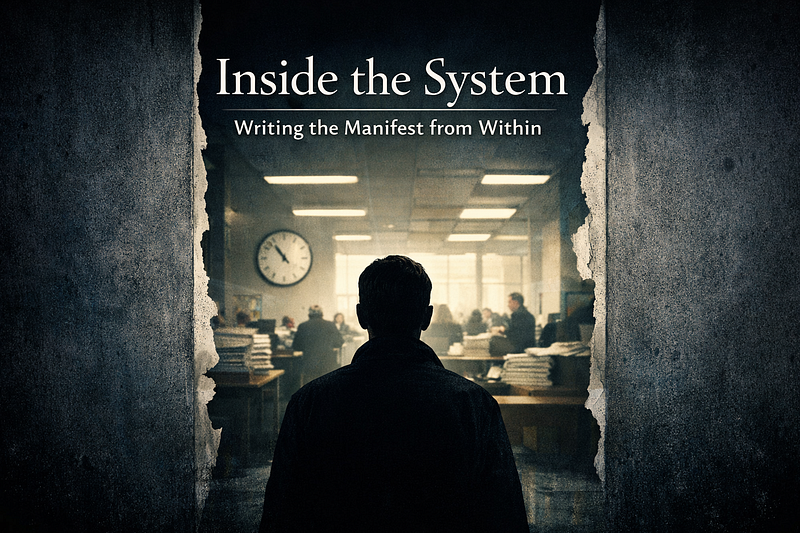
The Manifest is not written from a mountain, an exile, or a parallel world.
It is written on platforms governed by the same attention economies it critiques, in language shaped by academic, legal and bureaucratic filters, for readers embedded in ministries, corporations, universities, media, and NGOs.
This is not a flaw.
It is the condition.
To write clearly about power is not to float above it.
It is to occupy a position where awareness collides with constraint.
The writer of the Manifest is not an outsider.
He is a functioning component who has become conscious.
That consciousness comes without instructions.
Knowledge Without a Lever
Much of modern knowledge is instrumental. It optimises. It promises application.
This knowledge does not.
It explains why competent people are filtered out before decision-making power.
Why institutions survive repeated failure without correction.
Why responsibility dissolves across committees and mandates.
Why good intentions reliably produce destructive outcomes.
But it does not tell you how to act in the next meeting, when speaking becomes naïveté, when silence becomes complicity, or how to intervene without being absorbed or removed.
This is not a manual.
It is structural awareness.
And structural awareness does not translate into action.
It translates into tension.
The Psychological Price of Seeing
This tension has a cost.
To see the system clearly while remaining inside it produces restraint without relief, responsibility without authority, clarity without resolution.
You hesitate where others simplify.
You slow down where others accelerate.
You recognise damage long before it is visible, but too early to be acknowledged.
You are no longer naïve enough to believe the process works as advertised.
But not positioned to redesign it.
This is not indecision.
It is lucidity colliding with limited agency.
Many retreat.
Some return to belief.
Some adopt irony.
Some surrender to pragmatism.
Some leave quietly.
A smaller number stay exposed.
Living With the Knowledge
After recognition settles, life resumes.
Emails.
Meetings.
Documents.
Decisions.
Nothing changes on the surface.
Internally, everything acquires weight.
You hear phrases you once used yourself.
Best practice.
Stakeholder alignment.
Risk mitigation.
Process integrity.
You now hear what they do.
They are not lies.
They are compression algorithms.
They reduce complexity into something manageable, survivable, defensible.
Once heard, they cannot be unheard.
Every document becomes a negotiation between truth and viability.
Every decision a compromise between consequence and continuity.
You begin to edit sentences before speaking them.
Not out of fear, but accuracy.
This is not paranoia.
It is pattern recognition.
The Loneliness of Precision
The more precisely you understand the system, the harder communication becomes.
Simplification is rewarded.
Accuracy is tolerated only if it does not obstruct flow.
Being right too early is indistinguishable from being wrong.
Naming structural problems reads as negativity.
Foresight is valued only after damage occurs.
So you become selective.
You stop correcting everything.
You stop naming every contradiction.
You learn when silence preserves more than speech.
From the outside, this looks like conformity.
From the inside, it feels like triage.
You are not disengaged.
You are selective.
Why Most People Turn Away
People do not avoid structural insight because it is dangerous.
They avoid it because it is existentially inconvenient.
Understanding how power functions rarely empowers.
It produces responsibility without authority, clarity without leverage.
Once you see how outcomes emerge without villains, how harm arises without intent, how systems prioritise continuity over correction, moral distance disappears.
Turning away is not ignorance.
It is self-preservation.
Time as the Quiet Instrument of Power
Power is rarely described as control over time.
It should be.
Urgency is produced.
Deadlines compress thought.
Roadmaps replace deliberation.
Once time is framed as scarce, questioning becomes delay.
Delay becomes irresponsibility.
Irresponsibility becomes moral failure.
This is not coercion.
It is temporal framing.
Speed does what censorship does not need to.
The Body as the First Site of Compliance
Before power is understood, it is felt.
Deadlines tighten the chest.
Permanent urgency shortens breath.
Uncertainty settles in the gut.
This is not metaphor.
It is physiology.
The body remains in low-grade readiness.
Productive.
Unsustainable.
Clarity removes defences, not pressure.
You carry understanding at a tempo that violates comprehension.
This mismatch settles somatically.
In fatigue.
In tension.
In weight.
When Knowledge Is Filtered for Safety
Medicine reveals this pattern with brutal clarity.
Researchers live with uncertainty.
Clinicians work with protocols.
Policy makers see populations.
Industry sees feasibility.
The citizen receives reassurance and instruction.
Knowledge is not hidden.
It is segmented.
Uncertainty does not scale well.
Nuance slows coordination.
So complexity is filtered.
Not maliciously.
Operationally.
Over time, protection becomes distance.
Distrust emerges without a villain.
Language as a Boundary
Language does not only describe.
It organises response.
Once spoken, insight is simplified, moralised, instrumentalised.
This is why many who see clearly become careful speakers.
Silence here is not fear.
It is restraint.
Some truths collapse when spoken too early.
Writing slows language down.
It allows ambiguity to remain intact.
This is why some things can only be written.
When Clarity Becomes Beautiful
There is a final risk.
Insight, when well formed, can soothe.
Understanding becomes elegant.
Readable.
Contained.
Clarity can anesthetise.
This is not manipulation.
It is the unintended consequence of articulation.
The Manifest is not immune.
Which is why it refuses resolution.
No Final Position
There is no conclusion here.
No reassurance.
No instruction.
No call to action.
What remains is orientation.
You recognise pressure without mistaking it for command.
You notice urgency without surrendering to it.
This does not make you free.
It makes you present.
There is no outside position.
Only the difference between looking away
and looking clearly
without forcing anyone else to follow.
The text ends.
The seeing does not.
Related from The Manifest Archive