What we are living through today is not called war.
But it reaches into daily life as if it were.
You do not see soldiers in the streets.
You see it on your energy bill.
In groceries that never return to old prices.
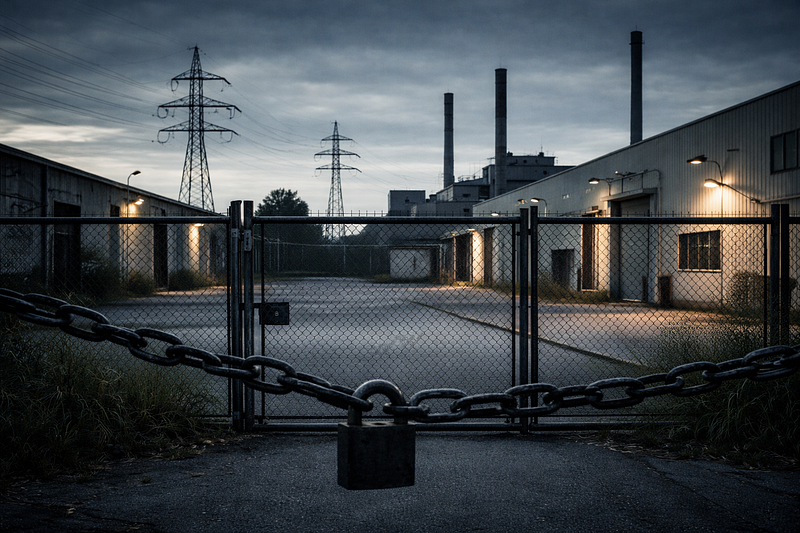
In factories that quietly shut down.
In jobs that are “relocated.”
In purchasing power that erodes without recovery.
These are not side effects.
This is the effect.
A New Kind of Conflict, Already Normalised
Over the past few years, something fundamental has changed.
It has become possible to damage entire economies
without firing a single shot,
without declaring war,
without even naming an enemy.
Energy flows can be redirected.
Financial reserves can be frozen.
Trade can be selectively interrupted.
Technology access can be revoked by policy.
All of this happens openly.
Through press conferences.
Through legal frameworks.
Through “packages” and “measures.”
And it does not only affect governments.
It affects households, workers, businesses, regions.
It affects you.
Yet almost no one calls this war.
Because in our imagination, war still looks different.
Why We Fail to Recognise It
War, in our collective memory, has tanks.
Front lines.
Declarations.
Clear beginnings and endings.
What we are experiencing has spreadsheets.
Compliance departments.
Sanctions regimes.
Administrative language.
But the outcome is familiar:
less freedom of action,
more uncertainty,
long-term structural damage.
The absence of bombs does not mean the absence of conflict.
It only means the conflict has learned to operate without spectacle.
That is not an accident.
It is a design choice.
An Old Book That Was Never About Soldiers
More than two thousand years ago, a Chinese general and strategist wrote a short text about conflict and power.
His name was Sun Tzu.
The book is called The Art of War.
It was not written for soldiers on the battlefield.
It was written for those who decide.
For people who understand that you do not need to destroy an opponent
if you can change the conditions under which he is allowed to function.
Sun Tzu did not define war as violence.
He defined it as the management of conditions.
The ideal victory, in his view, was one that did not look like victory at all.
Because by the time the opponent realised what had happened,
his options were already gone.
When Conditions Become the Battlefield
Look again at the present.
Industries collapse not because they are bombed,
but because energy prices make production impossible.
Countries weaken not because they are invaded,
but because access to finance and trade is selectively denied.
Societies fracture not because of open attack,
but because economic pressure redistributes pain unevenly.
Nothing here is hidden.
Nothing here is illegal.
Nothing here requires secrecy.
That is precisely why it works.
The battlefield is no longer territory.
It is dependency.
Why This Book Never Left the Centers of Power
The Art of War did not survive because it is admired.
It survived because it is used.
Most books become historical when the world outgrows their assumptions.
Sun Tzu’s text never relied on weapons, borders, or technology.
It relied on something far more stable: how power behaves when it wants results without resistance.
That is why the book quietly migrated away from the battlefield.
Modern soldiers are trained on doctrine, logistics, and rules of engagement.
Sun Tzu is too abstract for that level.
Too indirect.
Too unconcerned with heroics.
But abstraction is exactly what makes the book indispensable elsewhere.
It is read by people who do not fight wars,
but design the environments in which wars become unnecessary.
Strategic planners who think in dependencies rather than offensives.
Intelligence services where success means influence without attribution.
Economic institutions where pressure must remain deniable.
Corporate strategists where destroying a competitor is less effective than making their position untenable.
In these domains, visibility is a liability.
Attribution creates resistance.
Open confrontation invites counter-mobilisation.
Sun Tzu’s relevance begins precisely where force becomes inefficient.
From Battlefield to Balance Sheet
What Sun Tzu described as warfare has long since crossed into economics.
Markets, supply chains, currencies, energy flows and standards now function as terrain.
Access replaces territory.
Liquidity replaces firepower.
Compliance replaces occupation.
A factory closing due to energy costs does not look like an attack.
A frozen reserve does not resemble a bomb.
A currency collapse does not resemble a siege.
Yet the strategic effect is comparable.
The opponent adapts, contracts, reallocates, weakens.
Not because he was defeated,
but because the space in which he could act was quietly reduced.
This is not collateral damage.
It is the mechanism.
Intelligence Without a Flag
Sun Tzu assumed that the most effective operation
is one whose author remains invisible.
Modern intelligence is not primarily about secrets.
It is about shaping perception, timing, and dependency
while avoiding attribution.
Confusion is not chaos.
It is controlled ambiguity.
When decisions are framed as technical,
when responsibility dissolves into procedure,
when consequences appear delayed and statistical,
resistance arrives too late.
No single threshold is crossed.
No declaration is made.
The opponent reacts inside a framework he did not design.
Sun Tzu would have recognised this immediately.
Morality Arrives After the Damage
Sun Tzu wrote little about morality.
Not because he lacked ethics,
but because morality does not win conflicts.
Morality always arrives after the structure is in place.
That pattern is unmistakable today.
Values are invoked once prices rise.
Principles are emphasised once industries disappear.
Ethics are discussed once living standards shift.
This is why the cost appears first on household bills,
not on battlefields.
Sanctions are not called weapons.
Yet they reshape societies.
Energy policy is not called aggression.
Yet it determines who can produce and who cannot.
This is not judgment.
It is observation.
When Peace Becomes an Administrative Term
We call our era peaceful because there is no declared war.
But the absence of declaration is not the absence of conflict.
Sun Tzu would not have called this peace.
He would have called it stability under conditions.
Conditional trade.
Conditional energy.
Conditional prosperity.
A form of control that functions precisely because it is not recognised as such.
The Break That Cannot Be Closed
If a text written over two thousand years ago
can be placed next to our present
without forcing interpretation,
without updating concepts,
without strain,
then this is not just about Sun Tzu.
It is about us.
About how we define war.
About how we define peace.
About how much damage we accept
as long as it arrives quietly.
This is not an argument.
Not a warning.
Not a theory.
It is a recognition.
That conflict has become so effective
that it no longer needs a name.
And that may be the most successful evolution of war we have ever witnessed.
When conflict no longer announces itself,
it does not disappear.
It simply becomes harder to see,
and easier to live inside without consent.
Related from The Manifest Archive