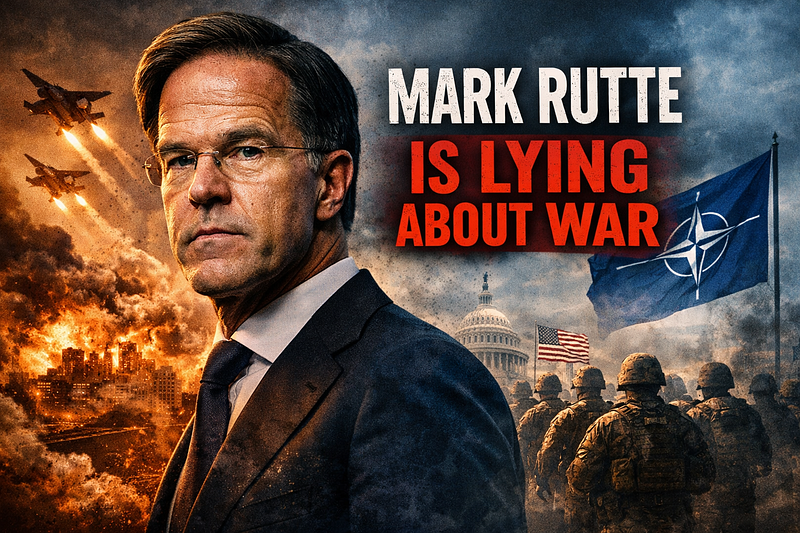
From Ukraine to Iran, the NATO Secretary General is not merely describing reality. He is reshaping it, in ways that make escalation easier to accept.
Mark Rutte is lying about war.
That is not a dramatic flourish, and it is worth slowing down on the word before defending it, because the accusation is heavier than it looks and the Manifest does not reach for it lightly. To call a statement a lie is to claim something about the speaker's mind, and the inside of another man's mind is the one place no investigation can go. So set the word aside for a moment and look only at what can be checked: the gap between what Rutte says about war and what the documented record shows. That gap is measurable. It recurs. And it always opens in the same direction. Whether you choose to call the pattern a lie or something more clinical, the function is identical, and the function is the subject of this chapter.
Shortly after the United States struck Iran in 2026, Rutte went on American television and praised the operation in the warmest terms. He described the allies as standing "all for one, one for all." He said the American president was making the world safer. He credited that president personally, declaring that without the present administration in Washington the alliance would never have reached its new commitment to spend five percent of national income on defence. The performance was one of unity, gratitude, and shared resolve.
The documented reality was not unity. It was division, and the division was specific enough to name. Several European governments said openly that they had not been properly consulted before the strikes, learning the scale of the operation from the news rather than from the alliance. Several NATO members refused to open their airspace to American military aircraft moving toward the theatre. Several declined to send naval forces to help reopen the Strait of Hormuz when the strait became the next crisis. These were not private grumbles. They were public acts of refusal, recorded at the time, by governments that had decided the risk was not theirs to share. The continent that Rutte described as standing all for one was, in the same week, fractured, hesitant, and in places openly resistant.
Hold the two sentences next to each other, because the whole chapter is in the gap between them. "All for one, one for all," said the man whose job is to know the real state of the alliance, in the same days that members of that alliance were closing their airspace and keeping their ships in port. This is not a subtle discrepancy that requires an analyst to surface. It is the difference between a description and its opposite, delivered by the one person least able to claim he did not know.
This is not a question of interpretation. If Europe was divided, then "all for one, one for all" was not diplomatic packaging or a harmless simplification. It was a description of a reality that did not exist, offered by the one official whose entire job is to know the real state of the alliance. And that matters more in this domain than in any other, because war is the one field in which a falsehood does not stay a falsehood for long. It becomes pressure. It becomes atmosphere. It becomes the soft preparation of consent.
Is this the language of a peacekeeper? That question should never have to be asked of a NATO Secretary General. A man in that office is supposed to reduce danger, preserve trust between allies, and protect the political space in which diplomacy can still function. He is supposed to speak with more precision, not less. With more restraint, not less. With a stronger allegiance to the verifiable, precisely when the stakes climb. Instead, what Europe increasingly gets is something else. Not an incident. A pattern.
This is not an incident
The Iran statement matters not only because it diverged from the record. It matters because it was familiar.
Across multiple dossiers, over multiple years, the same movement keeps returning. Reality is softened at the edges. Division is presented as unity. Pressure is repackaged as necessity. Escalation is described in the calm vocabulary of seriousness and duty. Then, later, after the pressure has done its work, a fuller and less convenient version of events begins to appear. Not always with the same stakes. Not always in the same form. But always with the same underlying instinct: the account becomes more flexible precisely when power needs more room.
That instinct was already corrosive in domestic politics, where its consequences were measured in careers and commissions. Around war, it becomes something else, because war does not tolerate distortion. It magnifies it. A misdescription that would cost a minister an awkward press conference in peacetime can, in wartime, narrow the space for de-escalation before anyone has noticed the space closing.
This is the heart of the empirical case, and it is deliberately narrow. The Manifest is not claiming to read Rutte's intentions. It is documenting that his public statements about war repeatedly fail to match the verifiable record, that the failures are not random but directional, and that the direction is always the one that makes escalation easier and dissent smaller. You do not need to prove a motive to establish a pattern. You only need the statements and the record, side by side, enough times that coincidence stops being a serious explanation.
The claim that manufactures what it describes
There is a particular reason a false statement about unity is more dangerous than a false statement about almost anything else, and it is worth isolating, because it explains why "broad support" is not just an error but an instrument.
A claim about the weather does not change the weather. A claim about unity changes unity. When the most senior figure in the alliance announces that support is broad and the line is firm, he is not only describing the room. He is instructing it. Every government that privately harboured a doubt now has to weigh that doubt against an official reality in which everyone else has supposedly already agreed. The political scientists have a name for the dynamic: a spiral of silence, in which people who believe themselves to be in a minority fall quiet, which makes the apparent majority look larger, which silences the next layer of doubters in turn. A declaration of consensus, repeated with enough authority, manufactures a version of the consensus it claims to be reporting.
This is why the gap between the statement and the record is not a private matter between Rutte and the truth. The statement reaches into the record and bends it. The airspace refusals and the naval reluctance were the visible residue of a division that, in a more honest information environment, might have grown into an actual debate about whether the strikes were wise. "All for one" did not describe that debate out of existence. It helped to close it before it could open, by telling every hesitant capital that hesitation was a minority position and therefore a slightly embarrassing one. A false description of unity is a tool for producing the real thing, and the tool works best precisely when the underlying reality is most divided, because that is when the public most needs to know the division exists.
Three roads to the same finding
One mismatch could be an accident. The strength of the empirical case comes from the fact that the same gap opens by several independent routes, on different subjects, each pointing the same way. Convergence, not any single quote, is the evidence.
The first road is the one already walked: the claim of unity over Iran, set against the documented refusals. The second is the claim of impossibility over European defence. When Rutte told the European Parliament that a Europe defending itself without the United States should "keep on dreaming," he presented a contested political question, how much capacity Europe could build and how fast, as a settled fact of nature. It is not a settled fact. It is a matter of spending, time, and will, on which serious people disagree, as the immediate pushback from French and EU figures demonstrated. Presenting a choice as an impossibility is the same move as presenting a division as a unity: a contestable reality is delivered as a closed one, and the closure always runs in the direction of less European autonomy and more alignment.
The third road is the claim of authorship over the alliance's strength. At Davos, Rutte credited a single foreign leader with the alliance being, in his words, stronger than it had ever been, and with forcing Europe to act. This is a claim about cause, and like the others it converts a complex, contested reality, the many pressures that moved European defence spending, into a clean and closed story in which the direction Rutte favours is the only one that produced results. Three subjects: unity, capacity, cause. Three statements. Each one takes something genuinely open and reports it as closed, and each closure points the same way. That is not three errors. That is a method visible from three angles.
How a gap about war does its work
A false or inflated claim about war does not remain rhetorical. It changes the political climate in which decisions are absorbed.
If the public is told there is broad support, resistance feels smaller. If allies are told the line is unified, hesitation feels marginal and a little shameful. If escalation is wrapped in the language of safety, risk begins to feel responsible, even mature. This is why the Iran statement is not a loose media problem but a structural one. A misstatement in wartime does not merely misdescribe reality. It reorganises the moral field around reality. It narrows the debate before the debate can properly begin.
That is what makes such language dangerous. Not because it sounds impolite. Because it makes escalation easier to absorb, and a continent that absorbs escalation easily is a continent that has lost one of its few defences against sliding into a war no one chose. The gap between the statement and the record is not a matter of honesty in the abstract. It is a matter of how much room remains for the public to object while objection still changes anything.
History is unkind to the idea that this is harmless. The catastrophes of the modern era were rarely launched by open argument over whether to fight. They were eased into being by men who described the fighting as already agreed, the support as already broad, the alternative as already exhausted, so that by the time the public understood a decision was being made, the decision wore the costume of a fact. A claim that escalation enjoys broad support does not merely report a political mood. It manufactures the permission slip that the next, harder step will cite. Each statement of consensus becomes the cited precedent for the move that follows it, and a chain of such citations can carry a continent a very long way while every individual link looks like nothing more than a man describing the room he is standing in.
The same method appears over Ukraine and the Atlantic
Iran is the sharpest recent example. It is not the first. The same instinct appears in Rutte's rhetoric on Ukraine and on Europe's relationship with the United States, and there the documented quotes are unusually clear.
Speaking to the European Parliament's defence committee in January 2026, Rutte told the continent that anyone who believed Europe could defend itself without the United States should "keep on dreaming." The sentence did more than describe a dependence. It froze it. It closed off political imagination before that imagination could become strategy. It told Europe that there was no serious adulthood outside continued reliance on the Atlantic hierarchy, and it did so not as an invitation to think but as an instruction to stop.
What makes the line so bitter is that it turned Europe's dependence into doctrine at the exact moment Washington was turning that dependence into leverage. Rutte mocked the idea of European strategic independence just as American reliability was becoming more conditional, more transactional, and more openly tied to obedience. That is not the language of strategic maturity. It is the language of managed submission, and it did not go unanswered. France's foreign minister replied that Europeans could and must take charge of their own security. A former president of the European Council answered, with a bluntness rare in that world, that Europe would defend itself and that the American president was not his father. The pushback was real. It also arrived after the sentence had already done its work.
Then there is the credit. At Davos in January 2026, Rutte declared that fundamentally, thanks to the American president, the alliance was stronger than it had ever been. He told the room he was not popular for defending the man, but that Europe should be glad he was there because he had forced the continent to take on more of its own defence. Read alongside the Iran praise and the "keep on dreaming" line, these statements expose a consistent function. Pressure is reframed as leadership. Dependence is reframed as realism. Alignment is reframed as necessity. One geopolitical direction is presented as the only serious one, one hierarchy as the only realistic one, one path of escalation as the mark of political maturity. The Iran misstatement is not an outlier in this system. It is the system applied to a single afternoon.
The older pattern beneath the present one
What makes the current moment serious is that this style did not begin with war. It was already there, fully formed, in domestic politics, where the stakes were lower and the mechanism therefore easier to see in isolation. Think of the Dutch years as the controlled experiment and the NATO years as the same reaction run at scale. In the laboratory of national politics, with no adversary and no missiles, the reflex could be observed cleanly: the account protected, the inconvenient record allowed to vanish, the question shifted from what happened to what was intended. The war version is not a new behaviour. It is the laboratory result released into a setting where the cost of the behaviour is measured in something other than parliamentary embarrassment.
Consider the Omtzigt affair. During the 2021 coalition negotiations in the Netherlands, Rutte stated flatly that the troublesome member of parliament Pieter Omtzigt had not been discussed. The denial was clean and total. Then came one of those accidents that occasionally lift the lid off a process: a press photographer with a long lens captured a departing negotiator carrying a sheaf of briefing notes, held just carelessly enough to be legible in the enlargement, and on the page was a line about Omtzigt and a "position elsewhere." The document existed. The conversation it recorded had, therefore, happened. Confronted with the photograph, Rutte revised his account. The discussion had taken place after all, he conceded, but he did not remember that part of it.
Trace the three stages, because they recur everywhere in this story. First the denial: it did not happen. Then, when a record surfaced, the retreat to memory: it happened, but I do not recall it. Then the grudging arrival at the truth, but only after concealment had been made physically impossible by a stray photograph. Denial first. Failed memory second. Clarity only when a document forces it into the room. It is the identical sequence the Manifest traces in his statements about war, run in a lower-stakes setting where the whole arc could be watched from start to finish in the space of a news cycle.
The text-message scandal made the same reflex concrete in a way that is almost diagrammatic. The phone itself became a small national emblem: an old model that could hold only a limited number of messages, which meant that keeping it usable required deleting old ones. For years Rutte had done exactly that, going through his texts and erasing the bulk of them on a routine, daily basis, keeping only the handful he personally judged worth forwarding to the archive. When this came out, the country had the rare experience of watching the mechanism in plain view: a sitting prime minister had been, by his own account, the sole curator of which of his communications survived to be examined later, and the survival rate was low.
His defence was revealing in its precision. He had never, he said, deliberately withheld anything important. Sit with the construction of that sentence, because it is the whole method in miniature. It moves the question away from whether the public lost access to relevant material, which is not in dispute and cannot be, since the material is gone, and toward whether intent can be proven, which never can, since intent lives in a head no inquiry can open. The debate is shifted out of the realm of the documented and into the fog of motive, which is precisely the realm where accountability goes to die quietly and without a verdict. An official review later concluded that important messages had been insufficiently archived and that many had been lost. By then there was nothing to recover. The record had already been curated down to whatever its single curator had chosen to keep.
This is more than selective memory. It is selective preservation, and the distinction is the whole point. A democracy does not only weaken when its leaders misstate the record. It weakens, more quietly and more permanently, when the evidence needed to check those statements is allowed to disappear before anyone can consult it. The lie about war and the deleted message are the same instinct operating at two scales: keep the room's account intact, and make sure the material that could contradict it is not available when the question is finally asked.
Why the record, not the motive, is the case
It would be easy, and weak, to rest this chapter on the claim that Rutte is a dishonest man. That is a claim about character, and character is unprovable and, in the end, beside the point. The stronger case is structural, and it does not require a single assumption about what Rutte privately believes.
Take the statements about war he has made in public over several years. Place each one next to the documented record available at the time. Count how often they match and how often they diverge. Then look at the direction of the divergences. If the misstatements were honest errors, they would scatter in both directions: some would overstate the threat and the unity, some would understate them. They do not scatter. They point, with a consistency that honest error does not produce, toward the version of reality in which escalation is more acceptable, allies more aligned, and dissent more marginal than the facts support. A man can be wrong by accident. A man is not wrong in the same direction, on the same subject, for years, by accident. That asymmetry is the finding. The word you attach to it is a matter of taste.
The test is worth making explicit, because it is the difference between this method and the conspiracy-thinking it could be mistaken for. The honest error has a signature: it is symmetrical. A leader genuinely confused about a fast-moving alliance would sometimes overstate the unity and sometimes, embarrassingly, understate it, would occasionally claim too little support and have to be corrected upward. He would be wrong in a way that cost him as often as it helped him. The directional pattern has the opposite signature: every error lands on the same side of the ledger. The unity is always fuller than the record shows, never thinner. The capacity for autonomy is always smaller, never larger. The credit for the alliance's strength always flows in the same direction, never the other. When the mistakes only ever run one way, the explanation cannot be that the speaker is bad at facts, because being bad at facts is random and this is not random. The pattern is selecting for an outcome, whether or not the man producing it could tell you what the outcome is. This is also, precisely, the discipline that separates a finding from a smear: a smear asserts the motive and skips the count, while the finding does the count and lets the motive remain an open question. The count is what is offered here. Anyone can repeat it.
What the count cannot do, and should not pretend to do, is reach inside and name the intention. It is entirely possible that Rutte believes every word as he says it, that the unity feels real to him because he wants it to be real, that the impossibility of European defence is, in his own mind, simple realism rather than a foreclosure. Self-deception produces the same directional pattern as deliberate deception, and from the outside the two are indistinguishable. That is why the chapter rests on function rather than motive. The effect on the public's ability to object is identical whether the man is lying or has merely convinced himself, and the effect is the only part that is checkable, and the only part that matters to the continent on the receiving end.
The strongest case for the defence
The honest objection deserves its full weight, because in its strongest form it is not an excuse but a different and defensible theory of the job. A Secretary General is not a neutral archivist, the defence runs. He is the political custodian of a coalition of more than thirty governments that agree on very little and distrust one another only slightly less than they distrust the adversary. Holding such a coalition together is not a clerical task of accurate reporting. It is an act of constant, deliberate emphasis: agreement is foregrounded, discord is managed in private, and the public face of the alliance is kept united precisely so that the adversary cannot read the seams and exploit them. On this account "all for one" was never a description of the airspace refusals at all. It was a statement of commitment, an aspiration spoken as fact, the way a captain speaks of a dressing room that is privately at war. To call that a lie is to misunderstand the genre of the utterance. Diplomatic language is performative, not descriptive; its truth lies in what it tries to bring about, not in whether it matches a snapshot of a single divided week.
The defence extends naturally to the rest. "Keep on dreaming" was not a false claim about European capacity but a deliberately blunt warning, calibrated to shock complacent capitals into spending, and bluntness in service of a real strategic need is not deception. Crediting one leader at Davos was flattery with a purpose, the diplomat's oldest tool, aimed at keeping an unpredictable but indispensable ally inside the tent. And the domestic episodes, on this reading, are the ordinary friction of a career measured in decades. Selective recollection under political fire is a universal human failing, not a method. A politician who deletes routine messages is doing what millions do with their phones, and the later finding of poor archiving is a procedural lapse, not evidence of a unified instinct to make the record disappear. By this account the Manifest has taken the normal, slightly grubby texture of high office and dressed it as a sinister and coherent system, which is exactly the kind of pattern-from-noise that the Manifest's own method is supposed to guard against.
This is a serious objection and it must be conceded what it gets right, which is a great deal. A leader does have legitimate reasons to project confidence. Diplomatic speech is partly performative. Not every gap between rhetoric and reality is a deception, and a method built on counting such gaps risks finding a conspiracy in what is merely the texture of power. If the case rested on any single statement, the defence would probably win, because any single statement can be read as performance, warning, or flattery.
But the defence accommodates the small cases and breaks on the large one, and it breaks on exactly the point where it seems strongest. Grant that diplomatic language is performative and aimed at an effect. The question then becomes: what effect? A performative statement is judged by what it is designed to bring about, and here the designs all point one way. The performance of unity suppresses the debate over whether the strikes were wise. The performance of impossibility forecloses the argument over European autonomy. The performance of gratitude entrenches a single strategic direction as the only one that works. These are not the neutral lubricants of alliance management. They are interventions, and every one of them intervenes on the side of more escalation and less public objection. The cost of projecting a unity that does not exist is borne differently in a benefits scandal than in a march toward war. When the subject is whether a continent is sliding into a conflict it never debated, the official with the fullest picture owes the public the real state of the alliance, precisely because the public's capacity to object depends on having it. A leader who smooths over discord on a budget vote is doing his job. A leader who smooths over discord on the question of war is removing, one performance at a time, the public's ability to apply the brakes. The defence excuses the diplomat. It does not excuse the function, because the function is the thing that decides whether a continent gets to argue about its own war.
What would falsify the Manifest's reading? If Rutte's public statements about war were placed against the record and found to diverge in both directions at random, sometimes understating unity and threat, sometimes overstating them, the claim of a directional pattern would collapse and "honest error" would win. The case rests entirely on the consistency of the direction. Test it. Keep the receipts. The pattern is the evidence, and the pattern is checkable by anyone willing to do the counting.
The reader who was told he was alone
It is worth, once, leaving the realm of officials and quotes and standing where the gap actually lands, because a chapter about the manufacture of consensus that never shows a single human being has missed its own point.
Somewhere in Europe, in the week of the Iran strikes, a person sat with a real and serious doubt. Perhaps a teacher, perhaps a nurse, perhaps a soldier's mother, who watched the news and felt that something about the speed of it was wrong, that a continent was being moved toward a wider war faster than it could think. That person turned on the television and heard the most senior security official in Europe say that support was broad, that the allies stood all for one, that the thing was settled and unified and right. And the doubt, which had been a thought worth voicing, quietly became a thought best kept to oneself. Who argues with a unanimity? Who wants to be the lone crank against a continent that has apparently already agreed?
That is the cost, and it is not abstract. It is paid in unvoiced objections, in the conversations that did not happen, in the letters to representatives that were not written because their authors had been told, by a man with no evidence for the claim, that they were a minority of one. The airspace refusals proved that they were not alone at all, that whole governments shared the hesitation. But the refusals were a footnote and "all for one" was the headline, and the citizen never learned that his doubt had company in the cabinets of Europe. A democracy's capacity to stop a war is made of exactly these small acts of voiced objection, accumulating into pressure. A false claim of unity does not censor those objections. It convinces the people who hold them to censor themselves, which is cheaper, quieter, and far more effective.
What remains when the speech is over
Strip away the word "lying," which is a provocation and was always meant to be one, and the durable finding is colder and harder to dismiss. The most powerful military official in the European theatre makes public statements about war that repeatedly fail to match the documented record, that fail in a consistent direction, and that have the reliable effect of making escalation easier to accept and objection easier to dismiss. Alongside that runs a career-long habit of ensuring that the material which could check those statements does not survive to be checked.
You do not have to read his mind to find that dangerous. You only have to read the record, and then read what he said about it, and notice that the two do not meet, and that the space between them always falls on the same side. A falsehood about war is never only a falsehood about words. It is a claim about risk, about necessity, and about the price that other people, somewhere far from the room, may soon be asked to pay.
And this is why the title of this chapter keeps the harsh word it began with, even after the analysis has carefully set the word aside. "Lying" is the accusation a citizen makes, and the citizen is entitled to it, because the citizen is the one whose capacity to object is being quietly removed. The forensic version, the directional gap between statement and record, is the same finding rendered in language that survives cross-examination. The Manifest offers the second because it can be checked. But it understands the first, because the person sitting at home with a doubt he has been told he does not share is not wrong about what is being done to him. He is simply early.
Evidence Map
Facts, interpretations, forecasts, and disconfirming signals.
Core claim. Mark Rutte's public statements about war repeatedly diverge from the documented record, and the divergences are directional: they consistently make escalation easier to accept and dissent easier to marginalise. A parallel career-long habit of not preserving checkable records reinforces the pattern. The case rests on the record, not on a proven intention.
Evidence level. Facts (high): Rutte's praise of the United States strikes on Iran and the "all for one, one for all" framing on American television in 2026; documented European division over those strikes, including airspace and naval refusals; the "keep on dreaming" remarks to the European Parliament defence committee, January 2026, and the French and EU pushback; the Davos statement crediting the American president for the alliance being "stronger than ever"; the Omtzigt "position elsewhere" episode of 2021; the deletion of text messages and the official finding that important messages were insufficiently archived. Interpretation (medium, marked): the reading of these as a single directional method, and any claim about intent, is an analytical conclusion, not a documented state of mind.
What would confirm this. Continued statements about war that diverge from the contemporaneous record in the same direction; continued shifting of accountability questions from "what happened" toward "what was intended."
What would disprove this. Rutte's public statements on war, placed against the record, diverging in both directions at random rather than consistently toward greater acceptability of escalation. Random scatter would defeat the claim of a directional pattern.
Watchlist. Future alliance statements during escalation episodes; whether records relevant to high-stakes decisions are preserved and made available, or not.
Jerry van der Laan writes The Manifest Archive, where he traces the structures beneath the headlines. He traces the structures beneath them.