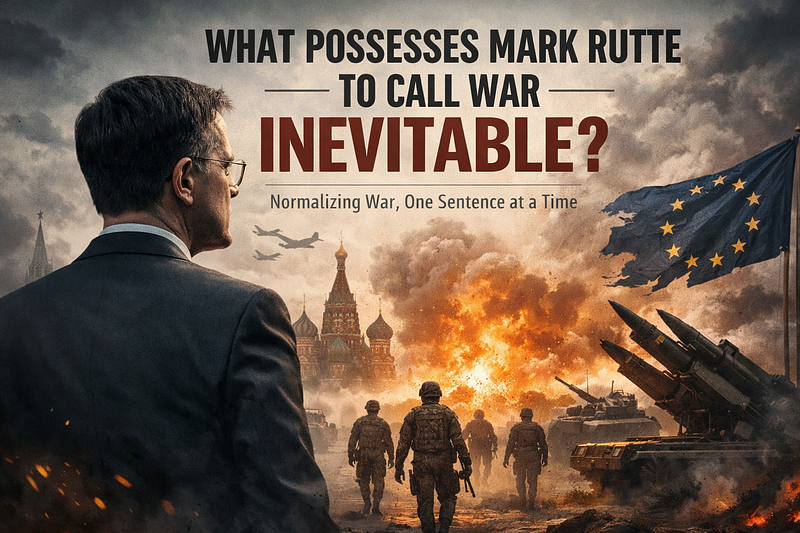
Mark Rutte keeps repeating a single sentence in different forms. War with Russia is inevitable. Sometimes he says it plainly. Sometimes he wraps it in warnings, timelines, or the careful grammar of strategy. But the message beneath the variations never changes. War is coming. It cannot be stopped. We must prepare.
That sentence matters more than any weapons shipment or defence budget, because before wars are fought with artillery they are fought with language, and the word doing the fighting here is "inevitable." It is worth asking, with genuine curiosity rather than outrage, what that word is for. What does a man in the most senior security office in Europe actually accomplish when he tells a continent that its largest war in eighty years can no longer be avoided?
He does not describe reality. He reshapes it. To call war inevitable is to make a specific political move disguised as an observation. It declares that political choice has ended, that diplomacy has already failed, that responsibility has dissolved into fate. And that declaration is, on its face, false. War is never inevitable while diplomacy exists, while escalation remains the product of decisions made by people in offices. Anyone operating at the level of NATO leadership understands this in their bones, which is the uncomfortable part. When inevitability is asserted by someone who knows better, it is not analysis. It is instruction. This is not realism. It is narrative control, and this chapter is about how the control works, sentence by sentence, on a continent that mostly does not notice it happening.
Inevitability as a form of power
When leaders describe a war as unavoidable, they perform a precise act, and the precision is the thing to see. They remove agency. If war is destiny, then no one chose it. If escalation is fate, then no one can be blamed for accelerating it. "There was no alternative" becomes the last refuge of authority, the sentence that ends every inquiry before it starts.
This mechanism is as old as modern warfare, and once inevitability is accepted, every subsequent step inherits its logic. Weapons become precaution. Militarisation becomes responsibility. Dissent becomes recklessness. Doubt becomes immaturity. The whole moral field tilts, and it tilts not because anyone argued for the tilt but because a single premise was accepted upstream of all the arguments. Rutte's language does not prepare Europe for defence. It prepares Europe for acceptance, and acceptance is the most dangerous stage of all, because once a war is accepted it no longer needs to be justified. It only needs to be managed.
There is a useful distinction to hold here, because the careless version of this argument overreaches and the careful version does not. The claim is not that Rutte wants a war, or that he is consciously engineering one. That would be a statement about a mind, and minds are closed to investigation. The claim is about what the language does regardless of what the speaker intends: it lowers the threshold of acceptability, shifts the burden of proof onto those who would resist, and converts an open political question into a settled background condition. A word can perform that work whether the man saying it is a cynic or a true believer. The function does not depend on the intention, which is exactly why the function, not the intention, is the subject.
The composure that does the work
Picture the setting, because the manner is as much of the message as the words. A podium, the blue flag with its compass star behind it, a row of microphones, a room of journalists with cameras. The Secretary General arrives on time, in a dark suit, and delivers the line about the coming war in the same even, slightly weary tone he would use to announce a revised meeting schedule. There is no tremor in it. There is no visible weight. The most consequential proposition a European official can utter, that the continent is heading into its largest war in generations, is delivered with the affect of an administrator reporting a logistical fact.
The composure is not incidental. It is the instrument. If the same words were spoken with visible dread, with the grief appropriate to what they describe, they would register as a warning, a cry to prevent, and a warning invites resistance and action. Delivered flat, they register as a report, and a report invites only acceptance. The calm is what converts the claim from an alarm into a fact, because we have learned to associate emotion with opinion and flatness with truth. A man who weeps as he describes a war is understood to be taking a position. A man who describes it without blinking is understood to be telling us how things are. The absence of feeling reads, to the listening public, as the presence of certainty, and the certainty is the thing being sold.
This is why the affect matters as much as the content, and why it belongs in any honest account of the mechanism. The conditioning is not carried only by the word "inevitable." It is carried by the tone in which the word is allowed to arrive, the unhurried, undramatic, almost bored delivery that tells the room there is nothing here to argue with, only something to absorb. Power that wanted you to debate would sound urgent. Power that wants you to accept sounds calm.
When language stops warning and starts conditioning
Rutte does not speak as a private analyst whose words evaporate. He speaks as the head of the largest military alliance in history, and his sentences are not commentary. They are signals to governments, institutions, editors, and publics, and they are received as such.
When he frames war as unavoidable, he is not warning Europe. He is conditioning it. Training it to believe that diplomacy is naive, that restraint is weakness, that escalation is the mark of seriousness. War stops being a tragedy to be avoided and becomes a horizon to be managed, and the shift happens so quietly that no one can point to the day it occurred. This is how escalation becomes normal. Not through hysteria. Through calm. Wars rarely begin with screaming. They begin with composed, reasonable, procedural certainty, repeated until the certainty becomes the air everyone breathes and stops being noticed as a claim at all. The most dangerous sentence in politics is not the one that frightens you. It is the one that has stopped sounding like a sentence, because you have heard it so often that you mistake it for the shape of the world.
This is the deepest layer of the mechanism, and it has a name in the study of how power works on the mind. A society does not adopt a new common sense by being argued into it. It adopts it by hearing the same premise repeated by authoritative voices until the premise stops sounding like a position and starts sounding like the weather. The genuinely effective forms of persuasion are the ones that never feel like persuasion, because they arrive as description. "War is inevitable" is such a form. It does not ask to be believed. It asks to be assumed, and an assumption is far harder to resist than a claim, because resisting it requires first noticing that a claim was ever made.
The vocabulary that launders the war
"Inevitable" does not work alone. It sits at the centre of a whole vocabulary, and the vocabulary is worth laying out, because the individual words are so mild that their collective effect is invisible unless you assemble them.
Escalation is rarely called escalation. It is called readiness, or deterrence, or stepping up. The transfer of weapons into a war zone is not called arming a combatant. It is called support, or assistance, or, in the gentlest register of all, sharing. A vast and open-ended increase in military spending is not called militarisation. It is called a defence commitment, or burden-sharing, the language of a household budget rather than an arms build-up. Each of these words performs a small laundering operation. It takes an action with grave and contested consequences and re-describes it in terms that no reasonable person could oppose, because who is against readiness, who is against sharing, who is against commitment.
This is the quieter companion of the inevitability claim, and it works on the same principle. The inevitability frame removes the question of whether. The euphemism vocabulary removes the question of what. Together they produce a public discourse in which a continent can be moved, step by step, toward a wider war while every individual step is described in language that sounds like prudence, generosity, or maturity. You cannot argue against a policy you cannot see, and a policy described as "sharing air defence" is a good deal harder to see than the same policy described as "removing the air defence over our own cities to send it into someone else's war." Both descriptions are accurate. Only one is ever used, and the choice of which one is used is not neutral. It is the work.
The tell of a laundered vocabulary is that it only ever softens in one direction. The words for escalation are gentle; the words for restraint are harsh. Diplomacy becomes appeasement. Caution becomes weakness. A negotiated settlement becomes capitulation, or a betrayal, or a reward for aggression. The same act, depending on which side of the inevitability frame it falls, is dressed in either the vocabulary of virtue or the vocabulary of shame. That asymmetry is not an accident of usage. It is the linguistic shape of a conclusion that has already been reached, distributed across a hundred individually innocent words.
How the unthinkable became the obvious
There is a way of measuring how far this has gone, and it does not require access to anyone's private intentions. It requires only that you remember what could and could not be said a few years ago.
Not long ago, the open discussion of a direct war between NATO and Russia, of conscription returning to western European countries, of economies placed on something approaching a war footing, sat at the alarmist edge of public debate. To raise these things as imminent was to be treated as a catastrophist. Then, gradually, through repetition by authoritative voices, the same propositions migrated inward, from the edge to the centre, until they became the ordinary furniture of a serious news bulletin. The boundary of the sayable moved. What had been the position of the alarmist became the position of the responsible adult, and what had been the mainstream assumption, that a major European land war was a receding historical possibility, quietly became the position of the naif.
This migration is the deepest level at which the inevitability language operates, and it is the level that classical propaganda analysis would recognise instantly. Power of the most durable kind does not win the argument. It moves the boundary of which arguments are permitted to feel serious. It does not refute the case for diplomacy. It relocates that case to the margin where it can be dismissed without a hearing, simply by association with naivety. The genius of the method, if a method without a single author can be said to have genius, is that no one has to be silenced. The boundary does the silencing, and the boundary is maintained by everyone at once, each speaker calibrating to where the others seem to stand. A repeated claim of inevitability is one of the most efficient instruments for moving that boundary, because every repetition normalises the last one, and a thing said often enough by serious people stops being heard as a claim and starts being felt as a climate.
When words become actions
The moral weight of all this would be limited if it stayed rhetorical. It does not, and the point at which rhetoric meets policy is where the case stops being literary.
Rutte has urged NATO countries to provide their air-defence systems to Ukraine, framing the transfer in the language of solidarity and shared sacrifice. The word usually chosen for it is gentle, cooperative, almost domestic: allies should "share." But air defence is not surplus equipment to be lent like a tool over a garden fence. It is the shield over cities, civilians, hospitals, power stations. It exists precisely to protect populations when tensions rise toward the kind of war Rutte describes as coming.
Hold the two halves together, because the combination is the indictment. To tell a continent that a major war is inevitable, and in the same breath to advocate stripping away part of that continent's defensive shield, is not solidarity. It is escalation wearing the costume of responsibility. You cannot tell a population that the storm is certain and then argue for removing the roof, and remain merely a neutral observer of the weather. This is not a technical debate about munitions logistics. It is a moral one, and it is the place where the inevitability language reveals what it actually licenses.
The combination that removes the excuses
Here is where the appeals to realism collapse, and they collapse on the pairing rather than on either half alone.
Rutte combines the language of inevitability with the behaviour of escalation. He tells Europe war is coming while supporting the steps that make confrontation more likely. He normalises conflict verbally and advances it materially, at the same time, from the same office. He removes doubt with one hand and accelerates momentum with the other, and the two motions reinforce each other into a self-fulfilling dynamic that becomes harder to stop with each repetition. Words prepare the ground. Actions follow. Together they create exactly the future the words described, at which point the words can be retroactively validated as foresight rather than recognised as cause. This is not leadership. It is participation in the outcome, dressed as prediction of it.
The transmission belt
A sentence spoken from the NATO podium does not reach the public directly. It passes through a relay, and the relay is part of the mechanism, because without it the repetition that does the conditioning could never occur.
When the Secretary General says war is inevitable, the statement becomes a headline within the hour. The headline is rarely framed as a contestable claim by an interested official. It is framed as news about the war itself, as though the inevitability were a fact that Rutte had reported rather than a position he had taken. "NATO chief warns war with Russia inevitable" is a sentence about Rutte. "War with Russia inevitable, NATO warns" is a sentence about the war, and the second is the one that runs. The grammatical shift is tiny and the effect is enormous: the press converts a political assertion into an ambient reality, and then the next official can refer to that reality as established, citing the coverage that his own predecessor's words produced. The claim launders itself through the reporting of the claim.
This is how a single voice achieves the repetition that conditioning requires. Rutte does not have to say "inevitable" a thousand times. He has to say it once, in the right room, and an entire ecosystem of bulletins, push notifications, and panel discussions will say it the other nine hundred and ninety-nine times on his behalf, each repetition stripping away a little more of the claim's contestability until it has hardened into the unquestioned premise of the next conversation. The transmission belt is not a conspiracy of the press. It is the ordinary operation of a news system that rewards certainty over nuance and treats the statements of the powerful as events rather than as arguments. The mechanism does not require the journalists to agree with Rutte. It requires only that they repeat him, and repetition is what the news system does for a living.
Why this violates the doctrine it claims to serve
The most revealing fact about this style is that it contradicts the very strategic tradition NATO was built on. Within classical military and diplomatic doctrine, declaring a war inevitable is not a hard-headed realism. It is an error, and a recognised one.
Clausewitz understood war as a continuation of politics by other means, not as the replacement of politics by fate. To declare inevitability is to announce that politics has stopped, which is precisely the surrender of the strategist's task. George Kennan, the architect of Cold War containment, built his entire strategy on restraint, ambiguity, and the deliberate refusal of fatalistic language, because he understood that calling conflict unavoidable is how you manufacture it. Henry Kissinger, whatever else one thinks of him, organised his strategic logic around preserving diplomatic space precisely to keep inevitability narratives from becoming self-fulfilling. Jack Matlock, the American ambassador who helped negotiate the end of the Cold War from inside the system, warned repeatedly that treating conflict as unavoidable is the method by which wars are produced, not the wisdom by which they are foreseen. Even NATO's own Cold War tradition rested on a single principle: escalation must be managed through doubt and open channels, never preached as destiny.
What Rutte does is the inversion of all of it. The doctrine says keep the future open. He announces it closed. The doctrine says preserve ambiguity. He manufactures certainty. The man holding the office built to prevent inevitability narratives has become the continent's foremost producer of one. That is not an opinion about his character. It is a comparison between the documented strategic tradition of his own institution and the documented content of his own speeches, and the two do not match.
Diplomacy is not forgotten. It is avoided.
It would be too generous to say that Rutte has forgotten diplomacy exists. He has not. He knows negotiations are possible, however difficult. He knows that proposals were sidelined, dismissed, or never seriously attempted. Diplomacy is not absent from his world through ignorance. It is avoided, because it is dangerous to the narrative in a specific way.
Real diplomacy raises questions that inevitability is designed to suppress. Why was this not attempted earlier? Which escalations were voluntary? Which red lines were crossed by choice rather than necessity? Who benefits from the war, and who pays for it? Every one of those questions reintroduces agency, and agency is the solvent that dissolves inevitability. If choices were made, then choices could have been made differently, and if they could have been made differently, then someone is responsible. So the questions are kept out of the frame, not by banning them but by making the war feel like a thing that is happening rather than a thing that is being done. Momentum is protected instead: the weapons flows, the production lines, the integration, the public habituation. Each of these is easier to defend as a response to the inevitable than as a choice among alternatives, which is the entire administrative advantage of the word.
A familiar historical pattern
The catastrophes of the modern era were rarely unleashed by fanatics screaming for blood. More often they were prepared by composed and respectable men who spoke calmly of inevitability, framed escalation as necessity, and let responsibility dissolve into fate.
The clearest single parallel is the summer of 1914. The statesmen of Europe did not, for the most part, argue openly for the slaughter that followed. They described mobilisation as unavoidable, the timetables as fixed, diplomacy as exhausted, and the war as a tragedy that everyone regretted and no one could stop. The railway schedules became the alibi: once mobilisation began it could not, they insisted, be halted without inviting catastrophe, and so the machinery was allowed to run because stopping it had been declared impossible. The historians who later took the timetables apart found that the impossibility had been overstated, that there had been room to pause that no one used, because using it would have required someone to act as though the war were still a choice. The machinery of "no alternative" did the work that no honest argument for war could have done, and a generation died inside the space that the word "inevitable" had cleared. The lesson the period teaches is exact and uncomfortable: the belief that a war cannot be stopped is itself one of the most powerful forces preventing anyone from stopping it. Inevitability is not only a description of the slide. It is part of the engine. The comparison is not that Rutte resembles any particular figure of 1914. It is that the linguistic mechanism is identical: a contestable political choice, re-described as a fixed condition, until the re-description becomes true by being believed. That this same mechanism was identified at Nuremberg, where the legitimisation of aggression through the language of inevitability and reaction was treated as a culpable act rather than mere commentary, is a fact about the history of the idea, not a moral equation of persons. The point throughout is functional, never ideological. Language that converts a choice into a fate has a particular role in the production of war, and that role has been recognised, repeatedly, after the fact.
A pattern, not an accident
This way of operating did not appear with the war. It is the same method Rutte used in domestic politics, where the absence of an enemy makes the mechanism easier to see in isolation.
In the Dutch child-benefits scandal, tens of thousands of families were wrongly accused, financially ruined, and in some cases torn apart by the state, while responsibility dissolved, for years, into procedure. No one had decided to destroy them. The system had simply proceeded, and the language of administration absorbed the catastrophe until it was too large to absorb. In Groningen, where decades of gas extraction caused earthquakes that damaged thousands of homes, public safety was subordinated to administrative and financial convenience for years, again under the calm grammar of process. The same three notes sound in both cases and in the war: calm authority, technical language, damage acknowledged only after it has become undeniable. Rutte is not an anomaly in this. He is the polished, fully developed expression of a style of power that prefers inevitability to accountability, because inevitability never has to apologise.
And there is a continuity of structure between the domestic and the geopolitical that is worth naming directly, because it is the reason the early cases matter to the later one. In the benefits scandal and in Groningen, the word that did the protective work was not "inevitable" but "procedure": the harm was nobody's decision because it was the output of a process. In the war, "inevitable" performs the identical function at a larger scale. Procedure dissolves responsibility for a domestic catastrophe into a system; inevitability dissolves responsibility for a continental one into fate. In both, the grammar removes the agent. In both, by the time the consequence is undeniable, there is no one left holding the decision, because the language was engineered, or at least functioned, to ensure that no decision was ever visibly made. The man is consistent. Only the scale of what the consistency costs has changed.
The strongest case for the defence
The objection to all of this is serious, and in its strongest form it is not a defence of evasion but a competing account of leadership in a genuinely dangerous time. It deserves to be put at full strength.
Perhaps, the objection runs, war with Russia really is highly likely, and a responsible leader has a duty to say so. Hard truths are not made false by being uncomfortable. If a serious military threat is building, the leader who tells the public it is coming is not manufacturing the danger; he is doing the unpopular work of preparing a complacent continent for a reality it would rather ignore. On this reading, "inevitable" is not a manipulation but a deliberate rhetorical compression, the only register blunt enough to move governments that had underfunded their defence for thirty years. To call this conditioning is to mistake honesty for propaganda. And the doctrine argument cuts both ways: Kennan and Kissinger preserved ambiguity in a world of two rational superpowers, but a leader facing an adversary he judges to be undeterrable by ambiguity may reasonably conclude that clarity, even fatalistic clarity, is the more responsible course. Calling that conclusion a violation of doctrine assumes the answer to the very question in dispute, which is whether the threat is real and imminent. If it is, Rutte is not normalising an avoidable war. He is refusing to let a continent sleepwalk into an unavoidable one.
This objection has real force, and it must be granted its core: a leader does have a duty to name genuine dangers, hard truths are not propaganda merely for being hard, and if the threat is real then preparing the public is not manipulation but responsibility. If the case against Rutte rested on the mere fact that he warns of war, the objection would win, because warning of war is sometimes exactly what the job requires.
But the case does not rest there, and the objection breaks on the same pairing that the rest of this chapter turns on. There is a decisive difference between "war is likely and we must prepare" and "war is inevitable and therefore beyond choice." The first is a warning, and a warning preserves agency: it says danger is coming, so let us act to prevent or prepare for it, and it leaves the question of prevention open. The second forecloses agency: it says the outcome is fixed, so the only task left is to manage it, and it quietly removes prevention from the table. A leader genuinely trying to avoid a war he believes is likely would saturate his language with the conditional, with the off-ramps, with the explicit insistence that catastrophe can still be averted, because that is how you mobilise a public toward prevention rather than mere acceptance. The tell is in which mode the language runs. Rutte's runs, consistently, in the second. And the pairing seals it: the leader who genuinely wanted to prevent a likely war would not, in the same period, advocate weakening the continent's defensive shield. Warning and preparation point one way. Inevitability and the transfer of air defence point the other. The objection defends the warning. It cannot defend the foreclosure, and the foreclosure is the finding.
There is a second, subtler version of the defence that deserves its own hearing, because it is the one a serious strategist would actually make. Projecting certainty, this version runs, is not conditioning the home public at all. It is signalling resolve to the adversary. Deterrence works by convincing an opponent that aggression will be met without hesitation, and visible doubt, audible conditionals, public talk of off-ramps, can read across the border as weakness, as an opening to be exploited. On this account Rutte's flat certainty is aimed not at the European voter but at the Kremlin, and its purpose is to prevent war by removing any impression that the West might flinch. The fatalistic language is, paradoxically, a peace instrument.
This is the strongest form of the objection and it cannot be waved away, because deterrence theory is real and resolve does matter. But it contains its own refutation, and the refutation is again in the pairing. Deterrence is a message about what you will do if attacked. Inevitability is a message that the war is coming regardless of what anyone does. These are not the same signal; they are opposite signals. A deterrent says: cross this line and you will face us, so do not cross it, because the outcome is still in your hands. Inevitability says: the outcome is no longer in anyone's hands. The first preserves the adversary's choice not to attack, which is the entire point of deterrence. The second tells the adversary that the confrontation is fixed, which removes his incentive to avoid it and can just as easily read as a reason to strike first. A leader genuinely practising deterrence would speak of consequences, not of fate, because fate deters no one. That Rutte's language runs to fate rather than to conditional consequence is, once again, the tell that it is doing something other than what the most generous reading claims.
What would falsify the reading offered here? If Rutte's language on the war were found, on examination, to be saturated with conditionals, with named off-ramps, with explicit and repeated insistence that the war could still be prevented and how, then the charge of normalisation would collapse and the honest-warning account would win. The claim is testable against his own words. Read them for the conditional. The mechanism predicts you will rarely find it.
The man who speaks without blinking
So what kind of person calmly talks a generation toward a war it never debated?
Not a monster. That is the disappointing and important answer. A monster would be easier, because a monster implies that a better man in the same chair would produce a better outcome. The harder truth is that the office rewards exactly this register, the unblinking certainty, the absence of visible doubt, the talent for making a choice sound like a condition, and it will tend to elevate whoever supplies it. Only someone who does not lose sons, does not defend cities, does not carry the bodies, can speak of an inevitable war without his voice changing. Only someone who has detached the words from the lives they describe can normalise catastrophe one sentence at a time and sleep.
That certainty is not strength. It is distance, and distance is what makes it dangerous. The most destructive figures of the modern era were rarely the loud ones. They were the composed ones, the men who spoke of necessity in measured tones while the consequences accrued to other people, somewhere else, later. The men who did not incite a war so much as describe it into being. The men who normalised it, calmly, reasonably, one sentence at a time, and never once had to raise their voice.
Evidence Map
Facts, interpretations, forecasts, and disconfirming signals.
Core claim. By repeatedly describing war with Russia as inevitable, Rutte performs a linguistic act that removes agency, lowers the threshold of acceptability, and conditions a public to manage a war rather than prevent it. The claim concerns the function of the language, not a proven intention to manufacture war, and it turns on the pairing of inevitability rhetoric with escalatory policy.
Evidence level. Facts (high): Rutte's repeated public framing of war with Russia as unavoidable; his advocacy that NATO members provide air-defence systems to Ukraine; the documented strategic tradition (Clausewitz, Kennan, Kissinger, Matlock) that treats fatalistic language as a producer rather than a predictor of war; the Dutch child-benefits and Groningen episodes as prior instances of the same administrative style. Interpretation (medium, marked): the reading of the inevitability language as conditioning, and the functional comparison to historical inevitability rhetoric, are analytical conclusions, not documented intentions.
What would confirm this. Continued use of unconditional inevitability framing paired with escalatory advocacy; an absence of named, repeated off-ramps in his public language.
What would disprove this. Rutte's language on the war proving, on examination, to be saturated with conditionals, explicit off-ramps, and repeated insistence that the war can still be prevented. That pattern would support the honest-warning account and defeat the normalisation reading.
Watchlist. The conditional-versus-fatalistic balance in future statements; whether warnings are paired with prevention or with acceptance.
Jerry van der Laan writes The Manifest Archive, where he traces the structures beneath the headlines. He traces the structures beneath them.