The days that felt empty
Between Christmas and New Year, the world always pretends to pause.
Government buildings close early. Press offices switch to skeleton crews. Parliamentary agendas thin out into placeholders. Commentators speak of a “quiet week,” as if silence were a natural state rather than an arrangement.
In 2025, that quiet felt different.
Not restful.
Not reflective.
Finished.
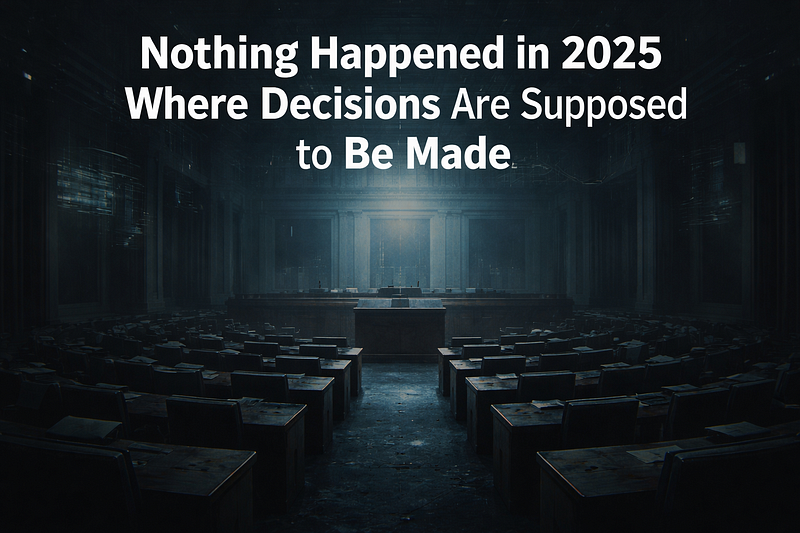
In one parliament building, the chamber lights were already off.
Not because debate had ended, but because nothing on the agenda required them to be on.
The microphones were muted. The voting screens dark. The schedule showed meetings that would not happen and items that would not be discussed. No decision had been cancelled. It had simply become unnecessary.
Trains kept running. Markets opened on schedule. Datacenters hummed without interruption. Security protocols refreshed automatically at midnight. No alerts were issued. No emergency sessions were convened. No speeches were given that anyone would remember.
Nothing important seemed to happen.
That was the problem.
Because when nothing happens where decisions are supposed to be made, it does not mean power has stopped. It means power has moved somewhere that no longer requires decision.
The year ended without a climax, without resolution, without even the pretense of choice. Not with collapse, not with breakthrough, but with continuation so smooth it became invisible.
2025 did not close with a bang.
It sealed.
When “temporary” stopped meaning temporary
There was no moment when the word changed its meaning.
No announcement. No legal amendment bold enough to be noticed outside specialist circles. No headline declaring that emergency had become norm.
And yet, by the end of 2025, temporary no longer described time. It described structure.
Measures introduced as provisional quietly lost their exit conditions. Deadlines became review dates. Review dates became renewals. Renewals became background. What was once framed as an exception became indistinguishable from baseline.
Exceptional powers were not abused. They were simply used, repeatedly, until repetition replaced justification. The language that once signaled urgency softened into administrative routine.
A travel restriction lifted in public communication but preserved in database logic.
A surveillance protocol narrowed in stated scope but widened in operational application.
A financial safeguard declared provisional, yet embedded into clearing systems that cannot simply be switched off without systemic risk.
No one voted to make them permanent. No one needed to.
The architecture adjusted itself.
Law followed procedure. Procedure followed precedent. Precedent followed convenience.
And convenience, once institutionalized, does not argue for its own removal.
What made this transition effective was not force, but politeness. Each extension arrived wrapped in reassurance. Each continuation framed as caution. Each renewal presented as responsibility. No one felt coerced. Everyone felt careful.
The extraordinary did not overstay its welcome.
It moved in.
The year without decisions
In public memory, years are defined by moments. Elections, wars, crashes, treaties, resignations. We remember history through visible ruptures.
2025 will be remembered, if at all, as strangely empty.
There was no decisive vote that altered the course of history. No summit where leaders visibly chose a new direction. No declaration that marked a turning point. The architecture of public decision-making remained intact, but hollow.
Parliaments met. Committees convened. Press conferences followed schedule. The choreography of democracy continued with practiced precision.
What disappeared was consequence.
Decisions were no longer the mechanism through which reality shifted. Reality shifted through alignment, inertia, and systems continuing along paths already laid. Outcomes emerged without moments of choice.
Budgets rolled over with minor adjustments. Military commitments deepened without fresh mandates. Sanctions regimes extended themselves through automatic clauses. Regulatory frameworks updated language without altering direction.
The absence of decision was not paralysis.
It was efficiency.
When systems mature far enough, they no longer require moments of choice. They require only maintenance. Maintenance does not debate alternatives. It preserves function.
And maintenance does not ask permission.
Where decisions used to be made
There was a time when decision-making was slow by design.
Not because institutions were virtuous, but because friction existed. Delays were built in. Documents circulated. Objections mattered. Votes could fail. Agreements could collapse under pressure.
This friction was not a flaw. It was a buffer.
Rooms mattered. Timing mattered. Attendance mattered. The physical act of gathering created exposure. People could be seen hesitating, dissenting, withdrawing support.
That exposure made reversal possible.
A decision could be postponed. A policy could be undone. A law could be repealed. Not easily, but visibly. Failure had a shape.
By 2025, that shape had thinned.
Decision-making did not vanish. It relocated into layers where friction had already been optimized away. Digital workflows replaced deliberation. Pre-aligned frameworks replaced debate. Mandates arrived pre-structured.
What once required agreement now required compliance.
The room still existed, but it no longer mattered. The outcome was determined before anyone entered. Attendance became symbolic. Debate became ceremonial.
Nothing illegal occurred.
Nothing dramatic.
Only the gradual removal of points where intervention used to be possible.
Management replaced choice
In one European capital, a mid-level official signed a document extending a framework he had not helped design and could not meaningfully alter. The signature took less than a minute. The document ran dozens of pages. The implications would outlast his career.
He did not feel powerful.
He felt careful.
This is how governance functioned in 2025. Not as command, not as debate, but as risk management. Each action justified not by vision, but by avoidance.
Avoid escalation.
Avoid instability.
Avoid uncertainty.
Avoid responsibility.
Choice implies alternatives. Alternatives imply accountability. Accountability implies exposure.
Management avoids all three.
Meetings no longer asked what should be done. They asked what could not be afforded to reverse. Policy language reflected the shift. Verbs softened. Sentences grew conditional. Commitments framed themselves as alignment with existing obligations rather than new directions.
Nothing was chosen.
Everything was preserved.
The system learned to continue
No one froze the system.
No one seized control.
No one needed to.
The system learned to continue on its own.
Once it did, interruption became the real risk.
Processes began to self-justify. Metrics replaced judgment. Alerts replaced responsibility. Deviations triggered automated responses long before human deliberation could intervene.
This was not autonomy in the science-fiction sense. It was continuity as default.
Systems were no longer designed to ask whether something should continue, but how smoothly it could do so. Stability became the highest value, because instability exposed structure.
And exposure had become dangerous.
The automation of consequence
One of the least visible shifts of 2025 was the automation of consequence.
Actions still had effects. Decisions still mattered. But the chain connecting choice to outcome no longer passed through identifiable hands. It passed through parameters.
A threshold was crossed. A protocol activated. A compliance score adjusted. An access level changed.
No one decided.
The system responded.
Responsibility dissolved into function. Blame became irrelevant. Errors were logged, not judged. Faults generated reports, not accountability.
This shift removed not only culpability, but the emotional weight of decision-making. Humans were no longer required to carry the burden of consequence. The system absorbed it.
And once consequence is automated, reversal becomes nearly impossible. You cannot argue with a parameter. You cannot negotiate with a threshold. You cannot appeal to a process that has no memory of intent.
This is how permanence is achieved without declaration.
Crises that no longer resolve
In earlier eras, crisis carried an implicit promise: that it would end.
War would conclude. Inflation would recede. Emergency would give way to normality.
By the end of 2025, that promise had quietly expired.
The war stabilized into permanence, a managed conflict with predictable costs and no endpoint. Economic strain normalized into a lower baseline, where recovery was measured against expectation management rather than memory.
Migration did not surge or stop. It continued, administratively absorbed, rhetorically reframed, politically instrumentalized.
Energy insecurity did not trigger transformation. It produced diversification strategies that locked in new dependencies.
Each crisis became a condition. Each condition became background. Each background justified further management.
Resolution would have required reversal.
Reversal would have required admitting that earlier decisions, or non-decisions, had consequences.
So nothing resolved.
It continued.
The silence that settled in language
Language did not disappear in 2025.
It thinned.
Words remained, but their edges dulled. Terms that once opened debate became placeholders.
Security no longer referred to protection. It referred to compliance with frameworks agreed elsewhere.
Stability no longer meant balance. It meant absence of disruption to systems whose legitimacy was no longer questioned.
Democracy remained in circulation, detached from decision-making. It described process, not outcome.
Even dissent survived, carefully curated. Allowed expression, denied effect. Opinion without leverage. Protest without consequence.
The most notable absence was not censorship, but fatigue.
Certain questions stopped being asked, not because they were forbidden, but because they no longer fit the rhythm of response. They slowed the system down.
And slowing down had become unacceptable.
The emotional cost of continuity
People did not revolt in 2025.
They adapted.
Not out of ignorance, but exhaustion. Permanent conditions do not provoke outrage. They produce resignation. When nothing changes, expectation collapses.
Hope requires reversibility. When reversal disappears, emotion recalibrates. Anger fades into cynicism. Engagement thins into routine.
This was not apathy. It was calculation.
Why protest a process that no longer listens. Why argue with a system that does not pause. Withdrawal became rational.
The most effective control is not fear, but predictability.
And predictability settled everywhere.
Why reversibility had to disappear
Reversibility is dangerous to systems that rely on continuity.
The ability to undo implies the possibility of error. Error implies accountability. Accountability threatens stability.
For systems operating at scale, instability is the enemy. Not injustice. Not inequality. Instability.
By removing reversal, systems protect themselves from scrutiny. They ensure that adaptation only moves forward, never back. Each step locks the previous one in place.
This is not ideology.
It is architecture.
Once reversibility disappears, permanence does not need to be declared. It becomes the only viable state.
The absence nobody announced
At some point during the year, without ceremony, the idea of reversal vanished.
Not abolished. Not declared impossible. Simply removed from operational reality.
Policies were no longer evaluated on whether they worked, but on whether they could be unwound without damage. Most could not.
Financial mechanisms created dependencies that made exit more dangerous than continuation. Legal frameworks overlapped until undoing one triggered cascading uncertainty.
International commitments layered themselves until disentanglement became synonymous with isolation.
This is how power secures itself without force.
By making retreat structurally irrational.
No announcement marked the threshold. No press release acknowledged it.
But by December, it was felt everywhere.
Nothing could be undone.
What quietly moved into place
If 2025 had a defining feature, it was consolidation without visibility.
Power did not centralize dramatically. It redistributed functionally.
Decision-making moved away from elected bodies not through rupture, but through delegation, automation, and pre-commitment.
Algorithms adjusted flows. Treaties enforced themselves. Markets disciplined deviation faster than policy ever could.
Institutions did not seize authority. They inherited it, piece by piece, as responsibility flowed upward and outward.
This was not conspiracy.
It was architecture.
The result was a landscape where outcomes were determined long before anyone spoke about them, and where speaking about them changed nothing.
The year that did not speak
History often announces itself loudly.
2025 did not.
It whispered through procedures. It settled into databases. It embedded itself in defaults.
Future historians will find no single law, no defining vote, no decisive speech.
They will find continuity.
History did not turn in 2025.
It settled.
And settled things are not decided again.
Related from The Manifest Archive