The crisis does not usually enter with sirens.
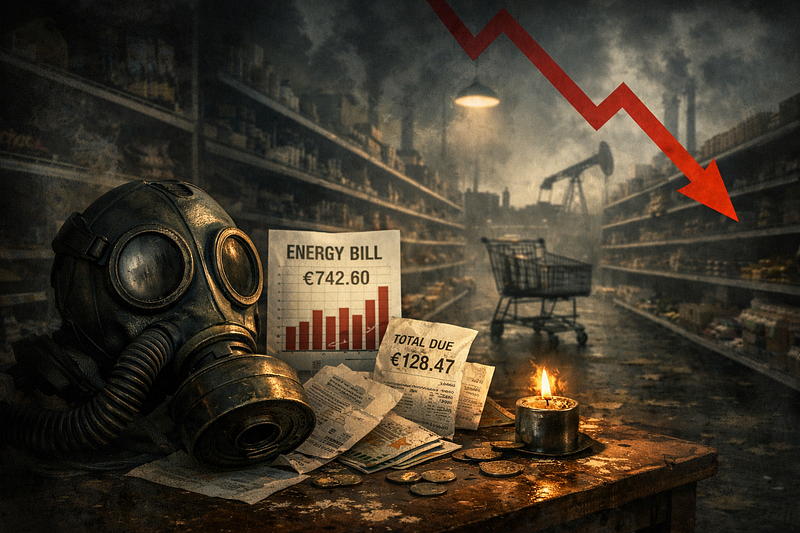
It enters through the kitchen. Through the receipt folded in a pocket. Through the small silence before someone turns the heat on. Through the fuel gauge that suddenly matters. Through the new habit of checking prices twice, then checking them again.
First comes the rise. Quietly at first, then all at once.
Fuel becomes expensive. Food follows. Energy bills arrive with numbers that look absurd, then are immediately explained as temporary. A disruption. A shock. A difficult phase. An adjustment. Something unfortunate, but manageable.
Then the instructions begin.
Drive less. Consume less. Lower expectations. Work from home where possible. Turn down the heat. Accept delays. Accept limits. Accept that the world has changed and that mature societies adapt.
None of it sounds irrational. Taken one by one, much of it is not.
But taken together, a pattern begins to reveal itself.
Every crisis now ends in less.
Less movement. Less room. Less certainty. Less purchasing power. Less margin for error. Less confidence that what disappears will ever really come back.
And after enough repetitions, something deeper changes. What once felt temporary starts to feel normal. What once felt like emergency starts to define the baseline. The shortage is no longer only a disruption to be endured. It becomes an environment in which people are expected to live.
What is introduced as emergency slowly becomes expectation.
That is where crisis stops being an event and becomes a structure.
This Did Not Begin Yesterday
It is tempting to treat each crisis as a separate story. An oil shock in one decade, a debt crisis in another, a financial panic, a pandemic, a sanctions spiral, a supply chain rupture, an energy emergency. Each one arrives with its own headlines, its own experts, its own rhetoric, its own urgency.
But the public experience is strangely repetitive.
Each time, the language changes less than the outcome. Citizens are told that this moment requires maturity. Consumption must be reconsidered. Mobility must be adjusted. Expectations must be lowered. Patience is needed. Stability must be protected. The nation, the market, Europe, the alliance, the system, all must be held together.
And holding it together almost always seems to mean the same thing. Ordinary life becomes thinner.
The oil shocks of the nineteen seventies already exposed the basic pattern. Geopolitical disruption reached straight into the household. The decades that followed did not remove that vulnerability. They reorganized it. Debt replaced resilience. Efficiency replaced redundancy. Supply chains stretched farther. Energy systems became more integrated and, with that integration, more fragile. Financial systems became more sophisticated at pricing risk, but not better at preventing ordinary people from carrying it.
What changes from crisis to crisis is often the trigger.
What remains remarkably constant is the social destination.
The event is new. The outcome is familiar.
This is one of the buried truths of the modern order. It is highly advanced, highly connected, and highly efficient at pushing stress downward.
The Bill Always Arrives Below
Most people do not experience geopolitics as geopolitics.
They experience it as a bill.
A war near a shipping lane appears months later in the price of transport. A sanction package drafted in one capital returns as a higher grocery receipt in another. An energy shock triggered far away settles into kitchens, commutes, wages, radiators, and household arguments. Power speaks globally, but collects locally.
That is how the modern system often works. Distance disappears only when costs are being transmitted downward.
This is not metaphor. The European Central Bank has written that sharply higher energy prices weighed heavily on household income and private consumption in the euro area. In a related analysis, it described wholesale gas prices as having peaked in September 2022 at around four hundred and forty percent above their level in December 2020, with the shock spilling far beyond the energy sector itself.
The crisis, in other words, does not stay in the charts.
It enters the home.
That is why the language around crisis matters so much. It tells people where to look, and just as importantly, where not to look. The official story usually begins with disruption. Something happened. Supply was interrupted. Markets reacted. Prices rose. Governments responded. Everyone must now do their part.
There is truth in that sequence. Wars do disrupt trade. Energy systems are vulnerable. Shipping routes can become dangerous. Inflation does follow instability.
But the deepest political change begins one step later, when a genuine disruption becomes the justification for a new normal of lower expectations.
At first, people are told to endure a phase. Then they are told to adapt to it. Then they are told that adaptation itself is maturity.
That is the point at which crisis has already moved beyond economics.
The home has become the final processing site of global disorder. A rupture may begin in shipping, sanctions, finance, or energy markets, but it is completed only when households silently reorganize themselves around the damage.
The speech happens in capitals. The suffering happens at the dinner table.
When Shortage Becomes Policy
A shortage begins as disruption.
It becomes power the moment someone decides ordinary people must reorganize their lives around it.
That is the distinction that matters.
When scarcity persists, institutions do not simply respond. They translate. A market rupture becomes behavioral advice. A fuel shock becomes a moral appeal. A structural fragility becomes a private instruction.
This is where the pattern becomes visible.
During a period of severe energy stress, the International Energy Agency did not only describe supply risk in technical language. In its emergency oil-saving plan, it proposed lower speed limits, more working from home where possible, greater use of public transport, car-free Sundays in cities, and replacing some business air travel with virtual meetings. The agency said these short-term steps could reduce oil demand by two point seven million barrels per day within four months in advanced economies.
None of those measures are extreme. That is precisely why they matter.
They reveal the processing logic of the system. A shock occurs high above ordinary life. The first durable response is often not structural redesign, but behavioral narrowing.
The shortage is real. The response is selective.
The first instinct of power is often not to dismantle the architecture that produced the vulnerability. It is to ask households to absorb more of the consequence. Spend differently. Travel differently. Heat differently. Live differently.
Modern crisis management begins where structural accountability ends.
That is how emergency settles into administration. Quietly. Reasonably. Respectably.
The Institutions of Less
No single institution designed this world in full. Reality is rarely that simple.
But modern crisis management does move through a recognizable constellation of power.
Governments declare necessity. Central banks redefine the room available. Energy agencies translate scarcity into acceptable behavior. International financial institutions frame the limits of affordability. Markets price instability in real time. Media systems absorb all of this and return it to the public as a language of realism.
This is how a civilizational downgrade becomes legible as policy.
Each institution speaks in its own polished dialect. Stability. Efficiency. Demand management. Inflation control. Fiscal prudence. Energy security. Market confidence. None of these words is inherently false. But together they form a language in which the downward redistribution of pain begins to sound not political, but inevitable.
That is the true elegance of the system. It does not always need to force obedience. It often only needs to define what counts as realistic.
Once realism itself has been institutionalized, resistance is made to sound childish. Concern sounds naïve. Anger sounds unserious. Refusal sounds economically illiterate.
Power becomes hardest to see when it speaks only in the language of necessity.
Why Scarcity Works
Scarcity is effective because it narrows the field of vision.
A household under pressure thinks differently from a household with margin. When rent, food, debt, transport, and energy all become harder to manage, time itself contracts. The horizon moves closer. Long-term judgment is displaced by short-term calculation. Survival becomes local, practical, immediate.
This is not a moral failure. It is a structural consequence.
A population under recurring material strain has less room for broad political thought because the pressure is continuous. The system does not need to silence everyone. It only needs to keep enough people busy adjusting.
That is why scarcity is so useful to concentrated power. It exhausts below while preserving maneuverability above.
Those at the top of a strained order retain insulation, mobility, optionality, and access. They can hedge. Diversify. Relocate. Profit from volatility. Ordinary households cannot. They budget, postpone, improvise, and absorb.
A society under shortage does not become equal in hardship. It becomes more visibly stratified by who can escape pressure and who must internalize it.
That is where scarcity stops looking like an unfortunate condition and starts looking like a sorting mechanism.
The system does not break. It teaches households to absorb the breakage for it.
The Moral Script of Decline
Every shortage arrives with a script.
Resilience. Flexibility. Shared sacrifice. Responsibility. Realism. Sustainable expectations.
The words shift slightly from crisis to crisis, but their function remains remarkably stable. They teach people how to interpret deterioration.
The message is almost always framed as adulthood. A serious society does not panic. A responsible citizen does not complain too loudly. A modern household adjusts. A good public accepts inconvenience for the common good.
Sometimes that appeal is fair. Real emergencies do require collective adaptation.
But the deeper political effect lies elsewhere.
The public is not only asked to endure loss. It is asked to moralize that loss. To experience it as proof of seriousness, solidarity, and realism. The burden becomes ethical before the causes are ever fully examined.
Once sacrifice becomes moral language, accountability begins to retreat.
Who created the dependence. Who deepened the vulnerability. Who designed the fragile system. Who profits from the instability. Those questions move outward, while the demand for discipline moves inward.
This is why modern systems rarely present decline as defeat. They present it as maturity. To consume less is wisdom. To expect less is seriousness. To travel less is responsibility. To accept deterioration without rupture is democratic adulthood.
What would once have been felt as loss is reframed as virtue.
A population under pressure is easier to govern when it is taught to interpret loss as virtue.
That is not only rhetoric.
It is social conditioning.
From Abundance to Permission
There was a time when modernity sold itself through expansion. More comfort. More access. More energy. More movement. More goods. More freedom from material constraint. Even where that promise was unevenly distributed, it still functioned as a horizon.
That horizon is fading.
The emerging model is not organized around abundance, but around permission. Permission to consume. Permission to travel. Permission to heat, drive, buy, move, expect, and use. Not always through direct rationing, and not always through overt command, but through price, pressure, behavioral guidance, and managed limitation.
This is a profound change.
A society built on abundance asks how prosperity can expand. A society built on managed scarcity asks who must adjust first, who gets to remain insulated, and how much narrowing can be normalized before it begins to feel natural.
That is why this subject reaches beyond economics.
It concerns the architecture of permission itself.
The central question is no longer who owns abundance, but who is expected to live without it.
The Citizen as Shock Absorber
There is a quiet political transformation hidden inside recurring emergency.
The citizen stops being treated as a participant in public life and starts being treated as a shock absorber.
A participant judges, questions, demands coherence, and expects a future. A shock absorber absorbs. It takes in impact. It compensates for failures elsewhere in the system. It is praised for flexibility precisely when it is losing ground.
This transformation rarely arrives through grand constitutional language. It arrives through expectation. Through wage stagnation treated as realism. Through shrinking purchasing power treated as adaptation. Through declining reliability treated as regrettable but unavoidable.
The meaning is always the same. The structure remains as it is. The citizen must become more adjustable.
This is one reason the word crisis can be misleading. It suggests interruption. Something breaks normal life, then normal life returns. But in many societies now, crisis does not interrupt the system. It reveals how the system prefers to operate.
Under pressure, downward transmission becomes the default method.
Bills move downward. Risks move downward. Expectations move downward. Responsibility, strangely enough, also moves downward.
That is not accidental.
It is structural convenience.
The Language Is Temporary. The Downgrade Is Not.
Modern governance depends heavily on one reassuring word: temporary.
Temporary shortage. Temporary inflation. Temporary shock. Temporary emergency measures. Temporary restrictions. Temporary pain before stabilization.
The word performs an emotional function. It tells the public that normality still exists somewhere ahead, intact and recoverable. Endure this now, and ordinary life will return.
But many defining conditions of recent years have followed a different pattern. They do not disappear. They layer. One emergency gives way to another. One justification remains available for the next. One behavior normalized under pressure becomes easier to demand again under renewed pressure.
That is how permanence enters modern life. Quietly. Procedurally. Respectably.
A lowered expectation, once normalized, becomes easy to keep. A behavior once moralized becomes easy to reactivate. A household trained to endure less room, less certainty, less autonomy, and less reliability is already living inside a new political condition, whether anyone chooses to describe it that way or not.
What matters is not only the disruption.
What matters is what remains after the disruption has officially “ended.”
In many cases, what remains is a thinner version of ordinary life.
The language is temporary. The downgrade is not.
Who Gains When Everything Tightens
Scarcity does not affect all actors equally.
That is one of the most important facts in the entire story.
Large institutions survive shortage better than small ones. Major corporations can outlast disruptions that crush smaller competitors. Financial actors positioned close to liquidity and pricing power can turn volatility into opportunity. States with reserves can buy time. Households with no buffer cannot.
Even the inflation debate itself exposed the asymmetry. In an International Monetary Fund working paper on euro area inflation, import prices accounted for forty percent of the average change in the consumption deflator between the beginning of 2022 and the beginning of 2023, while domestic profits accounted for forty-five percent. The same analysis noted that profit increases were especially pronounced in sectors benefiting from rising international commodity prices and supply-demand mismatches.
Another analysis from the same institution estimated that fully compensating the bottom forty percent of Europe’s households for the surge in energy prices since early 2021 would have cost zero point nine percent of gross domestic product in 2022 and one point two percent in 2023, roughly half the average cost of Europe’s then-current policies. Scarcity did not simply produce pain. It exposed choices about who would be protected, how, and at what scale.
This means shortage is never only about absence.
It is also about redistribution.
A tightening world rewards scale, insulation, access, and political proximity. It punishes fragility. It punishes dependence without protection. It punishes ordinary people living too close to the edge.
So while the public sees less on the shelf, less in the account, less in the monthly margin, another process unfolds above eye level. Market concentration deepens. Dependency grows. Optionality becomes more valuable. Power centralizes around those best positioned to navigate instability.
When societies tighten, elites do not experience the same less as everyone else. For them, instability often appears first as volatility, then as leverage. For those below, it appears first as cost, then as contraction.
The shock may be collective.
The downgrade is not.
Scarcity does not only reduce. It reorganizes.
The Managed Reduction of the Citizen
Once repeated crisis becomes normal, the meaning of citizenship changes with it.
The citizen in a stable society is imagined as someone with rights, expectations, room to plan, and a legitimate claim on the future. The citizen in a permanently stressed society is imagined differently. More adaptive. Less demanding. More resilient. More private in coping. Less public in expectation.
This is not merely economic.
It is political anthropology.
A population trained to live with recurring downgrades gradually internalizes a smaller model of itself. It learns not to ask for coherence, but for mitigation. Not for transformation, but for relief. Not for power, but for temporary assistance. The distance between citizen and managed population begins to narrow.
This is where the argument becomes larger than inflation or energy.
Less is not only a material condition. It is the quiet resizing of the human being as a political subject.
That may be the most important reduction of all.
The World That Learns to Expect Less
The deepest effect of repeated crisis is not only economic.
It is civilizational.
A society that lives too long under managed pressure begins to revise its imagination downward. Stability starts to feel nostalgic. Reliability becomes exceptional. Public ambition shrinks. Private caution grows. People stop asking what kind of future should exist and begin asking only how much damage can be avoided in the next round.
This is what makes recurring scarcity so corrosive. It does not simply reduce material conditions. It reduces the horizon of what people think is realistic.
And once that happens, power has already achieved something profound. It no longer needs to persuade people that deterioration is good. It only needs to persuade them that deterioration is inevitable, responsible, mature, and unavoidable.
That is a much easier task.
The result is a society that slowly confuses endurance with health. Survival with legitimacy. Adjustment with consent.
At that point, the crisis has done more than raise prices or interrupt supply.
It has rewritten the emotional baseline of everyday life.
Closing Reflection
Not every shortage is engineered. Not every disruption is desired. Wars are real. Energy systems are vulnerable. Supply chains break. States miscalculate. Markets panic. Reality is complex, and serious analysis should remain honest about that.
But complexity is often where modern power hides in plain sight.
Because once the immediate explanations have been acknowledged, the pattern remains. Again and again, crisis is processed through the same social machinery. Public language turns necessity into virtue. Institutions define contraction as realism. Citizens are asked to adapt faster than structures are asked to change. The architecture remains standing. Ordinary life becomes narrower.
That is why every crisis now seems to end in less.
Less certainty. Less room. Less purchasing power. Less expectation that what disappears will return. Less confidence that the future belongs to the people asked to finance it with their restraint.
The European Central Bank’s own work on the recent energy shock reinforces the core pattern. The price shock did not stay confined to commodity markets. It moved through household income, consumption, and the wider cost structure of ordinary life.
And over time, this does more than reduce comfort. It alters the civic imagination. It teaches populations to confuse endurance with health, obedience with responsibility, and adaptation with freedom.
That is the deeper victory of managed crisis. Not merely that people lose more after each shock, but that they are gradually taught to experience the loss as maturity.
The final form of power is not simply to take from people. It is to make them believe that living with less is the highest form of realism.
Related Chapters of The Manifest
- Europe and the Strait of Hormuz: Drifting Into a War It Cannot Control
- Strait of Hormuz: The Chokepoint That Could Break the World Economy
- The Iran Escalation Is Bigger Than the Headlines
- Europe’s Last Strategic Choice: Peace with Russia or Permanent Dependency
- The Growing Condemnation of the US-Israeli Attack on Iran
The Manifest is an ongoing investigation into power, history, finance, and the structures that continue beneath the surface of modern events.
If this chapter spoke to you, you can follow the publication here.
Related from The Manifest Archive