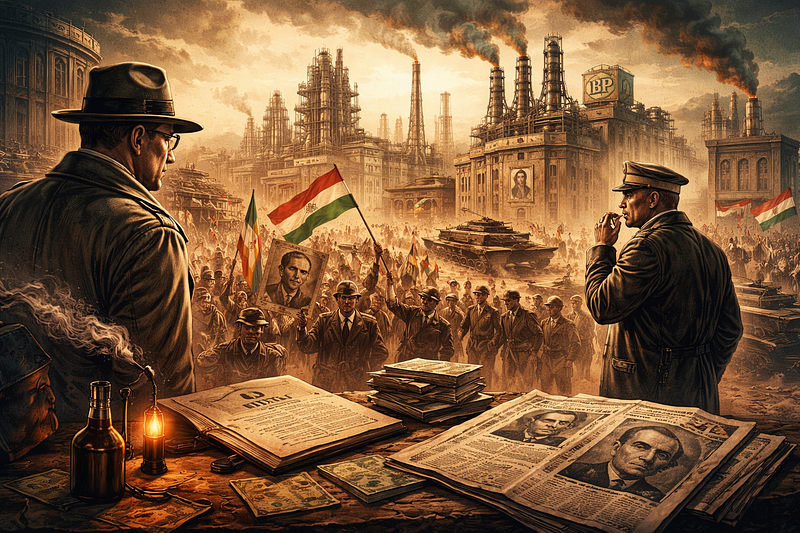
The coup failed the first time. This is the detail almost everyone forgets, and it is the one that matters most, because what a society does with a thing that nearly did not work tells you more than what it does with a success.
On the night of the fifteenth and sixteenth of August, 1953, the operation collapsed. The order to dismiss Iran's prime minister was delivered, the units meant to carry it out hesitated or refused, the plot leaked, and by morning it had become a fiasco. Mohammad Mossadegh was still in power. The Shah, who had signed the decrees and then waited to see if they would hold, panicked and fled the country, first to Baghdad and then to Rome. In Washington the cables turned grim. The CIA's own headquarters sent word to its man in Tehran that the thing was over and he should get out before he was caught.
He did not get out. Kermit Roosevelt Jr., grandson of a president, running the agency's side of the operation in the Iranian capital, decided the failure was not final, and over the next three days he spent what was left of his roughly one million dollars on the only assets that still answered: newspapers that would print what he paid them to print, officers who could be bought, and crowds that could be hired to fill a street and look like a nation rising. On the nineteenth of August the second attempt worked. Mossadegh was arrested. A general the agency had chosen, Fazlollah Zahedi, took his place. The Shah came home.
The story is usually told as a triumph of covert action, or as a crime against a democracy, and it is both. But the most consequential thing about the 1953 coup in Iran is not that it succeeded. It is that an operation which had failed three days earlier was, almost immediately, treated not as a near-disaster to be studied for its fragility but as a proven method to be used again. The lesson the United States took from Tehran was not caution. It was confidence. And confidence in a method is how an event stops being an event and becomes a template.
What the operation was actually for
Begin with the surface reason, because it is true as far as it goes, and then notice where it stops explaining.
Two years before the coup, in 1951, Iran's parliament had voted to nationalize the Anglo-Iranian Oil Company, the British concern whose refinery at Abadan was then the largest in the world and whose oil had fueled the Royal Navy and propped up Britain's postwar finances. The British government owned a controlling share of the company. For decades it had paid Iran a small fraction of the profits, declared its accounts in London where Iran could not audit them, and collected, in some years, more from the operation in British taxes than Iran received in royalties. Mossadegh, a constitutional nationalist rather than a revolutionary, nationalized the company through a lawful parliamentary vote, on the same sovereign principle by which any state claims its own ground.
Britain's response was not, at first, a coup. It was infrastructure. London organized a worldwide boycott of Iranian oil, pressured tanker companies not to carry it, withdrew the maritime insurance without which no cargo could move, and filed international legal challenges to cloud the title of every barrel Iran tried to sell. Iranian production fell from around six hundred and sixty thousand barrels a day to almost nothing. Iran owned its oil in law and could not sell it in practice, because the things that turn oil into money, the ships, the insurance, the refineries, the buyers, the settlement, were held outside its borders and could simply decline to cooperate. This is worth holding onto, because it is the quieter half of the lesson: a country can win sovereignty on paper and discover that sovereignty over a resource means nothing without control of the system that moves it.
When the embargo strangled Iran's economy without breaking Mossadegh's government, the operation escalated to the coup. And here the official reason and the real outcome begin to diverge. If the point was to restore British oil, the point was not quite achieved, because Britain did not get its monopoly back. What followed the coup was the 1954 Consortium Agreement, under which the old British company, soon renamed British Petroleum, kept forty percent of Iranian oil, and five American majors took forty percent between them, with the rest going to Shell and a French firm. The British monopoly was not restored. It was broken open and shared, and the new partner at the table was the United States, which had not been in Iranian oil at all before it helped remove the man who nationalized it. The coup did not return the old order. It produced a new one, in which America had acquired both a stake in the oil and something it valued more.
The thing worth more than the oil
What America acquired in Tehran, and carried out of it, was not primarily a share of a consortium. It was a proof.
Before 1953, the covert overthrow of a foreign government by the United States was a theory, an option discussed but not yet demonstrated, attended by the doubt that hangs over anything untried: that it might not work, that it might be exposed, that it might cost more than it returned. After 1953 it was a demonstrated capability. An elected government had been removed, in a strategically vital country on the Soviet border, for a sum so small it barely registered in a defense budget, without a single American soldier officially setting foot in the fighting, and with enough deniability that the CIA would not acknowledge its role in its own released records for sixty years. The operation produced a government, yes. But governments are temporary and were always temporary. What it produced that lasted was the knowledge, held now with evidence rather than hope, that this could be done, that it was cheap, that it could be hidden, and that it would be gotten away with.
That knowledge is the determining variable of this whole history, and it is why the coup matters far beyond Iran. An outcome affects one country. A proven method affects every country to which it might next be applied. Once an institution has watched a tool work, the tool changes the institution, because every future problem is now seen through the question the tool answers. A government that has demonstrated it can quietly remove an inconvenient leader will, from then on, find inconvenient leaders where before it might have seen merely difficult negotiations, because the existence of a cheap solution reshapes the perception of the problem. The coup did not just change Iran. It changed what the United States believed it was capable of doing, and a change in what a power believes it can do is a change in what it will attempt.
You can watch the template move almost at once. The same administration, the same Director of Central Intelligence, Allen Dulles, who had presided over the Iran success, turned the following year to Guatemala, where another elected government had moved against the land of an American corporation, and ran another covert operation, code-named PBSUCCESS, to remove another elected leader. The personnel on the ground were not the same men, and it would be wrong to claim a single team carried the playbook from Tehran to Guatemala City. What carried was something less visible and more powerful than a team. It was the doctrine and the confidence: the settled institutional belief, now backed by a recent success, that this was a thing the agency did, a normal instrument of policy rather than an extraordinary gamble. Iran proved the concept. Guatemala applied it. And the line that runs from one to the next is not a conspiracy of individuals but the ordinary way an organization adopts a method that has worked, the way any institution reaches again for the tool that solved the last problem cheaply.
The kit that could be used again
To see why the proof mattered, look at what the proof consisted of, because the components turned out to be as portable as the confidence they produced.
The operation had assembled, and shown to work, a small and repeatable kit. There was a chosen replacement, a general willing to take power and acceptable to the country's establishment, in this case Fazlollah Zahedi, identified and cultivated in advance so that the moment of removal would have somewhere to land. There was a purse, around a million dollars, modest enough to vanish in a national budget and large enough to buy what needed buying. There was a press operation, money paid to newspapers and journalists to fill the country with stories of chaos and communism until the public mood seemed to demand exactly the change the operation intended to produce. There were crowds for hire, demonstrators paid to fill the streets, and, in one of the cruder touches documented in the agency's own accounts, provocateurs encouraged to stage actions designed to discredit Mossadegh among religious audiences, so that the prime minister would be blamed for disorder his enemies were staging. And there was a legal fig leaf, the Shah's royal decrees dismissing the prime minister, which let the whole operation be dressed, after the fact, as a constitutional act of the monarch rather than a foreign intervention.
None of these components was specific to Iran. A chosen general, a purse, a paid press, a rented crowd, and a domestic figure of authority to sign the paperwork: this is a kit that can be packed and carried, and its power is precisely that it does not depend on the particular country it is used in. The achievement of 1953, from the point of view of the institution that ran it, was not that it solved Iran. It was that it produced a procedure general enough to be solved again elsewhere, a set of moves that could be lifted out of one crisis and set down in the next. An event teaches you about itself. A procedure teaches you about everything it might later be applied to, and what Tehran produced came to be understood, inside the institution, as a procedure.
Why a precedent outlives its result
Here is the asymmetry that makes a template so much more consequential than any single use of it, and it is the heart of the matter.
A government can be restored. The thing the coup undid in Iran, an elected nationalist administration, was the kind of thing that can in principle come back, and in some times and places it does. But a precedent, once set, cannot be unset. The day after the first successful covert regime change, the world contained a fact it had not contained the day before, which was that the most powerful state on earth would do this, could do this, and had done this, and no later event could remove that fact from the record of what was possible. They came for the oil and left with a method; others would come for the method, and the oil, or the canal, or the election, would be only the occasion. The single coup is reversible in a way the precedent it establishes is not, and that is why measuring 1953 by its Iranian outcome, by who got which percentage of which consortium, misses the larger and more permanent thing that was created, which was a lowered threshold, a demonstrated option, a new and standing item on the menu of what a great power does when a small country does something it dislikes.
This is also why the secrecy mattered so much, and why the eventual admission mattered. For decades the United States would not officially acknowledge its part in the coup; a Secretary of State first conceded a significant American role in 2000, and the CIA's own history said so in released form only in 2013. That reluctance was not mere embarrassment. A method works best when it is deniable, because deniability is what keeps it cheap, and what keeps it repeatable, and what prevents the accumulation of the political cost that open conquest incurs. The Iranians knew, the British knew, the historians increasingly knew, and still the formal silence held, because the formal silence was part of the instrument. Only in 2013, in documents released to the National Security Archive, did the CIA's own internal history finally describe the coup as having been carried out "under CIA direction as an act of U.S. foreign policy, conceived and approved at the highest levels of government." Sixty years is a long time for an agency to keep a secret that everyone already knows, and the length of the keeping is itself a measure of how valuable the deniability was, which is to say, of how much the method, and not just the single use of it, was worth protecting.
The two men, afterward
The asymmetry of the method shows in the fates of the two men at its center.
Mohammad Mossadegh, the elected prime minister, was tried for treason by the government that had replaced him, convicted, and sentenced at the end of 1953 to three years, after which he was held under house arrest on his estate outside Tehran until he died in 1967, a man who had nationalized his country's oil through a lawful vote and then spent the rest of his life as a prisoner of the order that undid it. Kermit Roosevelt, the officer who had run the operation and refused the order to flee, returned home, was quietly decorated, and would later write a memoir recounting the operation with something close to pride. One man lost a country's democratic future and his own liberty. The other gained a medal and a good story.
The point is not the contrast in their luck. It is what the contrast reveals about how the institution understood what it had done. A government that regarded the coup as a regrettable necessity, a distasteful exception never to be repeated, does not decorate the man who ran it and let him publish the tale; it treats the episode as something to be buried. The honoring of Roosevelt, and the ease with which the operation was recounted inside the agency long before it was admitted outside, tells you that within the institution this was never experienced as a crime or even an aberration. It was experienced as a success, a job well done, a capability proven. And an institution that experiences a thing as a success does not resolve never to do it again. It resolves to keep the capability.
The case the doubters make, which is not weak
Now the discipline, because this subject attracts an overconfidence that has to be resisted precisely where it feels most satisfying, and the strongest challenge to the standard story deserves to be put at full strength.
There is a serious revisionist argument, made most forcefully by the historian Ray Takeyh, that the popular account overstates the CIA's role almost beyond recognition. On this reading, the coup succeeded not because a clever American in a basement orchestrated it but because powerful Iranian actors, the clergy around figures like Ayatollah Kashani, the army, the merchant class, and the monarchists, had turned against Mossadegh and would have brought him down with or without Washington. Mossadegh, the argument continues, was no spotless democrat: by August 1953 he had dissolved parliament through a referendum reported at more than ninety-nine percent in his favor, conducted with separate yes and no voting booths, and had taken emergency powers to rule by decree, moves that alienated many of his own former allies. The Americans, in this telling, spent a million dollars to take credit for a fall that domestic forces were already producing. And it is true beyond dispute that the operation began as a British project, not an American one, and that the United States joined a scheme London had been pushing.
That case is not nothing, and an honest account has to grant its strongest parts. Mossadegh's late-stage moves toward one-man rule are documented and were real. Iranian actors were genuinely central; no coup of this kind succeeds in a country that is wholly united against it, and the operation worked by exploiting fractures that already existed rather than inventing them. The British origin is a matter of record. A reader who comes away believing that a single CIA officer simply reached into Iran and toppled a government like a chess piece has been told a fairy tale, and the Manifest's method is worthless if it cannot say so.
But notice what the revisionist case does not reach, and where the mainstream scholarship, from Mark Gasiorowski to Ervand Abrahamian, holds the line against it. To establish that Iranian actors were necessary to the coup is not to establish that the American role was unnecessary, and the two are routinely confused. The documented record, including the CIA's own history, shows money spent, mobs hired, officers recruited, newspapers paid, and a second attempt mounted precisely after the domestic forces had, on the sixteenth, failed to carry it. If the clerics and the army were going to do it anyway, the agency would not have needed to come back three days after the collapse and spend the rest of its budget making the street move. The honest position is not that the CIA single-handedly overthrew Mossadegh, which is false, nor that it was a bystander to an Iranian event, which is also false. It is that the operation was a genuine and probably decisive external intervention working through, and amplifying, real internal divisions, and, for the purposes of this essay, the revisionist debate barely touches the central claim at all. Whether the CIA's contribution was eighty percent or forty percent of the cause, what Washington took away from Tehran was the belief that it had done this, and that belief, not the precise apportionment of historical credit, is what became the template. A method is built from what an institution thinks it accomplished, and the United States thought, with reason, that it had removed a government and could do so again.
What the method cost, eventually
A template is adopted for its cheapness, and the cheapness is real in the short run and illusory in the long one, which is the part the institution that adopts it is structurally least able to see.
In Iran the immediate price was low and the eventual price was enormous, though the two were separated by enough years that the connection was easy to deny. The coup restored Mohammad Reza Shah, who ruled for another twenty-six years as an increasingly autocratic monarch, his secret police, SAVAK, established in 1957 with American and later Israeli help, narrowing the space for dissent until the only opposition that could survive was the one organized in the mosques, beyond the reach of a security service built to watch secular and leftist politics. When the revolution came in 1979, it was not caused by 1953 alone, and it would be a different kind of overreach to claim that it was. But the coup and the quarter century of Western-backed autocracy it enabled were woven through the grievances that made the revolution, and Mossadegh, the constitutional nationalist removed by foreign intelligence services, became the permanent symbol of a sovereignty interrupted from outside. The students who seized the American embassy in 1979 were acting partly on a fear, not irrational given the history, that the embassy would again become the command post for restoring a Shah, exactly as it had been in 1953.
This is the recurring blindness of the cheap method. The covert operation is selected because it appears to solve a problem at a fraction of the cost of war, and within the time horizon on which governments are judged, it does. The bill for the deeper consequence, the radicalization, the lost legitimacy, the enemy made permanent, arrives decades later, on a different administration's watch, severed by enough time and enough intervening events that it can always be attributed to something else. The method's cheapness and its catastrophe are both real; they are simply not visible at the same moment, and the institution books the cheapness immediately and discovers the catastrophe too late to connect it to the choice. A template is not only a tool that works. It is a tool whose true cost is structurally deferred past the point where anyone reaching for it has to weigh it.
The quieter template
There is a second template in this story, older and less dramatic than the coup, and it is the one most in use today.
Before the CIA ever moved, Britain had already demonstrated a different way to overturn a sovereign decision without an army: the embargo. By organizing the boycott, pressuring the tanker lines, and withdrawing the insurance, London showed that a country's lawful choice could be made inoperative simply by persuading the systems the choice depended on to stop cooperating. No government was overthrown by the embargo. It did something subtler. It proved that you did not need to overthrow a government at all if you could reach the infrastructure beneath it, that legal sovereignty could be left formally intact and quietly emptied of effect, and that this could be done with paperwork and pressure rather than guns.
Of the two templates Iran produced, this quieter one has proven the more durable, because it is even cheaper and even more deniable than the coup. The covert overthrow leaves a fallen leader and, eventually, a paper trail and a sixty-year secret. The infrastructure embargo leaves only a set of commercial decisions that each look defensible on their own, and a country that cannot sell its oil, or move its money, or run its systems, for reasons no single actor has to own. The modern descendants of the Abadan boycott are everywhere: the sanctions regimes that cut a state out of the dollar, the exclusions from payment networks that strand a country's banks, the quiet denial of the cloud or the chips or the settlement that a sovereign vote cannot conjure for itself. The tank in Tehran is the part of 1953 that history remembers. The insurance market that strangled Abadan before the tank ever rolled is the part that is still running.
Sovereignty as installed capacity
Step back from Iran to the principle the whole episode exposes, because it reaches well past oil and well past coups.
The deepest thing the 1953 coup demonstrated is that sovereignty is not what a parliament declares. It is what a country's infrastructure can actually execute. Mossadegh's government could vote, lawfully and unanimously, to own its own oil, and that vote was sovereign in every formal sense. What it could not do was conjure the tanker fleets, the insurance markets, the refineries, the foreign buyers, and the financial settlement that turn a barrel in the ground into revenue in a treasury, because those systems lived outside Iran and answered to other powers, and a resource you cannot move, insure, refine, or sell is a resource you do not, in the way that counts, control. The embargo proved this before the coup ever did. The coup only finished what the embargo had begun, which was the demonstration that legal ownership and operational control are different things, and that the second, not the first, is where sovereignty actually resides.
No army crossed Iran's border. No war was declared. No territory changed hands. Iran kept its flag, its parliament, its seat at the United Nations, and the outward forms of an independent state, and lost decisive control over the one asset on which its independence was supposed to rest. That gap, between the sovereignty a state displays and the sovereignty it can operate, is the space in which this kind of power works, and it is wider and more populated now than it was in 1953. A country today can be sovereign in law and dependent in fact on payment systems it does not run, cloud infrastructure it does not own, supply chains it does not control, and reserve currencies it cannot issue, each of them a modern version of the tanker insurance that strangled Abadan, each of them a place where a vote can be overruled not by an army but by the quiet withdrawal of a system's cooperation. Iran in 1953 learned the lesson first and at the point of a tank. The lesson itself was not about tanks.
What was really overthrown
So return, at the end, to the man under arrest on the nineteenth of August, and ask what was actually removed that day.
A prime minister was removed, and a government, and for a generation a particular Iranian future in which a constitutional nationalist might have built a state that owned its own resources on its own terms. Those were real losses and they belonged to Iran. But the thing that was created that day belonged to everyone, and it has outlived every person who was in Tehran. A method was proven. A threshold was lowered. An option that had been theoretical became, by demonstration, available, and the demonstration could never be taken back. The United States took nearly half a century to concede its role, and the CIA sixty years to put it in its own released history, and the admission, when it finally came, changed nothing about the method, because the method had long since stopped depending on the secret and started depending only on the memory, held in the institution, that it had once worked.
They came for the oil and left with a method, and the method was the part worth keeping. Every covert intervention that followed, in Guatemala the next year and onward through a long list, was in some sense a sequel to a film whose first reel had nearly failed on a August night when the plot leaked and the Shah ran and headquarters said come home. He did not come home. And because he did not, the world acquired not a single fallen government, which could have been mourned and eventually replaced, but a permanent piece of knowledge about what was possible, which is the one thing a coup produces that no later election can ever vote out.
Evidence Map
Facts, interpretations, forecasts, and disconfirming signals.
Core claim. The lasting product of the 1953 Iran coup was not the oil outcome (a modest British-to-Anglo-American split) but a TEMPLATE: the first demonstrated proof that the United States could covertly remove an elected government, cheaply (~$1M), deniably, and get away with it. The determining variable is the precedent itself, which is irreversible in a way the single government it removed was not. A proven method reshapes what a power believes it can do, and therefore what it attempts; Iran 1953 emboldened the covert-action doctrine carried into Guatemala 1954 (PBSUCCESS) and after. The coup's cheapness was immediate; its catastrophe (autocracy, SAVAK, the 1979 rupture) was structurally deferred.
Evidence level. Facts (high, documented): Iran's 1951 nationalization of the Anglo-Iranian Oil Company (renamed BP in 1954); the British boycott/embargo collapsing output from ~660,000 bpd toward standstill; the joint CIA-MI6 operation (TPAJAX / Operation Boot), ~$1M budget, Kermit Roosevelt Jr., the failed first attempt of 15-16 August 1953, the Shah's flight (Baghdad, then Rome by 18 August), the successful 19 August 1953 coup, Mossadegh arrested, Zahedi installed; the 1954 Consortium (BP 40%, five US majors 40%, Shell 14%, CFP 6%); SAVAK formed 1957 with US help; the CIA's 2013 acknowledgment ("under CIA direction," "an act of U.S. foreign policy"). Interpretation (medium, marked): the template/precedent reading; the doctrine-and-confidence transfer to Guatemala 1954 (continuity of doctrine, NOT identical field personnel); the coup→SAVAK→1979 link (mainstream but contested in degree, marked). Contested-as-fact (named): the revisionist case (Ray Takeyh) that Iranian domestic actors were decisive and the CIA role is overstated, presented as the strongest counter and noted as rejected by mainstream scholarship (Gasiorowski, Abrahamian, Alvandi). Also marked: Mossadegh's own authoritarian late moves (the August 1953 referendum) are real and granted. The US "regret" (Albright, 2000) was a regret, not a formal apology.
What would confirm this. Continued evidence that demonstrated covert-action successes lower the threshold for reuse; documented institutional reasoning that treats a prior covert success as license for the next; the persistence of deniability as the feature that keeps the method cheap and repeatable.
What would disprove this. Evidence that 1953 did NOT influence subsequent covert-action doctrine (that Guatemala 1954 and later operations were independent of the Iran precedent); or that the CIA role in 1953 was genuinely marginal (the strong Takeyh position), which would weaken "the United States believed it had done this" as the seed of the template.
Watchlist. How declassification continues to reshape the documented record; the recurring pattern of covert/structural intervention substituting for overt war; modern analogues where control of a system (payments, cloud, insurance, settlement) overrules a sovereign vote without an army.
Correction, 10 October 2026: an earlier version said the United States did not formally admit its role for sixty years. A Secretary of State acknowledged a significant American role in 2000; the CIA first did so in its own released history in 2013. References to Kermit Roosevelt working "from a basement" have been removed as unconfirmed. Details: themanifestarchive.com/standards.
Related from The Manifest Archive
- Chiquita: How a Corporation Learned to Rule Without Flags
- Hitler Lost the War. Von Braun, Gehlen and Dulles Won the Peace.
- Is the U.S. Dollar Losing Reserve Currency Status? The Quiet Erosion Explained
- The Deep State: The System That Never Stands for Election
Jerry van der Laan writes The Manifest Archive, daily forensic essays on power, language, and the systems that shape what we are allowed to see as reality. He traces the structures beneath them.