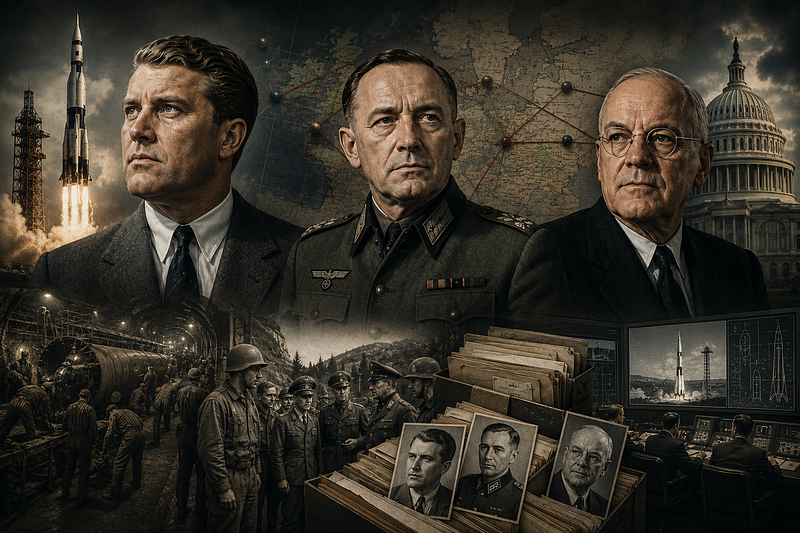
The Red Army broke the Wehrmacht. The order that replaced the Reich was built by three men: two who had served it and one who had negotiated with it.
What the Red Army did and what came after
The Soviet Union absorbed roughly twenty-seven million dead between 1941 and 1945. The great majority of German military losses were suffered on the Eastern Front. The decisive defeats of the Reich, Stalingrad in February 1943, Kursk in July 1943, Operation Bagration in the summer of 1944, were Soviet operations. The Western Allies opened the second front in June 1944, almost three years after Barbarossa, and met Soviet troops at the Elbe in April 1945. By every meaningful measure of the war as a war, the Soviets won it.
The emerging order in the Western occupation zones was not Soviet. It was American, and three of the German careers it absorbed are paradigmatic for the wider operation. Wernher von Braun, NSDAP member 5,738,692 and SS-Sturmbannführer, would design the Saturn V that lifted Apollo to the Moon. Reinhard Gehlen, chief of Wehrmacht Foreign Armies East, would build the West German intelligence service the Federal Republic still operates. Allen Dulles, OSS station chief in Bern and later director of the CIA, would help build the apparatus that absorbed both men, one that did not yet exist when the war ended and that they helped to design.
Hitler lost the war on the steppe. Three men who had served his regime, or negotiated with it, won the peace that replaced his regime in the West. Operation Paperclip is the visible part of that transfer. The wider operation begins where Paperclip ends.
This article is not written to argue that the United States chose Nazi Germany over the Soviet Union, nor to claim that an apex centre coordinated every step. It is written to argue something narrower and harder to dispose of. What was defeated was absorbed; what absorbed it was changed by what it absorbed. The defeat became the architecture, and the architecture became the present.
Wernher von Braun and the Saturn V that was built in Mittelwerk
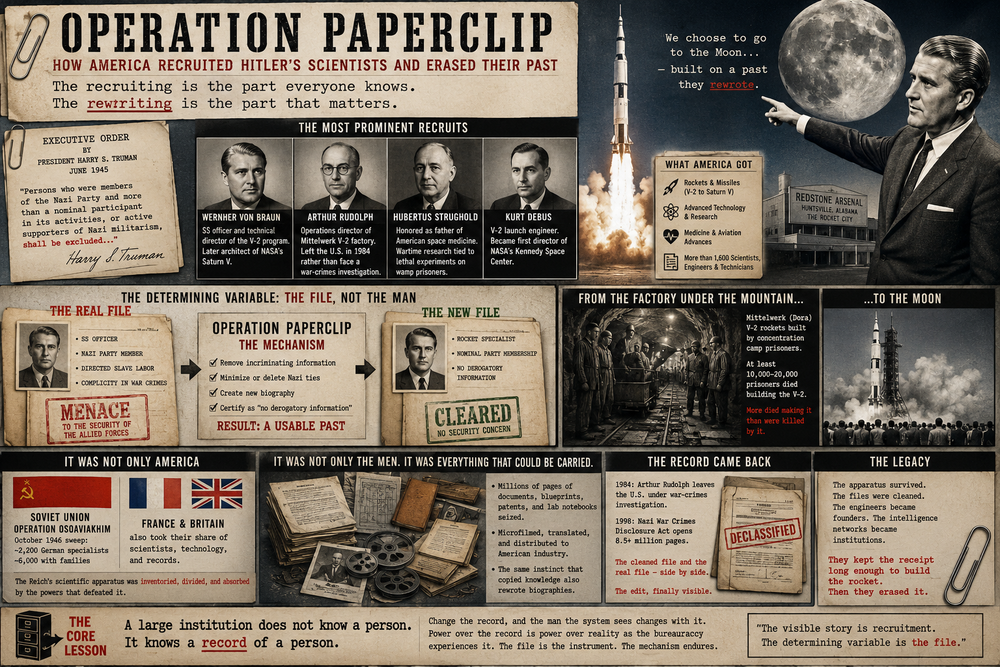
The V2 was not a precision weapon. It killed an estimated nine thousand people between September 1944 and March 1945, most of them civilians in London, Antwerp and other Western cities. Some twenty thousand prisoners died in the Mittelbau-Dora camp system that built it, around the underground production complex at Mittelwerk near Nordhausen in Thuringia; about twelve thousand of them died in the production itself. More people died building the weapon than were killed by it, and it is a fact about the V2 that does not appear in the Apollo monuments.
Von Braun was the V2’s scientific director. He applied for NSDAP membership on 12 November 1937. He joined the SS in 1940 and rose to Sturmbannführer. He later acknowledged visiting Mittelwerk about a dozen times and called the conditions repulsive, while saying he never saw anyone die there. He did not deny knowledge. He did not claim he could have changed them. He said he had no operational authority over the labour regime, which was true, and that he had concentrated on his rockets, which was also true.
On 2 May 1945 his brother Magnus approached a soldier of the US 44th Infantry Division in Tyrol, and von Braun, Walter Dornberger and a small group from the Peenemünde team surrendered. Fourteen tons of V2 documentation, hidden in a mine at Dörnten in Lower Saxony, were retrieved by US troops that month. He was thirty-three. He then helped the US Army choose which members of the Peenemünde team to bring to America. By the end of 1945 he was at Fort Bliss, Texas, under Operation Overcast, the pre-Paperclip cover. He and his team lived in Army barracks there. By 1950 he was at Redstone Arsenal in Huntsville, Alabama. In 1960 he became director of NASA’s Marshall Space Flight Center. He was the chief architect of the Saturn V that lifted Apollo 11 in July 1969. He received the National Medal of Science in 1975. He died in 1977.
The architecture that built the Saturn V was not built around von Braun. It was built around the Peenemünde team as a unit. Arthur Rudolph, Operations Director of Mittelwerk, became Saturn V production manager at Marshall and received the NASA Distinguished Service Medal in 1969. Kurt Debus, SS officer and Peenemünde test director, became the first head of the Kennedy Space Center and authorised the Apollo launches, including Apollo 11. Eberhard Rees succeeded von Braun at Marshall in 1970. Hubertus Strughold, who had directed Luftwaffe aeromedical research while experiments were conducted on Dachau prisoners, became the founding head of the Department of Space Medicine at Randolph Air Force Base and is still called, in some NASA historical literature, the Father of Space Medicine.
A documentary record this thick is not a story of individual recruitment. It is the record of an institutional design.
Reinhard Gehlen and the CIA’s eyes in Eastern Europe
Gehlen had been chief of Fremde Heere Ost, Wehrmacht’s Eastern Front intelligence directorate, since April 1942. By the spring of 1945 he understood two things. The Reich was finished. His files, his agents and his analytic templates were the most valuable Soviet-facing asset on the European continent.
In March 1945 he ordered the photographic duplication of his most important records and had the microfilm sealed in watertight drums and buried at several sites in the Alps. On 22 May 1945 he surrendered to the United States Counter Intelligence Corps near Schliersee in Bavaria. He brought no troops. He brought a map of the Alps marked with the cache locations, the agent rosters the cases contained, and the analytical templates that organised the rosters. By September 1945 he was at Fort Hunt in Virginia, debriefed by US Army G-2. By July 1946 he was back in Germany, running what would be called the Gehlen Organisation under American patronage, from late 1947 out of a compound at Pullach, near Munich. The organisation was staffed largely by ex-Wehrmacht and ex-SS personnel. It included figures with substantial war crimes records. Klaus Barbie, the Gestapo chief of Lyon who had tortured Jean Moulin to death in 1943, worked for adjacent CIC networks before American intelligence helped him reach Bolivia in 1951.
In 1949 the Gehlen Organisation was transferred from US Army custody to the new Central Intelligence Agency, which had itself been formed in July 1947. The Cold War’s most important organisational instrument and its most important Soviet-facing asset were thus operationally fused at the moment the Cold War was institutionalising itself. In 1956, when the Federal Republic of Germany was permitted to rebuild a security service, the Gehlen Organisation was reformed as the Bundesnachrichtendienst. Gehlen served as the BND’s first president until his retirement in 1968. He died in 1979.
The early CIA’s Soviet threat estimates leaned heavily on Gehlen-derived analysis. Those estimates were, by later assessments, often inflated. They were inflated because Gehlen’s institutional position depended on the Soviet threat being existential. They were also inflated because his network had been penetrated. Heinz Felfe, an SS officer who became Gehlen’s head of Soviet counterespionage, was unmasked in 1961 as a KGB double agent. By that date the Gehlen-shaped templates had already configured a decade of Western strategic doctrine. The Atlantic alliance was built, in part, on intelligence supplied by the regime the alliance had defeated, filtered through an officer the alliance’s principal adversary had partially controlled.
This is not a story that fits any standard rendering of the Cold War. It is the operational record.
Allen Dulles and the architecture of the postwar order
Allen Dulles was a Wall Street lawyer at Sullivan and Cromwell before the war and after the war. The firm represented German clients into the mid-1930s, including chemical and steel concerns whose participation in the Reich’s war economy was substantial. His brother John Foster Dulles, also at Sullivan and Cromwell, would become Eisenhower’s Secretary of State in 1953. The brothers’ careers map onto the postwar order with a precision that is hard to overstate. One designed its foreign policy. One ran its covert operations.
From November 1942 Dulles ran the OSS station in Bern. Switzerland was the only neutral capital with direct routes to senior German military, industrial and intelligence figures. He used those routes. He worked from a private residence in the Herrengasse. But it was not there that SS-Obergruppenführer Karl Wolff met him on 8 March 1945; the meeting took place further north, in Zurich, arranged by the Swiss intelligence officer Max Waibel. Wolff offered the surrender of German forces in northern Italy. Dulles took the offer. The arrangement was given the cover name Operation Sunrise. The negotiations were held without Soviet knowledge. Moscow was told of the contacts on 12 March and refused a place at them. Molotov protested on 22 March, and Stalin then accused Roosevelt directly. Roosevelt replied that there had been no negotiations, only contacts to arrange a meeting. The distinction was thin.
Wolff had been chief of Himmler's personal staff and was later convicted of complicity in the deportation of 300,000 Jews to Treblinka. He had directed reprisals against Italian partisans. He was not prosecuted at Nuremberg. He was held, then released, then arrested in West Germany in 1962, convicted in 1964, and released on health grounds after serving only part of his sentence. He died in 1984. The man Dulles dealt with in March 1945 lived as a free citizen of the Federal Republic for most of the postwar era.
Dulles became director of Central Intelligence in February 1953. He held the post until November 1961, the longest tenure in the agency’s history. In those eight years the CIA carried out the operations that became its postwar signature. The 1953 coup in Iran that removed Mohammad Mossadegh and restored the Shah. The 1954 coup in Guatemala that removed Jacobo Árbenz. The 1961 invasion of Cuba at the Bay of Pigs that ended his career. He was director when the CIA, which had taken the Gehlen Organisation over from the Army in 1949, handed it to Bonn in 1956, and his agency kept using former Nazi intelligence men well beyond that network. He sat on the Warren Commission after the assassination of John Kennedy, the man who had forced him out two years earlier.
The architecture that he and his brother helped design was not built around them. It was built so that the things they had been doing throughout the war and immediately after would have a home.
How JIOA, the National Security Act and NASA were designed around them
The institutions that absorbed Paperclip personnel were not pre-existing structures with a small Nazi component bolted on. They were structures that came into being in the same twenty-four months that the Paperclip recruitment was operationalised, and they were configured to make that recruitment durable.
The Joint Intelligence Objectives Agency was formed in July 1945 within the War Department. Its specific function was to coordinate the scientific intelligence exploitation of the defeated Reich. Its specific institutional innovation was to handle the contradiction between Joint Chiefs of Staff Directive 1067, which mandated denazification, and the recruitment imperative, which required men whose denazification screenings had marked them as unsuitable.
Truman’s directive of 3 September 1946 formalised Operation Paperclip. The directive’s plain language excluded anyone who had been “a member of the Nazi Party and more than a nominal participant in its activities”. JIOA reinterpreted “more than nominal” as a case-by-case clearance procedure that JIOA itself controlled. Specific files Linda Hunt later compared show unfavourable OMGUS security assessments replaced, in the versions submitted to the State Department, by findings that the men were not a security threat. The bureaucratic vocabulary of denazification was being preserved while its operational meaning was being inverted. In a letter to the State Department in March 1948, JIOA Director Bosquet Wev complained that the continuing focus on the scientists’ Nazi affiliations amounted to what he called, borrowing the phrase, “beating a dead Nazi horse”.
Internal opposition to these arrangements was real. State Department lawyers objected to specific clearances. The Immigration and Naturalization Service flagged personnel files. Drew Pearson’s syndicated column in 1952 named Walter Schreiber, a former Wehrmacht medical general working at Randolph Air Force Base, and within months he left Texas for Argentina. Each of these frictions produced a delay or a rerouting. None of them changed the trajectory of the programme as a whole. Absorption was a contested bureaucratic outcome, not a single coordinated act, and the contest was won by the side with operational momentum.
The National Security Act of 26 July 1947 created the National Military Establishment, renamed the Department of Defense in 1949, along with the National Security Council and the Central Intelligence Agency. NSC 4/A of December 1947 authorised psychological warfare as a permanent instrument. NSC 10/2 of June 1948 established what became the Office of Policy Coordination under Frank Wisner, who had helped design Operation Bloodstone, approved that same month. Bloodstone recruited Eastern European veterans of the Wehrmacht, the SS and Nazi-collaborationist police forces for covert action against the Soviet Union. The line between Paperclip, which was nominally about scientists, and Bloodstone, which was about covert operatives, was procedural rather than operational. Both relied on the same JIOA-style clearance logic.
The National Aeronautics and Space Act of 29 July 1958 established NASA as a civilian organisation. Marshall Space Flight Center, when it became part of NASA in 1960, was a direct administrative continuation of the Army Ballistic Missile Agency, which was a direct continuation of the Fort Bliss arrangement, which was a direct continuation of Peenemünde. NASA was civilian by statute. NASA’s senior leadership at Marshall and the Kennedy Space Center was substantially the same group of men who had built rockets for the Wehrmacht.
The institutional build-out and the recruitment of its personnel ran as inseparable processes. By the time the apparatus was named, the men were already inside.
The Russian counterweight that made all of this necessary
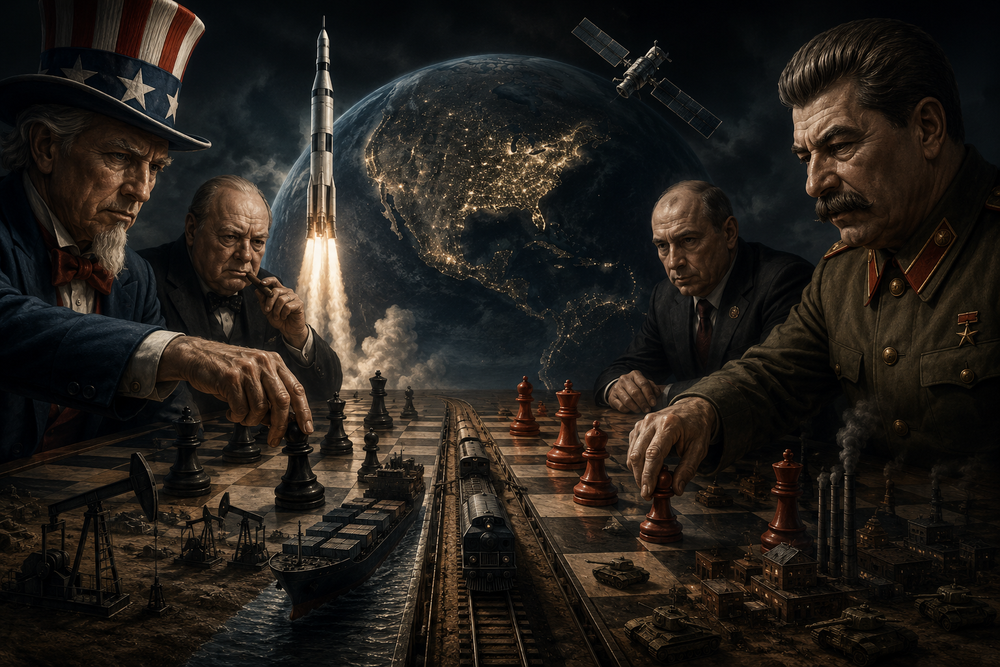
None of this would have been done without Russia. The Soviet Union was the structural reason the absorption operation was undertaken at the speed and on the scale at which it was undertaken. Three layers of Russian power had to be neutralised, and the neutralisation determined what the postwar architecture would have to be.
The Russian counterweight was geographic. Halford Mackinder’s Geographical Pivot of 1904 had named the Eurasian Heartland as the structural pivot of world power. Nicholas Spykman’s Geography of the Peace, published in 1944, restated the doctrine as a Rimland strategy. Whichever continental power held the Heartland could not be defeated by maritime power alone. The Heartland in 1945 was Soviet. The architecture that would contain it had to be a global ring of bases, allies and intelligence positions along the Rimland, and that architecture is what NATO, CENTO, SEATO and the basing system of the 1950s actually were.
The Russian counterweight was financial. The Sovnarkom decree of 21 January 1918 had cancelled Tsarist debt. It was the largest sovereign default in history to that point and held the record into the postwar period. Through the 1928-1941 five-year plans the Soviet Union built its industrial base substantially with imported American and German technology. The Magnitogorsk steel works were designed by Arthur McKee Company. The Stalingrad tractor plant was designed by the Detroit firm of Albert Kahn. The Gorky automobile plant was a Ford project. The Dnieper hydroelectric dam was constructed by Cooper Engineering. The financing came from Soviet gold reserves, grain exports, and currency arbitrage. It did not come from Western loans. There were no credits whose service could discipline Soviet policy. The Bretton Woods conference of July 1944 produced articles of agreement that the Soviet delegation signed and that the Politburo, in December 1945, declined to ratify. The dollar-anchored international monetary system that came into being in 1946 had no Soviet member. The dollar could not be used against the rouble in the way it would be used against every other industrial economy.
The Russian counterweight was ideological. Lenin’s Imperialism, the Highest Stage of Capitalism, written in 1916, had named British and American imperialism as the principal adversaries of the colonised world. The Comintern from 1919 had funded anti-colonial movements wherever they emerged. After 1945 Soviet economic and military support made it possible for Egypt, India, Indonesia, Cuba, Vietnam and a long list of other states to refuse Western conditions. When the United States and Britain withdrew their offer to finance the Aswan High Dam in July 1956, the Soviet Union financed it instead. The dam was completed in 1970 with Soviet engineering and Soviet credit. Cuba’s survival after the Bay of Pigs in 1961 and the missile crisis of 1962 depended on Soviet support. Indian non-alignment under Nehru, Tanzanian socialism under Nyerere and Egyptian Arab nationalism under Nasser were each made possible, even where they were not communist, by the existence of a Soviet alternative against which Western terms had to compete. The presence of the alternative softened Western leverage in countries that never adopted the Soviet model.
These three layers were what the Anglo-American architects of 1945 were working against. Operation Unthinkable, drawn up by the British Joint Planning Staff in May 1945 for an attack on the Soviet Union using rearmed Wehrmacht divisions in the same month that the Reich surrendered, demonstrates how complete the pivot from anti-German to anti-Soviet already was. The plan was found militarily unworkable. The orientation it expressed continued. The Iron Curtain speech of March 1946 made public a doctrine that had been operationally adopted nine months earlier.
The defeated Reich’s Eastern Front intelligence director, the defeated Reich’s V2 designer and the OSS officer who had negotiated with the SS were absorbed into the new American security state because the Soviet adversary across the line made them appear to the architects of that state as too valuable to lose.
Britain won the war in 1945 and lost the empire by 1956
The Anglo-American story has another half. Britain went into the war as the senior partner in a global empire and came out of it as the dependent junior of a successor power. The transition was already running before the war began, on at least eight separate fronts, but the war finished it.
Bretton Woods in July 1944 installed the dollar as the new anchor currency. The Anglo-American Loan of 1946 made convertibility a condition of British survival. When sterling became convertible on 15 July 1947 it collapsed within five weeks. The McMahon Act of 1946 excluded Britain from American atomic information after British scientists had helped build the bomb. The Tizard Mission of September 1940 had already handed over much of Britain's most secret technology, in search of American production capacity.
The Suez Crisis of November 1956 was the public ratification. Britain, France and Israel attacked Egypt without American clearance. The United States, through the United Nations General Assembly and through pressure on the pound sterling, forced a ceasefire within days and a full withdrawal by Christmas. The Royal Navy could not even guarantee its own oil tanker traffic without American cooperation. The administration in which John Foster Dulles was Secretary of State applied the pressure that ended the operation of its own formal ally. By 1956 the Dulles brothers held the foreign policy and the covert operations of the power that had emerged from the wartime transition as the senior partner. Whether the displacement of Britain was the original strategic aim or the structural outcome of asymmetric capacities applied across forty years, the documentary record does not finally resolve. The outcome is documented. The intent is hypothesis.
What survived the imperial transfer was the elite cluster that operated above the imperial level. The Pilgrims Society, founded in London in 1902 and in New York in 1903, kept the same families connected through the change of headquarters. The Council on Foreign Relations and Chatham House, founded in 1921 and 1920 by veterans of the same Versailles delegations, kept the same doctrinal frame circulating in two capitals. The hegemonic position migrated from London to Washington while leaving the substrate intact.
The three streams, and the one mechanism
Set the three men side by side and a structure appears that none of them alone reveals. Von Braun was the science, the rockets that became American missiles and the American space program. Gehlen was the intelligence, the networks of officers that became the West's eyes on the East and, in 1956, the nucleus of the West German BND. Dulles was the architecture, the lawyer turned spymaster who built the institutions that would hold the other two. Three domains, three men, two of them formed in the Reich’s service and the third its negotiating partner, each set at the foundation of a permanent American capability. The postwar order did not borrow them. It was built around them.
And all three streams ran through the same door. None of the German men at their centre was admissible under the rules the United States had just written for itself; each became admissible only after his record was managed, by the paperwork of the Joint Intelligence Objectives Agency, by the quiet arrangement that shielded an SS general, by the institutional decision to value the asset above the past. That mechanism, the conversion of a forbidden man into an allowed one by editing what the system is permitted to see, is examined in full elsewhere in this archive. The point here is that it was not applied three separate times by coincidence. It was the standard procedure of a state that had decided an enemy's apparatus was worth more than the principle that should have barred it, and it ran on all three streams at once.
The vehicle that made the arrangement permanent was the National Security Act of 1947, which in a single stroke created the Central Intelligence Agency, the National Security Council, and the unified military establishment that would become the Department of Defense. The absorbed men and the absorbed methods now had permanent homes, with budgets, charters, and successors. What had been a wartime improvisation in 1945 was, by 1947, the architecture of the state. The Reich was gone; its machine had been given American institutions to live in.
Did the Nazis win? The honest answer.
The title of this piece invites a claim it does not make, and the distinction is the whole point. No, the Nazis did not win. Their ideology was defeated and discredited, their state was destroyed, their leaders were hanged or imprisoned, and the racial project that defined them was stopped and remains, rightly, the moral floor of the modern world. Anyone who reads this as "the Nazis secretly run America" has missed the argument entirely, and that reading should be rejected as firmly as the regime itself.
The claim is narrower and, for that reason, harder to dismiss. What survived was not the ideology but the apparatus: the rocket science, the intelligence networks, the men who ran them, and above all the willingness to suspend a principle when an asset was valuable enough. The Reich lost everything it believed and kept almost nothing it stood for. What the victors took was the machinery, stripped of the creed, and folded it into a new order with its own purposes. That is not the Nazis winning. It is something more ordinary and more durable, an apparatus outliving the regime that built it, because apparatus, unlike ideology, is transferable. The men were not kept because of what they had believed. They were kept in spite of it, which is exactly why this story is about institutions and not about belief.
What 1945 built is still operational in 2026
The architecture that was assembled between May 1945 and April 1949 is still the architecture of the present. NATO, founded on 4 April 1949, has grown from sixteen members to thirty-two since the Soviet Union ceased to exist. Sweden joined in 2024. Finland joined in 2023. The Russia that the architecture was originally configured to contain is now contained more comprehensively, and on a longer perimeter, than it was in any decade of the Cold War.
The Bundesnachrichtendienst still operates. Its founding director was Reinhard Gehlen. The agency’s reckoning with its institutional past, undertaken by an official historical commission from 2011, is real but incomplete. CIA files released under the Nazi War Crimes Disclosure Act show at least a hundred former SD or Gestapo officers in the Gehlen Organisation. The commission also established that in 2007 the BND had destroyed 253 personnel files, about sixty of them belonging to men who had held significant positions in the SS, SD or Gestapo.
NASA still operates the Marshall Space Flight Center and the Kennedy Space Center. The Strughold Award of the Space Medicine Association was retired only in 2013. In 1984 the Saturn V production manager, Arthur Rudolph, gave up his American citizenship and returned to West Germany rather than face denaturalisation proceedings. Forty years later most Apollo retrospectives still describe von Braun as a German rocket engineer who came to the United States after the war.
The pattern that this article documents is not over. It is operational. The institutions that were filled in 1945 are still standing. The doctrine that was written in NSC 68 in 1950, that the United States must bear the costs of organising a permanent global containment of a structural adversary, has been transferred from the Soviet Union to Russia, and is being prepared for transfer again, to China, with the same vocabulary and the same instruments.
Hitler lost the war on the steppe in 1943. The men he had trained, and the OSS man who had negotiated with his SS, designed what came after. They did not design it because they believed in him. They designed it because the strategic position they inherited required absorption rather than punishment, and because the adversary across the line was the same adversary their grandfathers’ classical-strategic education had named as the structural pivot of world power.
By 1960 the architecture had been built. Its senior personnel at NASA Marshall, the Kennedy Space Center, the Pullach station of the new Bundesnachrichtendienst, the chemical and biological research at Edgewood and Detrick, and the aerospace medicine programmes at Randolph included a substantial number of men who in 1944 had been officers, scientists or administrators of the regime that the architecture had defeated. This continuity is in the personnel files. It is acknowledged in the work of the historical commission the Bundesnachrichtendienst appointed in 2011, and in the Nuremberg declaration of 2012 in which the German Medical Assembly accepted the profession’s responsibility for crimes under National Socialism.
The personnel continuity was not incidental. By 1960 it had become institutional. The men named in this article had served a regime that lost the war. They were paid by a regime that won the peace.
The names are public. The archives are open. The facts have been in the record for thirty years. What is missing from the standard narrative is not access to the facts. What is missing is the assembly.
Sources for this piece are catalogued in the Paperclip dossier of The Manifest Archive. Primary records: NARA RG 330 (JIOA personnel files), RG 263 (CIA Name Files released under the 1998 Nazi War Crimes Disclosure Act), RG 549 (CIC records), British National Archives CAB 120/691 (Operation Unthinkable). Scholarship: Linda Hunt, Christopher Simpson, Annie Jacobsen, Eric Lichtblau, Tom Bower, Adam Tooze, Carroll Quigley, Götz Aly, David Edgerton, Frank Costigliola. The Interagency Working Group’s 2005 and 2007 reports remain the official synthesis.
The Von Braun thread runs deeper. Did Wernher von Braun Predict the Alien Card? traces the threat-selection mechanism from Peenemünde to the policy instruments von Braun would later see deployed.
Jerry writes The Manifest Archive. Forensic analysis of the institutional structures that shape geopolitics, history, and power. Published on Substack and Medium.
Correction, 10 October 2026: a revision on that date corrected the location of Mittelwerk, the V2 document cache and Gehlen's surrender; the V2 death tolls; the details of Karl Wolff's conviction; the interval between Dulles's dismissal and the Warren Commission; NATO's enlargement since 1991; the end of the Suez crisis; and the builder of the Stalingrad tractor plant. A claim that Dulles oversaw the protection of Klaus Barbie was removed. Details: themanifestarchive.com/standards.
Related from The Manifest Archive