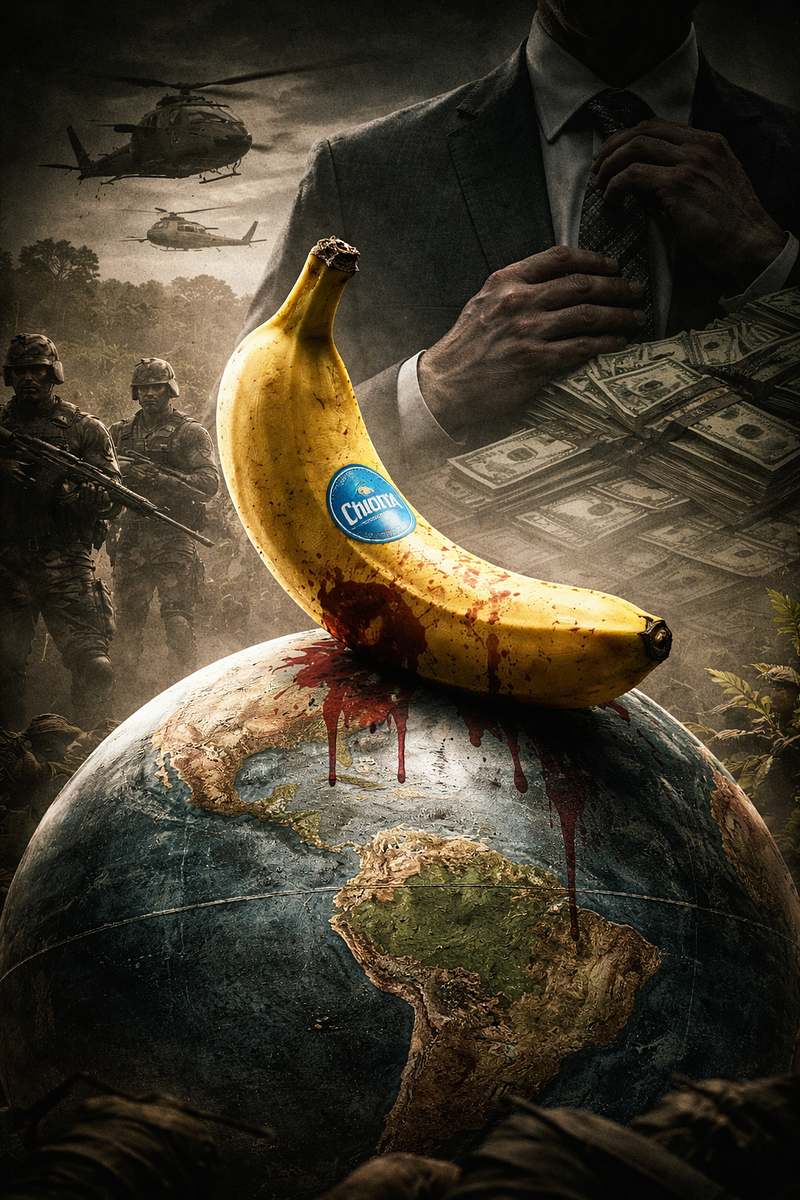
A banana lies on the supermarket shelf under a small oval sticker, and nothing about it asks to be explained. It costs less than almost anything else you can eat. It arrives every day of the year from thousands of miles away, ripened on schedule, unblemished, identical to the one beside it. It carries no trace of how it got there. That smoothness is not a property of the fruit. It is the finished output of more than a century of work, most of it not agricultural, by a company that learned to do something most corporations never attempt and most governments would envy. It learned to govern without holding office, to rule territory it did not formally own, and to keep doing both long after it had been caught, fined, and convicted.
Here is the fact that should be the hardest to absorb, and is somehow the easiest to forget. In 2007 the company that sells that banana, Chiquita Brands International, pleaded guilty in a United States federal court to financing a terrorist organization. Not metaphorically. It admitted to more than a hundred payments, over several years, to a Colombian paramilitary group on the State Department's list of foreign terrorist organizations. And the detail that turns a scandal into a structural finding is this: in the same period, in the same country, it had also paid the left-wing guerrillas those paramilitaries existed to fight. It did not fund a side. It funded whoever controlled the ground its fruit grew on. That is not the behavior of a victim, and it is not quite the behavior of a criminal. It is the behavior of a sovereign managing its security policy.
This essay is about that sovereignty, the kind that needs no flag, and about why it has proven so much harder to hold to account than the governments it operated among.
What a company is, when it stops being only a company
Begin before the name Chiquita, because the apparatus is older than the brand.
The company was born in 1899 as the United Fruit Company, a merger of a Boston importer and the Central American holdings of a railroad man named Minor Keith. From the start it was not, in any ordinary sense, a fruit seller. It was an owner of the conditions under which fruit could be grown and moved. By the 1930s it held something on the order of three and a half million acres across Central America and the Caribbean and was the single largest landowner in Guatemala. The acreage is the least of it. What matters is the list of things it owned that have nothing to do with farming.
It owned the railways. Through a subsidiary it controlled the International Railways of Central America, which by the early twentieth century held nearly all of Guatemala's rail network, including the country's only rail link to the Caribbean coast, and charged independent growers many times the rate it charged itself. It owned the ports those railways ran to. It owned the ships, the famous Great White Fleet, that carried the fruit across the sea. It built and ran the telegraph and radio network across the region through its own communications company, becoming, improbably, one of the early partners in the American radio patent pool alongside the firms that became RCA and AT&T. In 1901 the government of Guatemala hired it to run the national postal service. It built the towns its workers lived in, the housing they slept in, the hospitals that treated them, the stores they bought from. In Latin America they did not call it the United Fruit Company. They called it el pulpo, the octopus, because there was no part of national life its arms did not reach.
Add those holdings together and a strange object comes into view. A government legislates, taxes, moves people and goods, carries the mail, runs the wires, and polices its territory. United Fruit did all of those things across whole regions of several countries. The difference was not in function. It was in accountability. A government that does these things answers, however imperfectly, to the people it does them to. United Fruit answered to shareholders in Boston. It had acquired the powers of a state without acquiring a single one of the obligations, and the gap between those two was not a loophole it had found. It was the entire business model.
The town with one owner
The abstraction of railways and ports becomes concrete in the place where a worker actually lived, because the company governed not only territory but lives, completely.
A man who cut bananas for United Fruit could be born in a company hospital, housed in company barracks, paid in a form that spent best at the company store, treated by the company doctor, and buried in company ground, without a single one of those institutions answering to anyone he could elect. The enclave, as economists later called it, was a self-contained world in which the firm supplied every function a town normally divides among employers, landlords, governments, and merchants, and held all of them at once. For the worker this was not a metaphor for sovereignty. It was the daily experience of living inside an institution that set his wage, owned his home, priced his food, and policed his movement, an institution he could not leave without leaving everything, because the company was not merely his employer in the place. It was the place.
What happened when that arrangement was challenged shows where the real power sat, and it is the oldest receipt in the file. In late 1928, tens of thousands of United Fruit workers in the Colombian region of Ciénaga struck for the most elementary terms, written contracts and an end to being paid in coupons redeemable mainly at company stores, the things a labor force asks for when it has none of them. The Colombian government, pressed by the company and by an American government warning of disorder, sent in the army. On the night of the fifth and sixth of December, soldiers opened fire on workers and their families gathered in a town square. The death toll has never been settled, and the gap in the count is part of the story. The commanding officer reported forty-seven dead; historians' estimates run upward toward two thousand; no one will ever know, because the bodies of the people who cut the bananas were not the kind a state of that era counted.
Hold that beside the structure. The company did not fire the rifles. The state's army did. But the army was in that square because the company's interest and the era's fear of disorder had converged on it, exactly as they would converge on a Guatemalan election a quarter century later, and the company kept its plantations and its labor terms while the state absorbed the dead and the blame. This is sovereignty by proxy, the cleanest form of the whole mechanism: the power to have violence done on your behalf by an institution that will answer for it, while you answer for nothing, because on paper you only grow fruit.
Why no one had to plan this
It is tempting, looking at that octopus, to imagine a conspiracy, a design, men in a room deciding to seize a continent. The documents do not show that, and the truth is more durable than a plot, because a plot can be exposed and stopped and this could not.
The state functions were not seized. They were required, by the fruit itself. A banana is a clock with the alarm already ringing. It is harvested green and rots fast, which means it cannot wait for a railway that may or may not come, a port that may or may not be free, a government that may or may not honor a contract next year. To move a perishable crop at scale across weak and unstable states, a company must control the railway, or the railway will fail it. It must control the port, or the port will be closed to it. It must secure the land, the labor, and the route, because any link it does not own is a link that can break in the eight days the fruit has left to live. Each acquisition was a rational answer to a real vulnerability. The octopus did not grow because anyone wanted an octopus. It grew because every arm solved a problem the last arm had created.
This is the part that the moralizing version of the story gets wrong, and getting it wrong is what lets the structure survive. There was no master who decided that a corporation should rule Central America. There was a crop that could not survive an unreliable state, a company that could not survive an unreliable crop, and a logic that drove the company to internalize one state function after another until it had, without ever declaring it, become a government that happened to be owned. The economist's name for an order like this is emergent: a pattern that looks designed but assembled itself out of many separate, sensible decisions, each one defensible, the sum of them a sovereignty no one had voted to create. You cannot indict a logic. That is precisely why it was so safe.
When an election becomes a logistics problem
The trouble with becoming a government you did not run for is that real governments occasionally appear and try to do their job, and the most famous collision of the company's history is the one where that happened.
In 1951 Guatemala elected Jacobo Árbenz, who set out to do the single thing most threatening to a landowner whose power rested on holding land it did not use. His agrarian reform, Decree 900, allowed the state to expropriate uncultivated land and compensate the owner at the value the owner had declared for tax purposes. United Fruit had spent years declaring its land nearly worthless to lower its taxes, and now the state proposed to pay it exactly what it had claimed the land was worth. The company that had gamed the valuation in peacetime found the valuation turned against it, and it objected, not through the Guatemalan courts, where it would lose, but through Washington, where it would not.
Here the discipline of the record matters, because the popular version overreaches in a way that weakens the real point. It is often said flatly that United Fruit ordered the 1954 coup. The documents do not support a single corporate order, and the claim is not necessary. What the documents do support is convergence. United Fruit lobbied intensely, spending heavily and hiring the public-relations pioneer Edward Bernays to recast a land dispute as a communist beachhead in the hemisphere. Its law firm, Sullivan and Cromwell, had deep ties to the two men running American foreign policy, Secretary of State John Foster Dulles and his brother Allen, the director of the CIA. And the United States had its own reason to act, independent of bananas: a Cold War doctrine that read any leftward land reform in its backyard as a Soviet foothold. The CIA's operation, code-named PBSUCCESS, removed Árbenz in 1954. Decree 900 was repealed. The company's land was restored.
You do not need the company to have given an order. You need only to see what the structure made possible. A corporation that could not win inside one country's law reached past that law to a superpower whose strategic fears its commercial interest happened to fit, and the machinery of a government far larger than Guatemala was brought to bear on the problem of a Guatemalan election. The coup was followed by decades of military rule and civil war in which more than two hundred thousand people were killed or disappeared. United Fruit kept its holdings. The country kept the consequences. The company had discovered that a democracy, when it became inconvenient, could be treated not as a sovereign to be respected but as an obstacle to be routed around, and that there existed, in Washington, an address where that routing could be arranged.
The receipt no one had to sign
To see how old and how consistent the pattern was, step back four decades from Guatemala, to a man who did order a coup, and did so personally.
In 1911 Samuel Zemurray, a banana importer who would later run United Fruit itself, financed the overthrow of the government of Honduras to protect the interests of his own fruit company. He did not lobby for it or hope for it. He bought a surplus warship, hired two American mercenaries out of New Orleans, backed a deposed former president, and put him back in power, after which the new government rewarded Zemurray with the land and tax concessions he wanted. Zemurray was not a rogue. He was so successful that United Fruit eventually bought his company, and in 1933 he took control of United Fruit, becoming its president a few years later. The man who had privately purchased a national government became the head of the largest agricultural enterprise in the hemisphere, and nothing about that was treated as a scandal at the time. It was treated as competence.
What changed between 1911 and 2007 is not the behavior. It is the paperwork. Zemurray's coup left almost no trace that could be prosecuted; it was simply how business was done in a place the law did not reach. By the time the same impulse reappeared in Colombia at the end of the century, it left a paper trail, because the modern corporation documents everything, and that documentation is the only reason we can now see the structure at all. The continuity is the finding. The company did not become more violent over the century. The world became better at writing things down, and the writing caught a pattern that had been running, unrecorded, since before the company had its modern name.
Violence with invoices
So come to Colombia, where the structure left its receipts, and where the both-sided payment exposes what kind of actor the company really was.
Through the 1990s and into the 2000s, Colombia was fractured by overlapping wars between the state, left-wing guerrillas, and right-wing paramilitary federations, the largest of which was the AUC, responsible for some of the worst massacres of civilians in the conflict. Chiquita grew bananas in the middle of that terrain. Between 1997 and 2004 it made more than a hundred payments, totaling around 1.7 million dollars, to the AUC. The United States designated the AUC a foreign terrorist organization in September 2001, which made paying it a federal crime, and the most damning fact in the entire record is what the company did after that date: it kept paying. Roughly fifty more payments, more than eight hundred thousand dollars, flowed to a designated terrorist organization after the company knew, and its own lawyers knew, that the payments were now illegal.
And before the paramilitaries, the company had paid the other side. The documents, later assembled and published as the Chiquita Papers, show payments over the preceding years to the left-wing guerrillas, the FARC and the ELN, the very forces the paramilitaries had formed to destroy. The company's money went, at different times, to both armies of a civil war. This is the detail that dissolves the simplest reading. A company that funds one side of a conflict has taken a side, for profit or for ideology. A company that funds whichever side controls the ground beneath its plantations has done something else entirely. It has treated the armed groups of a country the way a state treats the weather, as a condition to be managed and paid for, and it has run, in effect, its own foreign and security policy, choosing its counterparties not by loyalty but by who could deliver the one thing the fruit required, which was an uninterrupted route from the field to the ship.
The company said it had no choice. The payments, it insisted, were extortion, money handed over under threat to protect its employees from being killed. That claim deserves to be heard, and it is not nothing, and we will return to it at full strength. But notice for now only what it concedes. To say you paid because an armed group could otherwise have killed your people is to admit that you were operating in a place where you, not the state, were negotiating directly with the men who held the guns. The extortion defense is itself a description of sovereignty. States get extorted by other powers. Suppliers get extorted by criminals. Only an actor that has assumed a state's exposure on foreign soil finds itself, year after year, personally treating with the militias over the price of peace.
What the law could and could not do
When the structure was finally dragged into a courtroom, the courtroom revealed its own limits, which are the limits of holding a sovereign-shaped thing to account with tools built for companies.
In 2007 Chiquita pleaded guilty to engaging in transactions with a designated terrorist organization and was fined twenty-five million dollars. Measured against the crime, the number is strange. No senior executive went to prison. No board member was barred. No license to operate was revoked. The company paid the fine out of the revenue the conduct had helped protect and continued selling bananas without a day's interruption. The law had performed its function, which was to convert an atrocity into a figure on a balance sheet, a cost the enterprise could absorb and move past. A fine that a company can pay and survive is not a punishment in the sense that a prison sentence is a punishment. It is a price, and a price is just the toll on a road the traveler intends to keep using.
It took until 2024 for the other kind of accountability to arrive, and its rarity tells you everything. That year, a federal jury in Florida found Chiquita liable for financing the AUC and awarded 38.3 million dollars to the families of eight people the paramilitaries had killed. It was widely described as the first time an American jury had held a major American corporation liable for human rights violations committed abroad. The first time. A company structure more than a century old, exercising state functions across multiple countries, and the legal system produced its first such civil verdict in 2024, in a single bellwether trial, subject to appeal, covering eight deaths out of a war that consumed tens of thousands. The verdict is real and it matters. It is also a measure of how nearly impossible the law has found it to reach this kind of actor, and how long the reaching takes, and how little of the conduct any single judgment can touch.
The address that does not exist
Now the determining variable can be named, and it is not greed, and it is not violence, both of which are ordinary and everywhere. It is the absence of an address.
A state, for all its power, has a permanent vulnerability that a corporation does not. It is fixed. It cannot move its territory, it cannot change its population overnight, and it answers, through elections or through force, to the people who live inside its borders. You always know where a state is, which means you always know where to send the bill. A flag is, among other things, the mark of that location, the public declaration of an entity that can be found, held, invaded, voted out, or made to answer, because it is somewhere and cannot be elsewhere. The state could be reached but could not move. The company could move but could not be reached. It had no territory of its own to defend, no citizens who could vote out its leadership, no fixed place where the consequences of its conduct could be served. It operated everywhere and resided, for the purposes of accountability, nowhere. When Guatemala became hostile, the structure routed around Guatemala. When Colombia generated lawsuits, the conduct was already decades into the past and the company was an abstraction headquartered in another hemisphere.
This is what it means to rule without a flag. The company never needed to claim sovereignty, raise an army of its own, or print its own money, because claiming sovereignty would have created exactly the fixed, findable, accountable thing it benefited from not being. It exercised the functions of a state, transport and communication and security and the management of violence, while wearing the legal form of a private enterprise, which carries none of a state's duties and, crucially, none of a state's fixed address. Sovereignty is power that can be located and therefore, in principle, held to account. What the company invented, and what the modern corporation perfected after it, is power that performs sovereign functions while remaining unlocatable, an octopus with no head you can point to, because the head is a share register and the share register can be anywhere.
Why it takes a generation
The distance between the conduct and the reckoning is not an accident of slow courts. It is the structure defending itself in the one venue left to it.
The lawsuits over the Colombia payments were filed not long after the 2007 plea, and the first jury verdict against the company did not arrive until 2024. Seventeen years passed between the admission of guilt in a criminal court and the first finding of civil liability to a victim, and most of those years were spent not on whether the company had paid the paramilitaries, which it had already confessed, but on the prior questions the corporate form makes available: which court has jurisdiction, whether a parent company answers for what happened on a plantation, whether American courts can hear claims about deaths in Colombia at all, whether the duress the company asserted shielded it. These are not frivolous questions. They are the legitimate machinery of the law. But in aggregate they are the procedural expression of the missing address. A defendant that is everywhere and nowhere can contest, at length and in good faith, exactly where and whether it can be sued, and each contest is a year, and the years are themselves a form of protection, because witnesses die, memories fade, and the public that was briefly outraged moves on.
A government accused of a massacre cannot litigate for seventeen years over whether it is the right defendant. It is the defendant, and everyone knows where it is. The corporation's advantage was never that it stood above the law. It is that the law found it hard to locate, and that difficulty converts, on its own, into delay, and delay converts into impunity by attrition. The 2024 verdict is real precisely because it is so rare, and it is rare because reaching a sovereign with no address takes a generation of effort to do a single time, for eight deaths, subject to appeal.
The company's case, which is real
The strongest version of the other side has to be put now, at full height, because an argument that cannot survive the best objection does not deserve to be believed, and on this subject the objection is genuinely strong.
The company built things that were real and that lasted. The railways, the only Caribbean rail links some of these countries had, the ports, the telegraph and radio networks, the plantation hospitals and housing and the steady wages, were genuine infrastructure and genuine employment in regions that had little capital and few institutions capable of providing either. Millions of people ate affordable fruit because the system worked. On Colombia, the company operated in a theater of real and lethal violence, where armed groups extorted every business of any size, and its claim that the payments were made under duress, to keep its workers from being murdered, reflects a true and terrible dilemma that any firm in that position would have faced, even if a court later ruled it could not hide behind duress alone. On Guatemala, the coup had real Cold War drivers that existed entirely apart from bananas, and it is neither fair nor accurate to load the whole weight of 1954 onto a fruit company. And the states the company operated among were genuinely weak and genuinely unstable before it arrived and after it left, which means the company did not create the chaos it navigated, and often navigated it the way anyone would have.
All of that is true, and the honest form of this argument depends on granting every word of it. But notice what it does not reach. Each clause is a defense of the company's conduct, and the finding here was never primarily about conduct. It is about form. Grant that the infrastructure was real, that the duress was real, that the Cold War was real, that the instability predated the fruit, and the structural fact stands untouched: an entity performed the functions of a state across foreign territory while bearing none of a state's accountability, and that combination, not any single act of violence, is the thing that proved so durable. A government that built those railways could be voted out for the way it built them. A government that paid both sides of a war could be overthrown for it. The company could be neither, and that asymmetry is not erased by the reality of the extortion or the usefulness of the railways. It is exactly what the extortion and the railways were operating inside.
What the sticker hides
So return to the shelf, and to the banana under its small oval sticker, because the object and the structure are finally the same thing.
That frictionlessness, the low price and the constant supply and the total silence about its own history, is not the absence of a story. It is a story that has been completed: the land secured, the route controlled, the violence paid for, the fine absorbed, the name itself rebranded from United Fruit to Chiquita, every rough edge sanded down across a century until what reaches you appears to have no origin at all. The company did not hide its history from you. It did something more thorough. It metabolized that history into the price, present in every cent of how cheap the fruit is and visible in none of it.
This was never a story about bananas, and it did not end when the plantations became supply chains. The lesson the fruit company taught the century after it is portable, and it is being applied now by enterprises that would never touch soil: that an actor can perform the functions of a state, and answer for them in money it can always find more of, so long as it never takes on a state's fixed and findable form. A government can be held to account because you can find it. The genius of ruling without a flag is that there is no door on which to serve the bill, so the bill is folded into the price of everything, paid by everyone, and addressed to no one.
Evidence Map
Facts, interpretations, forecasts, and disconfirming signals.
Core claim. United Fruit / Chiquita is the clearest case of a private entity that acquired the FUNCTIONS of a state (land, railways, ports, communications, the postal service, security, the management of violence) while bearing NONE of a state's accountability. The determining variable is not greed or violence but the absence of a fixed, findable address: a state can be reached but cannot move; a corporation can move but cannot be reached. This is "rule without a flag," and it explains why the structure proved so much harder to hold to account than the governments it operated among. The apparatus is emergent, not a plot: a perishable crop across weak states forced the internalization of state functions one by one.
Evidence level. Facts (high, documented): United Fruit formed 1899; ~3.5M acres and largest landowner in Guatemala by the 1930s; control of the International Railways of Central America, ports, the Great White Fleet, Tropical Radio/telegraph, and the Guatemalan postal service (1901); "el pulpo." Zemurray's privately financed 1911 Honduras coup and his 1933 takeover of United Fruit. Guatemala 1954: Árbenz elected, Decree 900 land reform, UFCo lobbying + the Bernays campaign + the Dulles/Sullivan & Cromwell ties, CIA operation PBSUCCESS, land restored, ~200,000 killed in the subsequent decades of war. Colombia: Chiquita's 2007 guilty plea, ~$1.7M in 100+ payments to the AUC (1997-2004), ~50 payments / >$825,000 AFTER the Sept 2001 FTO designation, $25M fine; documented payments also to FARC/ELN ("paid whoever held the ground"); the June 2024 Florida jury verdict, $38.3M to 8 families. Interpretation (medium, marked): the reading that the determining variable is "sovereign functions without a sovereign's address," and that the apparatus is emergent from the logic of the perishable crop. Contested / attributed (marked): the 1928 Banana Massacre death toll (47 to ~2,000, disputed); the duress defense (the company's claim, judicially limited, not an accepted finding); "first" not "only" US corporation so convicted; the 2024 verdict is a bellwether, appealable. Rejected overclaim (named): that United Fruit alone "ordered" the 1954 coup; the record supports convergence of corporate interest and Cold War strategy, not a single corporate order.
What would confirm this. Further cases of private entities performing state functions abroad while escaping state-level accountability; continued multi-decade lag and partial reach of legal remedies against such actors; the recurrence of the "pay whoever holds the ground" pattern among firms operating in contested territory.
What would disprove this. Evidence that the company was, in accountability terms, no different from a fixed domestic firm (routinely reachable, its leadership removable by those it harmed); or that its state functions were trivial rather than load-bearing; or that legal systems in fact reach such actors as readily as they reach governments.
Watchlist. The remaining Chiquita multidistrict cases after the 2024 bellwether and any appeal; the broader question of corporate liability for conduct in conflict zones; modern analogues where supply-chain control substitutes for territorial sovereignty.
Related from The Manifest Archive
- Microsoft and the Digital Veto
- Who Owns the Federal Reserve?
- Everyone Is Watching Food Prices. Nobody Is Watching the Gas That Feeds Half the World.
- Palantir: How CIA Seed Capital Became the Backbone of American Government
Jerry van der Laan writes The Manifest Archive, daily forensic essays on power, language, and the systems that shape what we are allowed to see as reality. He traces the structures beneath them.