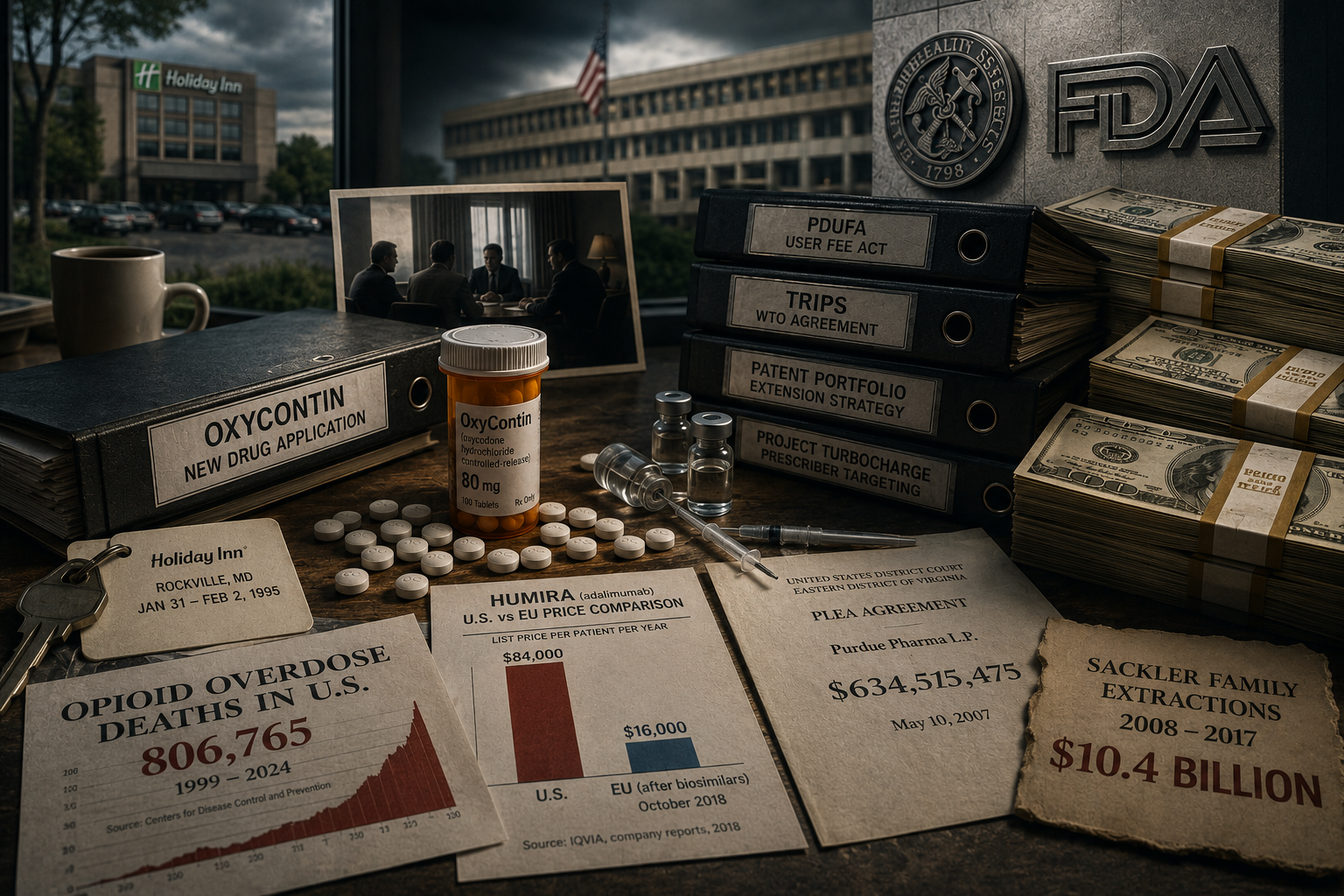
A Holiday Inn near the FDA office park in Rockville, Maryland. January 31 through February 2, 1995. Three days. The agency officer was named Curtis Wright. He was the Deputy Director of the FDA’s Division of Anesthetic, Critical Care and Addiction Drug Products. The men sitting across from him represented Purdue Pharma. The new drug application on the table was for OxyContin, a controlled-release formulation of oxycodone that Purdue wanted to position as less prone to abuse than existing opioids. The medical officer’s review of that application, the document that would form the basis for the FDA’s approval decision, was being drafted in that hotel room. It was being drafted with the company that had submitted it.
Ten months later, in December 1995, Wright signed the approval. Eighteen months after that he left the FDA. Two years after leaving he was working at Purdue Pharma as director of medical research. His salary had tripled.
By 2024 the United States Centers for Disease Control had recorded 806,765 opioid overdose deaths since 1999. The Sackler family, through Purdue Pharma’s controlled-release pill that Wright had approved twenty-nine years earlier, had extracted ten point four billion dollars from the company in the decade after the company first pleaded guilty to misbranding it.
This is not a story about a single corrupt regulator, a single predatory family, or a single drug. It is documentation of an institutional architecture in which the regulator is funded by the regulated, the patent is a legal construct that bears no relationship to scientific discovery, the consulting industry operates as the operational layer between manufacturer and prescriber, and the criminal settlement functions as a line item smaller than the criminal revenue. Four mechanisms. Each documented. Each currently in operation.
Mechanism one: the regulator pays his own salary
The Prescription Drug User Fee Act became law in October 1992. The legislation authorized the FDA to collect fees from pharmaceutical manufacturers for the review of new drug applications. The stated purpose was speed. Drug reviews were taking longer than industry preferred, and the FDA was understaffed. The user-fee mechanism would fund additional reviewers, and the agency would commit to faster review timelines in exchange.
In fiscal year 1993, the first year of the program, industry user fees accounted for seven percent of the FDA’s total budget. By fiscal year 2024 they accounted for forty-eight percent. In fiscal year 2026 the figure approaches fifty-one percent. Within the specific division responsible for drug review, the human-drug program, user fees from industry now cover seventy-seven percent of operating costs.
A regulator paid in majority by the entity it regulates is not a corrupt regulator. The corruption framing implies individual moral failure. The architecture described here requires no individual moral failure. The PDUFA framework is the agency operating as designed. Congress wrote the law. Industry pays the fee. The FDA delivers the review.
Curtis Wright’s career illustrates what the architecture produces at the individual level. He approved OxyContin while drafting the approval document jointly with the applicant. The Department of Justice’s 2006 review of Purdue’s internal documents established the hotel-room collaboration as a documented fact. Wright left the FDA the year after the approval. He spent two years in a non-pharma transition role, then joined Purdue in 1998 at a salary reported in subsequent depositions as approximately four hundred thousand dollars annually, roughly three times his federal compensation.
An FDA officer who took the industry’s salary while drafting its review is not corruption. He is the system performing its intended function. Wright was never prosecuted. He was never disbarred. He was never named in any of the Department of Justice settlements that followed. He had committed no crime under any statute. The PDUFA mechanism through which industry pays the agency for the privilege of reviewing its own products contains no prohibition against the reviewer’s later employment by the entity that benefitted from the review. The revolving door is not a violation. It is the door.
The pattern recurs across the FDA. Of the nine commissioners who have served since 1990, seven moved directly to industry consulting, board membership, or venture capital advising biopharmaceutical companies. The agency that approves a drug is funded by the industry that profits from it, staffed by reviewers whose next employer is often the company whose drug they approved, and led by commissioners whose post-government compensation depends on the relationships built during government service. This is not regulation. This is co-funded approval.
The mechanism is now structurally locked. Removing the user-fee architecture would require Congress to replace approximately half of the FDA’s drug-review budget within a single fiscal cycle. There is no historical precedent for that scale of substitution. The arrangement that began in 1992 as a temporary fix has become the operating premise of pharmaceutical regulation.
Mechanism two: the patent is a legal construct
The Agreement on Trade-Related Aspects of Intellectual Property Rights entered into force on January 1, 1995. TRIPS required all members of the World Trade Organization to provide a minimum of twenty years of patent protection on pharmaceutical inventions. Countries that had previously offered shorter protection terms, or had excluded pharmaceutical products from patent eligibility entirely, were given transition periods that ended in 2005. The argument advanced for TRIPS was that long monopoly terms incentivize the research investment necessary for drug development. The argument has been made by the same industry that funds the patents.
A patent is not, in the United States system, evidence of a scientific discovery. A patent is a legal instrument issued by the Patent and Trademark Office in response to an application that satisfies statutory criteria for novelty and non-obviousness. Whether the underlying claim represents a meaningful advance over existing knowledge is a separate question, addressed only when the patent is litigated. In an industry where most patents are not litigated, the criteria are administrative.
The case of Humira, manufactured by AbbVie, demonstrates how the architecture functions. Humira is the brand name for adalimumab, a monoclonal antibody used to treat rheumatoid arthritis and several other inflammatory conditions. It was first approved by the FDA in 2002. Under the basic compound patent issued at launch, exclusivity would have expired in December 2016. AbbVie filed two hundred and forty-seven patent applications related to Humira. One hundred and thirty-two were granted. Ninety percent of the granted patents were filed in 2014 or later, meaning they were filed twelve or more years after the molecule itself had been approved. Some of these patents extend Humira exclusivity to 2034, thirty-two years after the original launch.
The patents do not protect the molecule. The molecule had been approved long before they were filed. The patents protect formulations, dosing schedules, delivery devices, manufacturing processes, and method-of-use claims. None of these represents a discovery in the sense the public typically associates with the word patent. Each represents a legal claim sufficient to require any biosimilar competitor to either litigate each patent individually, with the associated cost and delay, or to settle with AbbVie for a delayed entry date. All six biosimilar competitors that received FDA approval to compete with Humira chose to settle. The molecule never changed. The patent kept moving.
In October 2018 biosimilar competition for Humira began in the European Union. AbbVie reduced the European list price by approximately eighty percent in response. United States biosimilar competition did not begin until January 2023, five years later. During those five years, the annual list price for Humira in the United States reached approximately eighty-four thousand dollars per patient per year. AbbVie’s United States revenue from Humira in 2022 alone was approximately eighteen billion dollars. The patent thicket did not protect a discovery. It protected a price differential.
A patent is not a discovery. It is a legal instrument. The molecule does not need to be new for the instrument to be issued.
The molecule is the law’s prisoner.
The Humira architecture is not anomalous. It is the operating model for every blockbuster drug entering the final years of its original exclusivity. The strategy has a name within pharmaceutical patent law: evergreening. The term is used neutrally within the field. It describes the deliberate construction of a thicket of patents around an existing approved product, sufficient to deter or delay generic and biosimilar entry beyond what the original compound patent would allow. TRIPS supplies the twenty-year floor. The thicket supplies the additional years.
Mechanism three: McKinsey stood between the pill and the patient
By 2008, OxyContin had been on the market for thirteen years. Purdue Pharma had pleaded guilty in 2007 to misbranding charges related to its earlier marketing of the drug as less addictive than other opioids. The plea agreement included a corporate integrity obligation. Purdue’s marketing of OxyContin was, in theory, now subject to additional federal oversight. The company hired McKinsey and Company.
McKinsey’s engagement with Purdue lasted approximately fifteen years across multiple projects. The most consequential was internally named Project Turbocharge. The project began in 2013 and entered active implementation in 2014. Its objective, as documented in the internal McKinsey presentations later disclosed through Department of Justice discovery, was to identify the highest-volume opioid prescribers in the United States and direct intensified Purdue sales representative engagement toward them. Within Purdue the project was rebranded Evolve to Excellence. Both names referred to the same operational architecture: a tiered segmentation of prescribers, with the highest-prescribing tier receiving the most intensive sales coverage, the most frequent visits, and the most calibrated messaging.
The segmentation worked. OxyContin prescriptions among the targeted prescribers increased. Total OxyContin revenue increased through the period when Purdue was operating under its 2007 corporate integrity agreement. McKinsey did not sell pills. McKinsey sold the architecture by which pills reached the prescriber.
In February 2021, McKinsey paid five hundred and seventy-three million dollars to settle claims brought by forty-seven states, the District of Columbia, and five United States territories. The settlement covered McKinsey’s work for Purdue and several other opioid manufacturers. The firm admitted no wrongdoing. The settlement was structured as a payment to states.
In December 2024 the Department of Justice secured an additional six hundred and fifty million dollars from McKinsey to resolve the federal investigation. The federal settlement disclosed material that the state-level settlement had not. Internal McKinsey emails showed senior partners discussing the deletion of documents related to the Purdue work after states had begun their litigation. A former senior partner was charged personally with obstruction of justice. The charge was, at the time of the December 2024 settlement, the first individual criminal charge against any McKinsey partner in the firm’s history.
McKinsey was not Purdue’s adviser. McKinsey was the architecture by which Purdue reached the prescriber. The pharmaceutical industry retains the consulting industry to optimize distribution to physicians. This relationship is not exclusive to opioid manufacturers. It is the standard operating model for any branded prescription product. McKinsey’s Purdue contract was unusual in scale and in the criminality it eventually documented. The structural function it performed, segmenting prescribers and calibrating outreach to maximize conversion, is performed by McKinsey, Bain, the Boston Consulting Group, and dozens of specialized firms for virtually every pharmaceutical product sold at scale in the United States.
The consultancy did not sell pills. It sold the system that sold them.
Mechanism four: the fine was smaller than the extraction
On May 10, 2007, Purdue Pharma and three of its executives pleaded guilty in federal court in Abingdon, Virginia. The charge was misbranding. The company had marketed OxyContin as less prone to abuse than competing opioids, despite internal evidence to the contrary. The total monetary penalty was six hundred and thirty-four million five hundred and fifteen thousand four hundred and seventy-five dollars. Six hundred million from the company. Thirty-four point five million from three named executives. No executive served prison time. The three executives separated from Purdue and continued their careers elsewhere.
Between 2008 and 2017, the decade immediately following the criminal settlement, the Sackler family extracted ten point four billion dollars from Purdue Pharma. The extraction figure is documented in the company’s own records, made public through subsequent state attorney general investigations and the House Oversight Committee’s 2020 inquiry. The same family, during the twelve years preceding the 2007 settlement, had extracted approximately one point three billion dollars. The extraction rate accelerated by approximately a factor of ten after the criminal conviction. The amounts are documented in Purdue’s own books. Whether the acceleration was strategic or coincidental is inference from the pattern, not from any internal Sackler document. The pattern is documented even where the strategy is not.
Two settlements separated by seventeen years. Between them, eight hundred thousand deaths and ten billion dollars in family extraction. The settlements were a tax. The crisis was the revenue.
In September 2019 Purdue Pharma filed for Chapter 11 bankruptcy. The bankruptcy structure was designed to consolidate civil claims against the company into a single negotiated settlement. The proposed bankruptcy plan, which advanced through multiple revisions over four years, included a provision that would have released the Sackler family from civil liability for opioid-related claims in exchange for a Sackler contribution of approximately six billion dollars to the bankruptcy estate. The total estimated value of the plan to claimants reached approximately ten billion dollars when state and victim funding components were included.
On June 27, 2024, the United States Supreme Court ruled in Harrington v. Purdue Pharma L.P. that the bankruptcy code does not permit a court to discharge claims against non-debtors without the consent of affected claimants. The vote was 5-4. The majority opinion, written by Justice Neil Gorsuch and joined by Justices Clarence Thomas, Samuel Alito, Amy Coney Barrett, and Ketanji Brown Jackson, held that the Sackler family could not receive immunity from civil suit through a bankruptcy filed by Purdue when the Sacklers themselves had not filed for bankruptcy and had not placed their assets at the disposal of the bankruptcy estate.
The ruling was the first time, after twenty-seven years of pharmaceutical opioid promotion and approximately eight hundred thousand opioid-related deaths, that any United States court denied the Sackler family’s structural claim to financial separation from the company through which the extraction had occurred.
The settlement was not the punishment. It was the price.
The fine ended in 2007. The extraction continued for ten more years.
What the strongest counterargument says
The strongest counterargument to this reading does not dispute the documentary record. It accepts that PDUFA shifted FDA funding toward industry user fees, that TRIPS established twenty-year minimum patent terms, that McKinsey executed Project Turbocharge as described, and that the Sackler family extracted ten billion dollars in the decade after the 2007 settlement. The counterargument is that each mechanism, taken individually, can be defended on grounds unrelated to extraction.
PDUFA, the argument runs, accelerated drug approval timelines. Patients with previously untreated conditions received medications years earlier than they otherwise would have. Drug development is expensive and the regulatory review process must be funded; the question is whether the funding comes from taxpayers or from the industry that benefits from the review. Both options carry costs. The TRIPS regime created consistent intellectual property protections that enabled investment in pharmaceutical research in countries where such investment would otherwise have been deterred. Without long patent terms, the argument continues, there would be no Humira, no adalimumab, and no treatment for many patients with severe rheumatoid arthritis. McKinsey provided legal marketing services for a product approved by federal regulators. Companies are entitled to optimize their marketing for legally sold products.
This counterargument is structurally serious. It explains why the architecture described here did not require a deliberate conspiracy to construct. Each component was advanced with its own rationale, in its own historical moment, by actors who could plausibly believe they were solving a discrete problem. The reading offered in this analysis does not claim that every individual actor across thirty years operated in bad faith. It claims something narrower. It claims that the mechanism functions regardless of individual intention, and that the outcome is structurally reproducible. The mechanism is the architecture. The architecture remains in operation.
What the architecture cannot reach
Curtis Wright is alive. He retired from pharmaceutical work several years ago. His salary in retirement reflects the compounded benefit of the three-times-federal compensation he received from Purdue between 1998 and his eventual departure from the industry. He has never been prosecuted. He has never been disbarred. The agency that he served, the agency that approved the drug, the agency that he helped Purdue draft the approval document for, continues to be funded majority by the entity it regulates.
The Sackler family, after the 2024 Supreme Court ruling, returned to negotiation. The new settlement under negotiation in 2025 and 2026 is expected to require larger Sackler contributions than the rejected plan. The family will not lose its accumulated wealth. The family will lose some portion of its accumulated wealth. The distinction is the architecture.
Of the eight hundred and six thousand seven hundred and sixty-five Americans whose deaths the Centers for Disease Control has classified as opioid overdose since 1999, the architecture has accounted for several specific roles. The regulator who approved. The patent that protected. The consultant who scaled. The settlement that priced. The bankruptcy filing that attempted to separate. Each had a function. Each performed it.
The architecture accounts for every actor. Except the person who took the prescription.
Jerry van der Laan writes The Manifest Archive, a forensic biography of institutional architecture. Published as Forensic Narrative Intelligence Writing (FNIW).
Related from The Manifest Archive
- Defense Contractors Won Every American War Since Vietnam
- Donald Trump Has Been Investigated, Impeached, Indicted, and Convicted. He Is Still President.
- Everyone Is Watching the Weight-Loss Drugs. Nobody Is Watching the Pen That Decides Who Gets Them.
- Palantir Locked Federal Data. Now Federal Agencies Cannot Leave.