January 20, 2025. Washington, D.C. The temperature outside the Capitol was seven degrees Fahrenheit. For the first time in forty years, an inauguration was moved indoors. A man who had been investigated, impeached, indicted, and convicted placed his right hand on a Bible in the Capitol Rotunda and recited the oath of office. The ceremony lasted twenty-two minutes.
These are not allegations. They are the documented record.
Donald Trump was investigated by a Special Counsel for two years. The investigation produced a 448-page report documenting ten potential instances of obstruction of justice. It produced no charges. The Special Counsel stated that charging a sitting president was not an option the office could pursue.
Donald Trump was impeached by the House of Representatives twice. First in December 2019, for abuse of power and obstruction of Congress related to Ukraine. Second in January 2021, for incitement of insurrection following January 6th. He was acquitted by the Senate both times. He was not removed from office.
Donald Trump was criminally indicted four times in 2023. By a Manhattan grand jury on 34 counts of falsifying business records. By a federal grand jury on 37 counts related to classified documents at Mar-a-Lago. By a federal grand jury on 4 counts related to efforts to overturn the 2020 election. By a Georgia grand jury on 13 counts under the state RICO statute. A total of 91 criminal charges across four jurisdictions.
Donald Trump was convicted by a Manhattan jury on May 30, 2024. All 34 counts. Guilty. He was sentenced on January 10, 2025, to an unconditional discharge. No prison. No probation. No fine. No supervision. An unconditional discharge is, in legal terms, a conviction with no consequence.
On January 20, 2025, Donald Trump was inaugurated as the 47th President of the United States.
The question is not whether these facts are disturbing. The question is structural: how is this possible?
How is this possible is not a moral question. It is an architectural one. The answer is not found in the character of one man. It is found in the design of the system that surrounded him, a system assembled over two centuries by different actors, for different purposes, in response to different pressures. No single actor designed it. No meeting produced it. It accumulated.
What follows is an account of four accountability mechanisms, investigation, impeachment, indictment, conviction, and the four structural layers that made each one insufficient. Each institution operated within its designed parameters. Each produced its rational output. The aggregate result was impunity.
Trump did not exploit a loophole. He used the front door.
One additional fact: each indictment produced a fundraising spike. The more charges, the more money. The prosecution of the leading candidate funded the campaign of the leading candidate. That is not an anomaly. It is a feature of the system that will be described in the final section.
The Investigation Architecture
October 20, 1973. Washington, D.C. The Saturday Night Massacre. Nixon ordered the firing of Special Prosecutor Archibald Cox. Two attorneys general resigned rather than comply. The third carried out the order. Congress responded with impeachment proceedings. Nixon resigned nine months later.
The lesson that the Department of Justice drew from Watergate was not that presidents could be prosecuted. The lesson was the opposite.
In 1973, the Office of Legal Counsel produced a memorandum concluding that a sitting president cannot be indicted or criminally prosecuted while in office. The reasoning: indicting a president would incapacitate the executive branch. The constitutional remedy for presidential misconduct was impeachment, not criminal prosecution. The memo was written by Robert Bork. It was not published. It became internal DOJ policy.
In 2000, the Office of Legal Counsel reaffirmed the position in a second memorandum. The sitting president is constitutionally immune from indictment. The memo acknowledged that this creates a gap: a president who commits crimes while in office cannot be held criminally accountable until after leaving office, if at all. “If at all” is the operative phrase. It was not elaborated upon.
The gap is not incidental. It is structural. A sitting president cannot be prosecuted while in office. Once out of office, the political will to prosecute a former president faces its own constraints: the appearance of partisan targeting, the mobilization of the former president’s political base, the years required to move a case through courts. The OLC memos created the gap. The political environment after leaving office preserves it.
Robert Mueller was appointed Special Counsel in May 2017. His investigation ran for twenty-two months. It produced 2,800 subpoenas, 500 search warrants, 230 orders for communication records, 50 orders authorizing use of pen registers, 13 requests to foreign governments for evidence, and interviews with approximately 500 witnesses.
Two years. 2,800 subpoenas. One conclusion: we cannot conclude.
Volume II of the Mueller Report documented ten episodes of potential obstruction of justice by the president. It did not reach a conclusion on whether a crime had been committed. Mueller explained why in a single paragraph: “Fairness concerns counseled against potentially reaching that judgment when no charges can be brought.” If the president cannot be charged, it would be unfair to accuse him without giving him the opportunity to defend himself in court. Therefore the report would not conclude that a crime had occurred.
“If we had confidence after a thorough investigation of the facts that the President clearly did not commit obstruction of justice, we would so state.” He did not so state. The ten episodes remained in the report. No charges followed. The investigation ended. The president remained in office.
The report was 448 pages long. It produced no charges. That ratio has a name: procedure.
An investigation without enforcement is not a constraint. It is a performance.
Congressional investigation operates by the same logic at a different speed. Congress can investigate. Congress can subpoena documents and testimony. Congress can hold witnesses in contempt. What Congress cannot easily do is enforce. During the first term, the Trump administration refused or delayed compliance with more than 70 congressional subpoenas. Legal battles required to enforce those subpoenas moved through courts over months and years. By the time courts ruled, the presidency had ended.
The investigation architecture was not designed to prevent a president from being investigated. It was designed to prevent an investigation from producing a consequence. The mechanism is precise: investigations generate findings. Findings generate headlines. Headlines generate fundraising. The accountability loop is broken at the enforcement step.
The investigation documented the system. The system refused to act on it.
America did not lack findings. It lacked the machinery to make findings matter.
The Impeachment Architecture
September 17, 1787. Philadelphia. The Constitutional Convention concluded its work. The framers had debated at length how to remove a president who abused power. They settled on impeachment: a process requiring a majority of the House to charge and two-thirds of the Senate to convict. The two-thirds threshold was a deliberate design choice. The framers feared a factional majority using impeachment as a political weapon. The high threshold would ensure that only misconduct severe enough to produce cross-partisan consensus would result in removal.
The design has functioned exactly as intended for 235 years. No president has ever been removed by impeachment. Not once.
December 18, 2019. The House voted 230 to 197 to impeach Trump on two articles: abuse of power and obstruction of Congress. The charges related to efforts to pressure Ukraine to investigate political rivals while withholding congressionally approved military aid. The Senate acquitted, 52 to 48. One Republican, Mitt Romney, voted to convict on abuse of power. It was the first time in American history a senator had voted to convict a president of his own party.
Romney stood and read from a prepared statement. He said he understood the consequences. He voted guilty. The Senate acquitted 52 to 48. The number did not change.
January 13, 2021. Seven days after the attack on the Capitol. The House voted 232 to 197 to impeach Trump a second time, on a charge of incitement of insurrection. Ten Republicans voted yes. The most bipartisan impeachment in American history. The Senate voted to convict: 57 to 43. Seven Republicans voted guilty. The largest bipartisan vote to convict a president in American history.
57 votes were not 67 votes. Trump was acquitted.
The threshold was set in 1787 to prevent partisan removal. It now prevents accountability. Both things are true simultaneously.
The structure of American politics after 1990 made the 67-vote threshold mathematically close to unreachable. In a Senate divided along partisan lines, with each party holding roughly half the seats, removing a president requires approximately 17 members of his own party to vote against him. The political cost of that vote, in terms of primary challenges, fundraising losses, and base support, is enormous.
Six of the seven Republicans who voted to convict in the second impeachment and were not retiring subsequently faced primary challenges. The mechanism that discouraged cross-partisan votes operated as designed. The framers built impeachment to require consensus. The party system built over two centuries made consensus structurally improbable. The two designs interact to produce a near-absolute shield.
The framers feared a partisan majority. They got a partisan shield.
The votes were counted. The outcome was already known.
The Indictment Architecture
January 20, 2021. Trump left office. The OLC memos no longer applied. A former president carries no constitutional immunity from criminal prosecution. The legal protection that had shielded him for four years ended at noon.
It took two years for indictments to arrive. They came in sequence, from four separate jurisdictions, across eight months in 2023. 91 criminal charges. Four jurisdictions. One defendant.
The two-year gap was not procedural delay. It was institutional caution. Prosecuting a former president was without modern precedent. The Merrick Garland Justice Department spent more than a year building a record, appointing Jack Smith as Special Counsel only in November 2022 after Trump had formally announced his 2024 candidacy. The sequence matters: the announcement of candidacy preceded the appointment of the prosecutor. The prosecution of a candidate by an administration of the opposing party created the appearance, and the political fact, of politicized prosecution. The architecture of delay had already shaped the public meaning of the charges before the first indictment was filed.
Two years. Four indictments. Then: an election.
Each indictment carried genuine legal weight. The Manhattan case was built around a documented pattern of falsified business records tied to payments designed to influence the 2016 election. The classified documents case rested on 37 counts supported by photographs, witness testimony, and audio recordings. The January 6th federal case charged conspiracy to defraud the United States. The Georgia RICO case named 19 defendants and cited more than 160 specific acts.
November 5, 2024. Trump won the presidential election. The OLC memos reactivated at 12:01 pm on January 20, 2025. A sitting president cannot be prosecuted.
November 25, 2024. Jack Smith filed two pages. One to dismiss the classified documents case. One to dismiss the January 6th case. His stated reason: longstanding DOJ policy. The evidence was unchanged. The witnesses were unchanged. The 91 counts were unchanged. The office had been won. That was enough.
The Georgia case remained paused, pending an appeal over the disqualification of District Attorney Fani Willis. It remained paused through the inauguration.
The indictments did not fail because the evidence was insufficient. They ended because the office was reoccupied.
Four indictments. Three dismissed or paused. One conviction with no prison sentence. The mechanism: the presidency itself dissolved the charges. Not through acquittal. Not through a finding of innocence. Through institutional policy that makes prosecution of a sitting president structurally unavailable.
The indictments did not test the legal limits of presidential immunity. They tested the temporal limits. The charges existed in the window between presidencies. The window closed. The charges followed.
The cases did not run out of evidence. They ran out of time.
The law moved forward. The calendar moved faster.
The Conviction Architecture
May 30, 2024. Manhattan. Room 1530, Criminal Court Building. The jury returned after deliberating for eleven hours across two days. The foreperson read the verdict on each of the 34 counts. Guilty. Guilty. Guilty. All 34 counts. The first criminal conviction of a former president of the United States.
The courtroom was quiet for a moment. Outside, the campaign had already moved on to the next state.
Sentencing was scheduled for July 11, 2024. It was postponed four times. On January 10, 2025, ten days before the inauguration, Judge Juan Merchan sentenced Trump to an unconditional discharge. No prison time. No probation. No fine. No supervision. Under New York law, an unconditional discharge is the lightest sentence available. It is a conviction with no consequence attached to it. A jury had said guilty 34 times. A judge translated that into nothing. Ten days later, the same man was president.
Judge Merchan explained his reasoning in a 14-page sentencing memorandum. He noted the unprecedented nature of the case: no court had ever sentenced a president-elect. He noted that a custodial sentence would create a constitutional conflict between state criminal law and the incoming federal executive. He chose the path that imposed accountability in form while avoiding confrontation in substance.
July 1, 2024. The Supreme Court issued its ruling in Trump v. United States. The court held that former presidents have absolute immunity from criminal prosecution for actions taken within their core constitutional powers, and presumptive immunity for all other official acts. The decision was 6 to 3, along partisan lines. Chief Justice Roberts wrote the majority opinion. Justice Sotomayor wrote in dissent: “The President is now a king above the law.”
The immunity ruling did not apply retroactively to the Manhattan conviction, which concerned private conduct before the first term. But it established the framework for everything after. Actions taken as president are, presumptively, immune. The second term began under that framework. The practical effect: the January 6th case, already weakened by the ruling’s requirement that official acts be excluded from evidence, became structurally difficult to prosecute before the election ended it entirely.
The verdict was guilty. The system absorbed it without producing a consequence.
A jury of twelve citizens found beyond reasonable doubt that Trump had committed 34 felonies. A judge sentenced him to nothing. The Supreme Court immunized future conduct. The electorate returned him to office. Each of those four outcomes was produced by a legitimate institutional process operating within its designed parameters. No single institution failed. The architecture functioned.
The Four Layers
None of these outcomes required failure. They only required sequence.
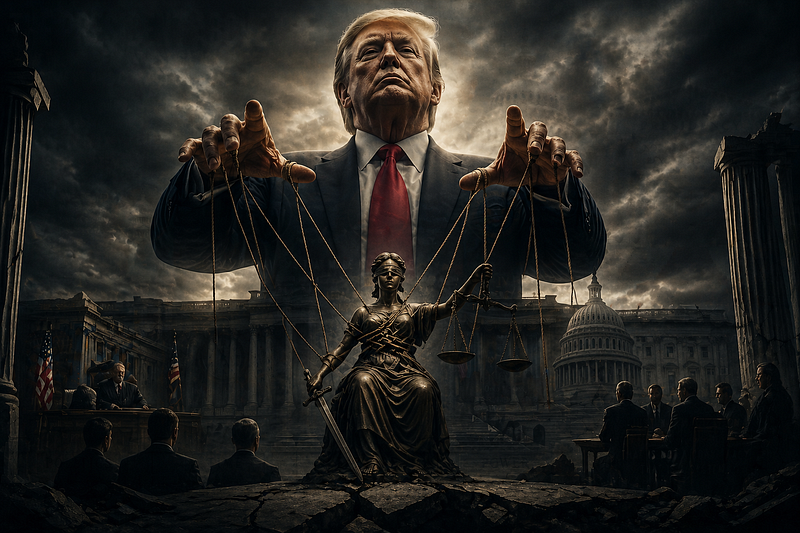
The five preceding sections document specific institutional mechanisms. Each one operated independently. None required coordination. None required bad faith. Each institution performed its designed function. The aggregate result: a man who was investigated, impeached, indicted, and convicted returned to the presidency with no legal consequence. That result was not accidental. It was structural. The architecture has four layers.
The legal layer: the OLC memos of 1973 and 2000 established that a sitting president cannot be indicted. The Supreme Court immunity ruling of 2024 established that a former president has broad protection from prosecution for official acts. The two together create a near-complete legal shield: immune during the presidency, protected after it for anything done within it.
The Constitution imposes no criminal disqualification for the presidency. A convicted felon can run. A convicted felon can win. A convicted felon can serve. The framers did not anticipate this combination of circumstances. The legal architecture they built did not foreclose it.
The shield was constructed before Trump arrived. It will remain after he leaves.
The institutional layer: impeachment requires 67 Senate votes. In a polarized two-party system with roughly equal partisan division, that threshold functions as a near-absolute barrier. Congressional investigation requires enforcement that moves through courts over years. Prosecutorial discretion at the DOJ is constrained by OLC policy.
Each institution operates within its designed parameters. None is designed to override the others. The result is not a failure of any single institution. It is the predictable output of institutions operating in sequence, each deferring to the next, none able to produce a terminal accountability.
No institution was broken. Each one did exactly what it was designed to do.
The financial layer: between 2023 and 2024, Trump’s political committees raised over $1 billion. A significant portion funded legal defense costs. Each indictment produced a fundraising spike. The more charges, the more money. The legal jeopardy and the financial machine fed each other. The financial layer did not protect Trump legally. It protected him politically, sustaining his campaign infrastructure through four years of legal proceedings and ensuring that prosecution would not produce the resource depletion that often ends political careers.
The inversion is structurally significant: in a normal criminal prosecution, the cost of legal defense depletes the defendant’s resources and narrows their options. In this case, the prosecution generated the resources that funded the defense and simultaneously financed an active presidential campaign. The accountability mechanism and the political machine drew from the same well, and the well refilled with each new filing. Legal jeopardy as a fundraising instrument is not new in American politics, but it had never operated at this scale, with this visibility, in direct service of a simultaneous bid for the office that would end the prosecution.
The prosecution financed the campaign. That inversion has no modern precedent.
The media layer: each investigation, impeachment, indictment, and conviction generated coverage at a scale that made Trump the dominant figure in American political media for eight consecutive years. The coverage was not uniformly favorable. It did not need to be. Media organizations whose business model depends on engagement found that Trump coverage drove engagement. The incentive to cover him was independent of whether the coverage helped or harmed him. The media architecture was not designed to produce accountability. It was designed to produce attention. It produced both simultaneously, and the attention outlasted the accountability.
Accountability and attention occupied the same space. Attention won.
These four layers did not coordinate. No meeting produced this outcome. No instruction was issued. Each layer operated according to its own incentive structure, within its own institutional logic, producing its own rational output. The aggregate was impunity.
No coordination was required. Only alignment.
That is not a conspiracy. That is a system.
This pattern is not unique. It is portable.
The architecture was not built for Donald Trump. It was assembled over decades, by different actors, for different purposes, in response to different pressures. The OLC memos emerged from Watergate. The impeachment threshold was set in 1787. The immunity doctrine was constructed case by case across a century of jurisprudence. The campaign finance structure was shaped by Citizens United in 2010. The media attention economy was built by digital platforms optimizing for engagement.
Trump did not build this architecture. He inherited it. What he did was use it without the restraint that previous presidents applied voluntarily. The norms that supplemented the rules were not legally enforceable. When they were set aside, the rules alone were insufficient.
The presidency was investigated. The presidency was impeached. The presidency was indicted. The presidency was convicted. The presidency absorbed each of those outcomes and continued.
The architecture does not require Trump. It requires only that the next occupant understand what was demonstrated here.
The system promised accountability. It delivered procedure.
And procedure, repeated long enough, becomes immunity.
The system did not break. Trump is what it looks like when it works.
Jerry writes The Manifest Archive forensic analysis of the institutional structures that shape geopolitics, history, and power. Published on Substack and Medium.
Related from The Manifest Archive