The stage and the script in American history
Every four years, America lifts the curtain on its grandest performance. A hand rests on a Bible, an oath echoes across the National Mall, and the republic is told it has been reborn. Crowds cheer as though history itself has shifted. Washington, Lincoln, Roosevelt, Kennedy, Obama: each appeared to turn a page, each promised rupture and renewal. Yet none of them truly held the pen.
Beneath the pageantry lies a script older than the republic itself, written not in speeches but in ledgers, treaties, intelligence files, and shadow networks of power. Presidents step forward like protagonists, but they are not authors of history. They are masks worn by the same system, actors moving across a stage whose lines were handed to them long before the spotlight found their face.
This is the thesis: presidents are not leaders but marionettes, and power is continuity.
Liberty’s mask and the hidden empire
George Washington, The mask of liberty: George Washington rides into American mythology on a white horse: the victorious general who refused to be king. He is remembered as the embodiment of liberty, a leader carved in marble as the father of the nation. Yet Washington was not only a general; he was also a planter, land speculator, and slaveholder. His personal wealth came from Mount Vernon, where hundreds of enslaved people labored. The man revered as the father of liberty entered the presidency bound to property and credit. His Treasury Secretary, Alexander Hamilton, promptly established the nation’s first central bank and a system to fund war debts. Revolutionary War veterans had been issued certificates for their service, but many, hungry and unpaid, sold these IOUs for pennies on the dollar to speculators. Years later, Hamilton’s plan redeemed those certificates at full face value, enriching Northern financiers at the expense of the original soldiers . For example, a discharged soldier in 1783 might have sold his government IOU just to feed his family, while the speculator who bought it later retired wealthy when those IOUs were paid in full. Washington’s statue was raised in the capital as a symbol of freedom, but the young republic’s economic foundation was already etched with inequality. In his Farewell Address, Washington called the unity of government “a main pillar” of “that very liberty which you so highly prize.” The words endured. The ledger told a harsher truth: liberty was the mask, property was the script.
Thomas Jefferson, Equality on paper, empire in practice: Thomas Jefferson’s pen gave the world its most quoted creed: “All men are created equal.” Generations of schoolchildren have recited these words as civic scripture. Jefferson is remembered as the poet of liberty and the philosopher of the republic. Yet the record books at Monticello tell another story: Jefferson enslaved over 600 human beings over his lifetime . His plantation ledgers carefully listed names, births, and the sale of people as property. He envisioned a nation of independent yeoman farmers, even as his own wealth rested on the bondage of others. In 1803, as president, Jefferson negotiated the Louisiana Purchase, doubling the nation’s size. The façade was one of democratic expansion; the reality was conquest. Native American tribes were soon pressured or forced from their lands under treaties signed at gunpoint. Imagine a Cherokee mother around 1808, watching in anguish as surveyors drove stakes into the forest her family had lived in for centuries. To Jefferson and American policymakers, the parchment treaties signed in Washington marked “progress”; to her, they marked erasure. Jefferson’s words promised equality, but his policies facilitated dispossession and expansion of an “empire of liberty” that was free for some and unfree for others.
Abraham Lincoln, Emancipation as strategy: Abraham Lincoln stands in collective memory as the Great Emancipator. His words at Gettysburg “that government of the people, by the people, for the people, shall not perish from the earth” are etched in stone. But Lincoln’s Civil War was not only a moral crusade; it was also a structural and economic reckoning. The Southern planter elite seceded not merely to preserve slavery as an institution of racial control, but to defend an entire economic order, one threatened by Northern banks, factories, and railroads. Lincoln’s mission to save the Union also ensured the primacy of a single national market, heralding what some historians later called the “triumph of industrial capitalism.” The Emancipation Proclamation of 1863, while morally profound, was as much a weapon of war as a declaration of principle. By declaring enslaved people free in the Confederate states, Lincoln aimed to destabilize the Confederacy’s labor system and deprive the Southern war effort of its workforce. A Union officer at the time noted that if enslaved laborers left the plantations, the Confederate armies would be crippled by lack of food and supplies. Indeed, as enslaved people learned of their liberation, many fled to Union lines or abandoned plantations, undermining the Southern economy. In the decades after the war, many freed families and their children moved north seeking paying work. By the early twentieth century, a Black worker who had left the South might labor twelve hours a day in a Pittsburgh steel mill, his children growing up in crowded urban tenements rather than on a slave cabin floor. Liberty was proclaimed; exploitation endured in a new form.
By the close of the republic’s first century, the pattern was unmistakable. Lofty ideals had been spoken, liberty in Washington’s addresses, equality on Jefferson’s parchment, emancipation in Lincoln’s proclamations, but property and power continued to dictate the terms. Inequality and conquest expanded alongside expansions of formal freedom. The United States had been born in revolution and high-minded ideals, but it was baptized in credit, expansion, and blood. As a telling echo across time, the sword that Washington raised as a symbol of liberty would one day reappear as the raised fist of Donald Trump on an inaugural stage. The mask changes; the script endures.
The empire of capital
Ulysses S. Grant, The corruption of victory: Ulysses S. Grant entered the presidency as the victorious general of Appomattox, the savior of the Union and symbol of national honor. Citizens trusted the soldier-president to protect the fragile republic. Yet his years in office revealed something else: the growing, outsized power of corporations and capital in public life. Railroads were stretching across the continent, effectively swallowing towns and territories as they went. Senators and congressmen in Grant’s era often fell under the influence, or the payroll of railroad barons and financiers. The Crédit Mobilier scandal of 1872, for example, exposed that government itself could be purchased: congressmen had accepted stock in a fraudulent railroad construction company (Crédit Mobilier) to cover up its overcharging of federal contracts . Grant himself never personally stole a dollar and was never directly implicated in these schemes , but his administration became synonymous with corruption in the service of the Gilded Age’s capitalists. Meanwhile, on the other side of the country in the Sierra Nevada mountains, thousands of Chinese laborers were blasting tunnels for the Central Pacific Railroad. Paid less than white workers, they lived in canvas tents that could not withstand the brutal winters. In the brutal winters of 1865–66 and 1866–67, deep snowdrifts and avalanches buried entire work camps. No reliable count exists, but estimates of Chinese deaths over the whole construction run from a few dozen to more than 1,000, from explosions, accidents, and exposure. Their graves often went unmarked. Their sweat and blood carved the empire’s veins while senators in Washington pocketed dividends from railroad stocks. The general who had preserved the Union now presided over a republic where corporate interests commanded more loyalty in the halls of power than did the citizens on whose behalf government was supposed to act.
William McKinley, War as acquisition: William McKinley appeared a cautious, mild, almost forgettable figure, yet under his tenure the United States took a decisive leap into overseas empire. His public rhetoric during the Spanish American War of 1898 promised liberation for Cuba and a war fought for humane ideals. But behind the stirring speeches, the conflict was less about liberation than acquisition. The war ended with the Treaty of Paris (1898), under which Spain ceded Puerto Rico, Guam, and the Philippines to the United States, and Cuba came under effective U.S. control as a protectorate. The façade was humanitarian intervention; the reality was commercial and strategic expansion. Naval bases were established in the Pacific; sugar plantations and markets in the Caribbean and Asia came under U.S. dominance. New territories were acquired by force of arms. In Manila, a Filipino teenager in 1899 watched American soldiers march past, rifles gleaming in the tropical sun. They spoke of bringing freedom from Spanish tyranny. Months later, when Filipino nationalists resisted American annexation, that same village boy saw his town burned in a U.S. counterinsurgency campaign. Fields were blackened; families were uprooted. The republic that once proclaimed it did not seek an empire had now become one in all but name. McKinley’s war had “liberated” Cuba and the Philippines from Spanish rule, only to replace it with American military occupation and control.
Theodore Roosevelt, Reform at home, empire abroad: Theodore Roosevelt strides through history as both a reformer and an unabashed imperialist. At home, TR is remembered for trust-busting big corporations, mediating coal strikes, and establishing national parks, his face even appears on Mount Rushmore as a progressive champion. Yet he was also an apostle of American expansion. Roosevelt’s Corollary to the Monroe Doctrine (1904) declared that the United States had the right to intervene anywhere in the Western Hemisphere to enforce “civilized” behavior, effectively asserting an American police power over Latin America. He actively supported and facilitated a revolution in Colombia to carve out the new nation of Panama and build his long-desired canal, even sending U.S. gunboats to back Panamanian secession from Colombia. He expanded the U.S. Navy until it circled the globe in parade (the “Great White Fleet” of 1907). At home, Roosevelt gave the nation landmark conservation efforts and the rhetoric of a “Square Deal”; abroad, he gave it colonies, protectorates, and gunboat diplomacy. Reform was the mask; empire was the reality. In Panama, a local dockworker watched the Stars and Stripes rise over a Canal Zone sliced through his homeland. His children would grow up under foreign rule in a corridor where American engineers, companies, and Marines, not his own government decided the future. Roosevelt famously advised, “speak softly and carry a big stick.” He spoke of reform and fairness at home; he wielded a big stick of empire abroad.
Woodrow Wilson, The world safe for… Whom?: Woodrow Wilson, the professorial president, spoke loftily of morality and peace. His Fourteen Points promised autonomy for Europe’s subject nationalities and a League of Nations to end war. In April 1917, Wilson told Congress that “the world must be made safe for democracy,” framing U.S. entry into World War I as a principled crusade. Schoolbooks often present his words as the height of American idealism. But Wilson also led America straight into the carnage of the First World War, breaking a long tradition of avoiding entanglement in European conflicts. The façade was pure principle; the reality had a financial undercurrent. By 1917, American banks and businesses had lent over $2 billion to Britain and France, far more than the loans extended to Germany. Had the Allies been defeated, those Wall Street investments and war loans might have been lost. U.S. intervention helped ensure those debts would be repaid and that American financial power would shape the post-war order. Critics later charged that the United States entered the war not only to make the world safe for democracy, but also to make it safe for American shareholders and bankers. An Iowa farm boy drafted in 1918 had never left the Midwest before he was shipped to the trenches in France; he died in the mud at the Marne, his body lost in foreign soil. In New York, financiers sighed with relief as their war bonds and munitions contracts were suddenly secured by an Allied victory. The rhetoric of “peace and justice” masked the birth of an American financial empire. Indeed, the profits of U.S. arms and chemical companies soared during the war. DuPont, which by most accounts supplied up to 40% of the Allies’ explosives, saw its powder and explosives sales climb from $25 million in 1914 to $319 million in 1918. The enduring suspicion in the interwar years (crystallized in the 1934 book Merchants of Death and the Nye Committee hearings) was that America had fought less for democracy than for its bankers, its munitions makers and its shareholders.
By 1920, the pattern had hardened. Presidents invoked grand ideals, but policy often served markets and strategic interests. Wars were waged not as accidental entanglements but as instruments to expand or protect American networks of trade and credit. Beneath masks of reform, humanity, or moral duty, the empire of capital expanded across oceans. The United States entered the 20th century not as a mere republic of farmers and frontiersmen, but as a corporate empire in all but name its presidents largely masks for a deeper continuity of power.
War and reconstruction
Franklin D. Roosevelt, Saving capitalism by reform: Franklin D. Roosevelt came to power in 1933 amidst the ruins of the Great Depression. Families stood in breadlines; children wore patched shoes; unemployed workers sold apples on street corners. FDR’s warm voice on the radio reassured millions: “The only thing we have to fear is fear itself.” His New Deal programs put people to work building dams, bridges, and roads, and erected a modest social safety net. American democracy seemed to be rescuing its people from the abyss. Yet behind the scenes, the New Deal also stabilized banks and propped up industrial capitalism (albeit now with new regulations). It reined in the excesses of monopolies but ultimately preserved corporate power by binding it closer to the state. A new system emerged that tied government and big business more tightly, laying the groundwork for what would become the post-WWII military-industrial complex. Then war completed the transformation. During World War II, Roosevelt turned America into the “Arsenal of Democracy,” as U.S. factories roared to life producing tanks, planes, and ships at an unprecedented scale. Propaganda posters invoked Liberty and Uncle Sam, but the ledgers showed profit: companies like DuPont, General Motors, Ford, and IBM multiplied their fortunes under massive war contracts. (During World War I, DuPont’s profits had skyrocketed, its net income jumped from $5.5 million in 1914 to $82 million in 1916 thanks to munitions sales. World War II continued the trend of enormous corporate gains from wartime production.) A Detroit auto worker who a few years earlier had been in a breadline now worked overtime building B-24 bombers. His wages put food on his family’s table, but the government contracts made his company’s owners fabulously rich. Liberty was emblazoned on the posters; capital was inked in the balance sheets.
Harry S. Truman, Dawn of the superpower: Harry Truman, the plain-spoken senator turned unexpected president, ended World War II with two sudden acts of atomic fire. In August 1945, the cities of Hiroshima and Nagasaki were incinerated by the first and only use of nuclear weapons in war. Officially, the atomic bombings were meant to save lives by forcing Japan’s immediate surrender. In reality, they also sent a powerful signal to the world, especially to the Soviet Union that the United States now stood atop a new hierarchy of global power. Truman and his top advisors viewed the bomb as a kind of “atomic monopoly” that could intimidate the Soviets and give the U.S. leverage in shaping the post-war order. Indeed, Soviet observers and many international figures understood the message. As British physicist P.M.S. Blackett wrote in 1948, “the dropping of the atomic bombs was not so much the last military act of the second World War, as the first major operation of the cold diplomatic war with Russia”. After the war, Truman launched the Marshall Plan: billions of dollars in aid poured into war-torn Western Europe. The façade was generosity and humanitarian reconstruction; the reality was the creation of dependency and influence. Marshall Plan aid came with expectations that Western Europe align economically and politically with the United States. American money rebuilt factories and infrastructure, but it also tied Europe to Wall Street, to U.S. supply chains, and to the emerging NATO security alliance. A French shopkeeper in 1948 unpacked crates of flour stamped with the American flag, she could feed her children thanks to U.S. aid. Yet every shipment bound her country’s recovery a little tighter to American producers and policies. Truman helped rebuild a peaceful Western Europe, but also built leverage: a U.S.-led Atlantic order aimed at containing the Soviet Union and ensuring American access to markets. In short, the U.S. emerged from WWII as a superpower, using both the carrot of economic aid and the stick of nuclear might.
Dwight D. Eisenhower, The permanent war state: Dwight D. Eisenhower, the general of D-Day, became president as a symbol of stability and normalcy in the 1950s. On the surface, many Americans enjoyed a calm prosperity during his tenure. But beneath the placid mask, the permanent national security state was crystalizing. Under Eisenhower’s watch, the newly created CIA engineered covert coups in Iran (1953) and Guatemala (1954) to topple governments deemed unfriendly to U.S. interests. In Iran, the CIA helped overthrow the democratically elected Prime Minister Mohammad Mossadegh and restore the Shah to power afterwards, Western oil companies (five American firms, plus British and French interests) divided control of Iran’s petroleum riches between themselves. In Guatemala, when Jacobo Árbenz’s modest land reform threatened the vast holdings of the United Fruit Company, Eisenhower’s CIA sponsored a coup that ousted Árbenz and installed a military regime that promptly reversed the land reform. (A Guatemalan peasant in 1954 saw U.S.-supplied planes roar overhead as an elected government was toppled; soon after, his cooperative farmland was returned to a foreign banana monopoly.) At the same time, the U.S. defense budget remained enormous, and new weapons systems (from long-range bombers to early missiles) and alliances (like NATO) became permanent fixtures. In his Farewell Address in January 1961, Eisenhower himself famously warned of what had grown under his tenure: “We must guard against the acquisition of unwarranted influence, whether sought or unsought, by the military-industrial complex,” he said. “The potential for the disastrous rise of misplaced power exists and will persist.” He noted that the conjunction of a huge permanent military establishment and a vast arms industry was “new in the American experience”, and cautioned that it could threaten liberty and democracy if left unchecked. It was an extraordinary warning from a five-star general. Yet it was also ironic: Eisenhower had helped build the very machine he now feared. World War II had ended over 15 years earlier, but the machinery of permanent militarization kept churning on. In a Guatemalan village, a farmer who had never heard of Eisenhower’s speech nonetheless lived its reality: his nation’s fate could be decided behind closed doors in Washington and in corporate boardrooms, with guns and dollars rather than ballots.
The age of illusions
John F. Kennedy, Camelot and cold war: John F. Kennedy embodied youthful charisma and the optimistic vigor of a new generation. Television adored him, as did many Americans; his elegant wife and photogenic young family projected an image of a “New Frontier” of hope and progress. To millions, JFK’s inauguration in 1961 felt like a rebirth for the country a break from the stodginess of the past and a fresh commitment to idealism. Yet Kennedy’s presidency also sharply intensified Cold War conflicts. He authorized the CIA-backed Bay of Pigs invasion of Cuba in 1961, a covert attempt to overthrow Fidel Castro’s government that ended in fiasco. He presided during the harrowing Cuban Missile Crisis of 1962, when the world stood at the brink of nuclear war. And quietly, he began entangling the United States more deeply in Vietnam, sending thousands more military “advisers” and support to the South Vietnamese government. Kennedy spoke of peace and progress, but under his watch the number of nuclear missiles multiplied, and distant jungles in Southeast Asia started to burn under napalm. His shocking assassination in Dallas (November 1963) turned him into a martyr and an icon almost beyond critique. Citizens wept in front of their TVs as a young leader’s life was cut short, imagining what might have been. Yet the machinery of American power did not pause for reflection. The war in Vietnam would only escalate after his death, driven by the same Cold War logic that had governed JFK’s decisions. For a rice farmer in a village near Saigon, Kennedy’s idealistic talk of a New Frontier meant little; what he saw were the helicopters and bombs beginning to fall from the sky.
Lyndon B. Johnson, Great society at war: Lyndon B. Johnson assumed the presidency promising to build a “Great Society” at home. In a few short years, LBJ pushed through landmark civil rights legislation ending legal segregation, created Medicare and Medicaid, launched anti-poverty programs, and invested in education and housing. These measures fundamentally transformed American society and expanded the promise of democracy to millions. But Johnson’s name is equally bound to Vietnam, which he escalated into a full-scale and devastating war. By the late 1960s, hundreds of thousands of young Americans were being drafted and sent to Southeast Asia; entire Vietnamese villages were being razed; body bags and flag-draped coffins flowed home by the thousands. On television, President Johnson spoke of defending freedom in Southeast Asia while simultaneously declaring “war on poverty” at home. In reality, the war machine devoured an ever-expanding federal budget, and corporate defense contractors delivered weapons and supplies at enormous profit. By 1968 the same year Johnson’s civil rights and social programs were flowering, over half a million U.S. troops were fighting in Vietnam, and the conflict had become a bloody quagmire. The Great Society’s lofty promises were undermined and ultimately eclipsed by the war’s drain on resources and on public trust. In Akron, Ohio, a mother opened a telegram in 1968 informing her that her only son had died at Quảng Trị. That night, on her television, President Johnson still vowed that America would stay the course to victory. The society was called “great” in rhetoric, but in reality it was broken by the conflict that consumed Johnson’s presidency. In 1968, exhausted and politically damaged by the war, LBJ announced he would not run for re-election. The mask of noble domestic ambitions had been ripped away by the fury of napalm and the cry of protestors in the streets.
Richard Nixon, Law, order, and secrecy: Richard Nixon campaigned for president in 1968 on a promise of “law and order” at home and an “honorable end” to the Vietnam War abroad. He presented himself as a sober, experienced leader who would restore stability after the chaos of the 1960s. And indeed, Nixon did orchestrate the winding down of direct U.S. ground involvement in Vietnam (the last American combat troops left in 1973). But he also expanded the war in secretive and cynical ways. In 1969–1970, Nixon authorized a massive covert bombing campaign in neighboring Cambodia (Operation Menu), without Congressional approval and hidden from the American public . More than 100,000 tons of bombs were dropped on Cambodian soil in secret, as Nixon sought to destroy North Vietnamese sanctuaries, all while publicly denying any widening of the war . Nixon likewise pursued a global realpolitik: he made a historic trip to China in 1972, opening the door to relations with Beijing and reshuffling the Cold War balance. He and his Secretary of State Henry Kissinger also backed covert operations to support allies and undermine opponents (including tacit support for a military coup in Chile in 1973 that overthrew the elected president there). At home, however, Nixon’s presidency unraveled in the Watergate scandal, which revealed a White House consumed by paranoia, illegal surveillance, and abuse of power. When the tapes of Nixon’s own Oval Office conversations proved he had attempted to obstruct justice, he resigned in disgrace in 1974. The public saw a president brought down by his own lies and crimes, affirming that even the chief executive was not above the law. But tellingly, through all the turmoil, the underlying national security state and corporate power structure remained largely untouched. The Cold War arms race continued at full tilt; U.S. support for authoritarian anti-communist allies (from Iran to South Korea) continued unabated; defense budgets stayed enormous. Nixon fell, but the script endured. In a Cambodian village in the early 1970s, a farmer discovered craters where his rice paddies had been, the result of bombs Congress hadn’t even known about. Nixon’s public mask was one of sober stability and law-and-order; his script was one of secrecy and cynicism in pursuit of geopolitical aims. When he left office, the American people wrestled with distrust in government, but the Vietnam War soon gave way to a new normal of Cold War armament and covert interventions.
Ronald Reagan, Morning in America, midnight in central America: Ronald Reagan smiled and reassured Americans that it was “Morning in America” again. With his genial humor and Hollywood-trained charm, he sold a vision of national renewal during the 1980s. Many citizens fondly remember his warmth and the patriotic revival he encouraged. Yet Reagan’s policies unleashed Wall Street, slashed taxes for the wealthy, and poured hundreds of billions of dollars into defense. He spoke constantly of freedom and democracy, but under his administration the U.S. trained and financed bloody proxy forces in Central America. In El Salvador, Guatemala, and Nicaragua, Reagan’s government supported right-wing regimes and rebels, some of whom committed atrocities against civilians. Reagan dubbed Nicaragua’s socialist Sandinista government a threat, and in the Iran–Contra affair officials in his administration secretly funded the Contra rebels, even when Congress had explicitly prohibited such support. In El Salvador, U.S.-trained counterinsurgency units (like the Atlácatl Battalion) carried out massacres of entire villages for instance, the December 1981 El Mozote massacre, in which an estimated 800 unarmed men, women, and children were slaughtered by a U.S.-trained Salvadoran unit . All of this was justified under the banner of fighting communism. Reagan also ramped up a fantastical “Star Wars” missile defense project, escalating the arms race with the Soviet Union. Politics under Reagan increasingly took on the quality of entertainment, a well-crafted Hollywood production where the president was the performer-in-chief, offering folksy soundbites and stirring patriotic scenes. But behind the scenes, the same continuity persisted: wealthy interests grew richer (income inequality widened significantly in the 1980s), the military-industrial complex prospered, and covert interventions proceeded as usual. In El Salvador, a student protest in 1981 was met with bullets from security forces trained and funded by the U.S.; on American TV that same evening, President Reagan cracked a joke with reporters as if nothing was amiss. The nation became an audience to a feel-good show about strength and prosperity, while the machinery of power, economic and military, continued its work in the shadows. The mask was optimistic and patriotic; the script remained one of realpolitik and profit.
Chaos and continuity
George W. Bush, War on Terror Inc.: George W. Bush faced the day that defined a new era: September 11, 2001. After those terrorist attacks, smoke rose from the ruins of the World Trade Center, the Pentagon smoldered, and fear and fury gripped the country. Bush stood atop the rubble in New York with a bullhorn and declared, “The people who knocked these buildings down will hear all of us soon.” Americans, in their anguish, felt a powerful unity and resolve. The façade was the defense of freedom and homeland at all costs. The reality became a launch of an open-ended war, one that would extend across the globe and into a new century. The U.S. invaded Afghanistan in late 2001 to topple the Taliban (hosts of Al Qaeda), and then, in 2003, invaded Iraq on the pretext of neutralizing “weapons of mass destruction” that never materialized. In Iraq, a supposedly quick operation turned into a years-long occupation and insurgency. Lucrative reconstruction and logistics contracts were handed out to American companies, for example, Halliburton (a company once led by Vice President Dick Cheney) received billions to service the war effort. Defense budgets ballooned, nearly doubling in the early 2000s compared to pre-9/11 levels, to fund the new Department of Homeland Security, wars overseas, and a vast expansion of surveillance and security operations. Bush presented himself as the plainspoken protector of America. But the script followed an old pattern: permanent war and profit. Up to half of the $14 trillion spent by the Pentagon since 9/11 went to private defense contractors, reaping enormous profits from continuous conflict. In Baghdad, a doctor watched U.S. bombs fall near his hospital, turning children into casualties on bloodied stretchers. On CNN that night, President Bush spoke of liberation and democracy coming to Iraq. The mask was avenger and liberator; the script was the pursuit of geopolitical dominance and an endless War on Terror that proved immensely profitable for defense contractors and expanded the powers of the security state.
Barack Obama, Hope and shadow wars: Barack Obama appeared on the political scene as a dramatic rupture in the narrative. His 2008 campaign of “Yes We Can,” together with his identity as the first Black president, made the White House itself seem transformed. Around the world, millions hoped Obama’s election marked a true break with the past. And Obama did enact significant changes: he signed healthcare reform, embraced multilateral diplomacy, and in 2011 he ordered the Special Forces raid that killed Osama bin Laden. He also withdrew most U.S. troops from Iraq (by 2011) and reduced the American footprint in Afghanistan (though that war continued until 2021). Yet the wars did not truly end, they shifted. Obama vastly expanded the use of drone strikes and covert operations in places like Pakistan, Yemen, and Somalia, far beyond what Bush had done. Over his two terms, a total of 563 strikes (primarily by drones) hit targets in those countries, ten times the number of strikes under Bush’s presidency . These drone attacks killed thousands of suspected militants, and also hundreds of civilians , despite Obama administration claims about “surgical” precision. Obama also kept the Guantánamo Bay detention camp open (despite early promises to close it), leaving prisoners in a legal limbo with no trial. On the home front, when Wall Street’s recklessness brought on a financial meltdown in 2008, Obama continued the massive bank bailout begun under Bush, while millions of ordinary Americans lost their homes in the foreclosure crisis. The inspiring rhetoric of hope and change often masked a deep continuity: drone warfare and surveillance expanded in the shadows, and the economic order still favored the powerful. In December 2009, President Obama traveled to Oslo to accept the Nobel Peace Prize, speaking about peace. A week later, a U.S. cruise missile strike on the Yemeni village of al-Majalah killed 41 civilians, among them 14 women and 21 children. The mask was hope and change; the script was continuity, with warfare made more remote and technological, and with financial elites shielded by government intervention even as many citizens struggled.
Donald Trump, The outsider who reinforced the system: Donald Trump crashed into the presidency in 2017 as an ostensible outsider, vowing to “drain the swamp” of Washington corruption and upend the established order. His rallies were raucous carnivals of anger and grievance; to millions of his followers he presented himself as a brash truth-teller tearing the mask off a corrupt political class. And indeed, by his very chaos, Trump did expose some of the system’s facades, he openly said and did things that prior presidents only hinted at behind closed doors, thereby revealing how brittle certain norms of U.S. governance really were. But while Trump shattered norms and discarded the polite mask of the presidency, he never seriously dismantled the deeper machinery of power. In fact, by weakening oversight and sowing chaos in government, he arguably empowered those hidden networks even more. Trump filled his administration with Wall Street financiers and corporate executives (earning nicknames like “Government Sachs” for the number of Goldman Sachs alumni in top posts), as well as retired generals. He signed a massive tax cut that delivered enormous benefits to corporations and the wealthy in 2017. He rolled back regulations on banks, polluting industries, and other businesses. And he continued to expand defense budgets each year of his term. He antagonized traditional U.S. allies and disrupted diplomatic relationships, but he did not dismantle the military, intelligence, or corporate frameworks that truly guide policy. By tearing at institutions and driving out experienced officials (many agencies saw an exodus or dismissal of career experts, leaving key positions unfilled), Trump inadvertently gave the permanent bureaucracies and private power centers more room to maneuver without accountability. In Washington, a long-time civil servant watched decades of procedure and expertise thrown aside overnight. Contracts were quietly rewritten; environmental and financial rules were gutted, often benefiting those already in power. Trump imagined himself a revolutionary outsider storming the citadel of a hidden cabal. History suggests he was more akin to a Napoleon who crowned himself emperor only to find he was still constrained and guided by the real directors of the system. When he left office (after a chaotic term culminating in a disputed election and the unprecedented spectacle of a mob attacking the U.S. Capitol on January 6, 2021), the stage was in disarray but the undercurrents of capital and the national security state flowed on, largely untouched.
Joe Biden, Restoration and the arsenal of democracy (again): Joe Biden arrived in 2021 as a grandfatherly healer, promising a return to calm and normalcy after the tumult of the Trump years. Many Americans, and many U.S. allies abroad sighed with relief, feeling that the “soul of America” and stable leadership had been restored. Indeed, Biden’s style could not be more different from Trump’s: he prefers collaboration, works behind the scenes, and is generally predictable. Yet beneath the quiet demeanor, Biden’s administration has continued to pour hundreds of billions into defense contracts and military aid, maintaining the momentum of the security state. NATO has expanded further (for example, welcoming Finland in 2023) and U.S. troop presence in Europe increased after Russia’s invasion of Ukraine. The war in Ukraine, sparked by Russia’s February 2022 invasion, has been met with a massive U.S.-led response: by early 2023 the United States had committed more than $32 billion in military assistance, and by January 2025 about $66 billion in all, to bolster Ukraine’s defenses. (Congress’s total approved aid to Ukraine, including economic and humanitarian funds, was about $66 billion by autumn 2022 and about $113 billion by the end of that year.) Much of that money flows back to American weapons manufacturers to build new weapons or to replace U.S. stockpiles that were sent to Ukraine. By some analysts’ estimates, around 90% of U.S. military aid to Ukraine by dollar value is spent not in Ukraine but in the United States on American-made missiles, tanks, artillery shells, and aircraft. At a Polish border crossing in 2022, a Ukrainian mother clutched her child, grateful for the Western anti-tank missiles and humanitarian aid that helped halt the onslaught to her, Biden’s support meant survival and hope for her nation’s freedom. To U.S. defense corporations, it meant windfall profits and booming orders: major contractors have publicly reported rising revenues thanks to the surge in demand to replenish U.S. and allied arsenals. By late 2023, American firms like Lockheed Martin, General Dynamics, and RTX (Raytheon) were signing new contracts for hundreds of thousands of artillery rounds, Patriot missile batteries, and armored vehicles, with those orders “underpinning their results” in coming quarters. The mask is the experienced, empathetic statesman who promises to “restore the soul of America.” The script is the empire sustained: the vast global network of alliances, arms, and finance that keeps American influence dominant, and keeps the money flowing to those who build the arsenal of democracy, now and into the future.
And now we find ourselves in 2025. The political pendulum has swung again. Donald Trump returned to the stage, sworn in for a second term in January 2025, claiming vindication to his followers and causing despair among his critics. For the entrenched machinery of continuity, however, it is just another scene change. By tearing at some parts of the stage decor in his time, Trump ironically revealed the façade more clearly yet the undercurrent, the script, flows on. He may have imagined he could seize the throne of hidden power itself. But like Napoleon, he risked ending in exile (politically if not literally), while the true regisseurs behind the scenes endured through it all.
The script behind the names
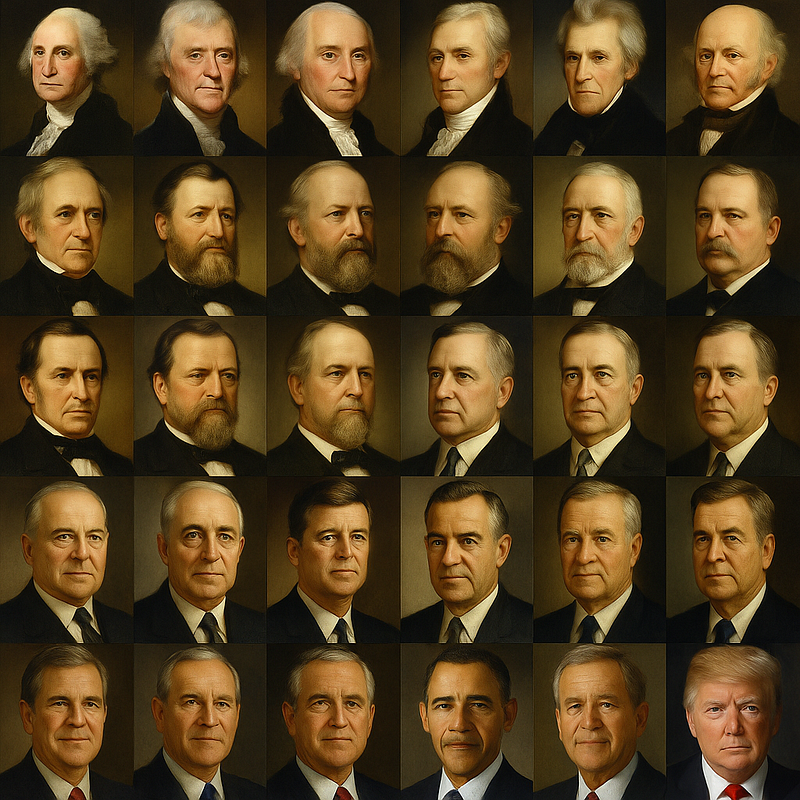
History is often taught and remembered as a gallery of great portraits: Washington’s noble pose, Jefferson’s quill, Lincoln’s top hat, Theodore Roosevelt’s spectacles, Kennedy’s smile, Reagan’s wave, Obama’s oratory, Trump’s brash gestures. Each face and each era seems unique; each presidency appears to mark a sharp rupture or advance from what came before. And indeed, each leader and each administration does have its distinct achievements, failures, and character. But behind them runs a continuous thread older than the republic itself, a durable script of power that transcends individual officeholders.
Consider an analogy from a much older power center: the Catholic Church. Across centuries, various figures challenged the Church’s authority, but its institutional power proved remarkably resilient. Martin Luther nailed his theses to a church door and sparked the Protestant Reformation, but the Catholic Church endured (and even reformed itself). King Henry VIII broke from Rome and declared himself head of a new Church of England, yet the Vatican persisted. Napoleon Bonaparte once arrested the Pope and held him prisoner, but after Napoleon’s fall, the papacy returned. Twentieth-century dictators like Hitler and Stalin tried to crush or co-opt the Church; they died, and Rome still stood. In each case, the mask of authority shifted or came under attack, but the underlying institution proved durable.
Similarly, American institutions and the powerful interests that operate through them, have weathered assaults and oscillations. Richard Nixon was forced to resign in disgrace, but the intelligence and security agencies whose abuses he expanded only grew stronger in the ensuing decades. George W. Bush had to seek Congress’s and the United Nations’ approval for the Iraq invasion in 2003, cloaking it in legal justifications, but the war proceeded and then morphed into new conflicts. Barack Obama, facing criticism, felt compelled to publicly acknowledge and defend the drone program in legal terms (and to release vague statistics on civilian casualties), yet the program itself persisted and even expanded. Donald Trump raged against the “Deep State” and gleefully shredded decorum, but in doing so he often merely exposed how much of the real governance could continue without him or beyond his control.
The public façade of ideals and democratic accountability not only shapes citizens’ perceptions, it can also restrain leaders at times. It toppled Nixon when he went too far outside the law. It forced President Bush to at least justify his wars in terms of self-defense and liberation. It pressed Obama to place drone strikes under a legal framework and greater transparency (however limited) when criticisms mounted. Presidents rise and fall under the weight of public expectations, scandals, and electoral pressures. But the hidden script, the continuity of strategic and economic power hardly falters. It thrives on continuity. Banks that outlive financial crashes shape each recovery. Defense companies that outlive wars eagerly arm the next conflict. Intelligence agencies that outlast presidencies quietly expand their reach from one administration to the next.
Trump tore furiously at the visible stage, imagining himself a kind of conquering hero who could rewrite the plot. Instead, by shredding some of the stage props, he inadvertently gave the regisseurs behind the curtain even more space to operate away from public view. Presidents, no matter how charismatic or disruptive, are not the true authors of the broad course of events in this interpretation. They are masks some inspiring, some deceiving, some infuriating. Their faces are remembered; their personal dramas dominate the news and the history books. But the undercurrent remains.
Citizens get the drama. Power writes the script.
The gallery and the regisseur
Walk through the National Portrait Gallery in Washington, D.C., and you will see a portrait of every U.S. president. There is Washington in his stately pose; Jefferson with quill and parchment; Lincoln solemn and gaunt; Theodore Roosevelt resolute; Kennedy youthful; Reagan smiling; Obama contemplative; Trump with his characteristic scowl. These images are displayed like a secular shrine of democracy. Visitors speak in hushed tones, as though in a cathedral of the American civic religion. The exhibit reinforces what we are taught: that history is made by great individuals, that each presidency is a self-contained chapter in the nation’s story with singular direction over its fate.
But behind those faces lies another gallery, one invisible to most and not found in any museum. It is the gallery of banks, corporations, lobby networks, intelligence communities, and transnational institutions the connective tissue of real power. This gallery has no painted portraits on display, only contracts, stock certificates, diplomatic cables, trade deals, and classified files locked away in vaults. It is not on the public tour, yet it never closes, and its script does not change drastically with each election. It is older than the Constitution in some respects, tracing back to colonial trade empires and financial systems that the United States inherited and then surpassed. It transcends party lines; it weathers scandals and shocks. Presidents come and go, but the permanent interests what might be called “the establishment” or even a ruling class remain. This is not to suggest a single conspiracy of a tiny cabal, but rather a broad and evolving network of powerful actors and institutions that persist through nominal change.
Americans believe their votes write history. In truth, more often they are choosing among masks. The major script securing markets, projecting military force, and managing a world order favorable to American elite interests is bipartisan and continuous. Even profound upheavals like the Civil War or the New Deal can be seen as adaptations of the script rather than complete rewrites. The façade of electoral politics and high ideals is necessary: it provides legitimacy, channels public passions, and occasionally forces adjustments in the script (as mass movements did with civil rights in the 1960s). But the pageantry also serves to obscure just how consistent the core trajectory has been. Freedom and equality, in the civic religion, are the beautiful decor; power and profit are the regisseur directing from the wings.
This, then, is the revelation of our “script”: what we conventionally call “history” the parade of elections, personalities, and public events, is often a façade. The true script, written in bank ledgers, diplomatic dispatches, and military deployment orders, continues across generations with remarkable constancy. The masks change, the script endures.
Correction, 12 October 2026: this piece has been corrected. The quotation attributed to Washington's Farewell Address does not appear in it and has been replaced with his actual words. Also corrected: the death toll among Chinese railroad workers, which has no reliable count; the dates of US aid figures for Ukraine; the year of Blackett's remark (1948); the tonnage of the secret Cambodia bombing; Nixon's 1972 opening to China, which preceded formal relations in 1979; Iran-Contra, run by officials in the Reagan administration; Iraqi oil contracts; TARP, begun under Bush; DuPont's wartime figures; an untraceable Merchants of Death quotation; the scope of the Fourteen Points; and the passage on 2025. A drone-strike scene in Yemen was replaced with the documented al-Majalah strike of December 2009, and an anachronistic 1865 scene was corrected. Several scenes of individual people throughout the piece are illustrative composites, not documented cases. The corrections log is at themanifestarchive.com/standards.
Related from The Manifest Archive