The cell was supposed to be watched. The guards were supposed to look in every thirty minutes, the cameras were supposed to record the hallway, and the most notorious federal prisoner in the country was supposed to be the one man in the building no one could afford to lose. None of it held. The guards did not make their rounds. A camera in front of the cell malfunctioned. And on the morning of the tenth of August, 2019, Jeffrey Epstein was found dead in a Manhattan jail, his trial ended before it began. The city medical examiner ruled it a suicide. The Justice Department's own inspector general later documented the failures in detail and called them negligence, not foul play.
For most of the public, that morning was the story. The question that filled the air was whether he had killed himself or been killed, as if the entire meaning of the case hung on the inside of a single cell.
It did not. The most revealing fact about Jeffrey Epstein is not how he died. It is what did not die with him.
He fell, and almost nothing around him fell. The banks that had held his accounts kept operating. The universities that had taken his money kept their endowments. The advisers, the foundations, the dinner-party hosts, the men who had flown on his planes and posed in his photographs, almost all of them stayed exactly where they were. One associate, Ghislaine Maxwell, was convicted and is serving twenty years. Beyond her, the structure that had surrounded him for thirty years absorbed the shock and closed over the gap.
That is the thing worth explaining. Not the man. The closing.
The variable that was never the man
It is tempting to explain the survival of that world the way scandal always gets explained, by reaching for a hidden hand. A list of clients. A blackmail operation. A coordinated agreement among powerful people to protect one another. The appeal of that explanation is that it gives the outrage somewhere to go. If there is a ring, the ring can be exposed. If there is a list, the list can be subpoenaed.
But the documented record does not require any of that to explain what happened, and the reach for a secret ring usually weakens the case rather than strengthening it, because it rests on the one thing no one can produce. There is a simpler mechanism, and it is more durable than any conspiracy, because it needs no one to run it.
The determining variable in the Epstein case was never the man and never a secret meeting. It was a structural fact about everyone who came near him: proximity to Epstein had been converted into shared liability. Each institution that took his money, each bank that kept his accounts, each university that accepted his gifts and then hid them, had quietly acquired a stake in his not being examined too closely. To expose him fully was to expose what they had known, taken, or ignored. So the safest course for each of them, acting alone, in pure self-interest, was to look away.
No one had to organize that. It is what a network of separately self-interested institutions does when a single node becomes radioactive. The silence was not a plot. It was an equilibrium.
What he actually sold
To see how proximity became liability, start with the question the official record never closes: where did the money come from.
Epstein began as a teacher at a Manhattan private school, joined Bear Stearns in 1976, left in 1981, and set up his own advisory firm. From there the public account thins to almost nothing. He marketed himself as a discreet money manager who worked for a handful of billionaires, and the names that anchor the documented record are few. In 1991 the retail magnate Leslie Wexner granted him full power of attorney, a legal instrument that let Epstein sign checks, buy and sell property, and borrow money in Wexner's name. Through that relationship he acquired the Manhattan townhouse that became his headquarters. Two decades later, the financier Leon Black paid him a sum that an internal review by the law firm Dechert, filed with regulators in 2021, put at one hundred and fifty-eight million dollars between 2012 and 2017, for tax and estate planning. A later Senate inquiry put the figure closer to one hundred and seventy million. The Dechert review found no wrongdoing.
What is missing from that account is the rest of it. There is no public, audited explanation of how a man with a few clients assembled the fortune he displayed. That gap is not a place to insert a theory. It is itself the finding. Because it tells you what the product actually was.
The product was not investment advice. The product was access. Epstein sold proximity to the people he already knew to the people who wanted to know them, and he sold the discretion that made the proximity safe. A man who can put you in a room with a head of state, a Nobel laureate, a media owner, and ask nothing in writing, is not selling a financial service. He is selling a position in a network, and a network is the one asset that does not appear on any balance sheet and cannot be audited after the fact.
Money is the least powerful form of wealth. Access is the real currency. Epstein understood that earlier and more completely than the institutions that dealt with him, and that understanding, not any single transaction, is what made him useful enough to keep around and dangerous enough to protect.
The asset that leaves no receipt
There is a reason the question of his fortune cannot be closed, and it is the same reason the network around him could not be prosecuted. Both were built out of the absence of records. A bank transfer leaves a trail. A contract leaves a signature. A board vote leaves minutes. What Epstein dealt in left none of these, because the entire value of what he sold depended on there being nothing to find. An introduction is not a document. A weekend is not a filing. A favor understood between two people who will never write it down cannot be entered into evidence, because it was built never to exist on paper in the first place.
This is the deepest layer of the mechanism, and it is easy to miss because it looks like a gap rather than a design. A system can act only on what it can record. Courts, regulators, and journalists all work on documents, and a structure that produces no documents is not hidden so much as formless, present everywhere and locatable nowhere. The missing explanation of the fortune is not a vault waiting to be opened. It is the shape of a business whose product was precisely the thing that leaves no receipt. The same recordlessness that made the access valuable made the accountability impossible. You cannot subpoena a relationship.
The oldest leverage
There is an older name for what bound the network to him, and it is not a financial term. Epstein's deepest leverage was appetite. He did not mainly lend money or trade favors. He arranged for powerful people to be given what they wanted and were not supposed to want, and what some of them were given was access to the abuse of the very girls the law existed to protect, which is the part no analysis should be allowed to soften. The wanting did the rest.
Appetite is a stronger bind than blackmail, and it is worth being precise about why. Blackmail requires a threat, and a threat can be reported, resisted, refused. Appetite requires nothing. A man who has been given what he should be ashamed of has not been threatened. He has been implicated, and he implicates himself further with every return. The structure never had to hold a file over anyone. It only had to have served them once.
This is why the moral vocabulary around the case so often misses the mechanism. The appetites an older world named as the deadly sins, vanity, greed, the hunger for proximity to power itself, were not weaknesses Epstein exploited from outside. They were the raw material he built with. He offered each powerful person the specific thing their position let them imagine they were owed, and the offering turned clients into participants, and participants into people who needed the arrangement to stay unexamined. Money buys silence by paying for it. Appetite buys silence for free, because the person who would have to speak is the person most exposed by speaking.
The machinery of distance
What the money built, when it was spent on something visible, was distance. Epstein assembled a private archipelago of spaces, each one a place where the powerful could be near him and unobserved at the same time. A Boeing jet. One of the largest private residences in Manhattan. An estate in Palm Beach, a ranch in New Mexico, an apartment in Paris, and the two islands off the coast of St. Thomas. To read these as the trophies of a rich man is to miss what they were for. They were instruments of the network, not displays of it.
A private island is not merely luxurious. It is unobserved. A private jet does not merely move you faster. It moves you without a passenger manifest anyone will ever read at the gate, without the small frictions of being seen entering and leaving. Each property widened the same gap the legal instruments widened, the gap between being close enough to influence powerful people and far enough to escape the consequences of how. The estate was the physical version of the non-disclosure agreement. Both bought the same thing, which was the absence of a record. A man whose business was access had every reason to invest his fortune in the one good that access most requires, which is privacy, and privacy at that scale is simply distance you have purchased and walled.
The banks that kept the client
The clearest documented proof that proximity becomes liability sits in the records of two banks.
JPMorgan Chase kept Epstein as a client for years, including years after his 2008 conviction for soliciting a minor. In 2023 the bank settled with his victims for two hundred and ninety million dollars, and with the United States Virgin Islands, where his islands sat, for seventy-five million more. Deutsche Bank, which took him on after JPMorgan finally dropped him, settled with victims for seventy-five million dollars in 2023, after already paying a hundred and fifty million dollar penalty to New York's financial regulator in 2020, the first time a regulator had penalized a financial institution over its Epstein dealings.
Every one of those settlements was made without an admission of liability. That phrase is not a footnote. It is the mechanism in legal form. A settlement converts a question about what an institution knew into a number it agrees to pay. The bank does not say what it saw. It says what it will pay to stop the matter being adjudicated. The victims are compensated, which is real and not nothing, and the record of institutional knowledge is sealed in the same motion, which is the point.
The allegation in those cases, never tried because it was settled, was that both banks saw the warning signs, the suspicious cash, the payments to young women, the compliance officers raising flags, and kept him anyway, because a client who moves money and knows everyone is worth the discomfort. Whether or not a court would have agreed, the shape of the resolution tells you how the system metabolizes its own exposure. It does not deny. It pays, and moves on.
Some of what the settlements sealed can still be glimpsed, because litigation pried a little of it open before the money closed it again. In the bank's own records, the Virgin Islands alleged, the warning was there almost from the start, and it kept coming back. A compliance officer would flag the account. The same client kept pulling physical cash out of it, more than seven hundred thousand dollars over the years, in withdrawals that looked built to stay under the line that would have triggered a report. The flag would go up the chain, and the account would stay open. The territory's filings described senior people at the bank keeping the relationship alive over the objections of the very staff whose entire job was to raise those objections. None of it was ever tested in court, because the bank paid before it could be. But the shape the allegation describes is the shape this whole account keeps arriving at. The people inside the institution who were paid to see the problem saw it, wrote it down, and were overruled by the people who were paid to keep the client.
The institutions endured, but the mechanism did claim individuals, and the way it claimed them is itself instructive. Jes Staley, the senior JPMorgan executive who had personally managed the Epstein relationship and later ran Barclays, was barred from holding senior roles in British finance after regulators found he had misrepresented how close that relationship had been. In his own emails he had described Epstein as one of his deepest and most cherished friends; the letter his bank sent the regulator said the relationship had not been close. A tribunal upheld the ban in 2025 and found he had shown no remorse. The detail that matters is the asymmetry of the result. The man was finished. The bank was fined and went on. The system did not protect everyone in it, and it never needed to. It protected the institution, in part by shedding the individual who had embodied the embarrassing tie. An organization that can give up a person to keep itself whole is not failing to protect its own. It is protecting the only thing it was ever built to protect, which is itself.
The universities that hid the donor
The same pattern runs through the institutions that are supposed to be furthest from that world. In 2020 the Massachusetts Institute of Technology published its own report into Epstein's donations. Between 2002 and 2017, after his conviction, he gave the university eight hundred and fifty thousand dollars, and the report documented something more telling than the sum: the gifts were deliberately concealed, logged as anonymous, recorded by initials, described in internal email as coming from a "VIP guest." The director of the famous Media Lab, Joi Ito, resigned in 2019 after the depth of his ties became public, including money Epstein had steered into Ito's personal investment funds.
The clearest moment the report fixes is in 2013. By then three of the institute's vice presidents knew two things at once. Money was arriving from Jeffrey Epstein, and Jeffrey Epstein was a convicted sex offender. They did not refuse it and they did not escalate it. They built, among themselves, an informal arrangement for continuing to take it, on the conditions that the gifts stay small, that they stay anonymous, and that he never publicize them. In the institute's own language he became a "controversial donor," a phrase bland enough to keep using. The president of MIT, the report found, was never told. That is the whole mechanism rendered in a single meeting, and nothing in it required a plot. Three administrators sat with an inconvenient fact and decided that the cleanest thing to do with it was to write it into the books in a way that let everyone go on not looking at it.
Harvard's own review found that the university had taken roughly nine million dollars from Epstein before his conviction, including a six and a half million dollar gift in 2003 that helped found a program in evolutionary dynamics, and that while Harvard took no money afterward, his access to the campus, an office, visits, continued until 2018. The donation bought a foothold inside one of the most prestigious institutions on earth, and the foothold outlasted the donations by a decade.
Notice what the concealment was not. It was not a single decision made in a single room by people coordinating a cover-up. It was a series of separate small choices by separate people, each protecting the same thing, the institution's reputation, each preferring not to ask the question that would make the money unspendable. The MIT report's own language, "VIP guest," is the architecture caught in a single phrase. No one needed to be told to write it that way. Everyone already knew what it was for.
This is what makes the mechanism so robust. A conspiracy has members, and members can be flipped. An equilibrium has only incentives, and incentives cannot be subpoenaed.
The philanthropy that bought distance
The banks hid a client and the universities hid a donor, but Epstein's deepest entry into the world of respectable power ran through a different channel, and it worked by the opposite logic. The banks concealed money. Science philanthropy displayed it. He gave to laboratories, funded conferences, attached himself to physicists and biologists and the institutions that house them, and in doing so converted cash into something money cannot ordinarily buy outright, which is the appearance of being a serious person in serious rooms.
This is why his relationships with figures from the technology and science elite were so valuable to him and so costly to them. Bill Gates, by his own account, met with Epstein several times between 2011 and 2014, after the 2008 conviction. The Gates Foundation has denied that Epstein directed any of its grantmaking, and a much-quoted internal university email describing a gift "directed by Jeffrey Epstein" was a document written inside MIT, not evidence of what Gates actually did. Gates has since called the association a grave error in judgment. The documented core, stripped of the contested parts, is simple and is enough: one of the most reputationally careful men in the world spent time with Epstein years after the conviction, because Epstein had positioned himself at the center of a network that even the cautious wanted access to.
That is the reputation economy at work, and it is a distinct mechanism from the bank's silence. The bank stayed quiet to avoid a liability. The scientist or the philanthropist showed up because proximity to the network conferred a benefit, and the benefit was worth the risk precisely because everyone assumed the risk was someone else's. Charity here functions as camouflage in a specific, structural sense: a gift to a laboratory does not merely launder a reputation after the fact, it builds, in advance, the presumption of seriousness that makes later questions feel impolite. By the time anyone asked what Epstein was, he was already the man whose money sat in the endowment, whose name appeared in the acknowledgments, whose presence the institution had a stake in defending. Philanthropy did not clean the record. It pre-purchased the benefit of the doubt.
What turned this from an advantage into a fortress was the way the associations compounded. A single tie can be a mistake. A web of ties becomes a credential. The scientists made the financiers comfortable, because a man who funds physics and dines with Nobel laureates cannot be merely a criminal. The financiers made the politicians comfortable, because a man trusted with the fortunes of billionaires must be sound. The politicians and the philanthropists and the university presidents each reassured the next, not through any agreement, but simply by being visible in the same frame. Every prestigious association became collateral for the one beside it, so that the question any single person might have asked, what is this man, was answered in advance by the company he kept. The network vouched for him, and because it vouched for him collectively, no individual member had to take responsibility for the vouching. This is the quiet genius of the position he built. He did not have to persuade anyone he was legitimate. He only had to be seen beside enough legitimate people that doubt began to feel like an insult to all of them at once. Legitimacy, like liability, had been socialized across the whole network, and a thing that belongs to everyone is defended by no one and abandoned by no one.
Why the silence held
There is one more thing the equilibrium needed in order to survive for thirty years, and it is the reason the silence did not simply break the moment any single institution decided it had had enough. The cost of leaving rose the longer you stayed.
An institution that had taken his money once could, in principle, have returned it, disclosed the relationship, and walked away clean. Few did, and the reason is structural rather than moral. Every additional year of entanglement, every concealed donation, every email that described him as a VIP guest rather than by name, raised the price of disclosure, because disclosure now meant admitting not just the original association but the concealment that followed it. The first silence is cheap. Each silence after it is paid for with the previous one. By the time the matter became public, no entangled institution could tell the whole truth without also confessing that it had spent years deciding not to.
This is the quiet engine underneath the whole structure. It is not that anyone was permanently loyal to Epstein. It is that leaving had been made expensive by the act of having stayed, and the longer the relationship ran, the more expensive leaving became, until the cheapest available option for almost everyone was to keep doing what they had been doing, which was nothing. A system in which the exit is always more costly than the silence will produce silence indefinitely, from people who feel no loyalty at all, who would each, if asked privately, say they wished they had never met him.
The first escape, and what it taught
There was a moment when the structure could have been opened, and the way it closed instead is the template for everything that followed.
In 2008, Florida prosecutors had built a case that could have put Epstein in federal prison. Instead he pleaded guilty to two state charges, one involving a minor, and served about thirteen months in a county jail with work release that let him leave during the day. A separate federal non-prosecution agreement, negotiated by the United States Attorney Alexander Acosta, ended the federal investigation and extended immunity not only to Epstein but to unnamed co-conspirators. The victims were not told. In 2019 a federal judge ruled that prosecutors had violated their legal rights by keeping them in the dark. The Justice Department's Office of Professional Responsibility, reviewing the matter in 2020, found that Acosta had shown "poor judgment" but cleared him of professional misconduct.
Read that sequence as a system describing itself. A prosecutable individual, a network of people who would have been exposed by a trial, and an outcome that protected the network by disposing of the case quietly. Not because anyone was bribed, on the documented record, but because the path of least resistance for a prosecutor facing a wealthy, well-lawyered defendant with powerful friends bent, every time, toward the deal. The 2008 agreement was the first proof that the cheapest thing for the system to do was to make the problem go away without making it visible. The 2019 arrest looked like a correction. The morning in the cell ensured it would never become one.
The ones who were not told
The 2008 deal had a second set of authors who were never consulted, the girls whose accounts had built the case in the first place. Under federal law the prosecutors were required to confer with them before resolving it. They did not.
Take the shape of it from where one of them stood. Courtney Wild was fourteen when Epstein abused her. She had given her account to investigators believing it would be used. While she waited, prosecutors and Epstein's lawyers were negotiating, in rooms she would never enter, an agreement that would end the federal case and seal itself shut, and the law that entitled her to be told that this was happening was simply not honored. She was not consulted. She was not warned. She learned that the case against the man who had abused her had been quietly closed, and she learned it largely on her own. Then she did the thing the structure does not expect of the person it has decided is the cheaper party to disappoint. She filed suit, and she did not stop. For eleven years she fought to make a court say out loud that closing the case in secret had broken the law. In February 2019 a judge agreed that it had. By then the deal had already bought the man every year it was designed to buy him, and the ruling that vindicated her could not reach back and unmake a single one of them.
This is the human edge of a mechanism the rest of this analysis describes in the cool vocabulary of incentives and equilibria, and it should be said plainly, because the cost was not abstract. It was measured in a particular man's years of freedom, bought with particular girls' silence. When accountability finally came, it came for them too as money, the bank settlements, the estate's payments, arriving long after the thing money cannot return had already been taken. A settlement can compensate a victim. It cannot give back the years in which a system quietly decided she was the cheaper party to disappoint.
Why nothing above him moved
By 2019 the outrage was total and the coverage was everywhere, and within a year the documentaries had been made and the think pieces written and the season of attention had passed, and the alliances reassembled in the quiet that followed. This is usually described as the public losing interest. It is more accurate to say the system had a method for surviving attention, and the method worked.
Power of this kind does not fear exposure. It has learned to metabolize it. A scandal arrives, and the response is not denial but absorption: a settlement here, a resignation there, an internal report commissioned and published, one figure held up as the guilty party and convicted. Each of those acts looks like accountability, and each of them, in operation, is a way of ending the inquiry. The report closes the question by appearing to answer it. The settlement closes it by paying. The single conviction closes it by giving the story a villain, so that everyone else can be, by contrast, a bystander.
Ghislaine Maxwell's twenty-year sentence is real punishment for real crimes, and it is also the clearest example of the mechanism. The conversation needed one person to carry the weight of a structure, and one person did. The structure itself, the banks, the universities, the advisers, the men in the photographs, was never the kind of thing a court is built to convict. You can put a person in prison. You cannot put a network of incentives in prison, because it never broke a single law that any one member can be charged with breaking.
The defense that has to be answered
The strongest objection to all of this is that there is no mechanism here at all, only an ordinary crime that was, in the end, ordinarily punished. A predator and his accomplice were caught. The accomplice is serving twenty years. Banks paid hundreds of millions. The estate paid the Virgin Islands more than a hundred million. Victims received real compensation. Universities investigated themselves and published the results. By this reading the system did not protect anyone. It worked, slowly and imperfectly, the way justice usually does, and the talk of a self-sealing architecture is just the refusal to accept that a messy, partial accountability is what accountability normally looks like.
That objection deserves to be taken at full strength, because most of its facts are correct. Accountability did arrive. Money moved. Maxwell is in prison. Any honest account has to concede that the machine did not simply swallow the case whole.
But look at exactly where the accountability stopped. It reached the two people who could be charged and the institutions that could be made to pay, and it stopped at the precise line where it would have had to establish what the powerful knew. Every bank settlement was made without admission. The source of the fortune was never explained. No one above the level of Epstein and Maxwell was required, under oath, to account for what they had taken or ignored. The accountability was real and it was bounded, and the boundary was not random. It fell exactly where exposure of the individual would have become exposure of the structure. A system that punishes the person and seals the record of everyone who enabled him is not a system that failed to protect its own. It is one that protected them in the only way that leaves no fingerprints, by satisfying the demand for justice precisely up to the point where justice would have turned into discovery.
The settlement that admits nothing
There is a reason the phrase without admission of liability recurs in every chapter of this story, and the reason is that it is not specific to Epstein at all. It is the standard instrument by which powerful institutions in America resolve serious accusations, and its logic is the logic of the whole case compressed into a clause. In 2011 a federal judge in Manhattan named Jed Rakoff refused to approve a settlement between the Securities and Exchange Commission and Citigroup, in which the bank would pay two hundred and eighty-five million dollars over allegations that it had bet against its own customers while selling them an investment built to fail, and would neither admit nor deny having done so. Rakoff called the deal neither fair, nor reasonable, nor adequate, nor in the public interest, on the simple ground that it asked the public to accept a punishment while being told nothing about the crime. A higher court overruled him. The no-admission settlement survived, because the system it serves cannot function without it.
The same judge, twelve years later, approved JPMorgan's two hundred and ninety million dollar settlement with Epstein's victims. The continuity is not a coincidence and not a second scandal. It is the architecture showing through. The no-admission settlement is the mechanism by which an institution buys its way out of discovery, turning the question of what it knew into a figure on a page, and it is available to any institution large enough to afford the figure. Epstein's enablers did not invent a private form of immunity. They used the public one, the same instrument that lets a bank pay for a financial crisis without ever stating what it did, and that is exactly why the case does not stay contained to one dead man. What shielded the structure around him was not a singular conspiracy of the powerful. It was a general feature of how power settles its debts, and the Epstein affair is only its most lurid instance.
When the institution is too large to indict
The no-admission settlement is one instrument of this immunity. There is a second, and it shows the same logic from the other side. In 2012 the bank HSBC admitted that it had let Mexican drug cartels launder money through it and had moved funds for sanctioned states, and paid the United States nearly two billion dollars. What did not happen is the part that matters. No executive was prosecuted. The Justice Department entered a deferred-prosecution agreement rather than indict the bank, in part because prosecuting an institution that size was judged too dangerous to the financial system itself. The phrase that attached to the episode afterward was too big to jail.
Hold the two instruments side by side. In one, the institution pays and admits nothing, and the question of knowledge is sealed. In the other, the institution admits everything and no person is charged, because the institution is too important to break. Different mechanics, identical result. The money moves, the structure survives, and accountability stops at the threshold of the individuals who would have had to answer. The Epstein settlements were not an exception to how the system treats its largest members. They were an ordinary application of it. Whatever the specific wrong, the same rule governs the resolution, which is that the institution is the thing to be preserved, and everything else, the admission, the individuals, the record, is negotiable around that fixed point.
Disclosure is not discovery
If the structure were held together by secrecy, then exposure would dissolve it, and the years since have run the experiment. In January 2024 a court unsealed hundreds of pages of documents from the litigation around Epstein and Maxwell, and the names inside them, public figures of every kind, presidents among them, filled the world's front pages for a week. The release was treated as the moment the dam finally broke.
It produced no new charges. The courts and the press were careful, correctly, to repeat that being named in the documents was not an accusation of wrongdoing, that proximity in a deposition is not guilt. That accuracy is exactly the point. A name is not a crime. Appearing in a file is not the same as being shown to have known, and the gap between the two is the space the whole structure lives in. Disclosure gives you names. Discovery would give you what each of them knew and when, and discovery is the one thing the architecture is built to prevent. So the documents arrived, the names were read aloud, and nothing followed. The spotlight, having found everyone, moved on having reached no one. The lesson of the releases is not that the truth is still hidden. It is that the truth can be fully visible and still change nothing, because visibility was never what the structure feared.
No participant was a victim
There is a story offered whenever a powerful name surfaces, in which the powerful person is the one who was trapped. Ensnared by a manipulator. Compromised. Caught in a honeytrap. It casts the participant as a kind of victim, undone by a clever predator, and it is the most elegant move the immunity machine has, because it relabels complicity as misfortune.
It does not survive contact with the mechanism. Epstein did not create the desires he served. He found them, already there, in people whose power had taught them they were owed things. A structure that gives a powerful man what he wants is not entrapping him. It is serving him, and a willing participant is not a victim of the service he sought. The only victims in this story are the ones the law already recognizes as victims, the girls. To extend the word upward, to anyone who was given what those girls were forced to provide, is not compassion. It is laundering, performed in the vocabulary of harm.
This has to be held carefully, because the careful version is also the accurate one. Naming is not guilt. Participation is not victimhood. The structure would like both errors at once, every named person treated as condemned and every guilty person treated as ensnared, because the confusion of the two is itself a kind of cover. The discipline is to hold them apart, and to refuse the second error as firmly as the first. Whoever was merely named deserves the presumption that a name is not a verdict. Whoever actually used what was taken from those girls deserves the opposite of the word victim, and the structure's whole architecture exists to make sure the two are never sorted out in public.
The island and the throne
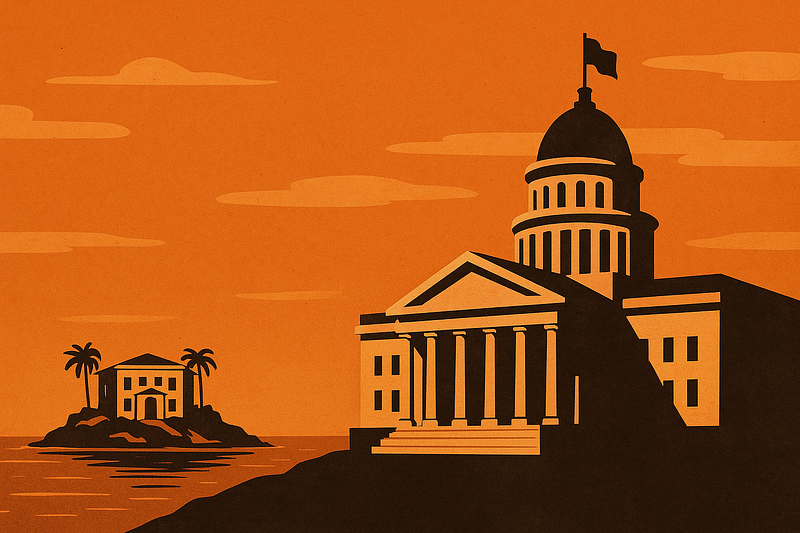
Epstein owned a private island, and the image of it became the symbol of the whole affair, the place where the powerful went to be beyond reach. But the island was only the literal version of something the entire structure provided. Distance. The powerful live close enough to events to shape them and far enough away to escape their consequences, and every instrument of modern privilege, the offshore company, the encrypted device, the non-disclosure agreement, the layered foundation, exists to widen that distance. The island hid them from the world. The throne, the position inside the network, protected them from it. Both did the same work.
The man was the scandal, and the scandal was never the man. He was the visible node, the one the structure could afford to lose, and losing him allowed everything he had connected to present itself as having merely been in the wrong room at the wrong time. What he sold was access, and access is exactly the asset that implicates everyone who buys it and protects everyone once bought, because to expose the seller is to expose the transaction, and no buyer wants the receipt read aloud.
It would be easier if there were a list. A list could be entered into evidence. A structure cannot be, because it is not a thing anyone signed. It is the sum of a thousand separate decisions to look away, each one defensible on its own, each one made by someone protecting nothing more sinister than their own institution's good name, and adding up, without a meeting or a plan, to the most effective protection money cannot openly buy. That is the part that should disturb more than any rumored client list. The worst outcome here did not require a single villain beyond the two who were caught. It required only that a great many ordinary institutions each do the narrowly sensible thing.
The cell was supposed to be watched. So was the rest of it. The two guards on duty that night were charged with falsifying records, entered a deferred-prosecution agreement, performed a hundred hours of community service, and had the charges dropped at the start of 2022. Even the one failure that was investigated and named dissolved without a conviction, which tells you the cell was not the exception to the pattern. It was the pattern in miniature. The failure to watch everything else was converted, settlement by settlement and report by report, into a debt that has now been paid in full.
The island itself was sold. Epstein had bought Little Saint James in 1998 for just under eight million dollars, and in 2023 his estate sold it and its neighbor for sixty million to a private buyer, who plans a resort. The property changed hands cleanly, its title clear, the new owner untroubled by what had happened on it.
Courtney Wild is in her thirties now. She gave eleven years of her life to making a court say that the 2008 deal had wronged her, and in the end a court did, and by then the man it concerned was dead, the houses were sold, and the network had quietly reassembled. The vindication was real and it arrived into a world that had already moved the furniture. That is the throne's last and strangest property. It outlasts not only the man who sits in it but the people who spend their lives trying to pull it down. The throne was not for sale, because no one ever owned it. They only sat in it, one after another, and stood up when the room got bright, and sat back down when it dimmed.
Evidence Map
Facts, interpretations, forecasts, and disconfirming signals.
Core claim. The Epstein network survived his fall not because of a coordinated protection ring but because of an emergent mechanism: proximity to him had been converted into shared liability, so each institution that had taken his money or access had a private, self-interested reason to avoid full exposure. The result was collective insulation produced without coordination.
Evidence level. Facts: high. The settlements (JPMorgan $290M to victims and $75M to the USVI, 2023; Deutsche Bank $75M to victims and a $150M NYDFS penalty, 2020-2023; the estate's $105M+ to the USVI, 2022), the convictions (Maxwell, 20 years, 2022), the 2008 non-prosecution agreement and the 2019 judicial finding that it violated victims' rights, the MIT ($850k, concealed) and Harvard ($9.1M) reports, and the official suicide ruling with the DOJ Inspector General's documented negligence, are all on the documented public record. Interpretation: medium, and marked. That these facts add up to an emergent equilibrium rather than ordinary partial justice is a structural reading, not a court finding. Source of the fortune: an open question on the record, treated here as a finding about the product (access), not filled with speculation.
What would confirm this. Further settlements that resolve institutional knowledge without admission; sealed records and bounded inquiries that stop at the line of individual culpability; the recurrence of the same pattern (single convicted figure, paid settlements, intact network) in comparable cases.
What would disprove this. Evidence that the institutions were in fact coordinating (a real, documented protection agreement), which would make it a conspiracy rather than an equilibrium; or, conversely, a full public adjudication in which powerful enablers were compelled under oath to account for what they knew, which would show the system is not structurally sealed at the line this analysis claims.
Watchlist. Ongoing document releases and congressional inquiries; whether any enabler above Epstein and Maxwell is ever held to a standard beyond a no-admission settlement; how banks and universities revise donor and client vetting, which reveals what they concluded they had done wrong.