The silence beneath the stone
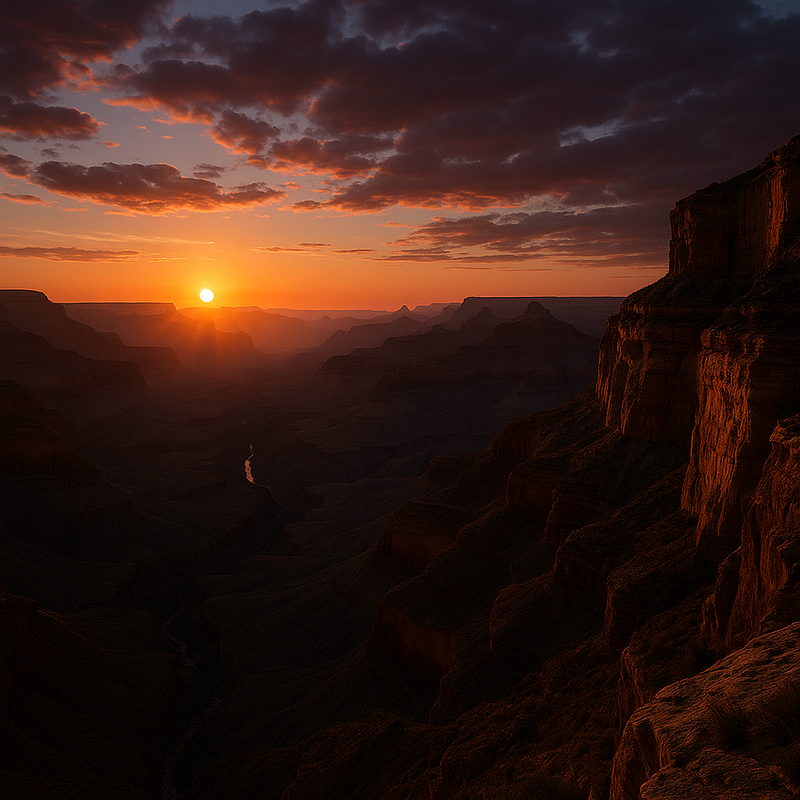
At sunrise the canyon breathes. The light does not fall, it seeps , a slow unveiling of walls that have endured longer than memory. The Colorado River far below glitters like a vein of quicksilver, pulsing through stone as if the earth itself were alive.
From the rim, the cliffs carry names that belong to another continent: Isis Temple, Tower of Ra, Cheops Pyramid. They rise not from the Nile but from Arizona, christened by nineteenth-century explorers who saw in the rocks the geometry of monuments. What began as poetry hardened into cartography, and so the gods of Egypt were carved into the American West.
The silence here is not absence but density. It is a silence that resists intrusion, that feels curated, as if the canyon itself has chosen what to reveal and what to withhold.
“History leaves fingerprints even when it hides its face.”
That fingerprint appeared in print on April 5, 1909, in the modest pages of the Arizona Gazette. The story spoke of a cave high in Marble Canyon, a labyrinth carved into stone, filled with relics that should not have existed. Egyptian idols, copper tools, hieroglyphs, even mummified figures seated in alcoves as if waiting for a sunrise that would never return.
It was a single report, written in the tone of a survey rather than a fantasy. And then it vanished. No photographs, no follow-up, no institutional record. The silence that followed was louder than any denial.
The canyon endures. The archives endure. Between them stretches an echo, the sound of something once spoken and then buried. An echo that still unsettles the official map of history.
The discovery of Kincaid
On April 5, 1909, the Arizona Gazette printed a story that has never stopped reverberating. The headline was stark in its simplicity: Explorations in the Grand Canyon. Beneath it appeared a name that no archive can fully contain, G. E. Kincaid.
A cave in the cliffs
Kincaid was described as a veteran of the river, a man seasoned by decades of navigating its rapids and shadows. He claimed to have seen, high on the wall of Marble Canyon, a dark opening that looked less like erosion than design. To reach it he climbed with rope and lantern, the Colorado shrinking beneath him with every pull.
Inside, the silence deepened. The tunnel was no jagged fissure but a corridor, its walls unnaturally smooth, its ceiling squared with a geometry that spoke of intention. His lantern revealed stairways cut into stone, cross-halls and chambers branching in measured symmetry.
“Absence is accident; symmetry is decision.”
The chambers within
Kincaid’s description grew stranger with every turn. Niches carved into the rock held figures wrapped and brittle, mummies seated upright, their faces turned east as if waiting for a dawn that never came. Along the walls were idols of copper and gold, statues of unfamiliar gods, and on the stone itself lines of hieroglyphs.
It read less like folklore than survey: corridors measured at one hundred feet, rooms recorded in precise dimensions, ventilation shafts described with an engineer’s detachment. The report even claimed the relics would be shipped to Washington under the supervision of a man named Professor S. A. Jordan of the Smithsonian Institution.
The Gazette published these details as if they were routine. No embellishment, no disbelief, just the cadence of a field report.
“The tone was not fantasy but record.”
Silence after the story
Then the silence began. No second article. No photographs. No Smithsonian report. No catalog entries, no shipping manifests, no trace of Kincaid or Jordan in institutional records. Two names emerged once from the canyon and then dissolved, as if erased by the very machinery of memory.
Real expeditions leave trails of paper: permits, maps, receipts, the detritus of bureaucracy. Here, there was none.
And when silence lingers too long, it begins to feel deliberate.
“What vanishes in archives often vanishes not by accident but by choice.”
The men who vanished
Two names, one echo
The Arizona Gazette printed them as if they were anchors of authority: G. E. Kincaid, explorer of the river, and Professor S. A. Jordan, scientist of the Smithsonian. Names are supposed to steady a story, to tie rumor to reality. Yet these two names dissolve the moment one tries to follow them.
No census records. No expedition logs. No Smithsonian employee lists. No letters, no requisitions, no shipping orders. In the immense paper machinery of early twentieth-century America, they appear once and then vanish.
“Silence in bureaucracy is never natural.”
The logic of erasure
In every genuine expedition there is residue: receipts for supplies, permits signed by officials, correspondence between departments. These traces are not romantic, but they are stubborn. They root events in the soil of history. The absence of such traces is itself a presence, the kind of gap that suggests intervention.
If Kincaid and Jordan were fabrications, their invention was precise: a veteran explorer with geological knowledge, a professor whose title lent gravitas, measurements and coordinates given with a surveyor’s eye. If they were real, their erasure was careful. Either way, the gap unsettles.
“When a name disappears, the question is not who was forgotten, but who did the forgetting.”
The silence that grows louder
For decades, researchers have searched for Kincaid’s trail. Letters to the Smithsonian return the same answer: no records exist. The words are polite, official, final, but they resolve nothing.
To say no records exist is not to say no event occurred. It is to place the burden back onto silence, a silence that grows louder with each repetition.
And here the pattern of the Manifest emerges again: names erased, archives closed, the past reshaped by absence rather than discovery.
The story of Kincaid does not collapse because it lacks evidence. It endures because its very erasure resembles intention.
The Smithsonian and the architecture of silence
A temple of certainty
The Smithsonian Institution was founded as a cathedral of knowledge, its marble halls promising preservation and classification. It was designed to give order to the unknown, to make the world legible. But every temple, no matter how secular, has its taboos.
In the late nineteenth century, under the influence of geologist and explorer John Wesley Powell, the Smithsonian embraced a doctrine that shaped the way Americans were allowed to imagine their past. Civilizations, Powell argued, had developed in isolation. The Old World and the New were parallel lines that never touched.
The Powell doctrine
Egypt belonged to one story. Mesopotamia to another. The Americas were to remain sealed off, their origins self-contained. Crossovers were heresy, contamination, or fantasy. Within that framework, an Egyptian tomb in the Grand Canyon was not simply implausible. It was inadmissible.
“Science does not always reject ideas because they are false. Sometimes it rejects them because they are inconvenient.”
The doctrine did more than shape scholarship. It became policy. Expeditions that contradicted it risked being sidelined. Findings that blurred the boundaries of history could be recategorized, misfiled, or buried in basements. What survived was not truth, but narrative.
Silence as method
When researchers later wrote to the Smithsonian about Kincaid’s cave, the response was always the same: “No records exist.” The phrase was official, polished, final, yet it did not close the matter. To say there are no records is not the same as saying nothing happened.
In bureaucratic language, absence itself becomes an instrument. What cannot be acknowledged is simply not indexed. The silence is not denial but containment, a fence built from words.
“The archive is not only where knowledge is kept, it is where questions are buried.”
Bureaucracy or intention?
Defenders of the Smithsonian argue that such gaps are inevitable. Its collections are vast, its catalogues incomplete. Boxes of field notes lie scattered, mislabeled, or forgotten. Many documents from the early twentieth century remain unindexed. Absence, they say, is not conspiracy but clerical accident.
And yet patterns matter. When the same kind of absence repeats itself, when stories that threaten the boundaries of history consistently vanish, the accident begins to resemble architecture.
The Smithsonian’s silence on Kincaid’s cave fits this pattern seamlessly. Not because it proves the cave existed, but because it reveals how institutions define reality, not by what they record, but by what they refuse to admit.
Restricted ground
The sealed face of Marble Canyon
The eastern wall of Marble Canyon has always carried a different silence. Even among cliffs that stretch for hundreds of miles, its air feels strange, thin, metallic, as though the stone is holding its breath. From a distance it looks unremarkable, another vertical face of shadow and ochre. But those who have approached it speak of a resistance, as if the rock itself refuses intrusion.
It was here, according to the Arizona Gazette of 1909, that G. E. Kincaid found his entrance. A dark mouth high above the river, accessible only by rope, concealed by the ledge itself. The article described a tunnel descending into the earth, a labyrinth sealed within stone.
A zone closed to the public
Today, the same stretch of cliff falls within a Special Use Zone of Grand Canyon National Park. Entry is forbidden without federal authorization. The official reason is safety: the cliffs are unstable, the terrain hazardous. Yet the explanation feels uneven. Dozens of equally dangerous areas remain open to hikers and climbers. Only this one, where Kincaid’s coordinates would place the entrance, remains sealed.
“Silence is a fence made of words that no one dares to test.”
Maps describe the forbidden areas with neutral language: Research Natural Area, Cultural Resource Site, Wilderness Protection Zone. Harmless phrases, bureaucratic comfort. But when these zones are plotted against the surrounding landmarks, a pattern emerges that defies coincidence.
The names of the gods
Isis Temple. Osiris Shrine. Tower of Ra. Shiva Temple. Formations christened by nineteenth-century explorers who saw in the cliffs the profiles of temples, the silhouettes of gods. At the time, the names were considered poetic flourishes. But in hindsight they feel uncanny: the very regions named for ancient deities are the ones where access is most restricted.
Coincidence, perhaps. Yet once perceived, the alignment exerts its own gravity.
“The landscape does not lie; it simply waits for interpretation.”
Whispers on the rim
Local hikers speak in hushed tones of entrances glimpsed and then sealed, of sudden patrols enforcing boundaries with severity beyond what safety demands. None of these accounts can be proved. They circulate as rumor, as oral fragments carried from one generation of explorers to the next. But each retelling adds another layer of dust to a story that refuses to die.
The Canyon keeps its silence not by concealment but by immensity. It can absorb secrets without effort, folding them into its stone. What is hidden here does not need to be destroyed. It only needs to be fenced, renamed, and left to the erosion of memory.
The canyon as memory
The first keepers of the stone
Long before nineteenth-century explorers christened cliffs with Egyptian names, the canyon already had guardians. To the Hopi, the Zuni, and the Havasupai, this was not scenery but origin. The walls were not monuments but thresholds, places where the world itself had opened.
The Hopi speak of Sipapu, a small opening near the river where the first people emerged from the underworld into this world. It is not a story of geology but of transition, a passage between states of being.
The geometry of descent
The imagery is unmistakable: underground chambers, corridors of stone, a hidden threshold between darkness and light. To read the legend of Sipapu alongside Kincaid’s description of halls and alcoves is to hear the same rhythm: a descent, a passage, a rebirth.
“The canyon is not a monument of stone. It is an open book that can only be read by those who remember how to listen.”
For the elders, erosion is not absence but voice. Each gust of wind is a messenger, each echo a memory. The canyon breathes, and in its breath one can hear floods, fires, footsteps, not as history but as pattern.
Parallels across continents
What is striking is not only the resonance within the American Southwest but its echo across oceans. Ancient myths from Egypt and Mesopotamia tell of journeys beneath the earth, of caverns where the soul travels before rebirth. Tombs were not endings but passages, chambers of transition.
Different continents, different tongues, yet the same geometry of meaning.
“Civilizations separated by oceans still carve the same shapes when they speak to the sky.”
The persistence of wonder
This shared architecture of myth suggests something older than contact, older than conquest: a common intuition that beneath the earth lies not only stone but memory. The canyon becomes a mirror, reflecting both the local and the universal.
That is why it attracts more than geologists or hikers. It draws seekers, people who sense that beneath the silence lies a pattern. One person sees erosion. Another sees intention. Both respond to the same gravity of wonder.
Erased history
Vaults of forgetting
Every era builds its own vaults. Some are carved in stone, others in policy. The Grand Canyon holds its chambers in silence, but institutions build theirs from marble and paper. The Smithsonian promised preservation, yet preservation always implies selection. For every artifact placed behind glass, a thousand others vanish into basements, drawers, or bureaucratic limbo.
What is displayed becomes history. What is withheld becomes silence.
“Forgetting is rarely an accident. It is an administrative decision performed in slow motion.”
Institutions as editors of memory
This is not always conspiracy. Often it is structure. The larger an archive grows, the easier it becomes for truth to drown in its abundance. Filing systems define visibility; categories define existence. What does not fit the frame is labeled as anomaly, then moved to the margins until the anomaly itself disappears.
In this way, institutions do not merely keep records. They edit reality.
A pattern across centuries
The Smithsonian’s silence over Kincaid’s cave echoes other mechanisms of forgetting. The Vatican, with its secret archives, has curated not only doctrine but memory, deciding which gospels belong to history and which are apocrypha. The Royal Society, in its early centuries, filtered knowledge as much as it disseminated it, shaping science by choosing what not to see.
UNESCO catalogues sites for protection, yet in doing so redefines which ruins are visible and which fall into dust. Even the modern university functions as a sieve, where entire traditions vanish not because they are disproved but because they are unfunded, uncited, unread.
“The archive does not hide knowledge; it defines it by what it refuses to hold.”
The invisible continuity
From the canyon to the Vatican, from London’s libraries to Washington’s museums, the pattern is constant. Knowledge that disrupts the official order is not destroyed but absorbed, sealed, renamed, or quietly misplaced. What remains visible appears seamless, but beneath that smooth surface lie fragments of truths, misfiled and waiting.
The story of Kincaid may be doubted, yet the mechanism of its disappearance is undeniable. It resembles the logic of every great archive: curate the visible, bury the rest.
The human hunger for mystery
Stories that refuse to die
Why do certain legends endure long after their sources fade? Not because they are proven, but because they answer a hunger that fact alone cannot feed. The story of Kincaid’s cave has no photographs, no confirmed records, no museum display. And yet it survives, repeated in whispers, retold in books, resurfacing on the edges of credibility.
It endures because it touches something older than journalism.
“When certainty becomes absolute, imagination becomes rebellion.”
The geometry of wonder
Human beings have always needed landscapes of wonder, places where the known thins and the unknown can be glimpsed. In the nineteenth century, explorers sought lost cities in jungles and deserts. In the twentieth, archaeologists dreamed of civilizations beneath the sands. In the twenty-first, seekers turn inward, into archives, into algorithms, into the forgotten corners of bureaucracy.
The terrain changes, but the geometry of wonder does not. It always begins with descent, discovery, disappearance. The canyon embodies all three.
The rebellion of awe
Modern knowledge has perfected measurement, but in the process it has nearly extinguished awe. Maps are complete, charts are accurate, histories are indexed. Yet the more thorough the record, the more people feel what is missing: the sense that the world still holds secrets.
To believe that something may still be hidden is to believe that discovery is still possible.
“The refusal to accept that everything has already been found is itself a form of resistance.”
Mystery as continuity
What the story of the Grand Canyon offers is not simply the possibility of Egyptian relics in Arizona, but the deeper intuition that history is not a straight line. It is a circle of rediscoveries, a rhythm of remembering and forgetting. The Kincaid tale resonates because it restores continuity, suggesting that civilizations are not isolated islands but threads of one fabric.
And if one thread can cross the ocean, perhaps others have too.
The imagination that survives silence
Institutions may bury questions, but human minds dig them back up. Silence breeds rumor, rumor breeds legend, legend returns as memory. In this cycle, what is suppressed often grows stronger.
The canyon does not need to reveal its secrets to sustain mystery. It only needs to remain vast enough to hold our projections. One person sees erosion. Another sees intention. Both are responding to the same hunger: the need for history to be more than what we are told.
Closing reflection | What the canyon remembers
The dusk of stone
At dusk, the canyon turns to fire and shadow. The last light flows down the cliffs like liquid metal, and for a moment the walls seem to breathe. Then darkness gathers, and the silence becomes complete, a silence not of emptiness but of witness.
The Grand Canyon does not argue. It does not confirm or deny. It endures. Within its stone it holds every version ever told about it: geological, spiritual, mythical, and imagined. All are layered, none erased. The rock is its own archive, written not in ink or policy but in pressure and time.
The endurance of silence
Perhaps that is why the story of 1909 still echoes. Its details blur, its sources are doubted, but its persistence reveals a truth about human memory: our refusal to believe that everything has already been found. Silence, when stretched across generations, begins to sound like testimony.
“When silence lasts long enough, it begins to sound like truth.”
Institutions curate the visible and bury the rest. Yet what is buried is never gone. Like fossils awaiting erosion, the silenced truths rise again, in rumor, in legend, in dreams.
The archive beneath our feet
The Smithsonian may say no records exist. The Park may close the zone. The maps may rename the cliffs with bureaucratic labels. But the earth itself is not bound by such measures. Its memory is deeper than our filing systems.
“The landscape keeps no secrets; it only waits for us to notice.”
The canyon reminds us that forgetting is never final. What is suppressed by archives may be revealed by erosion. What is silenced by policy may resurface as myth. What is denied by certainty may endure as awe.
A final aftertone
When night settles over the rim, the wind threads its way through hidden corridors. Perhaps it follows the same paths Kincaid once described. Perhaps it is only imagination. Either way, the effect is the same: a reminder that mystery is not the opposite of knowledge but its continuation.
The canyon remembers pressure and water, wind and time, and every question ever asked in its shadow.
In that endurance lies its final message:
that truth is never buried forever,
that even silence is a form of testimony,
and that somewhere beneath the stone,
something still waits to be seen.
Related from The Manifest Archive