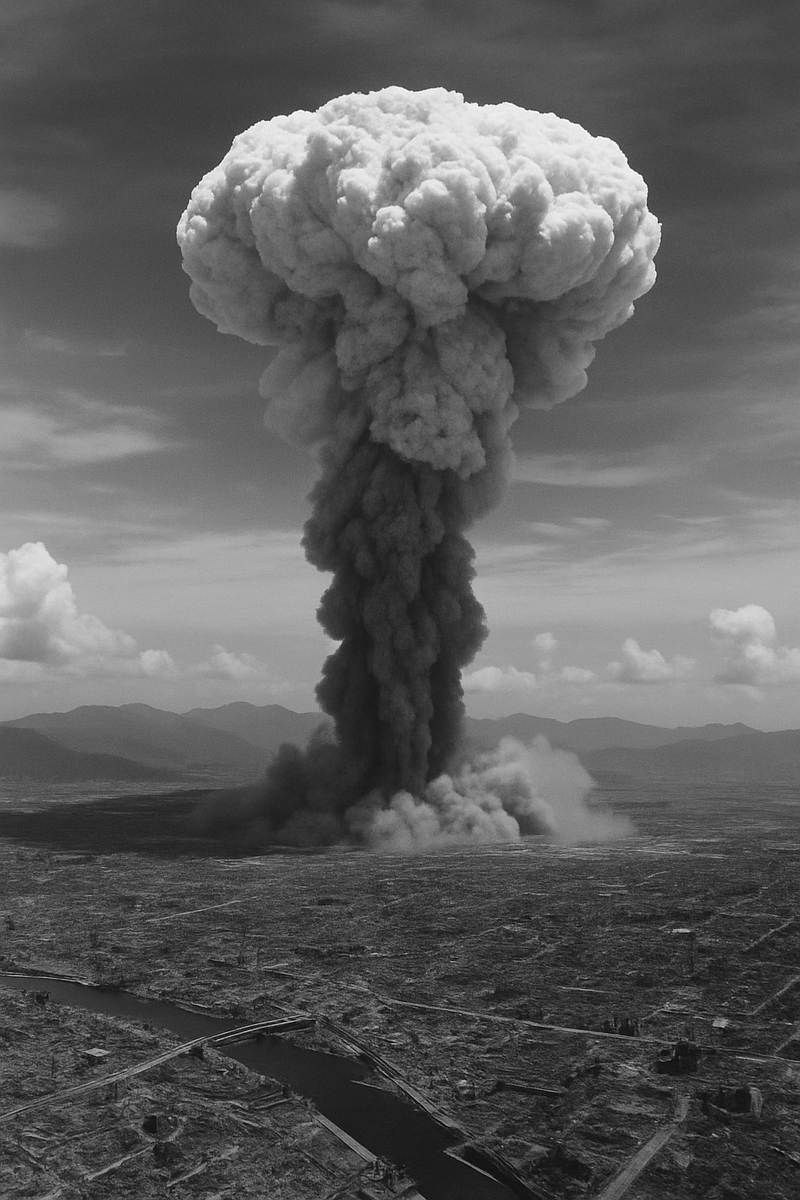
The blast is remembered as the end of one war. It fell across the opening of the next, and historians have argued ever since about which war it was really for.
At twenty-nine minutes past five in the morning on 16 July 1945, the sky over the New Mexico desert turned white. The first nuclear device had detonated at the Trinity site, and the men who had built it watched a false dawn climb over the Jornada del Muerto and harden the shadows of the mountains into something that looked permanent. The test worked. A week later, at the Potsdam Conference outside the ruins of Berlin, President Harry Truman mentioned to Joseph Stalin that the United States had developed a new weapon of unusual destructive force. Stalin, who through espionage already knew more about the bomb than Truman supposed, showed almost no reaction and merely said he hoped it would be put to good use against Japan. Two men stood at a table in Germany, both performing ignorance, and the postwar world was already being negotiated in the silences between them.
That scene is the start of a question that will not close. Hiroshima is remembered, taught, and memorialized as the act that ended the Second World War, the terrible mercy that spared a million lives by making an invasion of Japan unnecessary. That is the story most of the world carries. Underneath it runs one of the longest and least resolved debates in modern history, about whether the bomb that fell on Japan was aimed, in part or even in the main, at the Soviet Union. The debate is not a fringe suspicion. It is a documented argument among serious historians, and the honest way to tell it is not to announce the answer but to lay out what is known, what is contested, and what each side has to ignore to hold its position.
A nation already beaten
Begin with what is not in dispute. By the summer of 1945 Japan was defeated by every material measure that existed. Its navy had been destroyed, its merchant fleet sunk, its cities systematically burned by months of incendiary raids that had killed more people in a single night over Tokyo than either atomic bomb would kill outright. A naval blockade was strangling what remained of the home islands, and food was running short. American codebreakers, through the intercept program known as MAGIC, were reading Tokyo's diplomatic and military traffic, and Washington knew in detail how grim Japan's position had become. On this much the orthodox and revisionist accounts agree: Japan could not win, could not break the blockade, and could not defend itself indefinitely.
But defeated is not the same as ready to surrender, and this is where the agreement ends. The same intercepts that showed Japan's hopelessness also showed something the simplest revisionist version leaves out. Tokyo was exploring whether the still-neutral Soviet Union might broker a negotiated peace, but the Japanese government had not agreed among itself on terms, could not bring itself to define them when its own ambassador in Moscow begged for specifics, and remained controlled by a military leadership that wanted to fight at least one more great battle. The decision rested with an inner cabinet, the Big Six, that operated by consensus, which gave its hardline military members an effective veto, and at least three of them were not looking for a way out. They were preparing a defense of the southern island of Kyushu so costly that the Allies might offer better terms than unconditional surrender. A beaten nation and a surrendering nation were, in the summer of 1945, two different things.
The emperor and the unconditional demand
There was one condition Japan returned to again and again, and the documents show the Americans knew it. Tokyo could not accept a surrender that meant the abolition of the imperial throne and the trial or removal of the emperor, the kokutai that the regime treated as the nation's living core. The Allied demand, set out in the Potsdam Declaration of 26 July 1945, called for unconditional surrender and pointedly said nothing about the emperor's fate, an omission that Japanese leaders read as a threat to the throne itself. Inside the American government this was a live argument before a single bomb fell. The Secretary of War, Henry Stimson, and the former ambassador to Tokyo, Joseph Grew, urged that the terms be clarified to let Japan keep the emperor as a constitutional monarch, in the belief that such an assurance might bring surrender without invasion and without the bomb. The Secretary of State, James Byrnes, opposed any such softening, and Truman sided with Byrnes, in part because anything resembling a concession looked politically impossible.
The sharpest irony of the whole episode is documented and undisputed. After the two bombs had fallen and the Soviet Union had entered the war, Japan surrendered, and the United States allowed Hirohito to keep his throne, retaining him as emperor through the occupation because a cooperative monarch was useful for governing a defeated nation. The single assurance that Stimson and Grew had wanted to offer in July, and that might have shortened the war, was conceded in substance within weeks anyway. Whether offering it earlier would in fact have produced surrender is one of the great unanswerable questions of the war, and it is the hinge on which much of the necessity debate still turns.
The Soviet clock
The second undisputed fact is the calendar, and the calendar is the heart of the matter. At the Yalta Conference in February 1945, Stalin had promised to enter the war against Japan within roughly three months of Germany's surrender. Germany capitulated on 8 May. Three months pointed directly at the second week of August. Through the summer the Red Army moved hundreds of thousands of men east across Siberia in one of the largest secret redeployments in military history, massing an army of about one and a half million on the border of Japanese-held Manchuria. American planners knew it was coming. So did Tokyo, which is precisely why it was pinning its faint hopes on Soviet neutrality. If the Soviet Union entered the war, Japan's last diplomatic avenue closed and a second great army fell on its forces.
For Washington this created a problem that had nothing to do with Japan's defeat and everything to do with what came after it. If the war dragged into the autumn, the Soviet Union would be a full belligerent in the Pacific, with troops on the ground and a claim to share in the occupation and the postwar settlement, as it had just won one in a divided Europe. A Japan occupied jointly, or an Asia carved the way Germany and Korea were about to be carved, was a strategic outcome the United States had reason to avoid. The most thorough modern study of the surrender, the historian Tsuyoshi Hasegawa's account, frames the final weeks as a race: the United States hurrying to force a surrender before the Soviets could establish themselves, and Stalin hurrying to enter the war before Japan quit. The bomb was ready exactly as that race reached its final days. Whatever else it was, the timing was not neutral, and the clock it answered to was not running in Tokyo.
The cities kept whole
There is a detail in the targeting that the comfortable account rarely includes, and it is documented down to the dates. In the spring of 1945, as the firebombing campaign reduced one Japanese city after another to ash, a short list of cities was deliberately taken off the target maps and ordered preserved. On 15 May a directive went out to reserve Hiroshima, Kyoto, and Niigata from conventional bombing, and at the end of that month a Target Committee meeting confirmed them as candidates for the new weapon. The reason was technical and chilling in equal measure. To measure what a single atomic bomb could do, the planners needed a city that had not already been destroyed by other means, an undamaged canvas on which the effect could be read cleanly. Cities were kept whole so that their destruction would be legible.
The human residue of that decision survives in one name struck from the list, and it is worth slowing down on, because it is the rare moment in this story that can be watched rather than summarized. Kyoto, the ancient capital, sat at the top of the early target rankings. General Leslie Groves, who ran the bomb project, wanted it there precisely because the city was large and untouched, which meant the weapon could be displayed against it to maximum effect. Henry Stimson, the seventy-seven-year-old Secretary of War, would not have it. He had known Kyoto for decades, and across a series of meetings that summer he called Groves into his office and refused, again and again, to let the city stand on the list, telling him flatly, "I don't want Kyoto bombed." When Groves kept pressing, Stimson took the matter over his head to the President, and would not let it go until Truman agreed. On 25 July Kyoto came off the list and Nagasaki was written in to replace it. An old man's memory of a city he admired slid the crosshairs a few hundred miles, and the tens of thousands who would die at Nagasaki in August were, in that instant, chosen by the absence of a similar memory in anyone who spoke for them. The list was never a ranking of military necessities. It was a register of intact places, kept whole so the world's first look at the weapon would be undimmed, and which intact place burned was decided by men who knew they were curating a demonstration.
Potsdam, after the test
The timing of the Potsdam Conference was not an accident of the calendar either. Truman had pressed to delay the meeting until mid-July, in the hope that the bomb would be tested first and he would arrive holding a proven card rather than a promise, and the Trinity test obliged him on the conference's eve. The change in the American posture afterward is recorded in the diaries of the men who watched it. Stimson noted that the news from New Mexico left Truman visibly "pepped up," and that it transformed the mood of the delegation, including Churchill, who had been reluctant to share anything of the weapon with the Soviets and now, Stimson wrote, was inclined to treat it not as a secret to protect but as an argument to use in the negotiations in the Allies' favor. The bomb had not yet been dropped on anyone, and it was already functioning as leverage at a diplomatic table where the only adversary present was the Soviet Union.
This is the part of the record that the strictly military account has the most trouble absorbing. Before Hiroshima, before a single Japanese city had been touched by the new weapon, the men deciding its use were weighing what it would do to their standing against Moscow, and adjusting their conduct toward Stalin in real time on the strength of a test in the desert. Stimson himself, in the same days, recorded his deepening unease at his first close exposure to the Soviet system. The weapon's first effect, chronologically, was not on Japan at all. It was on the confidence of American negotiators in Germany, three weeks before it was used in anger.
The committee that chose
The formal decision passed through a small body assembled for the purpose. On 31 May 1945 the Interim Committee, chaired by Stimson and advised by a scientific panel that included Robert Oppenheimer, met to settle how the weapon would first be used. Its conclusion, reached that same day, was that the bomb should be dropped on Japan without prior warning, and against a target chosen to show its full force: not an isolated military base but, in the committee's own framing, a war plant closely surrounded by workers' houses. The possibility of a harmless demonstration, a detonation announced in advance over empty ground with observers invited, was raised and set aside. The reasons given were practical. A device that failed to fire, or that Japan could shrug off, would waste the shock and might harden resistance; the stockpile was tiny; and a demonstration, the scientists feared, might simply not move a government that had absorbed the firebombing of its cities without surrender. The logic is coherent on its own terms. It is also the logic of a side that had decided the weapon's value lay in being seen to work, on a living city, in full, and the question that decision never paused over was who, besides Tokyo, was meant to be watching.
The case that the bomb was a message
This is the documented foundation of the revisionist argument, which is older and more serious than its caricature. Its first sharp statement came from the British physicist P. M. S. Blackett in 1948, and its fullest from the historian Gar Alperovitz, whose 1965 book gave the thesis its name, atomic diplomacy, and who argued across decades of work that the bomb was not militarily necessary to end the war, that Truman and his advisers had reason to know it, and that a central purpose of using it was to demonstrate American power to the Soviet Union and strengthen Washington's hand in the unfolding confrontation over Europe and Asia. The argument did not rest only on inference. It drew on the words of senior American figures at the time. Admiral William Leahy, Truman's own chief of staff, wrote afterward that the atomic bomb had been of no material assistance against an enemy already defeated and ready to surrender, and that in using it the United States had adopted an ethical standard common to the barbarians of the Dark Ages. The United States Strategic Bombing Survey concluded in 1946 that Japan would likely have surrendered before any invasion even if the bombs had not been dropped. To the revisionist, the choice of Hiroshima, a city left deliberately untouched so that the new weapon's effect could be cleanly observed, looks less like the last act of one war than the first demonstration of the next.
The Soviet dimension is not only inference; it appears in the words of the men making policy. In late May 1945, weeks before the bomb was even tested, the physicist Leo Szilard and two colleagues met James Byrnes, soon to be Secretary of State, to argue against using the weapon on cities. By Szilard's account Byrnes did not claim the bomb was needed to defeat Japan, which he took to be already beaten; his concern was the spread of Soviet influence in Europe, and his view was that possessing and demonstrating the bomb would make the Russians more manageable. That a senior figure was weighing the weapon's effect on Moscow before it had been used, and in conversation with the scientists who built it, is among the most concrete supports the diplomatic reading has.
It also belonged to a debate that was alive inside the project itself. In June 1945 a committee of Manhattan Project scientists led by James Franck delivered a report urging that the bomb not be dropped on a city without warning, proposing instead a demonstration before international observers on barren ground. Szilard then circulated a petition, signed by dozens of scientists at the Chicago and Oak Ridge sites, arguing that an atomic attack could not be justified until Japan had been told the terms it faced and given a chance to surrender. The men closest to the weapon were the ones most determined that its first use be a choice considered from every side, and the record of their dissent is one reason the question of necessity cannot be waved away as hindsight. It was asked, in writing, before the fact. And the makers understood from the first morning what they had built. When the Trinity fireball faded, the test director Kenneth Bainbridge turned to Oppenheimer and said, "Now we are all sons of bitches." Oppenheimer would later reach for older words, the line from the Bhagavad Gita, "Now I am become Death, the destroyer of worlds." The weight of the choice did not need eighty years of argument to be felt. It was felt in the desert, before a single city had been named.
What the generals did and did not say
The revisionist case is often buttressed with the testimony of the soldiers, and here the honest account has to cut against its own argument, because that testimony is more contested than either side likes to admit. Some of the most senior American military men did record doubts. Dwight Eisenhower wrote in his memoirs that when Stimson told him the bomb would be used, he voiced his "grave misgivings," on the grounds that Japan was already defeated and the weapon therefore unnecessary, and that the country should avoid shocking world opinion with a weapon no longer needed to save American lives. Leahy's memoir went further still. Taken together, these passages have become the backbone of the claim that the warriors knew what the politicians would not admit.
But the claim is weaker than it is usually made to sound, and saying so is what keeps this account honest. Eisenhower's recollection was written years later, and no contemporary record corroborates the conversation as he described it, which has led careful historians to treat it with caution rather than as proof. More damaging to the tidy version, the two commanders who would have run the Pacific invasion gave no such advice when it counted. Neither Douglas MacArthur nor Chester Nimitz told Truman before the decision that he thought the bomb unnecessary or the invasion avoidable, whatever Nimitz said publicly after the war, and Nimitz, told in early 1945 that an atomic weapon was coming, is recorded responding not with reluctance but with impatience, asking in effect whether one could be had sooner. The picture of a uniformed officer corps quietly certain the bomb was wrong is partly a retrospective construction, built by selecting the memoirs that fit and passing over the fact that the men whose judgment would have mattered most raised no such objection at the time. The doubts were real and they were senior, but they were neither universal nor, in most cases, recorded at the time, and a reading that leans its whole weight on them is leaning on a memory.
The steelman
The strongest counterargument has to be met at its strongest, because it is formidable and rests on evidence the early revisionists did not have. When the full, unredacted MAGIC intercept summaries were released in 1995, the historian Richard Frank built from them a detailed reconstruction that left much of the revisionist reading looking selective. The intercepts, read in full, show Japanese diplomacy that was not genuine peace-seeking but a search for terms no Allied government could accept, conducted by a regime whose military was simultaneously reinforcing Kyushu with exactly the strength American planners feared. Neither the Emperor nor the armed forces, in Frank's account, were close to surrender in early August. The consensus machinery of the Big Six was deadlocked, and the hardliners held their veto to the end. What broke the deadlock was shock, two of them in three days. Japan's navy minister, Mitsumasa Yonai, remarked on 12 August that the atomic bombs and the Soviet entry were, in a sense, gifts from heaven, because they spared the leadership from having to say it quit the war because of the domestic situation, which he called his main worry.
The invasion that the bomb is said to have prevented was also not a fiction. Planning for Operation Downfall, beginning with a landing on Kyushu set for November, was real and advanced. The casualty estimates were genuinely uncertain and genuinely frightening: figures presented to Truman in June 1945 ran to tens of thousands for the first phase, while other military studies that spring implied that a full campaign could cost several hundred thousand American casualties, against Japanese losses and civilian deaths that would have been far greater still. A decision-maker in the summer of 1945, holding those numbers and facing a government that would not surrender, was not obviously choosing diplomacy over necessity by using the weapon. He may have been doing both at once, which is the possibility both extremes find hardest to sit with.
There is also a political reality the diplomatic reading tends to flatten. The Manhattan Project had cost some two billion dollars, an enormous secret sum, and a president who declined to use the resulting weapon, then accepted the casualties of an invasion or the open-ended delay of a negotiated peace, would have faced a reckoning no elected leader could survive once the secret came out. Truman was four months into the office, untested, governing in the shadow of a dead Roosevelt. To imagine him calmly setting the bomb aside on moral or strategic grounds is to imagine a politician unlike any the system produces. The decision was overdetermined: military readiness, bureaucratic momentum, genuine fear of invasion casualties, the diplomatic advantage against Moscow, and raw political necessity all pushed in the same direction at once. That a weapon's use is overdetermined does not make any one of those motives the true one, and it is the shared error of both camps to insist that a single cause must have been decisive. The bomb did not need one reason. It had every reason a state can have, and they all pointed the same way.
The three days
The second bomb is where the orthodox case is at its most strained, and an honest account should say so. Hiroshima was destroyed on 6 August. The Soviet Union declared war on 8 August and in the first hours of 9 August poured into Manchuria. Nagasaki was destroyed later that same morning, three days after the first bomb and before the Big Six had met to weigh what Hiroshima even meant. If the purpose was strictly to compel a surrender that Tokyo had not yet had time to weigh, the speed is difficult to explain on military grounds alone. The interval allowed almost no room for the first shock to do its work before the second arrived. Defenders of the decision argue that the standing order was simply to use the bombs as they became ready, and that a second blow was thought necessary to convince Tokyo the United States had a stockpile rather than a single device. Critics see in that same compression a demonstration of will and capacity addressed beyond Japan, a statement that the new power was not a one-time event but a permanent condition. The records do not settle the dispute, but they do show that the tempo was driven as much by readiness and momentum as by any close reading of Japanese intentions, because there was no time in three days to read them.
What the evidence will and will not bear
Set the two cases beside each other and a defensible reading emerges, narrower than the strongest version of the charge and stronger for it. The claim that the bomb was aimed at Russia and not at Japan goes further than the documents can carry, because the evidence that Japan's military would not surrender on acceptable terms in early August is strong, and the bomb did contribute to breaking that resistance. But the opposite claim, that the Soviet Union had nothing to do with it, that the bomb was a purely military act addressed only to Tokyo, is equally unsupportable, because the timing, the targeting, the diplomacy, and the testimony all point to leaders who were thinking hard about Moscow as they decided when and whether to use it. Hasegawa's synthesis, the most careful weighing now available, concludes that the Soviet entry into the war was probably even more decisive than the bombs in producing Japan's surrender, and that American leaders, conscious of the Soviet clock, used the weapon in part to end the war on American terms before their ally could claim a share of the result. The military reason behind that judgment is concrete. When the Red Army crossed into Manchuria in the first hours of 9 August it shattered Japan's Kwantung Army within days, and with it the last hope that Moscow might mediate and the last plan for a decisive home-island battle that could be traded for terms. The bomb destroyed a city. The Soviet entry destroyed a strategy. To the Big Six, deadlocked over whether to fight on, the second was the harder blow to answer, because it removed not a place but the entire premise on which fighting on had rested. That is not the comfortable story and it is not the conspiratorial one. It is the documented middle, and it is uncomfortable precisely because it refuses to absolve or to accuse.
What can be said at the level of mechanism, and held as interpretation rather than proof, is this. The event the world files under the end of one war sat exactly on the opening of another, and the same flash that closed the Pacific conflict also opened the long contest with the Soviet Union by showing, in a single irreversible instant, what the United States now held and others did not. The bomb had two audiences whether or not it was built for them, and the decision about its use was made by men who could see both. To remember Hiroshima only as the last page of the war with Japan is to read a document that is also, unmistakably, the first page of the Cold War, and to mistake a hinge for an ending.
How an event becomes a memory
There is a final layer, and it is the one most native to this archive, because it is about how a contested event hardens into a settled story. The necessity of the bomb was debated inside the American government before it was dropped and has been debated by historians ever since, yet the public memory that formed around it admitted almost none of that doubt. The bombing entered textbooks as clean arithmetic, so many lives spent to save so many more. It entered popular culture as tragic inevitability and reluctant righteousness. The uncertainty that the decision-makers themselves felt, the objections of senior officers, the live argument over whether a demonstration or a modified surrender demand might have worked, the documented weight of the Soviet dimension, all of it survived in the scholarship and almost none of it in the memory. The facts were never sealed in a vault. They were simply harder to carry than the story that replaced them, and a society will choose the usable account over the accurate one unless something forces the exchange.
The story even split along national lines, each version sanded smooth for the people who needed it. In the United States the bomb became the instrument of rescue, the hard mercy that brought the boys home. In Japan it became the founding wound of a victim nation, the unprovoked horror visited on civilians, a memory that quietly set its own empire's conduct in Asia to one side. Two peoples kept two incompatible single-sentence accounts of the same flash, and both accounts did the same work: they made an event that resists simple moral arithmetic carryable, by removing the part that would not fit. The accurate version, in which a defeated but unsurrendering enemy, a contested necessity, and a watching rival all occupied the frame at once, was available to anyone who looked. It was simply too heavy to be a national memory.
When something did force the exchange, the reaction showed how the settled story is defended. In 1994 the Smithsonian's National Air and Space Museum prepared an exhibition built around the fuselage of the Enola Gay, the aircraft that carried the Hiroshima bomb, under the title "The Crossroads: The End of World War II, the Atomic Bomb, and the Origins of the Cold War." Its curators meant it as a balanced account, one that placed the bombing inside the very debate this essay has traced, including the casualty estimates, the Soviet dimension, and images of the human cost on the ground. Veterans' organizations and members of Congress read that balance as betrayal. The Senate unanimously passed a resolution condemning the script as revisionist and offensive, members of Congress questioned the federal money the Smithsonian depends on, and under that pressure the institution capitulated. In January 1995 the exhibition was cancelled. What opened that summer instead was titled simply "Enola Gay," and it contained no interpretation, no graphic photographs, no melted artifacts, only the polished fuselage and a placard about the plane's restoration. The machinery that delivered the bomb was displayed; the question of what the bomb was for was removed. A museum had tried to put the archive's uncertainty on the wall, and a nation, through its legislature, decided the wall would carry the usable story instead. That is not a gap in the record left by carelessness. It is a settled memory being actively kept settled, in public, on the record, under pressure from the body that votes its money.
That is how nations metabolize the events they cannot afford to look at directly. The gap between what the archive holds and what the public remembers is itself a kind of evidence, about what a settled story is for and who is willing to spend political capital to defend it.
The light over Hiroshima has been studied for eighty years, and the debate about what it was for is not closed and may never be. What is no longer seriously in doubt is that the men who loosed it were watching two countries at once, and that the war it is remembered for ending was already, as it ended, becoming the next one. Japan absorbed the destruction. The Soviet Union read the meaning. The flash that ended a war began a world, and the world it began has not yet ended. The century that followed was lit, from its first morning, by a light that announced as much as it concluded.
Evidence Map
Facts, interpretations, forecasts, and disconfirming signals.
Core claim. The atomic bombing functioned simultaneously as the final blow against Japan and as the opening demonstration of power in the emerging contest with the Soviet Union, its timing and targeting entangled in the race to force surrender before Soviet entry could reshape the postwar settlement.
Evidence level. Facts (high confidence): the Trinity test of 16 July 1945; the Potsdam exchange and Truman's delay of the conference until after the test; the May 1945 reservation of cities (Hiroshima, Kyoto, Niigata) from firebombing and Stimson's removal of Kyoto, with Nagasaki substituted on 25 July; the bombings of 6 and 9 August; the Soviet declaration of war on 8/9 August; the MAGIC intercepts released in 1995; Leahy's recorded judgment; Stimson's diary on Truman "pepped up" after Trinity; the 1946 Strategic Bombing Survey conclusion; Navy Minister Yonai's "gifts from heaven" remark; Operation Downfall planning; the 1995 cancellation of the Smithsonian "Crossroads" exhibit and its replacement with the interpretation-free "Enola Gay." Interpretation (medium, marked): Soviet considerations materially shaping the decision and its timing (Hasegawa, Alperovitz for; Frank, Maddox against); the targeting choices read as a curated demonstration. The strong form of the claim, the bomb aimed at Russia and not Japan, is named and explicitly declined. Contested-as-fact (flagged): the claim that the senior military uniformly judged the bomb unnecessary, which rests on later memoirs (Eisenhower, Leahy) and is undercut by the absence of any such advice from MacArthur or Nimitz before the decision.
Primary sources. The reconstruction rests on primary records, not secondary summary: the Stimson diaries, the MAGIC intercept summaries (released in full in 1995), the Target Committee and Interim Committee records, the Potsdam Conference papers, the 1946 United States Strategic Bombing Survey, the Franck Report, and the Szilard petition.
What would confirm this. Further declassification showing Soviet considerations explicit in American deliberations over timing; the scholarly center of gravity moving toward the multi-causal synthesis; public memory continuing to lag the documentary record.
What would disprove this. Newly released records showing decision-makers giving no weight to the Soviet dimension; or, conversely, evidence that Japan would have surrendered on acceptable terms within days regardless, which would push the account toward the harder revisionist claim the piece declines to make.
Watchlist. Historical and effectively closed in its archive, but live as a case in how contested events become settled memory, and in who pays to keep them settled.