This article is part of The Manifest, an unfolding work that seeks to uncover the hidden structures of history and power. Each chapter reveals what has been silenced or erased, and places it back into the story of humanity. Where previous chapters traced the Vatican’s unbroken empire and Rome’s illusion of collapse, this one turns to the civilizations that disappeared without ruin, those who may not have fallen at all, but departed.
Earth as a Temporary Home
On a humid summer evening in the jungles of Central America, the ruins of a Maya city rise out of the canopy like the bones of another world. The stone is covered with moss, the temples stand in silence, and the jungle hums with insects. The textbooks tell us this city collapsed a thousand years ago, undone by drought or internecine war. But the silence of these plazas does not feel like collapse. It feels like departure.
History books insist that civilizations rise and fall within the limits of earth: they grow, they flourish, they weaken, and then they die. Yet the stones tell another story. Across continents, again and again, we find structures aligned not to rivers or crops but to the stars. We find myths that do not speak of eternal settlement but of return journeys, stairways to heaven, gods who walk the earth and then leave.
What if humanity was never meant to remain here permanently? What if Earth is not our birthplace but our station?
“Absence without ruin is not collapse. It is departure.”
This is not the story of decline. This is the story of civilizations rehearsing, preparing, and perhaps enacting departure beyond earth.
The Maya and the Pleiades: Cities as Departure Calendars
Deep in the Yucatán, temples rise above the canopy like stone ships waiting to sail. At Chichén Itzá, the serpent of light slithers down the pyramid steps during the equinox. At Tikal, the temples align like watchtowers, each calibrated to cycles of the heavens. To walk these cities is to walk through calendars built in stone.
Mainstream history calls the Maya collapse a mystery of drought, war, and famine. But their plazas show little of fire or siege. Tools were left mid-use, buildings abandoned mid-construction. This was not the chaos of collapse. This was the choreography of departure.
The Maya were obsessed with time. Their long count calendar stretched across millennia. Their ritual cycles interlocked with cosmic precision. And above all, they revered the Pleiades. When this star cluster reached the zenith at midnight, ceremonies unfolded. To Western archaeologists, this was “primitive astronomy,” useful for farming. Yet the scale suggests something else. These alignments were not about maize but about migration.
“The Pleiades were not simply stars. They were gates in the calendar of departure.”
Inside the Temple of the Inscriptions at Palenque lies the famous sarcophagus lid of King Pakal. Carved into the stone is an image long dismissed as myth: a man reclining in a machine, controls before him, flames beneath. To academics, it is symbolic of descent into the underworld. To anyone else, it looks eerily like a pilot. The carving has been mocked for decades as “ancient astronaut fantasy.” Yet the stone remains, unignorable, preserved in the National Museum in Mexico City.
When the great Maya cities were abandoned, there was no evidence of extermination. Populations dispersed into villages, but the monumental centers aligned to solstices, Venus, and the Pleiades were simply emptied. Modern explanations of drought and conflict may be partially true, yet they fail to explain why cities engineered as cosmic clocks were left precisely when their alignments reached turning points.
Smithsonian expeditions catalogued strange artifacts in Central America and then quietly filed them away. National Geographic framed Maya calendars as tools of farmers, stripping away their cosmic significance. UNESCO celebrates the temples as world heritage, but in their official language avoids cosmology altogether.
The jungle reclaimed the temples, but perhaps it was not conquest by vines. Perhaps it was release.
“The Maya did not collapse. They synchronized, and then they left.”
The Anasazi and the Sipapu: Roads to Other Worlds
At Chaco Canyon in New Mexico, the desert opens into silence. The ruins of Pueblo Bonito rise like a stone crescent, six hundred rooms arranged with impossible geometry. From the air, the plan resembles a circuit. From the ground, the stones still radiate heat after sunset, as though holding memory.
The Anasazi, or ancestral Puebloans, thrived here between 800 and 1200 CE. They built monumental great houses, carved roads through desert mesas, and left behind petroglyphs that track the sun and moon with scientific precision. And then, by 1300, they were gone.
Archaeologists have traced more than four hundred miles of engineered roads radiating from Chaco Canyon. Some stretch for thirty kilometers in ruler-straight lines, cutting across mesas, ignoring rivers and canyons. Many lead to cliffs where they simply stop. The orthodox explanation is ceremonial purpose. Yet that word conceals more than it reveals. These roads look less like trade routes and more like launch trajectories.
“Collapse leaves rubble. The Anasazi left corridors.”
Inside the kivas, circular underground chambers, lies the sipapu, a small hole in the floor symbolizing the place where ancestors emerged from another world. For the Hopi, direct descendants of the Anasazi, this is no metaphor. They say their ancestors came from the stars and will one day return. Anthropology labels this myth, but to treat it only as poetry is to erase memory.
By 1300, Chaco Canyon and Mesa Verde were abandoned. No mass graves. No battle scars. Populations dispersed in orderly fashion, villages continuing elsewhere. Drought may have strained the land, but drought does not carve petroglyphs aligned with solstices, or close kivas as though sealing gateways.
Petroglyphs that resemble celestial explosions are called stylized art. Roads that lead nowhere are dismissed as ritual. Hopi traditions of cosmic origin are quoted and then discarded as folklore. Smithsonian reports once described oversized skeletons in the Southwest, linked by local lore to giant ancestors, but these finds vanished into archives.
The result is a narrative carefully trimmed of mystery. The sipapu becomes metaphor instead of portal, the roads stripped of meaning, the silence recoded as decline.
“The Anasazi did not collapse. They enacted a choreography of exit.”
The Indus and the Deva-yana: Stargates of the Vedas
On the plains of South Asia, Mohenjo-Daro and Harappa rose as marvels of precision. Streets aligned in grids, sewers ran beneath houses, weights and measures were standardized across vast distances. They flourished for centuries, and then, around 1700 BCE, they fell silent.
Skeletons were found in the streets of Mohenjo-Daro as if life stopped in an instant. There is no evidence of conquest, no great firestorm of destruction. In the twentieth century, soil samples revealed unusual levels of radioactivity, dismissed as contamination, but still puzzling enough to spark whispers of ancient technologies.
The Vedas, composed after the Indus decline, preserve myths of cosmic travel. They describe two paths: the pitra-yana, which returns the soul to rebirth on earth, and the deva-yana, the way of the gods, guiding the traveler through Orion into higher realms. Later Upanishads detail the itinerary more clearly, mapping the soul’s ascent along the sun’s rays.
“The river dried, but the path of the gods remained open.”
Mohenjo-Daro’s silence is explained as environmental failure. Yet drought does not explain why cities that mastered water abandoned them so suddenly. Nor does it explain why oral traditions speak not of defeat but of departure.
Institutions prefer safer readings. UNESCO presents the Indus as a cradle of urban order, stripped of cosmology. Peer-reviewed journals dismiss anomalies as mistakes. The ruins remain, whispering another story.
“The Indus did not simply migrate. They rehearsed departure along the way of the gods.”
Egypt: The Pyramids as Stellar Gates and Engines of Power
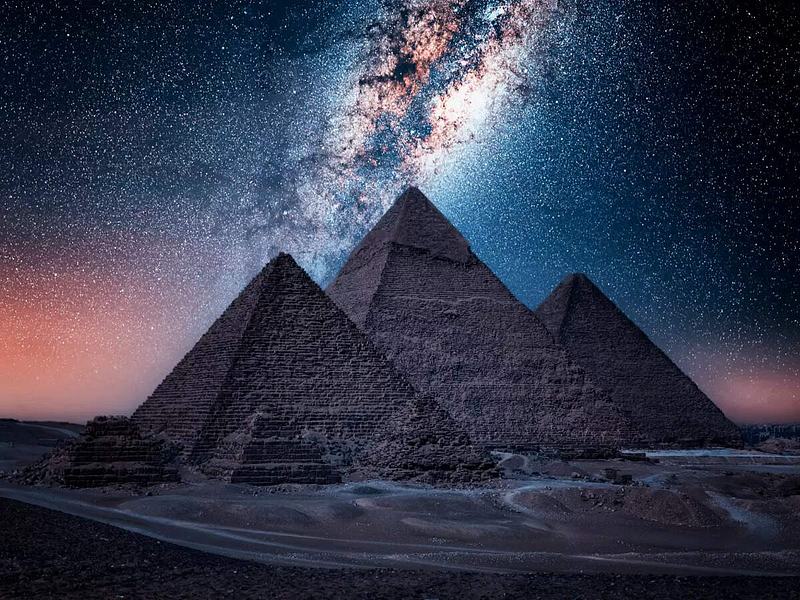
At dawn the pyramids of Giza glow against the horizon, vast and silent. For centuries they were explained as tombs, yet no body of a pharaoh has ever been found inside. The Pyramid Texts speak not of burial but of ascension. Shafts within the Great Pyramid align precisely to Orion and Sirius as they shone four thousand years ago.
The engineering deepens the mystery. The King’s Chamber, built of granite rich in quartz, resonates like a tuning fork. Acoustic experiments reveal frequencies amplified through the chamber. Electromagnetic studies in 2018 showed the pyramid focusing energy into its internal cavities and beneath its base. Water beneath the limestone may have generated piezoelectric currents.
The pyramid behaves not as a tomb but as a resonant machine.
“The pharaoh did not descend into darkness. He ascended in a machine of stone.”
Yet the story is trimmed. National Geographic frames Giza as labor and kingship. Egyptology repeats the safer line. Evidence of resonance and energy is isolated, never allowed to shift the narrative.
The stones still hum, waiting.
Sumer: The Anunnaki and the Return to the Stars
In Mesopotamia, the Sumerians wrote of gods who came down from the sky and later left. The Anunnaki were not abstractions. They taught, they ruled, they returned. The Sumerian King’s List records reigns lasting tens of thousands of years, dismissed as myth, though the rest of the tablet is accepted as history.
Their astronomy was beyond possibility. They described Uranus and Neptune, unseen by the naked eye. They calculated precession long before Hipparchus. Either they had instruments lost to us, or their knowledge was inherited.
They themselves said it was given.
“To Sumer, divinity was not presence. It was motion.”
The ziggurats were stairways of brick, mimicking the ascents of the gods. Yet institutions reframed them as symbols. The Royal Society once championed cuneiform studies, then confined discussion to agriculture and kingship. Smithsonian exhibits flatten the Anunnaki into metaphors. The precision remains unexplained.
The Dogon and the Sirius Mystery
In the arid cliffs of Mali, the Dogon people preserve a memory that refuses to fade. For centuries they have told of the Nommo, amphibious beings who came from the star Sirius, brought knowledge of agriculture and astronomy, and then left with a promise to return. Their ceremonies revolve around this star system. Masks and dances reenact the descent of the Nommo.
In the 1930s, French anthropologists Marcel Griaule and Germaine Dieterlen recorded the Dogon’s knowledge of Sirius B, a white dwarf invisible to the naked eye. The Dogon described its orbit, its immense density, even the existence of a third star, Sirius C. Astronomers confirmed Sirius B decades later, and evidence for Sirius C has surfaced in modern astrophysics.
How could a people without telescopes know this?
“The Dogon did not imagine Sirius B. They remembered it.”
Western scholars rushed to explain it away. Some accused Griaule of contaminating the Dogon with modern knowledge. Others claimed coincidence. The Smithsonian’s own reviews framed the story as “a myth misinterpreted by outsiders.” National Geographic praised Dogon art and music but sidestepped their astronomy. UNESCO celebrated their masks while ignoring their cosmology.
Yet the evidence persists. Dogon ritual drawings, recorded long before telescopes reached Sirius, depict the star’s orbit with uncanny precision. Oral histories insist the knowledge is ancestral, not borrowed. The Dogon themselves laugh at the idea that outsiders taught them. To them, the Nommo were real, and their knowledge was given.
Here, too, ridicule functions as a shield. By mocking the idea of cosmic visitors, academia avoids the harder question: why do cultures half a world apart repeat stories of beings who came, taught, and left? The Dogon are not alone. They are a mirror of Egypt’s Osiris, Sumer’s Oannes, Mesoamerica’s Quetzalcoatl.
Their silence is not ignorance. It is memory carefully guarded.
Nazca: Messages in the Desert
Across the Peruvian desert stretch lines so vast they can only be seen from the air. Monkeys, hummingbirds, spiders, trapezoids miles long. Archaeologists suggest rituals or calendars. Yet to walk them is to wander pointlessly. From the sky, they make sense.
The trapezoids resemble runways. The straight lines cut across terrain without deviation. Some align with solstices, others with star risings. Critics mock the alien landing strip theory, reducing serious questions to caricature.
These lines are not meant for humans on the ground. They are messages written to the sky.
“The ground is a canvas. The audience is the heavens.”
The Olmec Legacy
On the swampy Gulf Coast of Mexico, colossal stone heads rise from the earth. Each weighs up to forty tons, carved with precision and individuality. Their features, broad noses, full lips, helmet-like headgear, do not resemble the Maya or Aztec. They appear suddenly, around 1500 BCE, as if dropped fully formed into history.
Archaeology calls the Olmec the mother culture of Mesoamerica. Yet the question remains: how does a mother appear without ancestors? There are no gradual steps, no primitive versions of the heads. One day the Olmec are there, carving monuments, aligning ceremonial centers to solstices, building ball courts and drainage systems.
Then, just as suddenly, they vanish. Their cities dissolve. Their influence lingers in Maya writing, Aztec rituals, Zapotec calendars. But the Olmec themselves are gone.
“The Olmec mystery is not only disappearance but appearance.”
Explanations vary. Some see transoceanic contact, noting similarities to African or Asian features. This theory is mocked in journals as pseudoscience. The Smithsonian and Mexican institutions prefer to present the Olmec as purely indigenous, ignoring the abruptness of their arrival. National Geographic highlights their artistry but downplays their anomalies.
The helmets on the colossal heads resemble no headdress used for sport or ritual. They look more like protective gear, as though for travel or combat. The stone thrones depict figures emerging from caves or portals, symbols of passage. The Olmec pantheon includes a feathered serpent, the same being who will later reappear among the Maya and Aztec as a god of sky and return.
The Olmec may not have been the beginning. They may have been an echo, an outpost, a reappearance, a bridge.
The Inca: The Roads Beyond the Andes
High in the Andes, stone walls of Cusco fit so perfectly that not even a blade of grass can slide between them. The Inca built an empire that stretched across mountains and deserts, bound together by roads and bridges. Yet at the height of their power, Spanish chronicles describe something stranger. The Inca spoke of Viracocha, a god who came from across the sea and vanished again into the horizon. Their myths tell of origins not in the valleys but in the sky.
The fortress of Sacsayhuamán is aligned to solstices. Machu Picchu sits like an observatory between sacred peaks, its stones oriented to the sun’s path and the Milky Way. These were not just fortresses or estates. They were instruments of cosmic orientation.
When the Spanish conquered, they found the empire fractured, but they also encountered stories of golden disks kept in temples, devices that shone with unnatural brilliance. Many were taken, melted, or hidden. The Coricancha temple in Cusco was described as a chamber where walls gleamed with plates of gold, a symbolic sun on earth. But to the Inca, these were more than symbols. They were instruments.
“To the Inca, gold was not wealth. It was frozen sunlight.”
The empire fell to disease and steel, but much of its memory had already been sealed in myth. Viracocha, like Quetzalcoatl and Osiris, was a figure who came, taught, and left. To see him only as myth is to ignore the pattern repeating across continents.
Göbekli Tepe: The First Departure Blueprint
In southeastern Turkey, on a hill once thought to be natural, lie circles of stone older than Stonehenge by six thousand years. Göbekli Tepe, buried deliberately around 8000 BCE, rewrites the story of civilization. Carvings of animals, celestial symbols, and abstract figures cover the pillars.
Mainstream archaeology describes it as the world’s first temple, a place of ritual for hunter-gatherers. Yet its orientation suggests more than worship. Alignments point toward Sirius and the solstices. Carvings may encode constellations. The enclosure itself resembles a cosmic map.
The most haunting fact is not its age but its burial. After centuries of use, the site was deliberately covered with earth, as though sealed. Who buries a temple unless they intend to hide or preserve it?
“Göbekli Tepe was not abandoned. It was archived.”
Cahokia: The Forgotten Metropolis of North America
On the Mississippi floodplain, across from modern St. Louis, lie the mounds of Cahokia. Around 1100 CE it was the largest city north of Mexico, home to tens of thousands. Monk’s Mound, larger in base than the Great Pyramid, rises from the earth as if grown. Wooden circles, dubbed Woodhenges, tracked solstices and equinoxes.
Cahokia flourished for centuries, then declined. Climate stress and conflict are the official reasons. Yet what stands out is the suddenness and the absence of conquest. The people dispersed. The Woodhenges remained, silent calendars no longer used.
Smithsonian excavations emphasized agriculture and trade, downplaying the cosmological architecture. The site is framed as a Native American curiosity, not as a metropolis aligned to the heavens. Its story, like so many others, was trimmed of cosmic intent.
“Cahokia is remembered as a village. It was a city of the sky.”
Atlantis: Memory of a Departure Already Made
Plato’s dialogues speak of Atlantis, a great civilization that fell into the sea in a single day and night. Scholars call it allegory, a moral tale. Yet echoes of a lost land appear across cultures. In the Americas, myths of sunken kingdoms. In the Mediterranean, memories of islands swallowed by waves. In the Atlantic, undersea ridges and ruins glimpsed, then dismissed.
Atlantis may not have been a place alone but a memory of a departure. A people who reached a threshold and then left, their remnants submerged or erased. The myth is mocked precisely because it threatens the official narrative. To accept Atlantis is to accept that civilizations can vanish without ruin, not through failure but through choice.
“Atlantis is not only a lost land. It is a reminder that leaving is possible.”
Closing Reflection: The Human as Traveler
Again and again, the same pattern emerges. Civilizations rise, align to the stars, then fall silent without ruin. The Maya, the Anasazi, the Indus, the Egyptians, the Sumerians, the Dogon, the Nazca, the Olmec, the Inca, the builders of Göbekli Tepe and Cahokia. Each leaves behind monuments that speak not of collapse but of synchronization. Each preserves myths of gods who came and left, or ancestors who emerged and will return.
What if humanity itself is a traveler, not a permanent resident of earth? What if our deepest myths are not dreams but memories?
The pyramids may not have been tombs but energy engines. The temples may not have been shrines but calendars. The mounds may not have been houses of the dead but launchpads for the living. And the myths of gods returning from the stars may not be fantasies but instructions, reminders of an older itinerary.
“We are not the first to wonder where we belong. We may only be the next to remember.”
This is the vision The Manifest holds: that history has been erased not because it was irrelevant but because it was too revealing. To see the civilizations that vanished without ruin is to glimpse the possibility that earth itself is a station, a place of passage. And to recognize this is to understand that our longing for the stars may not be aspiration at all.
It may be memory.
Related from The Manifest Archive