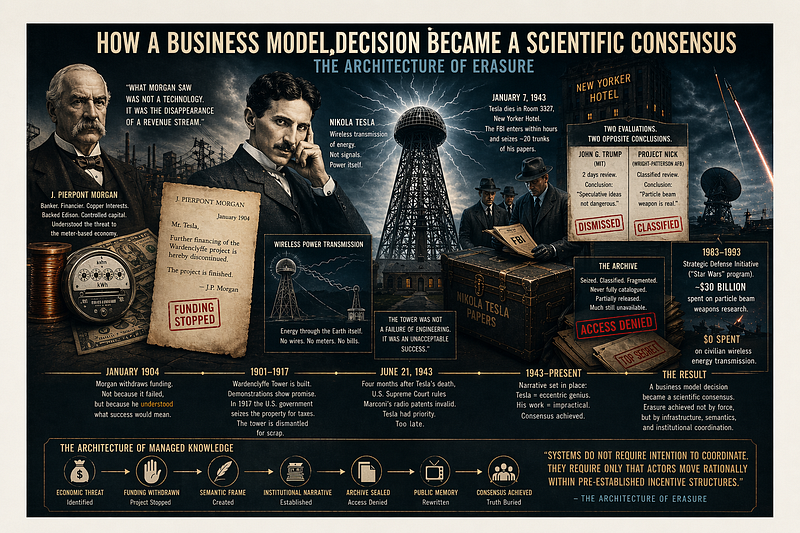
On the 9th of January, 1943, men from a government office let themselves into a room at the New Yorker Hotel and carried out the trunks.
The man who had filled them was two days dead. Nikola Tesla, eighty-six years old, the inventor of the alternating-current system that lit the modern world, had died alone in room 3327, where he had lived for years on credit, feeding pigeons and granting interviews about a weapon that would end all war. Within a day of his death, agents acting for the United States Office of Alien Property Custodian sealed and removed his papers, his notebooks, and the contents of his safe.
What they took mattered far less than what grew in the space where it had been.
Because this is not, in the end, a story about a stolen invention. It is a story about an absence, and about the strange physics of absence: that a sealed archive at the center of a famous life does not stay empty. It fills. It fills with exactly the wonders and the fears that the people looking into it most want, or most dread, to find. Tesla's missing papers are the clearest case in modern memory of a void that wrote its own legend, and the legend has long since swallowed the documented truth, which is quieter, stranger, and in its own way more unsettling than the myth.
The man who built the vault
Begin with an uncomfortable fact that most tellings skip: Tesla helped build the vault around his own legacy. He cultivated the mystery that would outlive him.
In his later years, after the patents that made other men rich and the projects that left him broke, Tesla became a kind of prophet of marvels he would describe but never show. In July 1934 he summoned reporters and announced a superweapon. The newspapers called it a death ray; Tesla preferred teleforce. It would, he said, send concentrated beams of particles through the open air to bring down ten thousand aircraft at a range of two hundred miles, and it would make war itself impossible by making defense absolute. He repeated versions of the claim for years, at birthday press conferences that became an annual ritual, and he never once, in public, explained how the thing actually worked.
This matters enormously, and it is the part the myth needs you to forget. A man who announces a world-ending weapon to the New York papers and then withholds the mechanism is not being silenced. He is performing. Tesla, brilliant and broke and largely forgotten by the scientific mainstream of his last decades, had discovered the one currency still available to him: the hint. The unshown wonder. The secret that is more powerful precisely because no one is permitted to examine it. By the time he died, he had spent a decade teaching the public to believe that he carried, in his head and in his trunks, inventions the world was not ready for.
So when the trunks were carried out of the New Yorker Hotel, the soil was already prepared. The legend did not need a conspiracy to take root. It needed only a sealed container and a man who had spent ten years insisting that something miraculous was inside.
The wound under the myth
Strip the fantasy away and a real injury remains, and the injury is what gives the myth its staying power.
Tesla was not a crank the establishment rightly ignored. He was one of the most consequential inventors who ever lived. His alternating-current system and his polyphase motor won the War of the Currents against Edison's direct current and became the electrical foundation of the industrial world; the current in the walls around you is, in its essentials, his design. And he was, by the end, comprehensively shortchanged by history's accounting. He had torn up a royalty contract with Westinghouse that would have made him one of the richest men alive, to save the company during a financial crisis. He watched other men take the fame for work that built on his. He died in a hotel room on credit while the civilization he had helped to electrify sent him neither royalties nor much thanks.
That is the true core the legend wraps itself around, and it is why the legend cannot simply be laughed off. The suppression myth is an exaggeration of a genuine wound. A real genius was really under-rewarded and under-credited, and a public that senses this reaches, understandably, for a story large enough to match the injustice. The trouble is that the true injustice, the ordinary grinding kind by which brilliant people are outmaneuvered and then forgotten, does not feel dramatic enough. So it gets upgraded into a conspiracy, because a stolen miracle seems more proportionate to the loss than the real explanation, which is only that the world is careless with its geniuses and generous to its salesmen.
But a wound, on its own, is not yet a legend. For the injury to grow into a myth it needed a vessel, a place where the imagination could pool and deepen. And within days of his death, the state was about to hand it exactly that.
The room and the trunks
Now the documented event, which is odd enough on its own that it never needed embellishing.
Tesla was not an enemy alien. He had become a naturalized American citizen in 1891, half a century before he died. And yet the office that moved on his belongings was the Office of Alien Property Custodian, the wartime body created to seize the assets of enemy nationals. A government that wanted, in the middle of a world war, to be sure that a famous inventor's papers on directed-energy weapons did not fall into the wrong hands reached for the nearest legal instrument, whether or not it strictly fit, and took everything. The seizure of a dead citizen's life work by the alien-property office is the first genuine strangeness in the record, and it is entirely real.
What they took was substantial: trunks, files, and the contents of his safe, the accumulated paper of a sixty-year career. They moved it into storage under federal control. And here the second strangeness appears, the one that would feed eighty years of speculation. The inventories do not cleanly agree. The number of trunks recorded by the government and the number that would later reach their destination are not the same. Somewhere between the seizure and the eventual release, the count slips. That gap, a discrepancy in a property inventory, is the literal physical hole at the center of the entire Tesla mythology. Everything the legend claims was suppressed lives, in the end, inside that small accounting difference.
Hold that, because the discipline of this whole subject depends on it. A discrepancy in an inventory is a real anomaly. It is also, on its own, evidence of nothing in particular. Wartime seizures were sloppy. Trunks were recounted, repacked, mislabeled, and lost to ordinary bureaucratic entropy all the time. The honest statement is the narrow one: the records do not perfectly match, and we do not know why. Everything beyond that narrow statement is something the reader brings, not something the document contains.
Why they took them
The seizure looks sinister until you learn what the government was actually afraid of, and then it looks merely human.
Tesla's heir was his nephew, Sava Kosanović, and Kosanović was not a private citizen. He was a Yugoslav diplomat, soon to be his country's ambassador to the United States, and the United States in January 1943 was a nation at war and uneasy about where a dead inventor's weapons research might travel. The declassified files are blunt about the worry. Some in the FBI feared that Kosanović was trying to get hold of Tesla's technical papers in order, in their words, to make such information available to the enemy, and at least one official raised the possibility of detaining him. The alien-property office moved on the trunks not because Tesla was an enemy alien, which he was not, but because the state wanted his papers beyond the reach of a foreign diplomat before anyone could decide, at leisure, what the law actually allowed.
That is not the behavior of a conspiracy. It is the behavior of a frightened bureaucracy in wartime, seizing first and reasoning afterward. And it supplies the ordinary motive the legend has to ignore, because a documented, mundane reason for the seizure is fatal to the story that the seizure was the opening move of a cover-up. The papers were taken to keep them from a foreign government, and then handed to an engineer to find out whether they were even worth keeping. The suppressing and the assessing happened in the wrong order for a cover-up, which is another way of saying there was none.
What the seizure did accomplish, without anyone intending it, was something else entirely. It placed a sealed, contested, miscounted box at the center of the most mythogenic life in American science. And a sealed box at the center of such a life is not, for long, an object. It becomes a question that cannot be closed, and this whole essay, though it has not said so yet, has been about that question and not about the box.
Two days, one verdict
Three weeks after the death, the government did the thing that should have ended the matter and instead launched the myth into orbit. It brought in an expert to read the papers.
The expert was John G. Trump, an electrical engineer at the Massachusetts Institute of Technology, a serious specialist in high-voltage and microwave work, and, as it happens, the uncle of a future American president. That coincidence has since become its own small industry of insinuation, and it deserves to be dealt with plainly and then set aside: Trump was a legitimate and well-qualified scientist asked to do a routine technical evaluation, the family connection is a genuine fact and an analytically empty one, and nothing in the record suggests he was anything other than what he appears to be, a competent engineer giving an honest professional opinion.
His opinion was deflating. After examining the seized material, Trump reported that Tesla's work of the previous fifteen years had been "primarily of a speculative, philosophical, and promotional character," and that the papers did not contain "new, sound, workable principles or methods" for realizing the weapons Tesla had described. There was, in his assessment, nothing of significant value to national security. The death ray, as a set of buildable plans ready to be stolen, was not in the trunks.
A skeptic should note how thin this is in one direction and how solid in another. Thin: a single engineer, a few days, a sixty-year archive, a verdict. Solid: the verdict was not a denial that Tesla had been a genius, which no one disputed, but a specific technical judgment that the late, famous, never-demonstrated weapon existed as vision rather than as engineering. Both of those things can be true at once, and the most economical reading of the record is that they are.
The determining variable was the emptiness
Here is the move the conspiracy version cannot make, because making it dissolves the conspiracy.
Ask what actually generated the Tesla legend, and the answer is not an invention. It is an absence. The determining variable in this entire story is not anything that was in the trunks. It is the fact that the trunks were taken, sealed, fought over, miscounted, and held by the state, and that into the space this created the public poured a century of longing. An absent archive behaves differently from a present one. A present archive can disappoint you; you can open it and find a speculative essay and a promotional letter and a diagram that does not work. A sealed archive can never disappoint, because it can never be checked, and so it becomes a perfect surface, a screen onto which a culture projects whatever it most wishes were true: free energy the oil companies buried, a weapon too powerful to allow, a genius the system could not tolerate. A full archive answers questions. An empty one grants wishes.
This is the mechanism, and it is not unique to Tesla. It is the general law of the missing document. Wherever a famous life ends with a confiscated archive, a sealed file, a redacted page, the gap does not read as empty. It reads as full, full of precisely the secret the believer already suspected was there. The less that can be seen, the more can be claimed, because nothing can be refuted. The vault is not where the truth was hidden. The vault is where the myth was manufactured, automatically, by the simple fact of being shut.
In the end it was the absence that fed the legend, and the legend that fed that absence, each making the other larger, until a routine wartime seizure of a broke inventor's papers had become, in the popular imagination, the crime of the century.
Where the wanting came from
But absence alone does not explain why the wishes pointed the way they did. To understand why the Tesla void filled specifically with the dream of suppressed free power, you have to go back four decades, to a tower on Long Island and a decision that had nothing to do with secrecy and everything to do with money.
In 1901 the financier J. P. Morgan gave Tesla the very large sum of a hundred and fifty thousand dollars to build a wireless transmission station at Wardenclyffe, on Long Island. Morgan understood he was funding a system to send messages across the Atlantic without wires, a rival to Marconi's telegraphy. But Tesla had a grander vision, and at Wardenclyffe he began to chase it: not the wireless transmission of information, but the wireless transmission of power itself, electricity broadcast through the earth to anyone, anywhere, with a receiver. And the rivalry went badly almost at once. In December 1901, while Wardenclyffe was still rising, Marconi sent a wireless signal across the Atlantic using equipment a fraction the size and cost of Tesla's tower, and in a single stroke made the grand station look like an extravagant answer to a question someone else had already answered cheaply. When Morgan, watching his money build a monument to a race that was being lost, declined to pour further fortunes into the project, the tower was never completed, and the dream died with it.
Tesla's admirers have read that withdrawal, ever since, as sabotage: Morgan killed free energy to protect his copper and his meters. The financier's exact motives are genuinely debated and cannot be cleanly recovered. But the structural fact beneath the legend is plain, and it is more interesting than the sabotage story. A system that broadcasts power freely through the earth to any receiver has no way to bill anyone. It is not that Morgan, specifically, refused to allow it. It is that no private fortune on earth had a reason to complete a machine designed to give away, untolled and untraceable, the one thing its owner was selling. Free wireless power did not die because a villain strangled it. It died because it was, by its own design, unfinanceable, and a technology that no one can be charged for has no patron in a world organized around payment.
That is the documented seed of the suppression myth, and notice what the myth does with it. It takes an economic fact, that you cannot run a business giving electricity away, and reads it as a moral crime, that they took free energy from you. The first is true and quietly damning about how innovation is actually funded. The second is a fantasy. The Wardenclyffe story is why the Tesla void, when it opened in 1943, filled with the specific dream of stolen abundance rather than with some other wonder. The disappointment was real. The villain was invented to explain it.
The vindication that was a myth too
The legend has a favourite final act, and it is worth dismantling precisely because it flatters Tesla, to show that the discipline cuts both ways.
The story goes that in June 1943, a few months after Tesla died penniless, the United States Supreme Court at last ruled that he, not Marconi, had invented radio, a vindication delivered with cruel timing, just too late for the man to know. It is a beautiful story, and it is not what happened. The case, Marconi Wireless Telegraph Company versus the United States, was a money dispute: Marconi's company was suing the American government for using its radio patents during the First World War. The Court did invalidate the broad Marconi patent, but it did so mainly on the prior work of an engineer named John Stone Stone, to whom the opinion devoted some twenty pages, alongside Oliver Lodge. Tesla's earlier tuned circuits were acknowledged in about two. The ruling was not a coronation of Tesla. It was a patent-royalty decision that happened to list him among several predecessors, and popular memory has since inflated it into a posthumous knighting the documents do not support.
Notice what the legend did here, and that it did it in Tesla's favour. It took a technical patent ruling and rewrote it as a moral drama of recognition denied and then granted too late, because that drama is more satisfying than the truth. The Tesla myth is not only the work of detractors imagining suppression. It is equally the work of admirers imagining vindication. Both are doing the same thing, filling a complicated documented reality with a simpler, more emotionally complete story. The myth has no party. It serves whoever needs it.
Hold the suspicion
Stop here, because the honest skeptic has been holding an objection for several paragraphs and it deserves its strongest form, not a quiet dismissal.
The objection is this. You are being awfully quick to file everything under bureaucratic accident. The seizure of a citizen's papers by the alien-property office was irregular. The trunk count really does not match. The government really did pursue directed-energy and particle-beam research in the decades that followed, behind heavy classification. A two-day review of a lifetime's work by one engineer is exactly what a cover would look like if you wanted one. Maybe the skeptical, nothing-to-see-here reading is itself the more naive position, and the believers, for all their excess, are at least pointing at the real anomalies.
That is a fair challenge, and parts of it are simply correct, and the correct parts have to be held rather than waved away. The seizure was irregular. The inventory does not reconcile. The state did classify energy-weapon work later. None of that is in dispute, and a serious account has to carry all of it. The disagreement is not about the anomalies. It is about what an anomaly is allowed to prove.
What an absence can and cannot prove
This is the center of the whole matter, and it is a point about evidence, not about Tesla.
An anomaly is a question, not an answer. An irregular seizure, an inventory that does not balance, a classified research program in an adjacent field: each of these is a real loose thread, and each is fully explained by causes that involve no hidden Tesla miracle at all. Wartime agencies seized first and sorted legality later. Inventories of hastily boxed estates routinely failed to reconcile. The state classified directed-energy research because directed-energy research is the kind of thing states classify, entirely independent of whether a dead man's trunks contained anything usable. To move from these anomalies to a buried wonder, you have to add the one ingredient the documents never supply: the wonder itself. The absence is doing all the work, and an absence can carry any cargo you load onto it, which is precisely why it can prove nothing.
And the strongest single fact runs the other way, and the legend rarely mentions it. The papers were not, in the end, lost. After years of legal wrangling, most of Tesla's estate was released and shipped, in 1952, to Belgrade, where it remains in a museum built around it. And in 1984, in that archive, researchers found exactly the thing the death-ray mythology insists was spirited away forever: Tesla's own particle-beam design documents, describing the open-ended vacuum chamber, the method of charging particles to enormous voltages, the scheme for projecting them in a tight stream. The plans for the famous weapon were not stolen into a black vault. They sat, for decades, in a public museum, available to anyone who cared to look, and what they reveal is an ambitious, partial, physically problematic design from a fertile and aging mind, not a working machine the world was denied. The most mythologized missing document of the twentieth century turned out, in large part, not to be missing.
A legend with no author
The clearest proof that the absence generates the myth came when the absence was partly filled.
Beginning in 2016, after decades of Freedom of Information requests, the FBI released some two hundred and fifty pages of its Tesla files, with a further batch and a catalogue of the seized papers in 2018. The releases were meant to satisfy the curious. They did the opposite. For one thing, the files showed that the FBI had never held Tesla's papers at all. The bureau stated plainly that it was not involved in the seizure and never possessed the documents, or any microfilm of them. To a neutral reader that is a dull administrative fact: the alien-property office handled the estate, not the FBI. To the legend it was a thunderclap of confirmation. If the long-sought FBI files do not contain the papers, then the papers must be hidden somewhere deeper still, and the search simply moved down one level. The release meant to close the question reopened it, because a myth built on absence reads every disclosure as evidence of a further concealment. You cannot fill a hole that grows larger each time you pour something into it.
There is one more thing the documented version makes clear, and it is the quiet center of the whole story.
No one designed this. There is no committee that decided to turn Nikola Tesla into the patron saint of suppressed genius. The economist Friedrich Hayek spent his life on the difference between an order that is consciously planned and one that simply emerges from many separate actions with no coordinating mind, and the Tesla legend is a pure specimen of the second kind. A frightened wartime agency made a seizure. A diligent engineer wrote an honest, deflating report. A bureaucracy miscounted some trunks. A diplomat fought for years to recover his uncle's estate. A broke old genius had spent a decade promising weapons he never built. Each of these people acted alone, for ordinary reasons, and out of the sum of their uncoordinated actions a myth assembled itself that none of them intended and none of them could have stopped, because the myth was not built by any of them. It was built by the empty space between them.
That is why the legend has no author and cannot be killed. You cannot debunk a vacuum. Every document that surfaces to deflate the story is read, by the faithful, as one more piece the system allowed out to throw you off the scent, and the absence simply expands to absorb the new evidence. A myth grounded in what is missing is permanent, because the missing can always be said to contain whatever the present evidence rules out. The believers are not, mostly, fools. They have correctly noticed that something is absent. They have only mistaken absence for concealment, and concealment for proof.
The legend at full volume
The final proof that none of this depends on evidence is that the legend is larger now, eighty years on, than it has ever been, in the age with the most access to the documents of any age yet.
Tesla today is a folk hero of the internet, the wronged genius of a thousand memes, the man Edison cheated and the establishment buried, his name fixed to the most valuable car company on earth by a founder who grasped the power of the myth even though the historical Tesla had nothing to do with electric automobiles. Around him orbits a permanent industry of suppressed-energy videos, death-ray documentaries, and claims that his real inventions, free power, anti-gravity, weather control, were seized by the government and hidden in the very trunks this essay has been describing. And the remarkable thing is that the documents have never been more available. The Belgrade archive is catalogued. The FBI files are online. The Trump report is a matter of public record. The legend grows anyway, faster than ever, feeding not on what is hidden but on the permanent structural fact that something, somewhere in the count, does not add up.
That is the signature of a myth with no author and no off switch. Evidence does not deflate it, because the myth was never about evidence. It was about a hole, and the hole is still there, and a culture that feels, correctly, that it is not always told the truth will go on filling that hole with the truth it suspects is being kept from it. Tesla is the patron saint of that suspicion, and the suspicion is not entirely wrong, which is exactly what makes the myth impossible to kill.
The empty room
Return, at the end, to room 3327, the morning after the trunks were carried out.
What was left was an ordinary hotel room where an extraordinary and broken man had died poor, owed money by half the world for the current that runs through its walls. The trunks held the papers of a genuine genius and the promotional fantasies of his lonely last decades, mixed together past the point where one stay-behind engineer could fully sort them in the time he was given. Most of it went, eventually, to a museum. Some of it, perhaps, was lost the way wartime paper was always lost. And into the small gap between what was taken and what arrived, an entire counter-history flooded, because that gap was the one part of the story that could never be closed, and an open question at the center of a famous life is the most fertile thing in the world.
And Tesla is only the most vivid instance of a law that runs everywhere. The same mechanism powers the endless afterlife of the sealed assassination file, the redacted intelligence page, the off-limits desert base, the document released with its most important lines blacked out. In every case the structure is identical: a gap in the official record, a public that already suspects it is not told everything, and the automatic conversion of one into the other. The redaction does not hide the secret. The redaction is read as the secret. A culture trains itself to believe that the truth is always exactly the size and shape of the space where the evidence is missing, and so the missing evidence becomes the most persuasive evidence of all. This is the engine room of the modern conspiracy mind, and Tesla's trunks are its purest specimen, because there the hole is small and literal and you can watch a whole counter-history pour through it.
The deepest lesson of Tesla's missing papers is not about Tesla, and not about the government, and not about energy. It is about what human beings do with a hole in the record. We do not leave it empty. We cannot. We fill it with our suspicions and our hopes and our sense that the truth is always being kept from us, and the less we are shown, the more certain we become of what the darkness must contain. Tesla spent his last years promising that the trunks held miracles. The state, by sealing them, made the promise impossible to test, and a promise that can never be tested is the only kind that never dies. A document that survives can be read, and found ordinary. A document that vanishes can be whatever we need it to be. That is the whole engine of it. The surest way to make a secret immortal is to lock it somewhere no one can ever prove it was never there.
Evidence Map
Facts, interpretations, forecasts, and disconfirming signals.
Core claim. The enduring "suppressed Tesla" legend was produced not by a hidden invention but by an absence: the wartime seizure, sealing, and imperfect accounting of Tesla's papers, combined with a genius who had spent a decade publicly promising unshown wonders. An absent archive does not stay empty; it fills with whatever a culture most wants or fears to be true. The documented record points to a routine if irregular seizure and a deflating technical assessment, not a buried miracle.
Evidence level. Facts (high): Tesla died 7 January 1943 at the New Yorker Hotel; the Office of Alien Property Custodian seized his effects despite his 1891 US citizenship; John G. Trump (MIT) reviewed them weeks later and judged them "speculative, philosophical and promotional" with "nothing of significant value" for national security; the trunk inventories do not reconcile (more recorded than later delivered); most of the estate was released to Belgrade in 1952 (Nikola Tesla Museum); Tesla publicly announced the "teleforce"/death-ray in 1934 without disclosing a mechanism; particle-beam design documents were found in the Belgrade archive in 1984. Interpretation (medium, marked): the absent-archive-breeds-myth thesis; the reading of Wardenclyffe's failure as an economic fact (unmeterable power has no private patron) that the myth recodes as moral suppression. Rejected (marked): the claims that the government suppressed working free-energy or stole a buildable death ray, and that Tesla's papers secretly fueled later classified programs; Morgan's precise motives at Wardenclyffe are noted as genuinely debated, not settled.
What would confirm this. Continued surfacing of once-"missing" Tesla material in public archives (as in 1984); documentation that the trunk discrepancy reflects ordinary wartime mishandling; absence of any buildable, suppressed device in the recovered record.
What would disprove this. Credible, authenticated evidence of a working Tesla device or a complete weapon design removed from the archive and secretly developed; documentation that the seizure and assessment were a deliberate cover for a recovered, functioning technology rather than a wartime precaution.
Watchlist. Further declassification of FBI/OAPC Tesla files; scholarship reconciling the trunk inventories; the continuing cultural growth of the Tesla legend independent of any new evidence, which is itself the phenomenon this essay describes.
Related from The Manifest Archive
- How the CIA Built the Surveillance Economy
- Black Nobility: The Roman Families Who Outlived the Papal State
- Vietnam Had a RAND Strategy.
- The Archive of Power: How the Vatican Survived Every Collapse
Jerry van der Laan writes The Manifest Archive, daily forensic essays on power, language, and the systems that shape what we are allowed to see as reality. He traces the structures beneath them.