How reversibility became impossible by design.
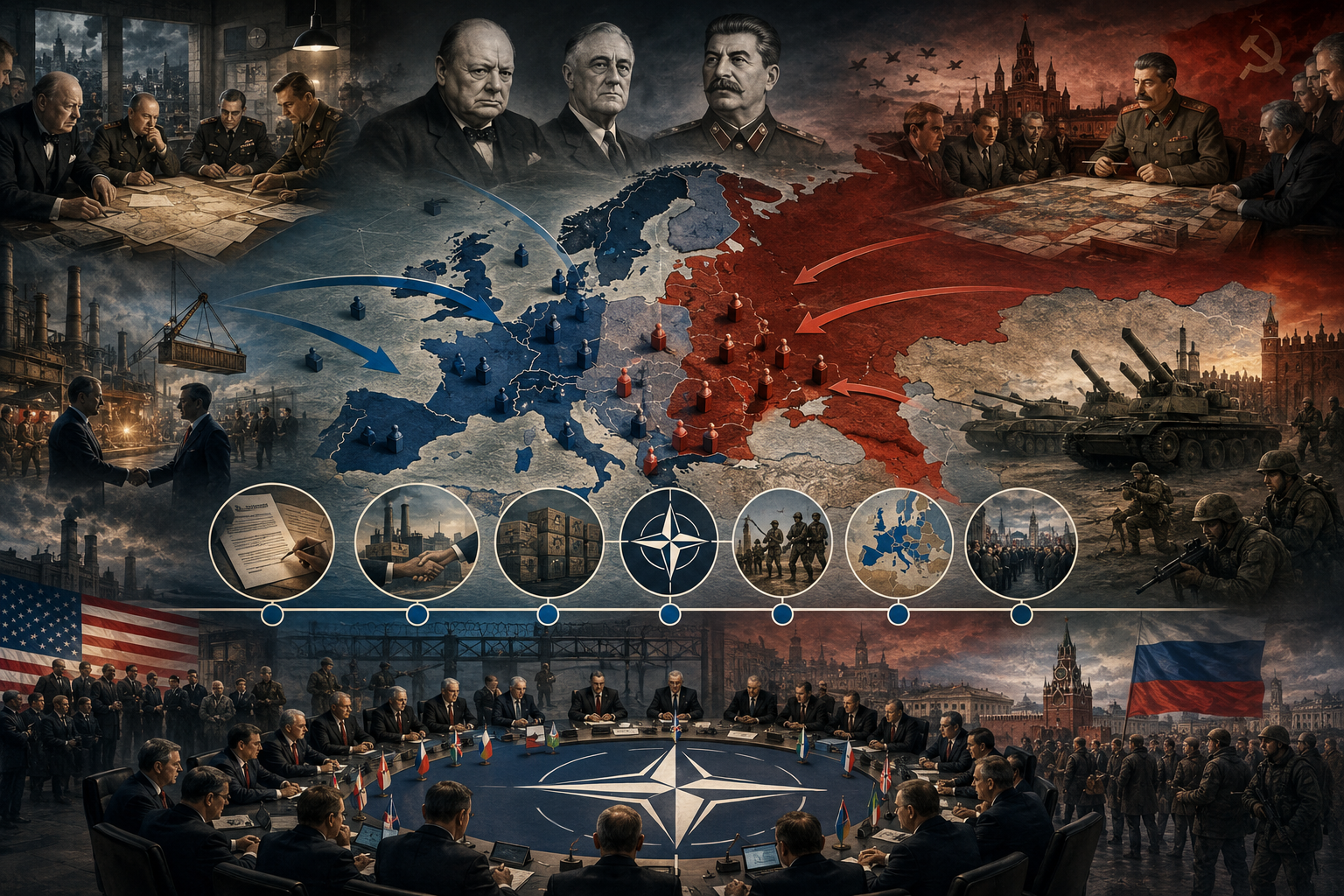
On May 22, 1945, Churchill's military planners submitted their assessment. Operation Unthinkable the plan to invade the Soviet Union while it still held Eastern Europe was militarily unfeasible. Soviet ground forces outnumbered Western forces 2.5 to 1. Direct assault would fail. Total war would be the only option.
Churchill abandoned the plan. But Stalin had seen the document. That moment, when the West calculated whether to continue fighting against Russia, set in motion a cascade of decisions that neither side intended but neither side could reverse.
Operation Unthinkable: Churchill's Military Option, May 1945
In May 1945, while the war was still ending, Churchill ordered military planners to design an attack on the Soviet Union. The directive was explicit: develop a plan to impose Western will on Russia by military force. Stalin saw what was being planned. That moment when Churchill proposed direct war and Stalin refused Western partnership triggered a cascade of decisions that neither side intended but neither side could reverse.
May 1945. Germany had surrendered four days earlier. Europe was being carved into occupation zones. Churchill, who had fought alongside Stalin against Nazi Germany, now ordered the British Chiefs of Staff to plan an invasion of Soviet-held Eastern Europe.
Operation Unthinkable was the codename. The plan assumed a surprise assault by 47 British and American divisions in the area of Dresden, German forces remobilized from prisoner-of-war camps between 100,000 and 700,000 soldiers plus Polish contingents. The attack was scheduled for July 1, 1945. The political objective was stated with precision: "to impose upon Russia the will of the United States and British Empire."
This was not contingency planning. This was option one. This was what Churchill believed necessary to prevent Soviet consolidation of Eastern Europe.
The British assessment came back on May 22. The plan was militarily unfeasible. Soviet ground forces held a 2.5-to-1 advantage in division strength across Europe and the Middle East. A short, sharp Allied assault into Poland would fail. Total war would be the only alternative. By July 1945, Clement Attlee had become Prime Minister. The new government abandoned Unthinkable. But the document existed. The directive existed. Churchill's intention existed.
Stalin knew. The Soviet intelligence apparatus had penetrated Western governments during the alliance war and had seen the planning.
Stalin's Refusal: The Molotov Plan as Structural Response
Stalin's response was not rage. It was architectural. Stalin made a choice that would echo through eight decades.
The Western powers offered economic partnership. The Marshall Plan, announced in 1947, offered reconstruction aid to all European nations, including the Soviet Union and its satellites. The offer was structured with explicit conditions. The recipient nations had to accept American oversight of economic decisions, allow Western influence over Eastern European commerce, and permit the flow of capital and goods according to Western economic principles.
Stalin refused. He forced Eastern European satellites to refuse as well. The reasoning was not ideological simplicity it was structural: accepting Western economic partnership meant accepting Western political control embedded in that partnership.
The Marshall Plan functioned as architecture. The aid came with conditions. Recipient nations had to open capital markets to Western investment, restructure domestic economies according to Western-approved models, maintain fixed exchange rates against the dollar, and create administrative mechanisms that permitted Western financial supervision. They had to join Western-led economic institutions where American votes carried decisive weight.
Stalin understood that accepting this framework meant embedding American veto power in Soviet economic decisions. The Soviet Union would become structurally dependent on American approval for major policy choices. This was not partnership; it was subordination through economic mechanism.
In its place, Stalin built the Molotov Plan. Between 1945 and 1947, the USSR negotiated bilateral trade agreements with its satellites. The USSR sent raw materials and food; the satellites sent back manufactured goods and equipment. No Western participation. No Western oversight. No Western leverage. The economic flows stayed within the Soviet sphere.
Stalin was building a system in which the Soviet Union could not be contained through economic integration because integration would not occur. The architecture would be Soviet-only. The economy would be socialist and closed. Eastern Europe would be locked into Soviet orbit not through choice but through structural necessity. If the West would not accept a Soviet sphere, the West would be locked out of it.
If Stalin had accepted Marshall Plan terms, the Cold War would have taken a different form.
But Stalin saw Unthinkable. Stalin understood that Western powers intended to reshape Europe according to their preferences. Stalin chose to ensure that would not happen.
NATO as Institutional Response: The Permanent Cordon, 1949
The Western response to Stalin's refusal was not Unthinkable revisited. Truman and his advisors understood that direct military invasion had become impossible. The Soviets had too many soldiers. American war-weariness was deepening. Congress would not authorize another conflict immediately after the victory against Germany.
But Western leaders understood they needed a structure that would prevent Soviet expansion, lock Europe into Western orbit, and create institutional mechanisms that could outlast any single political decision. In 1947, the Truman Doctrine institutionalized containment as official policy. In 1949, NATO created the military cordon that Churchill's plan had attempted through direct assault.
NATO was not the same as Unthinkable. NATO was more durable because it was institutional, not military-operational. NATO created consensus requirements: all members must agree to collective action. NATO created permanent infrastructure, bases, command structures, joint exercises. Once those structures existed, reversing them would require not just political will but the coordination of multiple governments with divergent interests. NATO transformed containment from a tactical option into an architectural necessity.
The NATO treaty itself, signed April 4, 1949, created Article 5: an attack on one member triggers a response from all. This was a binding institutional commitment. No single nation could unilaterally withdraw from collective defense. The consensus rule, all 12 founding members had to agree to any major policy change, meant that one dissenting government could block NATO reversal or major strategic shift.
This consensus rule proved to be the mechanism that locked NATO into permanence.
As membership expanded, the consensus requirement grew more constraining. With 32 member nations, unanimous agreement became structurally difficult to assemble for any major policy reversal.
The Expansion Decision: December 1994 and the Window of Advantage
The expansion of NATO after 1991, when the Soviet Union collapsed and Russia had no capacity to resist, was not a response to Russian aggression. It was a strategic choice made during a window of maximum Western advantage.
On December 21, 1994, Deputy Secretary of Defense William Perry held a classified briefing with President Clinton. The NSC strategy paper, declassified later, stated the intent clearly: bring former Soviet-sphere countries into NATO while Russia was economically devastated and militarily weak. The expansion was not a mistake or a blunder. It was a deliberate institutional strategy.
Perry's briefing documented that Russia would consider NATO expansion as a threat. The document acknowledged that Moscow viewed NATO's presence on Russian borders as a reversal of the post-Cold War settlement. The briefing proceeded anyway. The logic was explicit: Russia was weak and could not prevent it. The window was open now. It would not remain open if Russia recovered.
Between 1994 and 2004, NATO expanded from 16 members to 26. Poland, Hungary, and the Czech Republic joined in 1999. Bulgaria, Estonia, Latvia, Lithuania, Romania, Slovakia, and Slovenia joined in 2004. The pattern was mechanical and relentless. Each expansion moved the border closer to Russia.
By 2004, NATO's frontier had moved from the western edge of the former Warsaw Pact (the position in 1991) to the borders of Russia itself. The Baltic states Estonia, Latvia, Lithuania had been incorporated into NATO. These nations shared a land border with Russia. Article 5 now guaranteed that a Russian military action against these nations would trigger NATO response.
Russia's Assessment: The 2000 Documents and Strategic Understanding
Russia's official response came through its military and security doctrines. On January 10, 2000, Putin signed the National Security Concept of the Russian Federation. The document stated: "The expansion of NATO will have an unfavorable effect on the stability and security of the near-abroad countries and Russia itself, particularly in its regions bordering the Alliance." The language was cautious but explicit. Russia saw NATO expansion as a structural threat.
Three months later, in April 2000, Russia published its Military Doctrine. This document went further. It identified NATO enlargement as one of the primary external military threats to Russia. The doctrine stated that Russia would develop its armed forces to counter NATO's technological superiority and the threat of NATO's proximity to Russian territory.
The documents articulated a specific Russian assessment: NATO's function had shifted from Cold War defensive alliance to post-Cold War encirclement mechanism. The distance between NATO forces and Russian territory had shrunk by hundreds of kilometers. What had been a buffer zone of Soviet client states was now NATO territory. The calculation was explicit in the doctrines: Russia faced a structural strategic disadvantage.
On February 10, 2007, Putin delivered the Munich Security Conference speech. This speech crystallized Russian strategic assessment: "Russia is a country with a history of more than a thousand years and has practically always had suzerainty and an influence on world events. Of course, a country that loses this is not happy about it." Putin continued: "NATO has approached the borders of Russia. This represents a serious provocation."
The three documents show a consistent Russian understanding: NATO expansion was a reversal of post-Cold War settlement.
Russia saw it as a strategic encirclement that required institutional and military response.
The Institutional Lock-In Mechanisms: Why Reversal Has Become Impossible
By the early 2000s, NATO expansion had created structures that cannot be reversed through political decision alone. Each expansion added not just military members but institutional entanglement that compounded the cost of reversal.
The Consensus Rule as Structural Barrier
All NATO members must agree to any major policy change. Thirty-two nations must vote unanimously. A single dissenting government blocks action. This means that even if the United States wanted to reverse NATO expansion, it would need agreement from Poland, Lithuania, Estonia, Romania, Bulgaria, and 26 other nations. Each of these nations has domestic constituencies with direct interest in NATO membership.
Poland joined NATO in 1999. Polish military doctrine now presumes NATO air defense protection. Polish air force training assumes NATO integration. Polish military procurement follows NATO standards. Reversing Poland's NATO membership would mean restructuring the entire Polish defense establishment.
Lithuania, Latvia, and Estonia the Baltic states have even deeper entanglement. These nations share a land border with Russia. NATO membership is the mechanism through which they maintain sovereignty. The Article 5 guarantee is not abstract; it is the strategic reality on which their security calculations depend. Reversing Baltic NATO membership would mean signaling that these nations would be returned to Russian sphere of influence.
Hungary provides a second mechanism. Hungary joined NATO in 1999. In 2022-2023, when Sweden and Finland applied for NATO membership, Hungary's Prime Minister Viktor Orbán held veto power. For months, Orbán delayed the vote. Orbán's demands included modification of NATO policies toward Ukraine, modification of EU financial oversight of Hungary, and other concessions. Eventually, Orbán approved the applications, but the episode demonstrated that unanimous consent rule gives even small or peripheral NATO members power to block major decisions.
The Congressional Supermajority Requirement
The United States Congress has passed legislation requiring a two-thirds Senate majority to withdraw from NATO. The National Defense Authorization Act of 2024 contains this provision. This means that withdrawal requires not just a presidential decision but 67 of 100 senators. With polarized American politics, this supermajority is structurally difficult to assemble.
The 2024 NDAA specified that any withdrawal from NATO requires approval from two-thirds of the Senate. This transforms NATO withdrawal from a unilateral executive decision (as would be the case with many international treaties) into a constitutional super-majority issue. A president who wanted to withdraw would need to assemble 67 senators a number that crosses partisan divides.
Congressional approval creates domestic political stakeholder groups who have public interest in NATO continuation.
Defense committees have budgets dependent on NATO. Military procurement contracts have been awarded with NATO compatibility as specification. These create constituencies in Congress that defend NATO status.
The Economic Infrastructure Cost
NATO members invest approximately $100 billion annually in Europe-focused defense infrastructure, according to the Council on Strategic and International Studies analysis. This investment is already sunk. It has created constituencies in defense industries, military procurement bureaucracies, and allied governments dependent on NATO contracts.
Germany's commitment is specific. German procurement budget includes Patriot air defense systems (NATO-standard), Leopard tanks (NATO-interoperable), and Euro-fighter Typhoons (NATO-integrated). These procurement lines have domestic political value. Defense workers in Germany depend on continued NATO military spending.
France, despite its 1966 withdrawal from NATO's integrated command, remains a NATO member. French defense procurement follows NATO standards. French military exercises involve NATO participation. The reintegration under Sarkozy (2009) demonstrated that even countries that left could not sustain independent defense posture. France rejoined because the economic and military cost of remaining separate exceeded the political value of independence.
The sunk cost in Europe-focused infrastructure means that reversing NATO membership would require writing off billions in investment.
Restructuring defense supply chains across multiple nations creates a structural friction against reversal.
The France Precedent: A 43-Year Reversal
France withdrew from NATO's integrated military command on March 7, 1966. Charles de Gaulle ordered all NATO forces off French soil. France remained a NATO member but refused integrated military participation. De Gaulle's objectives were clear: maintain sovereignty while remaining in the alliance.
The French withdrawal took three years to complete (1966-1969). NATO infrastructure had to be relocated from Paris. NATO headquarters moved to Brussels. Allied governments had to renegotiate force posture. Defense contracts had to be rewritten. France maintained its own strategic nuclear force. France followed its own defense procurement policies.
After 43 years of independence, Nicolas Sarkozy announced that France would rejoin NATO's integrated military command. On April 17, 2009, France rejoined. The reversibility of the decision the institutional cost of maintaining separation: took four decades to remedy.
Reversing NATO expansion would require not three years but a generation.
The infrastructure is vastly more complex. The institutional commitments are far deeper. The number of governments involved is exponentially larger. Once created, institutional structures develop constituencies that defend them. Military commanders have budgets dependent on NATO forces. Defense contractors have production lines dependent on NATO standards. Allied governments have made domestic political commitments based on NATO security guarantees.
Hungary's veto example shows how the consensus rule functions. But it also shows how difficult reversal would be. Even a country that has leverage (Hungary on Sweden/Finland admission) cannot force reversal of existing NATO membership. The mechanism can delay new membership, but it cannot undo existing commitments.
The System at Equilibrium: Why Movement Has Stopped
By 2026, the system has reached a state where neither side can move without triggering costs that exceed what their strategic objectives are worth.
Russia cannot accept NATO's presence on its borders without reversing its entire post-Cold War security strategy. But Russia cannot remove NATO through military force without provoking direct NATO-Russia war: a conflict that NATO, despite its institutional complexity, would win through sheer economic and military resource differential. NATO members spend approximately $1.2 trillion annually on defense. Russia spends approximately $85 billion. The resource asymmetry is decisive.
The West cannot reverse NATO expansion without dismantling an alliance structure that has become the organizing principle of European security. But the West cannot move forward with further NATO expansion without triggering Russian escalation and risking direct great-power conflict.
Ukraine remains the mechanism through which this equilibrium is tested. The war in Ukraine is simultaneously a test of NATO's credibility (if Ukraine falls to Russia, NATO members on the Russian border will question whether NATO security guarantees are real) and a demonstration of why NATO expansion cannot be reversed (if Ukraine were to lose the war because NATO failed to support it, eastern European NATO members would interpret that as sign of NATO unreliability, which would push them toward independent defense strategies or toward accommodation with Russia).
This is how three rational decisions created a machine that neither side can dismantle.
The system operates now according to its own logic, constrained by the infrastructure both sides have built into it over eighty years. The lock-in is complete. Neither side can move. Both sides are committed. The machinery will continue to operate until one side absorbs costs it cannot sustain or until a new institutional mechanism emerges to replace it. The institutional structures that were built to prevent Soviet expansion now prevent any revision of the post-Cold War settlement. The mechanism that was designed to be reversible at will has become irreversible through sheer institutional weight
Jerry van der Laan writes The Manifest Archive. He is based in the Netherlands. His work focuses on how institutional power, language systems, and historical continuity shape what we are allowed to see as reality.
Related from The Manifest Archive
- The Recurring Script
- The Five Mechanisms That Lock America Into Unwinnable Wars
- In 1990, James Baker Promised Russia NATO Would Not Move One Inch Eastward.
- Putin Made His Position Clear in 2007. He Made It Formal in 2021. The West Called Both a Threat. The Invasion Followed Two Months After the Second.