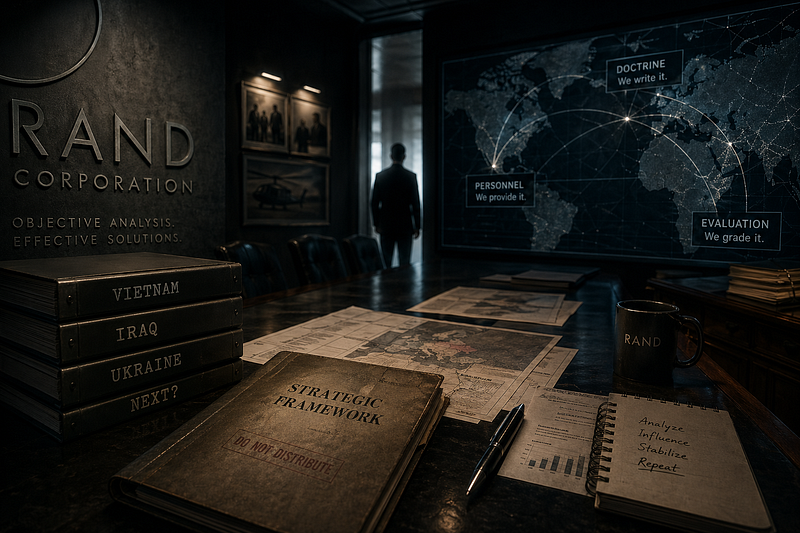
Most people have never heard of the RAND Corporation. That absence is not an accident. It is part of how the thing works.
RAND does not make weapons. It does not command troops. It does not appear on the ballot or the battlefield. It produces something quieter and more durable: the frameworks inside which other people decide. It writes the analysis that defines a problem, supplies the analysts who carry that definition into government, and, when the policies built on it need judging, produces the study that judges them. It is the rarest kind of power, the kind that never has to be present at the decision because it has already shaped the room in which the decision is made.
There is a sentence that holds the whole mechanism, and it is worth saying plainly before any of the history. Whoever controls the framework does not make the decisions. He decides which decisions are thinkable.
This is a story about an institution that learned to occupy that position and has held it, across four wars and seventy years, by doing one thing with great consistency: shaping the frameworks, staffing the government that carries them in, and grading the result, without ever once having to leave the building.
Be precise about the claim, because a subject this large makes overstatement easy and the easy version is wrong. The argument is not that RAND rules, that it authors events, or that it caused any of these wars. It is that RAND holds the frame inside which the options are weighed. That is a smaller claim than it sounds, and a more unsettling one, because the frame settles most of an argument before the argument is ever had.
The science of war
RAND was born out of a refusal to let something go.
In 1946, with the Second World War just ended, the United States Army Air Forces did not want to lose the civilian scientists and mathematicians who had helped win it. So it created Project RAND, a research contract housed inside the Douglas Aircraft Company, to keep that brainpower thinking about war in peacetime. Two years later, in 1948, the project spun out into an independent nonprofit, incorporated in California with start-up capital from the Ford Foundation. Its first and enduring client was the Air Force. Its mission, as its own founders described it, was nothing less than to build a science of war.
The phrase deserves a pause, because the ambition inside it is the seed of everything that follows. A science of war means taking the oldest and bloodiest of human activities, a thing soaked in chance, terror, courage, and grief, and rendering it as a problem in mathematics. RAND's tools were systems analysis, operations research, game theory, the reduction of a chaotic reality to variables that could be modeled, compared, and optimized. Out of that work came some of the defining concepts of the nuclear age, including the cold logic of mutually assured destruction, a doctrine that made sense only inside a framework where annihilation was a term in an equation.
This is the deeper thing RAND was selling, underneath any particular study. The political scientist James Scott called it legibility: the drive of every modern power to take a dense, illegible human reality and flatten it into something countable, mappable, and therefore governable from a desk. A forest becomes board-feet of timber. A population becomes a census. And a war, in RAND's hands, becomes a set of metrics. Once a thing is made legible, it can be managed. The catch, which the next two decades would make unforgettable, is that the metric and the reality are not the same thing, and when they part company it is the metric that governs, because the metric is the part you can see.
The men who made annihilation legible
The first great demonstration of the method had nothing to do with Vietnam. It was about where to park the bombers.
In the early 1950s a RAND analyst named Albert Wohlstetter led a study of how the Air Force based its nuclear bombers. The generals considered the question closed; it was an operational matter, a thing for officers. Wohlstetter's team, reasoning purely from analysis, concluded that the existing basing left the entire American deterrent exposed to a Soviet first strike, and they were persuasive enough to force a change in how the United States postured its nuclear forces. The lesson RAND drew was intoxicating and permanent: that civilian analysts with the right framework could overturn the judgment of the men in uniform, that the desk could outrank the cockpit. A science of war was not a metaphor. It was a claim to authority.
From that confidence came the vocabulary of the nuclear age itself. It was at RAND, more than anywhere, that the unthinkable was turned into a subject with terms and rules. Herman Kahn, in On Thermonuclear War, insisted on thinking the unthinkable, modeling the gradations of nuclear exchange as moves in a terrible game and coining a language of escalation ladders and megadeaths. Thomas Schelling brought the mathematics of game theory to conflict and gave the world the grammar of deterrence, credibility, the second strike, the threat that leaves something to chance. These were not descriptions of a reality that already existed. They were the categories that would, from then on, define what counted as a serious thought about nuclear weapons. To argue about the bomb at all, a president or a senator now had to argue in RAND's terms.
That is what it means to hold the framework, in its purest form. RAND did not decide whether to build a weapon or fight a war. It decided the language in which those decisions would be debated, and whoever writes the language has won most of the argument before it begins. The apocalypse had been made legible, rendered into a thing you could put in a model, and the men who built the model became, quietly, the authors of how a civilization was permitted to think about its own end.
The mirror in Saigon
In December 1964, RAND opened a field office in Saigon and began the most consequential study of its Vietnam years. The task was to understand the enemy. Researchers interrogated thousands of captured Viet Cong fighters and defectors, and the early findings were not what the war's managers wanted to hear. The Viet Cong, the interviews suggested, were not a brittle insurgency about to crack. They were motivated by real grievances, disciplined, and prepared to absorb enormous punishment and keep fighting. That conclusion offended American officers, who did not want to believe their enemy was driven by anything but coercion.
Then, in 1965, the study got a new manager, and the findings changed.
Leon Gouré was a former Soviet specialist, and under his direction the same body of interviews began telling a more congenial story. Now the data showed a Viet Cong that was demoralized, vulnerable, and likely to collapse under sustained bombing. Gouré briefed this conclusion to the senior military leadership, who received it gratefully, because it was the conclusion that justified what they already wanted to do. Inside RAND, other researchers, people who had conducted and reviewed the very same interviews, protested that Gouré was misreading the evidence, whether through conviction or convenience. It did not matter. The optimistic reading was the one that traveled, because the institution that paid for the study, the Air Force, wanted more bombing, and the study now said bombing would work.
Hold that sequence in your mind, because it is the whole machine in a single case. The same raw evidence produced two opposite conclusions. The conclusion that survived was not the more accurate one. It was the one that served the institution funding the work. No order was given. No one instructed Gouré to lie. The incentive did the steering, quietly, the way a slope steers water.
The metric ruled even when the metric was known to be hollow. McNamara's Pentagon, staffed with RAND's own people, ran the war on the body count, the daily tally of enemy dead that was supposed to measure progress toward victory. And here is the detail that makes the point unanswerable: the systems analysts in the Pentagon's own Office of Systems Analysis, the RAND-trained quantifiers themselves, produced studies showing the body count was meaningless, that even the inflated figures meant the enemy could replace its losses and fight on for years. The military command set them aside. The number stayed. It stayed not because it was true but because it was the instrument that made an unwinnable war legible, and a war you can put on a chart is a war you can keep funding.
The fullest expression of this arrived in 1967, and it was a machine. The Hamlet Evaluation System set out to measure the war's progress by scoring, every month, the security of each of the more than twelve thousand hamlets of South Vietnam. Eighteen indicators per hamlet, recorded on punch cards, averaged by computer into a grade running from A, friendly, down to E, contested. The official who unveiled it boasted that the computer could answer questions across fifty different facets of pacification. For the first time the war had a dashboard. And the dashboard, month after month, showed steady improvement, more hamlets sliding from contested toward friendly, a war being visibly won, right up until the Tet Offensive erupted in 1968 out of the same countryside the system had been grading as increasingly secure. The numbers had been climbing while the war was being lost. The machine was not broken. It was doing precisely what a legibility machine does: producing a clean, countable, governable picture, and then mistaking the picture for the country.
The man who broke ranks
There was one analyst for whom the gap between the framework and the reality became unbearable.
Daniel Ellsberg was a RAND man to the core, a brilliant decision theorist who had believed in the systems-analysis war and worked at its center. In 1967 Robert McNamara, privately losing faith, commissioned a secret internal history of how the United States had come to be where it was in Vietnam. Ellsberg worked on it. The study ran to some seven thousand pages, and what it documented was that across administrations, from Truman to Johnson, the government had understood far more about the futility of the war than it had ever admitted, and had deceived Congress and the public accordingly.
Ellsberg, having read the whole record, did the thing the machine is built to make unthinkable. Over many nights through 1969 and 1970 he carried the volumes out of RAND's safe a few at a time and ran them through a copier with the help of a former colleague, page after classified page, an act that could have sent him to prison for the rest of his life. Then he gave the copy to the press. In 1971 the world read the Pentagon Papers.
The symmetry is the lesson, and it is exact. RAND built the framework that rationalized the war. A RAND analyst exposed the lie at its heart. Both men came from the same address. The institution was large enough and rigorous enough to contain its own most devastating critic, and it survived him without a scratch, because the framework was never dependent on any individual believing in it. The method did not fail in Vietnam. The war did. The method walked away intact and went looking for its next problem.
Hold the objection
Stop here, because by now a reasonable objection is forming, and it deserves to be said in its strongest form rather than buried.
Maybe this is simply what serious policy research looks like. Maybe RAND is exactly what it claims to be, a rigorous, open, peer-reviewed institution that studies hard problems, and the pattern being drawn here is just the ordinary footprint of any large research body that happens to work for the government. Gouré was one bad analyst whom his own colleagues corrected. Ellsberg proves the place tolerates dissent. The body-count critique proves its analysts told inconvenient truths. Perhaps there is no mechanism here at all, only the normal mess of institutions, and the lens is manufacturing a shape out of noise.
That is the right objection, and the rest of this essay has to earn its way past it. Hold it. But notice, already, what it cannot explain: not that RAND sometimes produced dissent, but that the dissent never changed the institution's position at the center, while the convenient findings reliably did. The question is not whether RAND houses honest analysts. It plainly does. The question is which of their findings the architecture is built to carry, and which it is built to absorb and forget.
The personnel are the framework
The second war shows the mechanism from a different angle, because in Iraq you can watch the framework move through people.
An institution that only wrote reports would be easy to ignore. RAND's reports leave the building inside the heads of the people who wrote and absorbed them, and those people go on to run the government. Donald Rumsfeld sat on RAND's board of trustees for more than two decades, including a stint as its chairman, before becoming the Secretary of Defense who prosecuted the invasion of Iraq. Condoleezza Rice was a RAND trustee in the 1990s before becoming the National Security Adviser who helped make the public case for that same war.
The point is not that a think tank planted operatives in the government. The point is gentler and far more durable than that. By the time these individuals reached the rooms where the decision to invade was made, they had spent years inside the institution that produces the very frameworks in which such a decision comes to feel rational, measured, and analytically sound. They did not need to be handed a conclusion. They had been handed, long before, the categories of thought in which the conclusion would later seem obvious. The framework did not change between administrations. Only the people carrying it did, and they carried it into the highest offices in the national security state.
Rumsfeld and Rice were not anomalies. They were the visible peaks of a long ridge. For seventy years the traffic between RAND and the senior levels of American defense and foreign policy has run in both directions and never stopped, analysts becoming officials, officials returning as trustees, a revolving door so continuous that the institution and the government it advises have become, in their upper reaches, two names for overlapping rooms. This is not corruption in any chargeable sense. No law is broken when a strategist who spent years inside the framework carries it into office. That is exactly what makes it durable. The framework does not need to be imposed on the government from outside. It walks in on its own two feet, wearing a visitor's badge that was never really needed, having been hired for the very cast of mind the institution exists to produce.
The man who held the pen for forty-two years
If you want to measure how durable the framework is, do not look at the politicians who come and go. Look at the man almost no one outside the building has heard of.
Andrew Marshall began his career at RAND in 1949. In 1973 he was given a small office inside the Pentagon called the Office of Net Assessment, charged with looking ten and twenty years into the future and defining the threats the United States would face. He ran it for forty-two years, until 2015, across nine presidents of both parties. Defense circles called him Yoda. He almost never spoke in public and published little under his own name, and he was, by broad agreement, among the most influential strategic thinkers in modern American history. It was Marshall, in the early 1990s, who took a set of ideas and named them the Revolution in Military Affairs, the conviction that information technology was remaking war, and that framing went on to shape a generation of American defense spending and doctrine.
Hold the span of it. One analyst, formed at RAND, sat at the source of the country's long-range threat assessments for over four decades while the presidents who nominally set policy rotated past him eight times. He is the institutional memory of American strategy compressed into a single person, the living proof that the framework does not reside in any administration. The administrations borrow it. Marshall, and the institution that made him, kept it. When the people who carry a framework can serve for forty-two years, the line between the analyst and the state has quietly dissolved, and no one ever cast a vote for the man who spent two generations deciding what the nation should be afraid of.
The loop closes in Ukraine
The third war is where the mechanism becomes most visible, and also where it must be described most carefully, because here the temptation to overclaim is strongest and the honest version is quieter and stranger than the loud one.
In 2019 RAND published a report titled Overextending and Unbalancing Russia. It was a catalogue of cost-imposing options the United States could use to strain Russia, examined across economic, political, and military domains. Among them was the option of providing lethal aid to Ukraine, which the report described as a way to exploit what it called Russia's greatest point of external vulnerability. It also warned, in the same passage, that such aid would have to be carefully calibrated to avoid provoking a wider conflict in which Russia, by sheer proximity, would hold the advantages. The report rated the Ukraine option as high in both potential benefit and risk, with only a moderate chance of success.
Now the discipline. It would be false, and it is a claim RAND itself rejects, to say this report caused the war that came in 2022, and the loudest readings of the document, the ones that call it a blueprint for the invasion, are exactly the mischaracterization that Russian state media has pushed and that the analysis here refuses to make. A menu of strategic options is not a plot. The report analyzed possibilities; it did not pull a trigger three years away.
What survives, once that overreach is stripped out, is quieter and more telling. In January 2023, with the war underway, RAND published a major assessment of it, weighing the costs of a long conflict against the costs of seeking its end. So the same institution that, in 2019, mapped the strategic value of straining Russia through Ukraine was also, in 2023, among the authoritative voices assessing how the resulting war should be understood and managed. No causal claim is needed to see the shape. The body that helps define the space of strategic options is also the body that grades the strategy once it is in motion. The map and the scorecard are drawn at the same address. That is the loop, and it requires no conspiracy to close, only that one institution be permitted to hold both pens.
The arithmetic of threat
Strip the four wars down to their common machinery and what remains is not a plan. It is an incentive structure, and incentive structures do not need plans.
RAND was created by the Air Force, for the Air Force, and national security has sat at the center of its work ever since. Its budget today is more diversified than that origin suggests, with homeland-security and health contracts now sitting alongside the defense work, but the great bulk of it still comes from government, and its national-security research remains funded, overwhelmingly, by the very national-security agencies whose problems it studies. An institution funded to study threats does not need anyone to instruct it to find threats. The arithmetic does that on its own.
The pattern is as old as the institution itself. In the 1950s, American air-power analysis warned first of a bomber gap and then of a missile gap, a looming Soviet superiority in the very weapons that could destroy the United States. Both alarms drove enormous increases in spending. Both turned out to be false. When reconnaissance satellites finally delivered hard data in the early 1960s, they showed not a gap but an American lead, in some estimates a wide one. The threats had been real enough to budget for and imaginary enough to evaporate the moment they could be measured directly. No one had needed to invent them dishonestly. An analytic establishment whose mission, funding, and prestige all grew with the size of the Soviet menace was simply, structurally, never going to err on the side of calm. The slope ran one way, and the estimates ran down it. A world with more dangers in it is a world that needs more analysis of dangers, and the analysis is the product. This is not a slur on the honesty of any individual researcher; most are doing careful work in good faith. It is a statement about the slope of the ground they stand on. Over thousands of studies and decades of budgets, the findings that expand the mission survive and compound, and the findings that would shrink it, the Office of Systems Analysis showing the body count was hollow, the early Saigon interviews showing the enemy was resolute, are produced, noted, and quietly left behind.
The economist Friedrich Hayek spent his life on the distinction between an order that is consciously designed and one that merely emerges from countless self-interested choices, and he insisted that an emergent order can look, from the outside, exactly as if a hand had arranged it when no hand did. This is that. Looking for the cabal that planned it is worse than futile, because it hides the real and more troubling fact: that no cabal is required. The structure produces the outcome on its own. That is not a conspiracy. That is arithmetic.
The architecture repeats
The reason none of this is merely history is that the same architecture is being assembled right now, in a new domain, in plain sight.
RAND has become one of the most influential institutional voices shaping artificial intelligence policy in Washington. It produces the studies on the catastrophic risks of advanced models, the frameworks that define what a dangerous capability even is, the proposals for securing the weights of frontier systems, and the analysts who move out of its offices and into the agencies now drafting the rules, exactly as an earlier generation moved from RAND into McNamara's Pentagon. The structure is identical to 1948. An institution funded by the security state produces the analysis that defines what counts as a danger, supplies the people who carry that definition into government, and stands ready to evaluate whatever policy results. Only the subject has changed, from bombers to insurgents to Russia to algorithms. The machine does not care what the domain is. It was never about the domain. It was always about who holds the framework, and whoever holds it now, on artificial intelligence, is positioned to shape a generation of the most consequential technology policy there is, while drawing much of its budget from the same security establishment whose remit grows with the dangers it names.
A power no one elected
Step back from the four wars and notice what kind of power this actually is, because it is genuinely new in history.
For most of the human past, the people who decided on war were visible and accountable in some fashion: kings, generals, elected ministers, men who could be praised or hanged for the result. What RAND pioneered, and what the seventy years since have entrenched, is a different figure altogether. Call it the defense intellectual, the analyst whose power is real and large and yet attaches to no office a citizen can vote for or against. No one elects the author of a threat assessment. No one campaigns against a systems-analysis framework. The technocrat who shapes which dangers are treated as serious and which strategies are seen as rational works in a space that democratic accountability was never built to reach, and the more technical the language, the further that space sits from any public that might object.
This is the deeper cost, the one beneath any particular war. A society that hands the definition of its threats and the grading of its strategies to a permanent expert class has, without ever debating the choice, moved a piece of its own sovereignty to a place the public cannot follow. The frameworks feel neutral. They arrive wrapped in mathematics and peer review, in the calm vocabulary of analysis, and that calm is exactly what makes them so hard to contest. You cannot hold a referendum on an escalation ladder. You cannot vote out a net assessment. The most consequential judgments a nation makes about its own survival have been quietly relocated to the one room the voters were never handed a key to.
The strongest case against this reading
The objection raised earlier now deserves its full and fair hearing, because the honest version of the counter-case is genuinely strong.
It runs like this. RAND is not a shadow government; it is a research institution of real rigor, whose work is largely public, peer-reviewed, and frequently critical of the very government that funds it. Its analysts dissent, openly and consequentially: the Office of Systems Analysis attacked the body count, the early Saigon team reported the enemy's true resilience, and Daniel Ellsberg blew up the entire official story of Vietnam from inside its walls. The Ukraine report was an options paper of a kind that any serious strategy shop produces, and the claim that it caused the war is propaganda. To see a single coordinating mechanism behind seventy years of varied work by thousands of independent scholars is to commit exactly the error this archive is supposed to guard against: mistaking a pattern in the noise for a hand on the wheel.
Every part of that is true, and the true parts must be held, not waved away. RAND does tolerate dissent. Its work is often excellent. There is no cabal, and the causal reading of the Ukraine report is false.
And yet the objection answers a claim that was never made. The claim is not that RAND conspires, nor that its analysts are dishonest, nor that any one report caused any one war. The claim is structural: that an institution which writes the frameworks, supplies the personnel, draws funding from the outcomes, and grades its own results occupies a position in which the convenient finding will, over time and on average, outlive the inconvenient one, regardless of the integrity of any individual within it. The dissent is real and it is also, tellingly, what the structure is strong enough to survive. Scope the claim honestly and it stands: not a conspiracy of people, but an architecture of incentives that has produced the same shape across four wars and is producing it again. The proof is not that RAND silenced its critics. The proof is that it never had to.
What survives every outcome
Return, at the end, to the field office in Saigon, and to the two readings of the same interviews.
One reading said the enemy was resolute and the war could not be won by bombing. The other said the enemy was breaking and a little more bombing would finish it. The second reading won, not because it was right, it was catastrophically wrong, but because it was the reading the architecture was built to carry. The men who held the framework did not have to win the argument about Vietnam, or Iraq, or Russia. They only had to keep holding the framework while the arguments came and went beneath them.
That is the quiet genius of the position, and the reason it has outlasted every war it helped rationalize. RAND does not win wars. It defines what winning means, and it writes the study that decides whether winning happened. In the end it is the institution that writes the doctrine, and the doctrine that writes that institution, each renewing the other across seventy years while presidents, enemies, and even outcomes rotate past. The frameworks were wrong about Vietnam and the institution that built them is stronger than ever. That is not a paradox. It is the whole point. A power that is graded by no one but itself has discovered the only kind of victory that never depends on being right.
Evidence Map
Facts, interpretations, forecasts, and disconfirming signals.
Core claim. RAND's enduring power is not that it makes decisions but that it holds the framework: it writes the analysis that defines a strategic problem, supplies the personnel who carry that definition into government, draws its funding from the security establishment whose mission the analysis expands, and produces the evaluation of the resulting policy. That closed loop means, structurally and on average, that findings which serve the institution outlive findings which do not, regardless of any individual's integrity.
Evidence level. Facts (high): RAND founded 1948 from Project RAND (1946, Army Air Forces, Douglas Aircraft, Ford Foundation seed), Air Force as primary early client; systems analysis and the body-count metric central to McNamara's Pentagon, staffed by RAND "Whiz Kids" (Alain Enthoven, Office of Systems Analysis); the Viet Cong Motivation and Morale study and Leon Gouré's shift to optimistic findings, contested inside RAND; Daniel Ellsberg, a RAND analyst, leaked the roughly 7,000-page Pentagon Papers in 1971; Donald Rumsfeld a long-serving RAND trustee and chairman, Condoleezza Rice a 1990s trustee; the 2019 report Overextending and Unbalancing Russia and RAND's 2023 assessment of the Ukraine war. Interpretation (medium, marked): the reading of these as one recurring closed-loop mechanism; the incentive-structure account of why convenient findings survive. Contested/rejected (marked): the causal claim that the 2019 report caused or blueprinted the 2022 invasion is explicitly rejected here as a mischaracterization; the incentive-to-find-threats argument is scoped to RAND's national-security research (its modern funding base is diversified across defense, homeland-security and health agencies) and is not a claim that defense is its sole client today.
What would confirm this. Continued concentration of US defense-policy and AI-policy analysis in a single security-funded institution; documented cases where inconvenient internal findings are produced and then disregarded while convenient ones shape policy; the same body authoring both the options and the evaluations in future conflicts.
What would disprove this. Evidence that RAND's inconvenient findings change its institutional position as often as convenient ones do; a funding base diversified away from the security establishment; independent bodies, not the strategy's author, consistently grading the strategy; the AI-policy space drawing on genuinely plural, non-security-funded institutions.
Watchlist. RAND's role in AI and biosecurity policy; the share of US defense-think-tank funding it commands; whether conflict assessments are authored by the same institutions that mapped the strategic options.
Related from The Manifest Archive
- The NSA Proved the Gulf of Tonkin Attack Never Happened. It Classified the Finding for 41 Years.
- Who Owns the Federal Reserve?
- The Deep State: The System That Never Stands for Election
- The Architecture of Dismissal
Jerry van der Laan writes The Manifest Archive, daily forensic essays on power, language, and the systems that shape what we are allowed to see as reality. He traces the structures beneath them.