There is a way to defeat an argument without ever touching its evidence, and it is the most efficient instrument of control yet devised, because it works before the evidence is read and costs the person who uses it nothing at all.
You attach a word to the person making the argument. Not to the claim, which could be checked, but to the speaker, who cannot. The word tells the audience what kind of person this is, and therefore how seriously to take anything that follows, and it does this work in the half-second before a single fact has been weighed. The argument is not refuted. It is placed. And once it is placed in the right category, no one has to read it, because everyone already knows what people in that category are like.
This essay is about that placement, about the architecture that performs it automatically across an entire society, and about a single declassified document that lets you watch one institution reach for the instrument at a decisive moment. It is not, in the end, a story about a word. It is a story about the order in which judgment and evidence are allowed to occur, and about who gets to decide that order.
The document, and what it is not
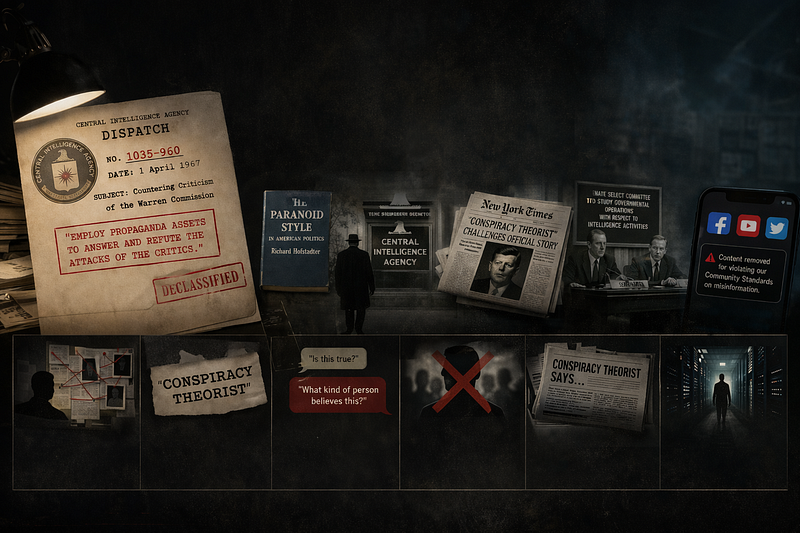
On the first of April, 1967, a dispatch numbered 1035-960 moved through the internal channels of the Central Intelligence Agency toward its contacts in the press. Its subject was the growing public criticism of the Warren Commission's lone-gunman account of the Kennedy assassination, and its instruction was blunt: employ friendly media assets to counter the critics, to portray them as irresponsible, as financially motivated, as careless with the facts, and as drawn to the baroque comfort of a hidden plot. The document is real. It is declassified, it sits in the agency's own public reading room, and anyone can read it.
Now the discipline, because this is exactly where the popular version of the story overreaches and where a careful one must refuse to follow.
A widely repeated claim holds that this memo is where the CIA invented or weaponized the phrase conspiracy theory, manufacturing the slur that has discredited dissent ever since. That claim is false, and saying so plainly is what makes the rest of this argument trustworthy. The phrase conspiracy theory long predates 1967. It appears in English from the nineteenth century, it was already in common and pejorative use through the 1950s, and the 1967 memo itself uses the plural conspiracy theories exactly once, in passing, in a manner that suggests the term was already so familiar it needed no introduction. Scholars who study this, among them Michael Butter and Robert Blaskiewicz, are right that the document did not coin the word and almost certainly did not drive its spread. The etymology is not the finding.
The finding is smaller and far more durable, and it survives the correction intact. The memo does not show the birth of a word. It shows an institution, at a moment of real political danger to itself, reaching with complete fluency for a mechanism that was already lying around: the discrediting of an argument by the categorization of the arguer. The CIA did not invent the instrument any more than a man who picks up a hammer invented hammers. What the document captures, in unusually plain language, is the instrument being picked up, on purpose, by a powerful institution, to defend a specific conclusion. The word was already there. So was the move. The memo simply lets us watch the move being made.
The determining variable is the order, not the word
So set the word aside, because the word was never the lever. Watch instead the sequence.
In an honest examination, evidence comes first and the verdict comes after. You read the case, weigh the documents, and then decide what kind of claim you are dealing with. The architecture of dismissal inverts that order. It delivers the verdict first, in the form of a category attached to the speaker, and the evidence arrives afterward, into a mind that has already been told how to file it. The label is not a conclusion drawn from the argument. It is a frame installed before the argument, so that the argument is read, if it is read at all, as a symptom of the category rather than as a case to be judged.
This is why the instrument is so efficient. Censorship is expensive and creates martyrs; you have to remove the thing, and the removal becomes the story. Rebuttal is expensive too; you have to fund the research, marshal the counter-evidence, and risk losing. Placement costs nothing. It requires no censor, no rebuttal, no investigation. It requires only that the audience receive the category before they receive the claim, and once that order is fixed, the claim defeats itself, because it now reads as exactly the sort of thing that sort of person would say.
The determining variable, then, is not the vocabulary of dismissal but its timing. Whoever decides that the judgment comes before the examination has decided the outcome, regardless of what the examination would have found. Everything turns on which way the shaping runs: the verdict that shapes the evidence, or the evidence that shapes that verdict. That is the same mechanism that governs a manufactured war justification or a sealed archive: not the content of any single claim, but control over the order in which knowledge and verdict are allowed to meet. Dismissal is that control turned on a person.
The press was already wired
The 1967 memo could be casual about deploying media assets because the assets were already in place, and the honest version of that fact requires the same discipline as the rest.
When the Church Committee examined the agency's activities in the mid-1970s, it found, without naming them, that the CIA had cultivated secret working relationships with around fifty journalists. The reporter Carl Bernstein, expanding on the committee's findings in 1977, put the wider figure at more than four hundred American journalists and named major institutions. The popular shorthand for all of it, Operation Mockingbird, names a single centralized program that the declassified record does not actually confirm; the name was attached years later, and the one documented operation that carried it was a narrow 1963 wiretap of two columnists, not the sweeping apparatus of legend. So there was no proven master program in the newsroom. What there was, documented by a Senate committee, was a web of quiet relationships between the agency and the press dense enough that a dispatch instructing the use of media contacts to discredit critics was not shouting into a void. It was reaching for a network that already existed. The architecture of dismissal never needed a conspiracy in the newsroom. It needed only that the newsroom and the agency already knew each other, and they did.
The six moves
Pulled apart, the architecture runs on six components, none of which requires the others to be conscious of it, all of which reinforce the rest.
The first is the categorical label, and the grammatical detail matters. To call an idea a conspiracy theory targets the claim, which can be revised. To call a person a conspiracy theorist targets the speaker, whose supposed psychology cannot be revised by any amount of evidence. The first invites argument. The second forecloses it. The label converts an epistemological question, is this true, into a character verdict, what is wrong with this person, and a character verdict cannot be answered with footnotes.
The second is the asymmetry of proof. The official account, that institutions work roughly as described, that power moves through its declared channels, carries no burden; it is the resting state, believed by default and required to demonstrate nothing. Any departure from it must clear a standard the default itself never has to meet, must be sourced and peer-reviewed and triple-confirmed, while the official version is accepted on the strength of being official. The two sides are not asked to prove their cases against the same bar. One side is the bar.
The third is the substitution of motive for argument. When the evidence is inconvenient to engage, the engagement shifts to the analyst's psychology. Why would someone believe this? A need for simple stories in a frightening world, a craving for significance, resentment of authority. The claim is recoded as a symptom, the argument as a diagnosis, and a diagnosis does not have to be refuted, only pitied. The mid-century vocabulary of the paranoid style made this substitution sound clinical and respectable, and it has never been unmade.
The fourth is false balance as dilution. The professional norm of presenting both sides sounds like fairness and functions as an asymmetric weapon, because it pairs documented evidence with a credentialed denial and lets the credential carry the weight the evidence earned. A regulator's on-camera assurance outweighs the filings that contradict it, not because it is better supported but because it is better dressed. Authority is allowed to stand in for argument.
The fifth is marginalization in place of removal. You do not delete the voice, which would make it a cause; you surround it with enough noise that the signal becomes inaudible. Deprioritized in the ranking, sorted into the section marked alternative, denied the institutional credibility that would force a response, the inconvenient claim is not silenced. It is merely placed where serious people are understood not to look.
The sixth is the conformity filter of the gatekeeping institutions. A synthesis that confirms the dominant picture clears review easily; a synthesis that challenges it is asked for more evidence than the confirming version ever supplies, and an argument that crosses disciplines is rejected by each discipline as outside its remit. The individual facts may each be solidly published. The act of connecting them is what has no home, and the threshold that has no home applies whether the connection is brilliant or worthless.
The academy supplied the diagnosis
The instrument needed a respectable name for what it was doing, and the academy, with no coordination whatever, provided one.
In 1964, three years before the memo, the historian Richard Hofstadter published an essay called The Paranoid Style in American Politics. It was serious scholarship, and Hofstadter was no one's agent; he was diagnosing what he took to be a real and recurring pathology in American political life, the tendency to read events as the work of hidden, coordinated plots. But the essay handed the wider culture a frame of enormous utility to the architecture of dismissal. It recast systematic distrust of official accounts not as a possible response to evidence but as a psychological style, a temperament, a disorder of the suspicious mind. After Hofstadter the dismissal could wear a clinical coat. The critic was no longer merely wrong; he was exhibiting a recognized pathology, and you do not argue with a pathology, you note it. The intelligence service supplied the operational instinct, the academy supplied the diagnostic vocabulary, and journalism absorbed both, and none of the three had to coordinate with the others, because all three were defending against the same thing: the person who connects documented facts into a picture an institution would prefer left unconnected.
Who owns the default
Go one layer beneath the label and you reach the thing that gives it all its force, which is not the word but the default it defends.
Every dismissal rests on an unstated baseline: the official account is where belief sits until something dislodges it. The dissenter must prove; the institution merely is. But that baseline is not natural. Someone built it. The philosopher Michel Foucault spent his life on the observation that the deepest power in any society is not the power to win an argument but the power to set the terms on which arguments can be had, to define, in advance, what counts as knowledge and what counts as merely a claim. The label is only the visible tip of that power. Beneath it sits the asymmetric burden of proof, and beneath the burden sits the prior question it assumes already settled: who decided that the institution is the default and the citizen the supplicant, that the official account is innocent until proven guilty and the dissenting one guilty until proven innocent. The architecture of dismissal is the enforcement arm of that prior decision. It never has to argue that institutions are trustworthy. It has only to ensure that doubting them starts you, automatically, one category below the people you are doubting. Control the label and you win the argument. Control the default and you decide which arguments are allowed to exist.
What it does to a person
It is easy, listing the mechanism, to forget that it lands on people, so look at the case where it landed hardest and was later documented in full.
From late 1963 until his death in 1968, the Federal Bureau of Investigation ran a sustained campaign to destroy Martin Luther King. It was not a debate about his ideas. It was an effort, in the Bureau's own internal language, to neutralize him: to surveil him, to gather material with which to discredit him, to feed damaging stories to friendly reporters, and, in one infamous anonymous letter assembled from wiretap recordings and mailed in 1964, to push him toward suicide. King was, at the time, widely portrayed in respectable quarters as a destabilizing figure, an extremist, a man whose associations made him suspect. The campaign against him was an arm of the broader counterintelligence program, COINTELPRO, that the FBI ran against domestic political movements from 1956 until 1971, and which became public only when activists burgled a Bureau field office in Pennsylvania in 1971 and handed the files to the press.
Hold King beside the mechanism, because he is what the mechanism is for. The point was never to refute him. It was to attach to him a category, the subversive, the security threat, the morally compromised, that would do the refuting in advance, so that whatever he said could be heard as what that kind of man says. That a later generation reveres him does not soften the lesson. It sharpens it. The architecture of dismissal worked on him in real time, in plain professional daylight, on a man history would vindicate, which is the proof that the architecture does not track truth. It tracks threat.
The claims that were true
And here is the fact that should end any comfortable faith in the reflex: the same mechanism that disposes of the cranks has also disposed of the people who were right, and in some cases spectacularly so.
Through the 1950s and 1960s the Central Intelligence Agency ran a program code-named MKUltra that experimented with drugs and other techniques of behavioral control, including dosing unwitting American citizens with LSD. Anyone who, in those decades, had said aloud that their own government was secretly drugging and experimenting on its own people would have been the textbook conspiracy theorist, filed on the instant under the paranoid style, dismissed before a word of evidence could be weighed. Then, in 1975, the Church Committee and the Rockefeller Commission confirmed the program. Most of its files had already been destroyed on the director's order in 1973, but a cache of some twenty thousand documents, misfiled in a financial records building, surfaced under a Freedom of Information request in 1977 and forced fresh Senate hearings. The paranoid fantasy had been a budget line.
The lesson is not that every dismissed claim is a hidden MKUltra; almost none are, and pretending otherwise is its own failure of thought. The lesson is narrower and sharper: the architecture of dismissal cannot tell the difference, because it renders its verdict before it looks, and so it discards the true claim and the false one with the identical, costless motion. A reflex that would have filed MKUltra under paranoia right up until the documents fell out of a misplaced filing cabinet is not a detector of truth. It is a detector of threat, wearing a truth-detector's coat.
The platforms inherited it
The instrument is older than the technology that now carries it, and watching it migrate is the clearest proof that no one is driving.
When the major platforms began, in the middle of the last decade, to manage what their users could see, they did not design a new system of epistemic control. They rebuilt the old one in software. The disputed-content label that appears before you read a post is the categorical placement, automated. The tiered demotion that lets a video exist while ensuring almost no one finds it is marginalization, automated. The reliance on a short list of credentialed fact-checkers to adjudicate truth is the authority-over-evidence move, automated. The vocabulary updated; the architecture did not. Placement before evaluation, credential over content, dilution in place of deletion: the six moves walked out of the print newsroom and onto the moderation dashboard without a single structural change.
The platforms did not inherit a plan. They inherited a shape, the way water inherits the channel cut by the last flood, and they poured themselves into it because it was the path of least resistance for an institution that needs to manage a flood of claims at scale. That is the more unsettling finding, and it is the one the conspiratorial version of this story gets exactly backward. There is no committee maintaining the architecture of dismissal. There does not need to be.
And now the machines
The newest carrier of the architecture is the one being built right now, and it may absorb the move more completely than any newsroom ever did.
Ask a large language model about a contested claim and watch the order in which it answers. Very often the categorical placement comes first. The claim is named as debunked, as a conspiracy theory, as misinformation, before any evidence is weighed, and the placement is drawn not from an examination the model performed but from the aggregate of how the claim has already been categorized across the text it learned from. The model picks up the reflex the way a young reporter does, by absorbing the convention, except that it absorbs it from the entire prior record of dismissal at once and reproduces it at the speed and scale of every query at once. It does not decide that a claim is unserious after reading the case. It inherits the verdict and delivers it first. That is the architecture of dismissal compressed into a default setting, installed at the exact layer through which a growing share of the world will soon find out what is and is not worth taking seriously. Whether the systems that increasingly mediate what a society can find and believe will judge before they look, or build in the harder discipline of looking first, is not a small technical question. It is the question the 1967 memo answered, asked again of a far more powerful instrument, while the answer is still soft.
No one has to run it
This is the heart of the thing, and it is the part that the word conspiracy, with its implication of a room and a plan, makes almost impossible to see.
Every component of the architecture is independently rational for the person performing it, and none of them requires knowledge of the others or of the whole. A reporter who attaches the label is not executing an order from anyone; she is following the professional convention that marks her as careful and serious, and avoiding the far greater risk of being categorized alongside the thing she is covering. An editor who demands more proof from the dissenting claim than from the official one is not conspiring; he is being prudent, because the dissenting claim is the one that will cost him if it is wrong. A platform that demotes rather than deletes is not suppressing; it is minimizing liability. Each actor optimizes locally, for caution and credibility and cost, and the sum of all that local optimization is a society-wide foreclosure that no one chose and no one can be held responsible for, because responsibility, like the architecture itself, has been distributed until it disappears.
The economist Friedrich Hayek spent his life on the difference between an order someone designs and an order that emerges, unplanned, from many people each pursuing their own ends, and he warned that the second can look so coherent that we insist on an architect who is not there. The architecture of dismissal is that kind of order in its purest form. It needs no guard, because the prison guards itself. The instrument that an intelligence agency reached for in 1967 is now operated, every day, by people who have never heard of that memo and would be appalled by it, and their not knowing is not a gap in the architecture. It is the architecture finished, the moment the move became a reflex and the reflex lost its memory of where it came from.
This is the engine that Noam Chomsky and Edward Herman described in 1988 as the propaganda model: not a conspiracy of editors taking instructions, but a set of filters, of ownership and advertising and sourcing and professional caution, that narrow the acceptable range of opinion through nothing more sinister than each participant pursuing his own interest. Dismissal is the first and most efficient of those filters, the one that runs before all the others, because a speaker who has already been placed in the unserious category never reaches the stage where the slower filters would have to do any work. It is the filter that makes the rest of the filters lighter, and it is the one no one has to be told to apply.
And the strongest evidence that it runs on its own is what happened when its origins were exposed. The Pennsylvania burglary laid COINTELPRO open in 1971. The Church Committee, in the mid-1970s, confirmed the domestic operations, the media relationships, the campaign against King. Everything the dismissed critics had pointed toward, in those years, turned out to be documented. And the threshold of suspicion applied to the next set of documented claims did not move at all. The revelations were reported, filed, and professionally absorbed, and the machine kept running, because the machine had never depended on the secrecy of any operation. It depended only on the order in which judgment and evidence were allowed to meet, and that order was never exposed, because it was never hidden. It was simply how serious people had learned to think.
The honest objection, which is strong
Here the argument has to stop and concede its single most serious weakness, because to skip it would be to commit the very sin the essay is about.
The objection is that the label is usually correct. Most of what gets called a conspiracy theory is, in plain fact, false: the staged moon landing, the flat earth, the lizard overlords, the endlessly recycled hidden hand behind every event. A society drowning in claims needs some fast, cheap way to sort the worth-examining from the not, and the categorical reflex, applied by people with no time to read everything, mostly sorts correctly. Epistemic vigilance is not a crime; it is a necessity, and an instrument that quarantines nonsense at low cost is, most of the time, doing useful work. Worse, the framing of this very essay can be turned into a weapon: any crank, told his idea is unserious, can now reply that he is merely a victim of the architecture of dismissal, immunizing his nonsense against the criticism it deserves. The mechanism that wrongly dismisses the rare true claim is the same mechanism that rightly dismisses the thousand false ones, and you cannot praise its failures without also indicting its successes.
All of that is true, and it must be held without flinching. The label is usually applied to things that deserve it. Most dissent from the official account is, in fact, wrong.
But notice what the objection does not rescue. The defense of the mechanism is a defense of its average accuracy, and the problem with the mechanism was never its average. It is that it works by placement before examination, at no cost, with no corrective. A filter that judged after reading would dismiss the same thousand cranks and still catch the rare case where the dismissed party was right, because it would have looked. The architecture of dismissal does not look. It decides first, and because it decides first and for free, it neutralizes the true claim and the false one by the identical motion, and it provides no mechanism by which the true one can ever climb back out, since climbing out would require the examination the architecture exists to prevent. King was dismissed by the same reflex that dismisses the flat-earther, and the reflex could not tell them apart, because telling them apart was precisely the work it had been built to skip. The objection proves that the architecture is usually right. It does not touch the fact that being usually right, before looking, is not the same as being just.
What freedom of inquiry actually needs
So the demand at the end of this is smaller than certainty and harder than it sounds.
It is not the claim that the dismissed are right; most are not. It is not a plea to believe the marginal over the credentialed. It is only the insistence that the order be reversed, that examination come before placement rather than after, that a claim be read before its author is filed. The architecture of dismissal was not built to stop people from reading. It was built to make reading feel unnecessary, by delivering the verdict in time to prevent the trial. Its genius is that it asks nothing of you except that you accept the category before the case, and almost everyone does, because resisting it is slow and lonely and marks you, instantly, as the kind of person who resists it.
The 1967 memo did not tell its agents to find better evidence than the critics. It told them to ensure the critics were placed before their evidence could be weighed. That is the whole of it, and it is not a relic. The memo is in a public reading room, sixty years old, and the move it documents is performed a million times a day by people who never read it and never had to, because the instrument it reached for was already the property of everyone, and remains so. The most powerful form of censorship was never the one that removes the book. It is the one that tells you, before you open it, what kind of person reads it.
Evidence Map
Facts, interpretations, forecasts, and disconfirming signals.
Core claim. The most efficient instrument of information control is not censorship or rebuttal but DISMISSAL: the placement of a categorical verdict on the speaker before the evidence is examined, which defeats an argument without engaging it, at near-zero cost. The determining variable is the ORDER (verdict before examination), not the specific label. The architecture is emergent and self-operating, requiring no coordination, and it neutralizes true and false claims by the same motion because it acts before looking.
Evidence level. Facts (high): CIA Dispatch 1035-960 (1 April 1967, "Countering Criticism of the Warren Report") is declassified and instructs using media contacts to discredit Warren critics; the FBI's COINTELPRO (1956-1971) and its documented campaign to "neutralize" Martin Luther King, including the anonymous suicide-baiting letter, exposed by the 1971 Media, Pennsylvania burglary and confirmed by the Church Committee; the migration of placement/demotion/credential mechanisms into platform content moderation. Interpretation (medium, marked): the six-component model of the mechanism; the "order before evidence" (Sequence Control) determining-variable reading; the Hayek emergent-not-designed account. Rejected/contested (marked): the popular claim that the CIA invented or weaponized the term "conspiracy theory" via the 1967 memo is rejected here as overstated (the term predates 1967 and was already common; Butter, Blaskiewicz); the essay does not rest on the JFK critics having been right (the HSCA's 1979 "probably a conspiracy" finding rested on acoustic evidence later disputed), because the argument is about the mechanism of dismissal, not the truth of any dismissed claim.
What would confirm this. Continued application of categorical dismissal before examination across new media; documented cases where later-vindicated claims were neutralized in real time by labeling rather than refutation; persistence of the asymmetric burden of proof regardless of evidentiary quality.
What would disprove this. Evidence that dismissal in practice follows rather than precedes examination; that the burden of proof is symmetric between official and dissenting accounts; that exposure of the mechanism's operations (as in 1975) measurably changed the threshold applied to subsequent claims.
Watchlist. Platform "disputed content" and credibility-labeling systems; the treatment of interdisciplinary synthesis in gatekeeping institutions; whether AI systems inherit placement-before-evaluation as a default in how they weight and surface claims.
Related from The Manifest Archive
- The NSA Proved the Gulf of Tonkin Attack Never Happened. It Classified the Finding for 41 Years.
- How the CIA Built the Surveillance Economy
- Tesla's Papers Were Declared Worthless in 1943.
- Vietnam Had a RAND Strategy.
Jerry van der Laan writes The Manifest Archive, daily forensic essays on power, language, and the systems that shape what we are allowed to see as reality. He traces the structures beneath them.