She spent her life fighting a machine for the right to own herself, and won just enough to prove it was possible. Then she died, and the machine took everything, more completely than it ever could while she was alive to resist.
In January 1954, the biggest female star in the world was suspended from her job for saying no. Twentieth Century-Fox had ordered Marilyn Monroe into another musical comedy, a forgettable picture called The Girl in Pink Tights, on a contract written in 1950 that paid her a fraction of what stars of her stature earned and gave her no say over the roles she played. She refused. The studio suspended her. And in that refusal is the whole of her, the part the legend erases under the lipstick and the breathy voice: a woman who understood exactly what had been done to her and spent the rest of her short life trying to undo it.
The story everyone is told is that pills killed Marilyn Monroe, that a fragile beauty could not survive her own fame. The documented story is harder and more damning. What consumed her was not a chemical but a machine, the industrial system that manufactured a person named Marilyn Monroe out of a woman named Norma Jeane, owned the result, typecast it, underpaid it, and could not forgive the woman inside for being smarter than the product. She fought that machine and won real ground. And then, in death, the machine achieved the total ownership it could never quite secure in life, turning her into a perpetual brand and, eventually, into an artificial intelligence that smiles on command. The pills are how the story ends. The machine is what the story is about.
Norma Jeane, Manufactured
Marilyn Monroe was not a person who became famous. She was a product that was designed. The woman underneath was Norma Jeane Mortenson, born into poverty and a chaotic childhood of foster homes and a mother who could not care for her, and what the studio system did with her is the literal manufacture of an icon. The name was invented. The hair was changed. The voice, the walk, the breathy delivery, the whole persona of luminous, available, slightly helpless sexuality was engineered, refined, and trademarked into the most recognizable image of an era.
This is not a metaphor and it is not unique to her; it is how the studio system worked, and she was its masterpiece. The system took raw human beings and built brands out of them, and it owned the brands. The contract was the instrument of ownership. A young performer signed away years of her working life at a fixed and modest wage, and the studio decided what she made, how she appeared, whom she was photographed with, and what the public was allowed to believe about her. The person and the property were legally distinct, and the property belonged to the studio. Norma Jeane became Marilyn Monroe, and Marilyn Monroe, in the most precise commercial sense, belonged to Fox.
The genius and the cruelty of the design was that it worked best when the audience could not see it. The manufactured quality had to feel like nature. The public had to believe that the breathy, dazzling creature on the screen was simply who she was, a force of effortless allure, because the moment you saw the engineering you saw the woman doing the work, and the work was the thing the system most needed to hide. So the official story insisted she was exactly what she appeared to be, a beautiful innocent, a happy accident of nature. The truth, that an intelligent and ambitious woman was performing a character built to studio specification, was the one thing the brand could not admit, because it would have returned to her the authorship the contract had taken away.
The Childhood That Made Her Usable
The raw material the machine worked with was a childhood of almost pure instability, and it matters because instability is exactly what the system found useful. Norma Jeane was born in 1926 to a mother who could not consistently care for her, never knew her father, and spent her early years moving through a series of foster homes and a spell in an orphanage. She married at sixteen, in part to escape the foster system, and was working in a factory during the war when a photographer noticed her and modeling work began. By the time Hollywood found her she had already learned the central lesson of a precarious life, that approval was conditional, that security had to be earned by being what others wanted, and that the self could be rearranged to survive.
That is the perfect psychological raw material for an industry that manufactures personas, and it would be naive to think the machine did not benefit from it. A performer with a stable sense of self resists being rewritten; a performer who learned early that her worth depended on pleasing is far more malleable, far more willing to become the product, far more frightened of losing the approval the product brings. None of this was a plot, and the studio did not engineer her childhood. But the system selected for and rewarded exactly the qualities her childhood had produced, the hunger to be wanted, the willingness to be remade, the terror of being discarded, and then it built those qualities into a global brand. The vulnerability that made her need the machine was the same vulnerability that made her perfect for it. The cruelty is that the thing about her the system found most useful was the wound.
The Dumb Blonde Was a Business Decision
The role that made her, and trapped her, was the dumb blonde, and it is essential to see that this was a commercial choice, not a description. The persona sold. It was reliable, repeatable, and enormously profitable, and so the studio cast her in it again and again, the breathy comic bombshell whose appeal was that she did not seem to know her own power. Audiences loved it. The studio counted the money. And the woman inside it, who read seriously, who wanted to act in real roles, who would later study with one of the most demanding teachers in American theater, was given no path out, because the product was working and a working product is not allowed to change.
This is the part the era could not forgive. The historical record is full of the contempt directed at the idea that Marilyn Monroe might be intelligent, might want serious work, might have an interior life that exceeded the character she was paid to play. A thinking blonde was a contradiction the system was not built to sell, and her insistence on being one was treated not as ambition but as ingratitude, even instability. She was supposed to be grateful for the cage, because the cage was made of fame and money, and a woman who questions a gilded cage is, in the logic of the machine, malfunctioning. The pressure to stay simple was relentless and it came from every direction, and resisting it was exhausting in a way that no contract clause records.
The cruelty here is structural, not personal, and that is the point. No single villain decided to waste her. The studio executives were following the money, the public was buying what it was sold, the press was printing what moved copies, and each rational choice in that chain pressed the same way, toward keeping Marilyn Monroe exactly as profitable and exactly as simple as she already was. The machine did not hate the woman. It simply had no use for the parts of her that were not the product, and a system that has no use for most of a person will, given time, wear those parts away.
The Library Nobody Photographed
In the autumn of 1999, at Christie's in New York, the private contents of Marilyn Monroe's life were arranged into numbered lots and sold to the highest bidders. Among the gowns and the letters were her books, several hundred of them, carried to the auction block and opened for inspection, and on their pages were notes in her own handwriting. Strangers leafed through a dead woman's marginalia, decided what it was worth, and paid. The most private evidence of who she actually was, her reading, her underlinings, her arguments with the authors, was catalogued, valued, and dispersed to anonymous collectors. Even her inner life, in the end, was inventory.
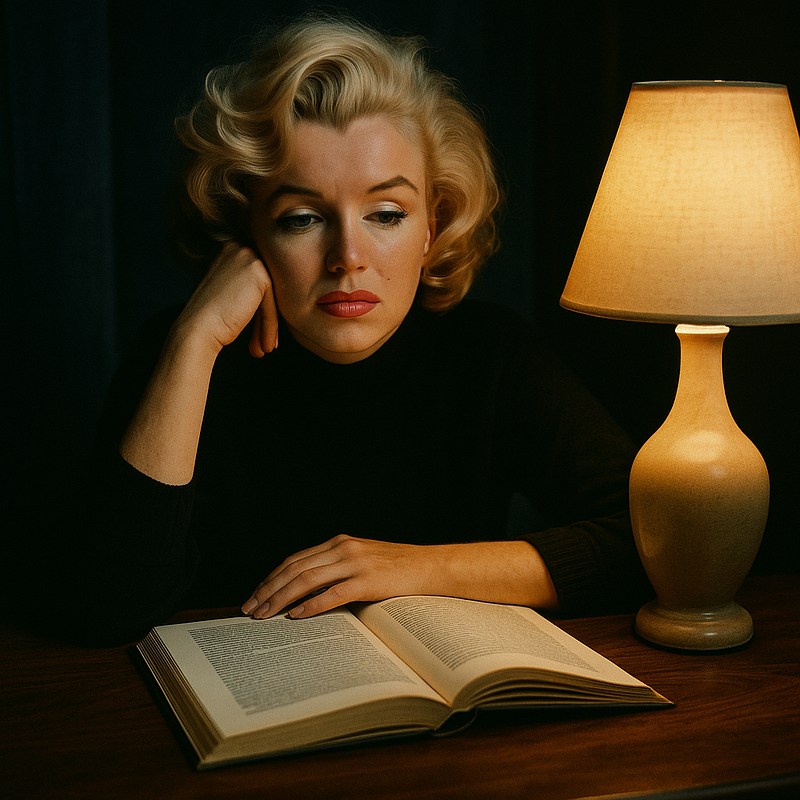
The clearest evidence of the gap between the woman and the product is what those books contained, because they were not props. They were the reading of a serious, self-educated mind: Joyce, Whitman, Dostoevsky, Milton, books on history and art and psychoanalysis, many of them annotated in her own hand. She took classes, she sought out the company of writers and intellectuals, she married one of the most celebrated playwrights in America, and she worked hard, against type and against expectation, to be taken seriously as an artist.
None of this fit the brand, and so almost none of it reached the public while she lived. The image the machine sold required that she be exactly as deep as a magazine cover, and a photograph of Marilyn Monroe reading Joyce was, commercially, a contradiction to be suppressed rather than a truth to be told. This is the quiet violence at the center of the manufactured icon: not only that the system built a false simple self and sold it, but that it actively hid the real complex one, because the real one was less profitable and harder to control. She was, by every surviving account, more intelligent than the role she was permitted to play, and the permission was never hers to grant. The library nobody photographed is the woman the machine could not use, and so the woman the machine erased, kept in a private room while the public bought the cover.
Why It Is Almost Always a Woman
There is a pattern in who the manufacturing machine consumes most completely, and it is not incidental that the clearest cases are women. The persona Marilyn Monroe was built to embody, the available, luminous, undemanding sexual ideal, is a specifically gendered product, and the system that builds it has always been more comfortable manufacturing women as images than employing them as authors. A male star of her era could be difficult, intelligent, and ambitious and have those qualities read as seriousness; the same qualities in her were read as instability. The product she was made into required that she be looked at rather than listened to, and the moment she insisted on being listened to, she became a problem to be managed rather than a talent to be developed.
This is why her story rhymes so exactly with others, with Anna Nicole Smith decades later, with the long list of women built up as images and consumed when the woman underneath proved inconveniently real. The machine manufactures a great many people, but it reserves a particular completeness of consumption for the women it turns into objects of desire, because the role it casts them in has the least room in it for an actual self. A persona built entirely around being wanted cannot also contain a person who wants things, and so the wanting, the ambition, the intelligence, the refusal, has to be pushed down, medicated, or punished. Marilyn Monroe is the most famous instance of a machine that runs, with grim reliability, on the manufacture and disposal of women, and the reason her face still sells is that the machine that made it is still running.
She Fought to Own Herself
What lifts Marilyn Monroe out of pure victimhood, and what the legend almost entirely omits, is that she fought back, intelligently and with real success. The 1954 suspension was not a tantrum. It was the opening move in a deliberate campaign to seize control of her own career from a studio that treated her as inventory.
Rather than capitulate, she did something almost unheard of for a female star of her moment. In 1954 she left Hollywood, went to New York, and founded her own company, Marilyn Monroe Productions, with the photographer Milton Greene, declaring that she would no longer simply be handed scripts. She spent a year on the project. She studied method acting under Lee Strasberg at the Actors Studio, working to become the serious actress the studio refused to let her be. It was a direct challenge to the ownership model itself, a star asserting that she, not the studio, should decide what she made. And it worked. By the end of 1955 Fox, unable to replace her and unwilling to lose her, gave her a new contract with far more money and, crucially, real control over her projects and her directors. She had taken on the most powerful studio in Hollywood and forced it to treat her as an author of her own work.
This is the documented heart of the story and it changes everything about how the ending should be read. Marilyn Monroe was not a passive object the system happened to break. She was a woman who saw the machine clearly, named what it was doing to her, and fought it with strategy and nerve, and won concessions almost no one in her position had ever won. The tragedy is not that she failed to understand her situation. It is that she understood it completely, fought it with everything she had, achieved a real and historic victory, and still could not finally escape a system whose ownership of her ran deeper than any single contract she could renegotiate. She proved the cage could be bent. She could not prove it could be left.
What the Era Did to a Tired Woman
The years after the victory were not liberation. The 1955 contract gave her approval over scripts and directors, but the films it produced, including the demanding shoot of The Misfits in the Nevada heat in 1960, drew on a woman who was increasingly exhausted, and the same intelligence and sensitivity that made her more than the product also made the relentless exposure harder to bear. The reputation for lateness hardened into a liability the studio would soon use against her. And through all of it ran the era's particular answer to a woman under that much strain, which was chemical.
The pills were real, and the dependence was real, and it is worth being exact about what they were, because the exactness is the indictment. This was the high era of the prescription sedative, when barbiturates were handed out freely, when a difficult or exhausted or sleepless woman was managed with chemistry rather than relieved of the conditions that exhausted her. Marilyn Monroe lived inside that culture at its most intense, a person under continuous pressure with ready access to the drugs that promised to make the pressure bearable, prescribed and re-prescribed by doctors who treated the symptom and never the machine producing it. The pills did not come from nowhere. They were the era's standard tool for keeping a valuable, struggling woman functional enough to keep working, and they were as much a product of the system as the persona was.
Fired, Then Found
The last act shows the machine turning on her in real time, and it is documented, not inferred. By the early 1960s the difficulty that the studio had always resented had hardened into a reputation, fairly or not, for lateness and unreliability, and the same Fox that had been forced to give her control in 1955 moved to reassert it. In 1961 she made The Misfits, written for her by her then husband Arthur Miller, a serious and demanding film and a grueling shoot. The following year she began a picture called Something's Got to Give, and amid absences attributed to genuine illness, the studio fired her in June 1962, publicly blaming her, even as it negotiated, quietly, to bring her back on better terms.
That sequence, fired in public and courted in private within weeks, captures the whole relationship in miniature. She was simultaneously indispensable and disposable, too valuable to lose and too inconvenient to respect, and the studio felt entitled to treat her as both at once. In the last months of her life she was, by the documented record, being publicly punished by the institution that had built her and was at the same time too commercially essential for that institution to actually let go. She died in August 1962 with the rehiring still in motion. The machine had not finished with her. It never got the chance to, because she ran out before it did, and even then it would resume its use of her within days, in death, on terms she could no longer contest at all.
What Killed Her
On the evening of August 4, 1962, Marilyn Monroe died at thirty-six in her home at 12305 Fifth Helena Drive in Brentwood, of an overdose of barbiturates. The deputy coroner, Thomas Noguchi, performed the autopsy, and the Los Angeles County coroner's office ruled the death a probable suicide.
It is necessary to be disciplined here, because few deaths have attracted more speculation. There are decades of theories, that she was murdered, that the Kennedys were involved, that the scene was altered, that intelligence agencies had a hand in it. None of these has ever been established, and this analysis does not depend on any of them. Set every conspiracy entirely aside, accept the documented finding exactly as the coroner wrote it, a probable suicide by barbiturate overdose, and the structural argument is not weakened in the slightest. It is strengthened, because it means no hidden hand was required. The machine did not need to kill her. It only needed to manufacture her, own her, typecast her, exhaust her, medicate her, and refuse her the room to be the whole person she was, and then a tired woman with a bottle of pills did the rest, alone, in a quiet house, at thirty-six.
That is the meaning of the claim that it was not the pills but America that killed her, and it should be read as the marked interpretation it is, not as a forensic cause of death. The pills were the proximate mechanism. The system that produced the despair, the dependence, the isolation, and the impossible role was the determining one. To blame the pills is to blame the woman for swallowing them. To see the machine is to ask why a person that gifted, that successful, that recently victorious, was nonetheless so depleted and so alone that the pills were there and the will to refuse them was not.
Owned in Death
Here the story turns, and the turn is the part that proves the thesis beyond argument, because it is entirely documented and still going on. The woman who spent her life fighting to own herself was, in death, owned more completely than she ever was in life.
Her image did not fade. It was monetized, and then it was consolidated. In January 2011, a company called Authentic Brands Group acquired the rights to Marilyn Monroe's likeness, the first celebrity estate it took on in what would become a portfolio of dead and living names. By the company's own reporting, the Monroe brand drives on the order of eighty million dollars a year in global sales. Her face sells cosmetics, clothing, and accessories she never saw, in a worldwide licensing operation that treats the woman as a trademark, which, legally, is now exactly what she is. The intelligent, ambitious person who founded her own production company to escape being someone else's property became, half a century after her death, a property line on a multinational's balance sheet.
And then came the final step, the one that completes the machine's victory. The same company partnered with an artificial-intelligence firm to build a Digital Marilyn, a real-time AI recreation of her face, her voice, and her mannerisms, able to smile, speak, and perform on command. The woman who fought the studio for the right to choose her own roles now endorses products chosen for her by an algorithm, says lines she never wrote, and cannot, this time, refuse. Every quality the studio system valued in her and could never quite secure, total availability, perfect compliance, an image that never ages or argues or demands a better contract, has finally been achieved by removing the woman entirely. The product has been perfected by deleting the person. In life she fought the studio to own herself. In death she became the thing a studio owns.
The Dead-Celebrity Industry
What happened to Marilyn Monroe after 2011 is not a quirk of one estate but the founding case of an entire industry, and seeing the industry is what turns her story from a sad biography into a structural one. Authentic Brands Group did not simply buy a famous face. It pioneered a model: acquire the intellectual property of dead celebrities, consolidate the licensing, and run the deceased as a perpetual revenue engine, and Marilyn Monroe was its first and proof-of-concept acquisition. The model worked so well that the company went on to assemble a portfolio of names, living and dead, run the way a fund runs assets, and the dead, it turns out, are the better assets, because they never age, never offend, never renegotiate, and never die again.
This is the logic of ownership taken to its endpoint. A living star is a difficult asset; she has opinions, a body that ages, a will that can say no, as Marilyn herself demonstrated in 1954. A dead star, properly secured as intellectual property, has all of the brand value and none of the friction. The right of publicity, the legal right to control the commercial use of one's image, was fought over for decades around her estate precisely because so much money depended on who owned the dead woman, and the resolution, like the contract before it, placed the ownership somewhere other than with her. The dead-celebrity industry is the studio system's original logic, the separation of the person from the property and the assignment of the property to a corporation, perfected by the removal of the one variable the studio could never fully control while she lived, which was the woman herself. Death did not free her from the machine. It made her its ideal product.
The Honest Objection
The strongest case against this reading deserves to be stated plainly. It is that this romanticizes a private tragedy into a political one. Marilyn Monroe was a woman with a genuinely difficult life, a traumatic childhood, real mental-health struggles, and a substance dependence that kills people in every profession and every era, famous or not. Plenty of stars passed through the same studio system and did not die at thirty-six. To pin her death on a machine, the objection runs, is to strip her of agency and to convert an individual's illness and choices into an indictment of America, which is both unprovable and a little self-serving.
The objection is serious and the response is not to deny her illness or her agency but to ask what produced and surrounded them. Addiction is real and so is depression, and the analysis does not claim otherwise. What it claims is narrower and survives the concession entirely. It is that the documented facts of her working life, the manufactured persona she did not author, the contract that owned her, the typecasting she had to wage a public campaign to escape, the era's reflex to medicate a struggling woman rather than relieve her, and the posthumous conversion of her whole self into licensed property, describe a structure that consumed her regardless of the private details, and that would have pressed on any woman placed inside it. The illness explains why a particular night ended as it did. The structure explains why she was that depleted, that typecast, that alone, and why the moment she died her image went to work and never stopped. You do not need to deny the woman's struggle to see the machine. You only need to ask who built the conditions the struggle took place in, and who profited, and who still profits now.
The Position Is Still Open
It would be comforting to file all of this under the cruelty of an old Hollywood that no longer exists, the studio system long since broken up, the contracts long since rewritten. The machine did not disappear. It upgraded.
The manufacture of a human being into an owned image is more total now than it was in 1954, not less. Performers are still discovered young and signed into long contracts at the point of least leverage. Their images are still managed, their personas still engineered, and the demand on them to be perpetually available, perpetually on, perpetually the product, runs through a feed that never closes rather than a studio that shuts at night. And the endgame Marilyn Monroe reached in death is now arriving for the living: the AI likeness, the synthetic performer, the image that can be made to say anything and refuse nothing. The technology that resurrected her as a compliant hologram is the same technology now being built to capture working artists while they are still alive, to license their faces and voices in perpetuity, to own them after they are gone and, increasingly, while they remain. The question her life poses is no longer about one woman in 1962. It is who, in an age that can manufacture a person and then keep the manufactured version running forever, will still be allowed to own themselves, and the answer the machine keeps giving, from Norma Jeane to the present, is the same. The product is allowed to exist. The person is optional.
Evidence Map
Facts, interpretations, forecasts, and disconfirming signals.
Core claim. Marilyn Monroe was a manufactured studio property (Norma Jeane engineered into "Marilyn Monroe"), typecast and owned under the studio-contract system; she fought it with a documented and partly successful campaign for control; she died in 1962 of a barbiturate overdose ruled a probable suicide; and in death she was converted into a perpetual licensed brand and an AI likeness, achieving the total ownership the system could never secure in life. The structural machine, not the pills, is the determining variable; this is marked interpretation, not a forensic cause of death.
Evidence level. Facts (high): the 1950 Fox contract, the January 1954 suspension over The Girl in Pink Tights, the founding of Marilyn Monroe Productions (1954) with Milton Greene, study under Lee Strasberg at the Actors Studio, the improved 1955 Fox contract; the August 4-5, 1962 death at 12305 Fifth Helena Drive, the Noguchi autopsy and the "probable suicide" barbiturate ruling; Authentic Brands Group's 2011 acquisition of her likeness rights, the reported ~$80m/year, and the AI "Digital Marilyn." Interpretation (medium, marked): that the studio/era machine, not the pills, is the determining cause; that posthumous branding completes the ownership. The piece explicitly sets aside the murder/intelligence conspiracy theories as unproven and unnecessary to the argument. Forecast (speculative): that AI likeness ownership extends to living performers.
What would confirm this. Continued expansion of posthumous and living-performer likeness licensing; the persistence of manufacture-and-own dynamics for young stars.
What would disprove this. Evidence that her career was under her own control on ordinary terms (no contract fight needed), or that her image was not converted into licensed property after death; a shift to artists durably owning their own likenesses.
Watchlist. AI-likeness law and consent for living and dead performers; the celebrity-estate industry; young-artist contract terms.