The most consequential thing that happened to America's gold this century was not a theft, a sale, or a discovery. It was a man in gloves checking that a seal had not been broken.
In fiscal year 2010, a small team moved through the Bullion Depository at Fort Knox and the other sites where the government keeps its gold. At each of forty-two sealed compartments they did two things. They inspected the joint seal already in place for any sign it had been tampered with. Then they fixed a fresh seal over the old one, while a Treasury auditor watched. No bars were lifted. No metal was weighed. No gold was counted. When the seals were confirmed intact, the audit was complete.
That is what an audit of Fort Knox now means. Not a count of the gold, but a confirmation that no one has looked at it. The seal does not prove the gold is there. It proves that nobody checked, and the not-checking has become the proof.
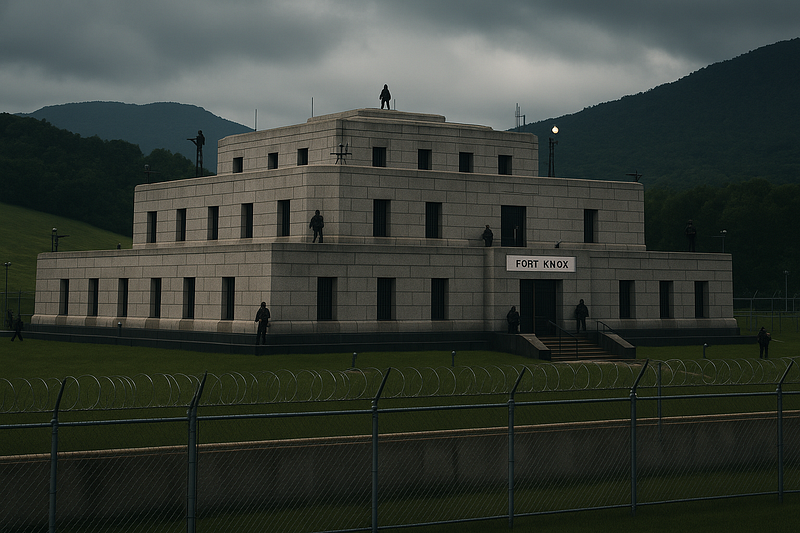
To most people Fort Knox is not a building but a guarantee. The name has dissolved into the language: as safe as Fort Knox. In the movies it is the prize even a master thief can only dream of cracking. In politics it is shorthand for a dollar that rests on something solid, something you could in principle drive to Kentucky and touch. Granite behind barbed wire, windowless, watched by guns, a vault door weighing twenty tons. The most famous strongbox in the world, and almost no one alive has seen inside it.
No independent auditor has counted the full holdings since 1953. Every few years the question surfaces in a headline or a congressional bill: is the gold really there? It is the wrong question. It is the question the fortress is built to keep you asking, because while you are wondering whether the gold is there, you are not asking the harder thing. Why, after 1971, it stopped mattering whether the gold is there at all.
The fortress built to be believed
It begins not with a fortress but with a confiscation. In 1933, in the trough of the Depression, Franklin Roosevelt issued Executive Order 6102. Americans were to surrender their gold coins, bullion, and certificates to the Federal Reserve and take paper dollars in return. Holding gold became a crime. The citizen handed over the metal and received a banknote, and the banknote was now the only legal shape the wealth could take.
The act was economic, but its real work was definitional. Gold moved from the category of private refuge into the category of national treasure. By gathering the nation's gold into one set of hands, Washington took command of the money itself. The metal you once kept under the floorboards against the failure of the state had become the instrument of the state.
Having taken the gold, the government needed a place to put it. Construction began in 1935 in the hills of Kentucky, inside an army post named for the Revolutionary War general Henry Knox, and finished the next year. The Treasury built in granite, steel, and reinforced concrete, walls measured in feet, a door measured in tons, an army base around it that could put tanks and aircraft over the site in minutes. Then the bullion came, by train and armored convoy, the wealth of a country stacked behind a single door.
What was built was not really a warehouse. It was a sight meant to be described rather than entered. On the eve of the Second World War the United States held the largest gold reserve in history, swollen further when Europe shipped its own gold across the Atlantic to keep it from the Germans. The vaults filled with metal that stood for American prosperity and, for a few years, for Western survival. The fortress was a statement before it was a function, and it made that statement most powerfully to the people who would never be let in.
When the metal still decided things
There was one moment when the gold inside Fort Knox genuinely set the value of money. Everything after it is the story of a guarantee outliving the thing it guaranteed.
In 1944, delegates from forty-four nations met at a New Hampshire resort called Bretton Woods to build the monetary order that would follow the war. They put the dollar at the center. Every other currency was pegged to the dollar, and the dollar alone was pegged to gold at thirty-five dollars an ounce. Any government holding dollars could present them to the United States and walk away with metal at that rate.
This is the only arrangement in which the contents of Fort Knox mattered physically. The bars were collateral. Issue too many dollars against too little gold and foreign governments could call the bluff, arrive with their paper, and leave with the metal. The walls in Kentucky were not a metaphor in 1950. They were the backing of the world's money, and a run on them was a live possibility, not a film plot.
The flaw was there from the start, and one economist named it early. In 1960 Robert Triffin described the bind that now bears his name. For the world to have enough dollars to use as reserves, the United States had to run deficits and push those dollars abroad. But every dollar abroad was another claim against a fixed pile of gold, and the pile did not grow. The country could supply the world with its currency or keep its gold backing intact. It could not do both forever. The thing that made the dollar useful was the same thing dissolving its guarantee.
By the late 1960s the strain was visible. America printed dollars for the war in Vietnam and for programs at home while Europe and Japan piled up claims and the urge to cash them in. To hold the line, eight nations pooled their reserves in 1961 into the London Gold Pool, selling metal whenever the price threatened to climb above thirty-five dollars. For a few years it worked. Then it broke. In a single week in March 1968 the pool bled close to a thousand tonnes, against a normal day's sale of five, a hundred tonnes on the eighth alone. The authorities shut the London market on the fifteenth behind a hastily declared bank holiday and split the world into two prices, the official thirty-five for central banks and a free price for everyone else. The metal was being treated as exactly what the treaty said it was, a fund that could be drained, and it was draining faster than it could be defended.
The day the link was cut
In August 1971 Richard Nixon went on television and announced that the United States would temporarily suspend the dollar's convertibility into gold. The word was temporary. The window never reopened. From that evening the dollar floated free of metal, its worth set by markets, by the credibility of the institutions behind it, and by the world's willingness to keep taking it.
The next morning the gold was exactly where it had been. Nothing physical had moved. But the gold's job had been quietly amputated. It was no longer collateral, because no one could present a dollar and demand a bar. It no longer decided what a dollar was worth. Overnight, by television, the metal stopped being money and became a monument.
Here is the turn the popular debate never makes. Before 1971, an empty vault would have been a catastrophe, because the metal was the guarantee. After 1971, an empty vault would change nothing you could measure, because the guarantee had already been replaced. The dollar now stood on trust: the full faith and credit of the United States, the depth of its markets, the reach of its military, and the plain fact that everyone else was using dollars too. The gold had become ornament on a structure now holding itself up by other means.
That is the determining variable, and it is almost always missed. The interesting thing about Fort Knox is not that it is secret. It is that the secrecy became safe to keep at the exact moment the contents stopped mattering. A custodian guards a working machine one way and a relic another, and somewhere in 1971 the gold quietly changed from the first into the second.
The audit that turned into a seal
The last full, independent count of the gold was in 1953, under Eisenhower, when teams weighed and recorded the bars. After that the doors closed on outside verification, and the way they closed says more than the fact that they did.
In September 1974, with suspicion rising that the gold was gone, the Treasury staged an answer. Under President Ford it flew journalists and members of Congress to Kentucky, walked them past stacks of gleaming bars, and let the cameras flash. Congressmen assured the public the gold was intact. But the visitors saw a fraction of the holdings under tight supervision, with no weighing and no independent assay. It was choreography. It opened the doors just wide enough to close the conversation.
Then came the part the gold-is-gone storytellers skip, because it complicates them. Between 1974 and 1986 a body called the Committee for Continuing Audit of the United States Government-owned Gold actually worked through the holdings. By 1986, officially, some ninety-seven percent of the Mint's gold had been counted and placed under official joint seal. The compartments were shut. In 2010 the seals were inspected and replaced, one by one, while an auditor watched.
So the honest version is not that no one ever looked. It is that the system looked once, sealed what it found, and then redefined the word audit. Since the compartments were closed, the annual audit has meant confirming the seals are unbroken. No gold is counted. No bar is weighed. The seal is checked, and the seal stands in for the gold beneath it. Verification has been folded inward until it verifies only itself.
It did not need to be counted. It needed to be sealed. It needed to be believed.
There is a documented oddity worth noting and not leaning on: several annual reports from the continuing-audit era could later not be found. Whether that is ordinary bureaucratic loss or something more is not established, and nothing here rests on it. The load-bearing fact is the one nobody disputes. The audit is now an audit of a seal.
The ledger tells the same story in the language of accounting. The United States holds about 8,133 tonnes of gold, of which Fort Knox keeps roughly 147 million ounces, a little over half, the rest at West Point, the Denver Mint, and the Fed's vault in New York. On the federal books that metal is carried at forty-two dollars and twenty-two cents an ounce, a price frozen by law since 1973, while the market price is counted in the thousands. At the statutory rate the entire Fort Knox holding is worth a few billion dollars; at the market rate, many times that. The books do not even pretend to track its value. They carry the gold at a number set in the year the dollar finished leaving it, which is exactly what you would expect of a thing whose real function has moved elsewhere. The ledger itself records that the metal stopped being money.
The Treasury's own filing category says it outright. Most of the gold is classified as deep storage, the portion sealed away and kept apart from the working stock the Mint actually uses. Deep storage is gold taken out of circulation and turned into a monument: on the books, counted in the totals, never expected to move. The phrase is bureaucratic and it is also honest. The gold is stored deep precisely because nothing depends on its being reachable.
Why no one with sense audits a symbol
Set aside, for a moment, every theory about where the gold might have gone. Assume the dullest case, that every bar is exactly where the records say. Even then, refusing to run and publish a full assay is not laziness. It is the rational behavior of a custodian guarding a symbol instead of an asset, and the logic reaches far beyond one vault in Kentucky.
A public audit of Fort Knox is a bet with the odds stacked strangely. Confirm the gold is present, the overwhelmingly likely result, and the system gains nothing, because that is what everyone already assumes. But the same audit opens a small door onto another outcome: a discrepancy, a question about purity, a bar that will not reconcile, a headline that reads not all accounted for. In a currency that now rests entirely on confidence, that is not an accounting matter. It is a crack in the one thing holding the structure up.
So the custodian faces a wager with no upside and a ruinous tail. The dull confirmation buys nothing. The unlikely failure costs everything. For an institution optimizing the survival of belief rather than the satisfaction of curiosity, the move is not to answer the question. It is to seal it. An unanswered question keeps all its reassuring vagueness. An answered one can only lose.
This is why the fortress is most useful when no one is let inside. The walls and the guns do not only protect metal. They protect the question from ever resolving, and an open question about something everyone wants to believe is a sturdier asset than the metal itself. A reserve, this late in its life, is a confidence instrument, and its power runs inversely to how closely it is examined.
And the confidence is not abstract. It pays. Because the world treats the dollar as the safe asset, America enjoys what a French finance minister once called an exorbitant privilege: it borrows in its own currency at rates no one else commands, runs deficits that foreign savers fund, and earns seigniorage on money the whole planet wants to hold. That privilege is worth a fortune, and it rests on the belief that the dollar is sound, the belief for which Fort Knox is the oldest and most touchable prop. So the real cost of an audit is not embarrassment. It is the small, live risk of nicking the confidence that underwrites a measurable national income. The secrecy is not hiding a crime. It is protecting an income, and the cheapest way to protect it is to keep the door shut. Whoever profits from the belief has every reason to forbid the test.
The vault is not guarded to protect the gold. The gold is there to protect the vault.
The natural experiment of 2025
If this reading is right, it makes a prediction. Force the audit question into the open, put it in the hands of people with the power to order one, and the system should reach for a spoken assurance instead of a count and let the matter die. In early 2025 the experiment ran in public.
After a high-profile case involving gold and a federal arrest, President Trump and Elon Musk, then running the cost-cutting effort called DOGE, both began demanding a physical audit of Fort Knox. Musk offered to livestream it. It was the rare alignment of presidential attention and a popular appetite to see the bars on camera. Around the same time Congressman Thomas Massie filed a Gold Reserve Transparency Act, which would have mandated a real independent assay of all American gold every five years.
Then it dissolved. By spring the Treasury Secretary, Scott Bessent, gave his word that the gold was present and accounted for. The president went quiet. The livestream never happened. The bill went nowhere. The loudest call for a Fort Knox audit in fifty years ended exactly as the model says it must, with a sentence standing in for a scale. The word was accepted in place of the weighing.
Note what did and did not happen. No one showed the gold was missing. The point is not that the assurance was false. The point is that the system reached for the assurance and not the assay, even with a president and the world's most famous businessman pushing the other way. When the reflex to keep the door shut is that strong, it is telling you what the gold is now for.
What Germany did instead
One country ran the opposite experiment, and it proves the mechanism from the other side. For decades the German central bank, the Bundesbank, kept much of its gold abroad, a Cold War habit from the years when gold near the Soviet frontier felt unsafe and gold in New York or Paris felt secure. Germans were told their reserves were safe in foreign vaults, and for a long time the telling was enough.
Around 2012 it stopped being enough. Germany's federal audit office complained that the Bundesbank had never properly verified the gold it held overseas. Confidence wavered. And when belief wavers, a statement will not repair it. Only the metal will. Between 2013 and 2017 the Bundesbank brought 674 tonnes home, about 300 from the New York Fed and 374 from Paris, hauling it back to Frankfurt in stages. The stated reason was disarmingly plain: to restore public confidence in the safety of the reserves.
That is the tell. The gold was no less safe in New York than the year before. Nothing about the metal had changed. What had changed was belief, and belief, once shaken, is mended only by the convoy and the count, the bars seen and weighed and brought home. Germany still leaves well over a thousand tonnes under Manhattan, and the calls to bring even that back have returned in the current distrust of American custody. The pattern runs both ways. When trust holds, the metal need never be seen. When trust cracks, nothing but seeing it will do.
And look at how Germany settled its doubt, because the contrast is the whole argument. It did not accept a seal or a sentence. It brought the metal home, melted a sample of the returned bars, assayed them for weight and purity, and published the result. Germany answered its question by counting. The United States answers the same question, for the gold on its own soil, by confirming that a seal it placed itself is still shut. One is a depositor, and a depositor reassures itself by looking. The other is the custodian, and the custodian has arranged things so that looking is the one event that never has to occur.
Underneath sits a question almost no one asks: who is allowed to say the gold is there, and what counts as having said it. Germany's answer became the assay of bars it had pulled from foreign vaults with its own hands. The American answer has narrowed, step by step, to a seal placed by the custodian, inspected by the custodian's own auditor, and vouched for by the custodian's own word. The institution that holds the gold also defines what verifying it means, and it has defined the job as confirming its own seal. Verification was not refused. It was redefined into a loop only the holder can run, which is more elegant than refusal, because it never has to say no.
The United States cannot easily run Germany's experiment in reverse. The issuer of the world's anchor currency cannot stage a full public audit, because the downside of any anomaly is too large and the upside of confirmation is nil. So it does the other thing. It seals the compartment, checks the seal, and lets the myth do the work the metal used to do.
The rumors, and why the thesis does not need them
Where there is no count, theory rushes in. Some say the gold has been quietly leased to bullion banks, present on paper while it circulates in the market. Some say the bars are gold-plated tungsten, right to the gram. Some say the vaults are simply empty, the metal long since sold or pledged abroad.
None of this is established by evidence, and the satisfying version, the one where the gold is secretly gone and a great fraud waits to be sprung, misses the finding entirely. Here is the uncomfortable part. For the mechanism described here, it does not matter whether the vault is full or empty. A sealed symbol works the same either way. If the gold is all there, the secrecy guards a real asset that has turned sacred. If some of it is gone, the secrecy guards the belief that it is there. Either way an audit is the one event the system has every reason to avoid. The fraud theory and the nothing-to-see-here theory arrive at the identical instruction: keep the door shut.
Honesty demands the strongest case against all of this be put at full strength. It runs like this. There is no mystery and no manipulation. The gold was genuinely audited in the seventies and eighties, found present, and sealed under a serious procedure. Sealed things stay sealed because recounting tons of bullion is expensive and pointless when the records are sound. The annual seal check is a sensible, cheap control, not a cover story. The 2025 push faded not because anyone feared the result but because a full assay is a logistical ordeal with no payoff, and a Secretary's word is, for most purposes, enough. On this reading the secrecy is ordinary bureaucratic caution, and reading meaning into it is the analyst seeing shapes in clouds.
That case is strong, and most of it should simply be granted. The refusal to audit is almost certainly not a plot to hide a missing hoard, and this piece does not claim it is. But granting the benign reading does not dissolve the finding. It sharpens it. The claim here is narrower and more durable than a conspiracy: that whatever the mix of inertia, cost, and habit, the result is a question about a national symbol that is structurally never allowed to resolve, held in place by an incentive every administration inherits whether it wants to or not. No one needs to plot to keep Fort Knox closed. Each new custodian faces the same wager, no upside and a ruinous tail, and reaches the same answer the last one did. That is why the non-audit survives across decades and across parties. It is not a plan being enforced. It is an incentive that regenerates on its own, which is harder to expose than a plan, because there is no plotter to catch. There is only a seal, and a reason no one wants to break it. And the boundary is exactly here: if a full independent assay were ever run and published and the dollar shrugged, the structural reading would lose its force, and the benign one would have been right all along.
The sealed compartment is everywhere now
Once you see the mechanism in Kentucky, you find it in places that hold no gold at all. The sealed compartment, the confidence instrument whose power depends on staying closed, has become a basic structure of modern finance, and it always takes the same form. A snapshot, or a word, stands in for a continuous independent count, and the substitution is accepted because opening the question would cost more than leaving it shut.
Watch what happened after the crypto exchange FTX collapsed in late 2022, a firm that swore it held its customers' assets and had in fact lent them away. The industry's answer was a wave of what it called proof of reserves, cryptographic snapshots showing that an exchange held what it owed, on a chosen day. But a tally of assets with no account of liabilities proves almost nothing, and a count on a chosen day says nothing about the day before or after. It was the seal inspection again, dressed in mathematics. It confirmed that something had been shown, not that everything was there.
The largest stablecoin is the cleanest case. For years Tether, whose dollar-pegged token now backs more than 180 billion dollars, published quarterly attestations from an accounting firm. An attestation is not an audit. It confirms the reserves matched the tokens at one instant, a photograph and not a film, which is precisely the difference between counting the gold and checking the seal. Only in 2026, after years of pressure and a settlement, did Tether move toward its first full audit. The reserves may have been sound the whole time. The point is that the system ran for years on the snapshot, because the snapshot was enough to sustain belief, and a real count was not demanded until the cost of refusing it finally rose.
The deepest version is stamped, in effect, on the dollar itself: full faith and credit. A modern currency is backed by no vault. It is backed by the credibility of the institution that prints it, a belief never independently counted and one that could not survive being counted the way metal can. Central banks guard their credibility the way the Treasury guards Fort Knox, by governing what is seen and when, because credibility, like the myth of the vault, is damaged by inspection and sustained by the discipline of never letting the question resolve. Fort Knox is not the exception. It is the oldest and most literal instance of the thing the whole system now runs on.
The vault of belief
Fort Knox began as a warehouse for confiscated gold and became, under Bretton Woods, the physical floor beneath the dollar's claim on the world. In 1971 that floor was cut away, and the fortress was left standing on nothing it could be said to hold up. It did not fall. It changed jobs. It stopped being the guarantee and became the icon of the guarantee, and an icon, unlike collateral, is harmed by inspection rather than by absence.
So the mystery of Fort Knox is not what is inside. It is why we are not permitted to know, and the answer is that the not-knowing is the asset. The secrecy turns metal into myth, storage into symbol, an open question into a source of power. The deepest reserve America keeps in those Kentucky hills is not the gold. It is the collective decision not to look, renewed quietly by every government that inherits it, sealed and re-sealed by gloved hands while an auditor confirms that the seal still holds.
A reserve full of gold can be questioned. A reserve full of belief cannot, as long as no one opens it.
The vault is not full of gold. It is full of belief.
Evidence Map
Facts, interpretations, forecasts, and disconfirming signals.
Core claim. After the dollar left gold in 1971, the physical contents of Fort Knox stopped determining the currency's value, and the reserve became a confidence instrument. From then on its power was inversely related to how closely it was examined, so the rational institutional move was to seal the question rather than answer it. The unbroken seal, not a gold count, is now the proof.
Evidence level. Facts (high): Executive Order 6102 (1933); depository construction (1936); the Triffin dilemma (1960); the London Gold Pool (1961-1968) and its March 1968 collapse; Bretton Woods peg at 35 dollars an ounce (1944); Nixon's suspension of convertibility (1971); last full independent count in 1953; the 1974 staged visit under Ford; the 1974-1986 Continuing Audit ending in compartments under official joint seal; the 2010 seal inspection and replacement; the annual audit now consisting of seal verification; total US reserves about 8,133 tonnes, Fort Knox about 147.3 million ounces; the deep storage classification; statutory book value frozen at 42.22 dollars an ounce since 1973; the 2025 Trump/Musk/Massie audit proposals and their quiet abandonment after Treasury assurances; Germany's 2013-2017 repatriation of 674 tonnes (about 300 from New York, 374 from Paris) and the Bundesbank's assay of the repatriated bars in Frankfurt; the post-FTX proof-of-reserves wave and Tether's shift from quarterly attestation to a first full audit in 2026. Interpretation (medium, marked): the asymmetric-payoff logic for why a symbol is not audited; the reading of the seal as self-referential verification; the depositor-versus-audience distinction. Speculative (Level 3, marked and explicitly not load-bearing): leasing, tungsten substitution, or empty-vault claims; the contested report of missing audit records.
What would confirm this. Future forced audit proposals continuing to end in verbal assurance rather than published independent assay; other reserve-currency issuers showing the same audit-avoidance while smaller, less-trusted holders (like Germany) physically repatriate to rebuild confidence.
What would disprove this. A full independent public assay of Fort Knox, conducted and published, with the dollar's standing unaffected, would weaken the claim that the symbol depends on secrecy. If belief survived sunlight, the seal would not be load-bearing.
Watchlist. The fate of Massie's Gold Reserve Transparency Act; renewed German and other European repatriation moves; any official move from seal-inspection back to a physical count.
Jerry van der Laan writes The Manifest Archive, a continuous investigation into how institutions, language, and systems shape what people are permitted to see as reality. He does not report events. He traces the structures beneath them.