In July of 2009, some two thousand people woke up to find that a book they had bought was gone. They had paid for it, downloaded it to their Kindles, and seen it sitting in their library, and then one night, without warning, Amazon reached across the internet into the devices people were holding and deleted it. The company issued a refund, so no money was lost, and later apologized, calling the act, in its chief executive's words, out of line with its principles. The detail that made the story travel, and that makes it the perfect place to begin, is which book had been deleted. It was George Orwell's 1984, the novel about a state that can reach into the record of the past and make any inconvenient fact disappear, removed from the very devices on which people thought they owned it, by a company exercising a power the buyers did not know it had.
The lesson of that morning was not that Amazon was malicious; it refunded the money and promised, more or less, not to do it again. The lesson was structural, and it is the subject of this essay. The people who lost their copy of 1984 had made an assumption so natural that no one thinks to examine it, which is that to buy a thing is to own it, and that what you own cannot be taken from you by the person who sold it. That assumption, in the digital economy, is simply false. They had not bought the book. They had bought a revocable permission to read it, governed by terms they had agreed to without reading, retained by a seller who had never actually let go, and the silent deletion was not a violation of the arrangement. It was the arrangement, working exactly as written, suddenly made visible.
The word stayed the same; the thing it bought changed
Start with the distinction the whole subject turns on, because almost no one who clicks the button understands it.
There is a difference, ancient and fundamental, between owning a thing and being licensed to use it, and the difference is about who keeps control after the transaction. When you own something, control passes to you. The thing becomes yours to use, modify, lend, resell, or destroy, and the person who sold it to you has no further say; ownership is precisely the point at which the seller lets go, permanently, and the thing leaves their reach and enters yours. A license is the opposite relationship wearing the same word. When you license something, control does not pass to you. You receive a conditional permission to use it on the owner's terms, terms the owner can change, attach conditions to, or revoke, and the owner never lets go at all; the thing remains theirs, and your access to it remains, forever, a matter of their ongoing consent. Ownership is a transfer that ends the seller's power over the object. A license is a transaction that preserves it.
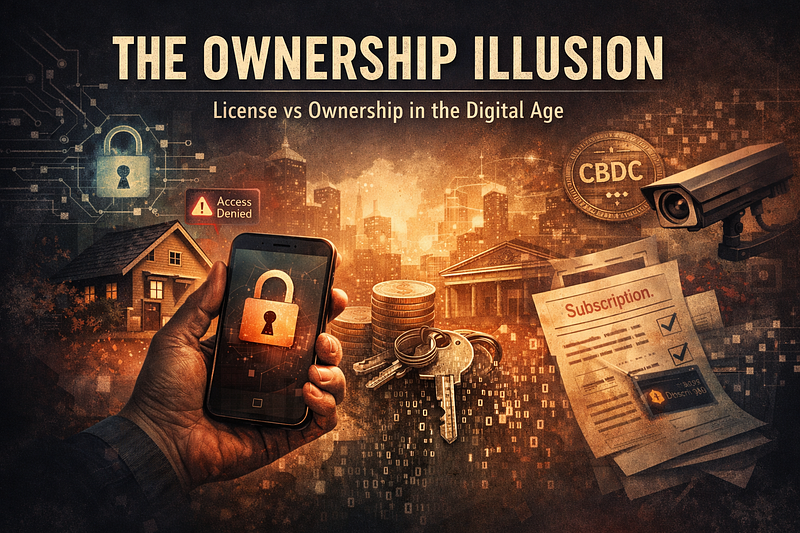
What happened across the digital economy is that the word stayed the same and the thing it bought quietly changed. The button still says buy. The interface still says purchase. The page still puts the item in something called your library or your collection, language designed to summon the old, intuitive sense of ownership. But what you acquire when you press that button is, in almost every case, a license, and the law is clear that this is what you have acquired even though nothing in the experience tells you so. You did not buy the e-book, the film, the song, the game, or the software. You bought a permission to access it, conditional and revocable, and the gap between what the word promised and what the contract delivered is the gap the entire arrangement lives in, because the seller gets the moral and commercial credit of having sold you something while retaining the control that selling is supposed to surrender.
What ownership used to mean
To feel what has been lost, recall what ownership was actually for, because it was never only about possession.
For most of human history, to own a thing was to hold a small zone of autonomy that no one else could enter. The field you owned, you could plant as you wished, without asking permission each season. The book you owned, you could annotate, lend to a friend, resell to a stranger, or throw on the fire, and no one could stop you, because it was yours. The tool you owned, you could modify, repair, or use in ways its maker never imagined. Ownership, in other words, was the point at which a thing passed out of everyone else's control and into yours, and the law built elaborate protections around that point precisely because so much depended on it: capital, inheritance, investment, and the basic independence of a person who held something the powerful could not simply take away. To own was to be, in that one narrow respect, sovereign. The thing was removed from negotiation. You did not have to keep asking.
That is the quality the digital transition quietly removed while keeping the word. A licence restores exactly the thing ownership was invented to abolish, which is the need to keep asking. Under a licence you are never finished acquiring the thing; you are permanently mid-negotiation with the seller, who can change the terms, raise the price, attach new conditions, or end the arrangement, so that the small zone of autonomy ownership created becomes a standing relationship of dependence that never closes. The book you owned was yours and the conversation was over. The book you license is available to you for now, on terms the other party controls and can revisit, and the conversation never ends. This is why the shift reaches past any single film or game. It is the difference between holding a thing and being permitted to use it, which is the difference between a kind of independence and a kind of tenancy.
The law that quietly switched
This is not a metaphor or a complaint about corporate behaviour. It is the actual legal structure, and the courts have repeatedly confirmed it.
For most of the history of property, a doctrine called first sale governed what you could do with a thing you bought. Once you owned a lawfully made copy of a book, you could resell it, lend it, or give it away without asking anyone, which is why second-hand bookshops and libraries and the entire used-goods economy exist; the copyright holder's control ended at the first sale, and the physical object was yours. The digital economy was built to escape that doctrine. In a 2010 case, a federal appeals court held that a man who had bought used copies of design software could not resell them, because he had never owned them; the software, the court ruled, was licensed, not sold, even though he had paid a one-time price and kept the discs, because the licence said so and the law let the licence say so. And in 2018 another court held that you cannot resell the digital music files you bought, because transferring a file requires copying it, and the right to resell protects only the specific physical object, which a file is not. The result is a clean and rarely noticed legal split. A physical book is owned, and first sale applies, and you may do with it as you please. A digital book is licensed, and first sale does not apply, and you may do only what the licence allows, which never includes selling it, lending it freely, or keeping it against the seller's wishes.
So the same purchase, of the same work, produces two completely different legal objects depending only on whether it is made of paper or of data, and almost no buyer knows which one they are getting, because the storefront is identical and the word is identical and only the underlying right is different. This is the switch that happened beneath the surface of the digital transition, presented to the public as mere convenience, the same content now weightless and instant, while the legal substance was being replaced underneath. You were told you were buying the same thing more easily. You were in fact buying a different thing entirely, a permission where there had been a possession, and the difference would stay invisible until the day the permission was revoked.
The cases that made it visible
The arrangement is designed to remain unseen, and it mostly does, surfacing only in the moments when a seller actually exercises the control it never gave up. Those moments are worth cataloguing, because each one is the structure briefly becoming visible.
In 2024 the game company Ubisoft shut down a racing game called The Crew, an online game that thousands of people had paid full price for, and in shutting down its servers made the game permanently unplayable, then formally revoked the licences of everyone who had bought it, without refunds. The game people had purchased simply ceased to exist, not because it broke but because the seller decided to stop allowing it, and a company executive, defending the model, was widely reported as saying that players should get comfortable with not owning their games. In late 2023 Sony told its PlayStation customers that it would be removing television shows they had purchased from their libraries, because of a change in its licensing deal with the studio, and only a public backlash and a renegotiated contract reversed the decision; the shows people had bought were saved not by any right of ownership but by the seller choosing, this time, not to take them. The same year and the next, carmakers began selling the right to use hardware already installed in the cars people had bought: heated seats whose elements sat in the seat the owner had paid for, switched on only by a monthly subscription, and acceleration already engineered into the motor, unlocked for a yearly fee. One of them, after the public reacted badly, withdrew the heated-seat subscription. Another kept the acceleration fee, and still charges it, because the structure permits it and the outrage faded.
And then there is the tractor, which makes the point most starkly because the object is so unambiguously owned. A farmer who buys a John Deere machine for hundreds of thousands of dollars owns it in every traditional sense; it is a physical thing, paid for in full, sitting in his field. What he does not own is the layer that actually makes it run. The machine has two parts now, the steel he bought and the software that governs the steel, and only the first was ever sold to him. The second is licensed, and the licence stays with the company. So he cannot fully repair the tractor he owns, because the software will not accept many repairs unless they are authorised through the manufacturer's own dealers, and the most basic attribute of ownership, the right to fix your own property, has been quietly retained through the code embedded in the steel. The dispute became large enough that in 2025 the Federal Trade Commission sued the company over it. The farmer owns the tractor. He does not own the conditions under which it will run, and in a machine that is now mostly software, the conditions are the tractor. This is the hinge of the whole shift, and the tractor shows it more plainly than any download could: the move was never simply that software became a licence instead of a product. It is that physical ownership itself became subordinate to the software licence layered on top of it. You can hold the object in your hands and still need the seller's permission to use it. Across media, games, cars, and farm equipment, the pattern is identical: the buyer holds the object, and the seller holds the control, and the two have been separated so completely that you can now own a thing entirely and govern it not at all.
The subscription turn
The licence economy reached its purest form when even the one-time licence gave way to the recurring one, and buying quietly became renting.
For a long time software at least pretended to be a thing you bought: you paid once, installed it, and kept that version, even if it was only a licence underneath. Then the industry discovered the subscription, and the pretence ended. The most widely used professional software no longer sells you a copy at all. It rents you access by the month, and the moment you stop paying, the software stops opening, including the software that holds years of your own work in formats only it can read. The change was sold, again, as a benefit, and it has real ones: continuous updates, always the newest version. But beneath the benefit is a relocation of power. When you owned the version you bought, you could refuse to upgrade, run the old program for a decade, walk away from the company entirely and keep working. Under the subscription there is no version you own and nothing to walk away with. Stop paying and you do not merely lose the new features. You lose the tool you built your livelihood around, and the reach into the work you made with it.
Picture the most ordinary version of this, because it happens somewhere every day. A designer opens her laptop on the morning of a deadline and finds that her subscription failed to renew overnight, and the program that holds years of her work, in a proprietary format nothing else can open, will not start until she pays again. Nothing has been stolen. Her files are still there, on her own machine. She simply cannot reach them, because the permission to do so lapsed at midnight, and she pays now not for a new feature or a better tool but for the bare ability to enter what is already hers. In that small, infuriating pause between the failed payment and the restored access, the whole distinction between owning and licensing becomes, for a moment, perfectly tangible. She thought she had a tool. She had a permission, and the permission had a renewal date.
The device that stops when the company stops
There is a sharper edge to this than a lapsed subscription, and it appears when the seller does not merely change the terms but disappears.
A great many of the devices people now buy and unambiguously own, the smart speakers and doorbells and thermostats and fitness trackers, are not really self-contained objects at all. They are terminals, dependent on a server somewhere that the manufacturer runs, and they do what they do only as long as that server stays switched on. When a company is bought, pivots, or simply shuts a product line down, the server goes dark, and the device the customer owns outright becomes, overnight, a piece of plastic that no longer works, not because it broke but because the thing it depended on was turned off by a company that no longer cared to run it. This has happened again and again: home hubs that controlled a whole house's lights rendered inert, speakers and cameras and trackers bricked by the closure of the service behind them, owners left holding hardware that functions only in the past tense. No law was broken and no warranty dishonoured, because the device did exactly what the fine print said it would, which is that it worked for as long as the company chose to keep it working.
This is the licence logic pushed to its limit, and the limit reveals what the logic was. With media, the licence at least leaves you nothing physical to mourn; with a bricked device you are left holding the object, fully owned and completely dead, the clearest possible proof that owning the thing and controlling the thing have come apart. You paid for it, it sits on your shelf, it is yours, and it does nothing, because the part that made it work was never sold to you at all. It was lent, on the maker's terms, for as long as the maker chose, and ownership of the husk was never the same as ownership of the function.
Why no one had to plan it
Here the discipline matters, because there is a famous phrase hovering over this subject, and the easy version of the story reaches for it, and the easy version is wrong.
The phrase is that you will own nothing and be happy, and it is endlessly cited as proof of a deliberate plan to abolish ownership, a designed agenda imposed from above. It is worth being precise: the phrase comes from a short speculative essay written in 2016 as a thought-experiment about one possible future, by a single Danish politician, and was never a policy, a programme, or a plan; it has become a meme detached entirely from its modest origin. And the reason to set the conspiracy version aside is not politeness. It is that the conspiracy version is a weaker and less frightening account than the truth, because a plan can be exposed and resisted and stopped, and what is actually happening has no plan and therefore nothing to stop.
No one decided to abolish ownership. The licence economy assembled itself out of a long series of separately rational decisions, each one sensible on its own terms. A digital good can be copied infinitely at no cost, so a seller who actually transferred ownership would be handing over something the buyer could reproduce forever, and licensing rather than selling is the obvious commercial response, not a scheme. Recurring subscription revenue is more stable and more valuable than one-time sales, so the financial markets reward companies that convert purchases into subscriptions, and every executive who makes that conversion is responding rationally to that reward. Consumers, for their part, genuinely preferred the convenience, the instant access and the low price and the automatic updates, and chose streaming over owning, again and again, of their own free will. Each of these choices was reasonable. The sum of them is a world in which ownership of digital goods has quietly ceased to exist and almost no one decided that it should, which is the more unsettling outcome precisely because there is no author to blame and no decision to reverse. The architecture was not built. It accreted, out of the ordinary incentives of everyone involved, until it was simply the shape of things.
Why licensing often wins
The strongest objection has to be put now at full strength, because the licence economy is not a swindle, and a story that treated it as one would be both unfair and easy to dismiss.
Licensing, for a great many goods, is not a trick played on the buyer but the rational and even the preferable arrangement, and it delivers real value the buyer wanted. It is what makes a vast catalogue of music and film available instantly for a low monthly fee instead of bought one expensive item at a time; it is what funds the servers and the updates and the security patches that a one-time purchase could never pay for; it is what lets software improve continuously rather than freezing at the version you bought. And for a good that can be copied infinitely and costlessly, a licence is arguably the only coherent legal object there is, because there is no scarce physical thing to own in the old sense, only a use to be governed. People did not have the licence economy imposed on them in the main; they chose it, abandoning the owned record collection and the owned film library for the convenience of access, because for most purposes access is what they actually wanted, and the freedom to resell a film they would watch once was worth less to them than the freedom to watch ten thousand films tonight.
All of that is true, and the honest form of this essay holds every word of it. The argument is not that licensing is evil or that ownership was always better; for streaming a song you will hear once, a licence is plainly the sensible arrangement, and the convenience is genuine and was genuinely chosen. The argument is narrower and harder to wave away. It is that the choice was made without most people understanding what they were choosing, because the word stayed buy when the thing became a licence, so that a society shifted from owning to licensing the substance of its cultural and increasingly its material life without ever quite deciding to, one unread agreement at a time. You can believe the licence is often the better deal and still see that a buyer who thinks the word buy means what it has always meant has not consented to the arrangement they are in. The problem was never that licensing exists. It is that the transfer of ownership out of people's hands was conducted in the vocabulary of ownership, so that the thing was given up by people who did not know they were giving it up.
Permission all the way up
Step back from the specific goods, because the pattern they form is larger than any of them, and it is the reason this is more than a consumer complaint.
What the licence economy installs, across media and software and hardware alike, is a world in which you increasingly do not hold things but hold permissions to use things, permissions recorded somewhere you do not control and governed by terms someone else can change. And once you see it as permission rather than property, you begin to see it everywhere, because the same shift is running through far more than the things you buy. The cloud that holds an institution's records is a permission its provider can revoke. The software a government runs is a permission its vendor can withdraw. The song an artist made is owned by whoever holds the copyright, and the artist is licensed back into her own work. The patient becomes a record, and the record, not the person, is what the system acts upon. In each case the visible thing, the file, the device, the service, the song, the body, is real, and in each case the control over it has quietly migrated to whoever holds the permission, the title, the licence, the record.
That is the determining variable running under all of them, and the digital ownership illusion is simply its most intimate and most universal instance, the place where nearly every person meets it directly, at the moment they press a button that says buy and receive something that is not theirs. The deepest question the licence economy poses is therefore not about Kindles or tractors or heated seats. It is what becomes of a society in which fewer and fewer people hold anything outright, in which the substance of cultural and material life is held instead as revocable permission, and in which the one party who keeps control after every transaction is never the person who paid.
The day nothing is taken
So end where the structure ends, which is not with a confiscation but with a quiet stop.
There will most likely never be a day when someone arrives to seize what you own, no decree, no repossession, no drama of the kind that ownership's defenders spent centuries building law against. The old threats to property were visible, and so they could be fought; you could see the bailiff at the door and the law could stand between him and your things. The new arrangement removes the need for any of that, because nothing is ever taken. One day a film is simply no longer in your library. One day the software will not open until you pay again. One day the game will not load, the device will not connect to the server that has been switched off, the feature you used yesterday asks for a subscription today. You will look for the moment you were robbed and find none, because you were not robbed; the terms allowed it, the law recognised it, and you agreed to all of it at two in the morning when you clicked accept to make the screen go away. What you own, the seller cannot take; what the seller can take, you do not own; and across the digital economy the second category has quietly swallowed the first.
That is the determining variable underneath the whole transformation, and it reaches well past media and machines. The question that decides whether you are an owner or a licensee is never the price you paid or the word on the button, which can be identical for both. It is whether control passed to you or stayed with the seller, whether the thing left their reach or merely entered your custody on their terms, and in more and more of modern life the answer has shifted, silently, from the first to the second, while the language of ownership stayed in place to keep anyone from noticing. You will still hold the device. You will still log in. You will still, each month, pay. And nothing will ever be taken from you, because there will be nothing, in the old sense, that was ever yours to take. There will only be permission, held at someone else's pleasure, until the day it changes.
Evidence Map
Facts, interpretations, forecasts, and disconfirming signals.
Core claim. The determining variable separating ownership from a license is who retains control AFTER the transaction. Ownership transfers control to the buyer (perpetual, transferable, beyond the seller's reach); a license keeps control with the seller (conditional, revocable, non-transferable, terms changeable). The digital economy replaced ownership with licensing while keeping the word "buy," so a society shifted from owning to licensing its cultural and material life without consenting to the change, one unread agreement at a time. The shift is emergent (infinitely-copyable goods + recurring-revenue incentives + chosen convenience), not a designed plan.
Evidence level. Facts (high, documented): Amazon's July 2009 remote deletion of Orwell's 1984 and Animal Farm from Kindles (refunds, Bezos apology, lawsuit settled); the first-sale doctrine (17 U.S.C. §109) applying to physical copies but NOT to licensed digital goods, per Capitol Records v. ReDigi (2nd Cir., 2018) and Vernor v. Autodesk (9th Cir., 2010, software is licensed not sold); California AB 2426 (signed Sept 2024, effective Jan 2025) requiring storefronts to disclose that a digital "purchase" is a revocable license; Ubisoft's 2024 shutdown of The Crew revoking paid licenses (and the reported "get comfortable not owning your games" remark, attributed to exec Philippe Tremblay); Sony PlayStation's Dec 2023 plan to remove purchased Discovery content (ultimately cancelled after backlash); John Deere software repair locks and the FTC's Jan 2025 suit; BMW's heated-seat subscription (introduced ~2020, expanded 2022, reversed 2023) and Mercedes' acceleration subscription (not reversed). Interpretation (medium, marked): the "control retained vs transferred" determining-variable reading; the emergent-not-designed account. Disciplined exclusion (named): "you'll own nothing and be happy" is a 2016 speculative essay by Ida Auken (WEF), a thought-experiment turned meme, NOT a documented plan, and is referenced only as a cultural phrase.
What would confirm this. Continued revocation/alteration of "purchased" digital goods by sellers; continued legal treatment of digital purchases as licenses; the spread of subscription/feature-locking into more owned hardware; disclosure laws (like AB 2426) existing precisely because "buy" does not mean own.
What would disprove this. Evidence that digital "purchases" confer real, irrevocable, transferable ownership at scale (that sellers cannot revoke or alter them); or that consumers broadly understood and consented to the license terms when buying; or a durable legal reversal restoring first-sale-style rights to digital goods.
Watchlist. AB 2426 enforcement and similar laws elsewhere; the Stop Killing Games campaign and game-preservation legislation; the John Deere/FTC litigation and right-to-repair laws; the spread or retreat of hardware feature-subscriptions; how AI services and cloud dependence extend the license model.
Related from The Manifest Archive
- Microsoft and the Digital Veto
- The Doctors Who No Longer See the Human Body
- Michael Jackson, the Beatles, and the Power of Owning Music
- Who Owns the Federal Reserve?
Jerry van der Laan writes The Manifest Archive, daily forensic essays on power, language, and the systems that shape what we are allowed to see as reality. He traces the structures beneath them.