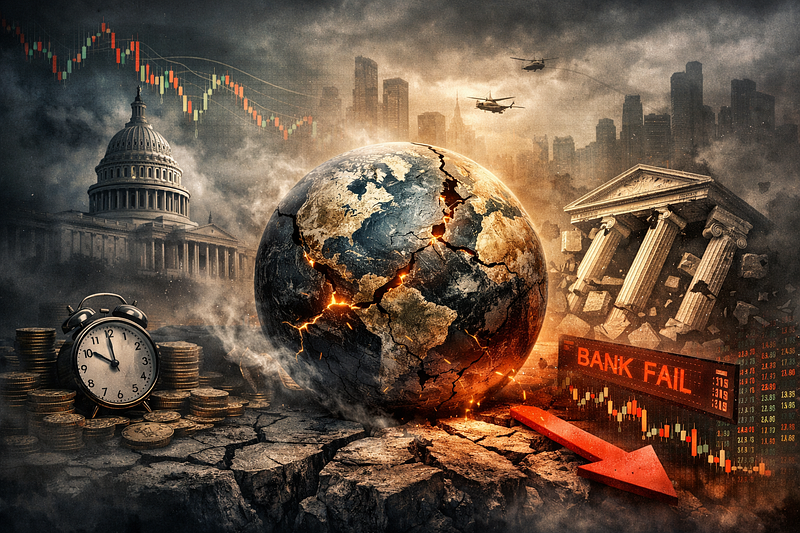
At 9:31 a.m., a trader in London watches a red headline cross his screen.
Another weak data release. Another signal that something underneath is not working.
The market rises.
No one leaves their desk. Phones remain quiet. Someone jokes that “bad news is good news again.” No one disagrees.
Outside, nothing looks broken.
Inside, no one expects correction anymore.
That is where we are.
Not confusion, not ignorance, not even denial. A form of governance has taken hold in which the primary task is no longer to fix instability, but to prevent it from appearing.
The Phase No One Names
This does not look like a crisis.
There are no bank runs on television, no emergency speeches, no sudden closures.
Charts still move. Analysts still reassure. Central bankers speak calmly.
Everything appears functional.
That is precisely the danger.
Systems rarely collapse when they visibly fail. They collapse when they reach the stage where failure is no longer allowed to appear, when correction becomes unacceptable and intervention turns into routine.
We are no longer in a crisis phase.
We are in a maintenance phase.
Silence is no longer the absence of alarm. It has become a tool. The quieter the system remains, the harder it becomes to question whether correction is still possible.
Nothing dramatic is happening.
That, too, is information.
A System That No Longer Trusts Itself
Central banks no longer behave as institutions managing inflation. They behave as institutions preventing breakdown.
This is not interpretation. It is procedural.
Interest rates are raised until something fractures. When stress surfaces, response is immediate. Liquidity facilities are activated. Guarantees are widened. Losses are reclassified. Legal definitions stretch quietly, often over a weekend.
One sentence returns, again and again, sometimes spoken, sometimes implied:
Stability must be preserved.
Translated into function, it becomes a stricter rule.
The system must not reveal its limits.
Correction is permitted only if it carries no consequence.
Failure is tolerated only if it teaches nothing.
A system that cannot absorb loss cannot learn.
The Banks That Fell Were Not Exceptions
When banks collapsed and markets convulsed in 2020, 2022, and 2023, the explanation followed a familiar script. Poor management. Unique exposure. Isolated cases.
The response told a different story.
In March 2020, emergency liquidity facilities were deployed globally within days. Temporary measures became permanent architecture. The boundary between market functioning and market rescue blurred into routine.
In 2022, the first serious rate hikes in over a decade exposed immediate stress. Bond markets cracked. Pension funds required intervention. Volatility was not absorbed. It was suspended.
Then, in 2023, banks failed again.
In March 2023, the collapse of Silicon Valley Bank unfolded not as a slow unraveling, but within hours. Deposits fled digitally, not physically. Over a single weekend, U.S. authorities invoked a systemic risk exception, extending guarantees beyond statutory limits while insisting no bailout had occurred.
Intervention arrived before markets reopened. Instruments were ready. Legal constraints proved elastic. Messaging aligned almost instantly.
This is not how anomalies are handled.
This is how rehearsed scenarios are executed.
Those banks did not fail because they misunderstood the system. They failed because they reflected it too accurately.
They stood on the fault line between two incompatible eras, the post-2008 world of zero rates and abundant liquidity, and the post-2022 reality in which that architecture no longer functions.
Their balance sheets did not malfunction.
They told the truth too early.
So it was isolated.
Markets Without Feedback
Negative information now produces relief.
Weak data triggers rallies.
Inflation surprises lift indices.
Institutional failure calms markets.
This is not confidence.
It is conditioning.
A system that no longer corrects does not only distort prices. It distorts perception. Over time, people stop expecting resolution and begin managing exposure instead.
Markets no longer price value. They price expected intervention.
When price ceases to transmit information, feedback disappears.
Without feedback, systems do not adapt.
They oscillate.
Then they break.
The United States as a Bankrupt Centre
On a routine Treasury auction day, demand still arrives. Yields adjust. The system rolls forward.
That normality hides the structure beneath it.
The United States is structurally bankrupt, yet monetarily unlimited.
This is not a slogan. It is the tension at the heart of the system.
Debt has grown beyond the scale of ordinary repayment logic, and the cost of servicing it has become one of the fastest-rising claims on the federal budget. The debt burden is no longer a future concern. It is a present architecture.
That combination does not create stability.
It creates the largest bubble in the current global system.
Permanent deficits, a debt trajectory that cannot be corrected without political rupture, and rising interest costs would bankrupt any ordinary state. The difference is not discipline, but privilege.
Printing money does not remove problems.
It inflates them.
A bankrupt hegemon is not weak.
It is unrestrained.
The Dollar: A Machine, Not a Myth
The postwar monetary order took shape after 1945 and held under constraint until 1971, when the dollar was detached from gold and restraint became optional.
After 2008, failure itself was removed from the system. Quantitative easing became baseline policy rather than emergency exception.
By 2020, emergency became architecture. Balance sheets expanded without hesitation. The system learned that delay could be operationalised.
The dollar no longer functions primarily as a currency.
It functions as a machine.
Machines do not rely on belief.
They rely on throughput.
As long as trade, debt, reserves, and energy settlement run through this layer, correction can be postponed by exporting it.
Not indefinitely.
Machines fail when internal stress exceeds tolerance, not when people lose faith, but when the structure can no longer carry its own weight.
Why the Analysis Keeps Returning to the United States
At a certain point in this work, a realization becomes unavoidable.
This analysis does not begin with the United States.
It does not seek it out.
It does not assume it as a conclusion.
Yet again and again, independent lines of inquiry arrive at the same place. Finance. Energy. Trade. Sanctions. Currency. Security.
This is not a fixation.
It is an outcome.
The Manifest does not pursue actors. It follows mechanisms. It traces behaviour, pressure points, and consequences across systems. Where those lines converge is not a matter of preference, but of structure.
The more rigorously behaviour is followed instead of explained, the more consistently the analysis returns to the same centre of gravity.
Not because everything originates there.
But because everything eventually passes through it.
This is not a moral judgement.
It is a positional observation.
Centrality does not require intent. It only requires gravity.
The Orthodox Counterargument, Briefly
The orthodox view insists the system is stressed but resilient. Debt is high, but manageable. Central banks still have tools. Growth will return. Markets will normalise.
This argument rests on one assumption.
That time remains an asset.
In a system where every intervention narrows future options, delay is not resilience. It is amplification. Tools used continuously cease to be tools and become life support.
Europe and the Price of Energy
Europe’s energy crisis is framed as an external shock.
Placed in time, it is the result of accumulation.
After 2014, dependency narrowed. In 2021, prices rose before war entered the narrative. By 2022, pricing became geopolitical. By 2023, industry began to leave.
Europe is not paying only for scarcity.
It is paying for constraint.
Energy has become priced obedience.
This does not deny internal political complexity, competing national interests, or policy errors that compounded exposure. Complexity, however, does not change outcome. In practice, the bill is paid in competitiveness, in industrial relocation, in households told to adapt to permanent volatility.
Russia and Asia: Hit Earlier, Not Better
Russia encountered conditional access in 2014, not 2022. Asia learned the lesson even earlier, during 1997–1998.
Early exposure did not confer moral clarity.
It forced adaptation.
They adjusted sooner because they had no choice, not because they were right.
Timing created resilience.
Not virtue.
Why There Is No Soft Landing
Most people no longer ask whether the system is stable.
They ask whether it will hold long enough.
There is no clean exit.
Inflation erodes social stability.
Austerity is politically impossible.
Growth cannot outpace debt.
Restructuring would expose insolvency.
Delay remains the only option.
Delay increases amplitude.
Gold, Crypto, and Quiet Preparation
Gold rises as trust withdraws. Central banks accumulate it without announcement.
Crypto is not banned. It is contained. Not because it fails, but because it functions without permission.
Gold opts out.
Crypto speaks too early.
Neither gold nor crypto resolves systemic dependency. They do not replace the machine. They reduce exposure to it, imperfectly, and at a cost. Gold can be immobilised, politically, administratively, legally. Crypto can be enclosed, regulated, routed through institutional wrappers until it resembles the system it once promised to bypass.
Even the apparent exits still cast shadows inside the same room.
Final Observation
The postwar order formed after 1945, lost restraint in 1971, removed failure in 2008, and normalized emergency in 2020.
Now, the system maintains rather than corrects.
The most dangerous moment for any system is not when it panics, but when it becomes too large to be honest with itself.
That is why everything feels calm.
If it breaks now, it breaks completely.
Not because of panic.
Because there is nothing left to absorb the shock.
Related from The Manifest Archive