Every morning begins with urgency.
A notification vibrates.
A headline flashes.
A sense of escalation arrives before the day has fully formed.
Inflation surges.
The Federal Reserve signals tightening.
A sovereign state nears default.
NATO convenes an emergency summit.
It feels like a sequence of unrelated shocks.
It isn’t.
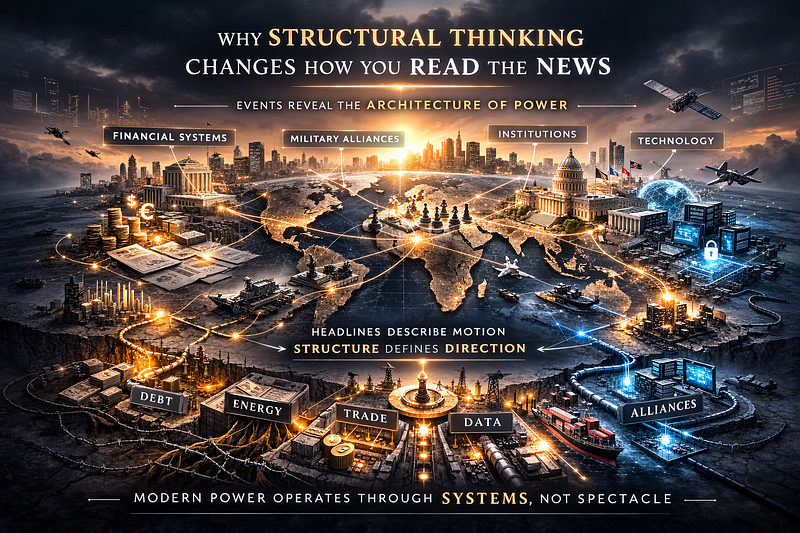
This article is about how structural thinking changes the way you read those headlines. It explains why institutions like the Federal Reserve, the International Monetary Fund and NATO do not merely respond to crises, but operate inside architectures that precede them. It argues that events do not create power. They reveal its boundaries.
Most news trains you to follow events.
Structural thinking trains you to follow constraints.
Once you see that difference, the news stops looking chaotic. It begins to look patterned.
The Event Reflex
Event thinking is intuitive.
A rate hike causes market volatility.
A bailout vote triggers unrest.
A sanctions package disrupts trade.
A military deployment signals escalation.
Cause and effect. Immediate. Digestible.
This framework is not false.
It is incomplete.
When the Federal Reserve raises interest rates, coverage centers on the announcement. Hawkish or dovish. Bold or cautious.
When the International Monetary Fund approves a stabilization package, cameras focus on parliamentary votes and street protests.
When NATO expands coordination, analysis revolves around deterrence and response.
The visible act becomes the explanation.
Structural thinking asks a slower question:
What system made this moment likely?
Not who reacted first.
Not who escalated fastest.
But what architecture constrained the field of possible outcomes long before the announcement.
As explored in Architecture of Power: How Modern Empires Hide in Plain Sight, modern institutions rarely rely on spectacle. They rely on systems.
Systems do not trend.
They persist.
Speed and the Illusion of Novelty
Modern media rewards acceleration.
Breaking alerts compete.
Narratives pivot hourly.
Outrage resets daily.
Inflation this week.
Debt crisis next week.
Military tension the week after.
Each story feels distinct.
Speed fragments continuity.
Fragmentation creates novelty.
Novelty creates urgency.
Urgency creates reaction.
Structural thinking slows perception.
It asks why the same institutional names recur across crises.
The Federal Reserve.
The IMF.
NATO.
Different headlines.
Recurring infrastructure.
Repetition across domains rarely happens by accident.
Repetition suggests structure.
Bretton Woods and the Architecture of Dollar Power
To understand why Federal Reserve decisions ripple globally, you must step back.
In 1944, at Bretton Woods, Allied nations created a new monetary order. The dollar was anchored to gold. Other currencies were anchored to the dollar. The IMF was established to stabilize imbalances within that system.
The architecture placed the United States at the center of global settlement.
When gold convertibility ended in 1971, the network did not dissolve. By then, global trade, oil pricing and reserve management were already structured around dollar usage.
The architecture no longer required gold. It required network dominance.
The Federal Reserve became more than a domestic central bank.
It became the anchor of global liquidity.
A rate decision in Washington moves capital in Jakarta.
A liquidity shift in New York tightens credit in Nairobi.
The event is national.
The structure is global.
The longer arc of dollar centrality is explored in Is the U.S. Dollar Losing Reserve Currency Status? The Quiet Erosion Explained.
Liquidity Cycles and Structural Constraint
In 2008, the Federal Reserve responded to financial collapse with near-zero interest rates and quantitative easing. Liquidity flooded markets. Capital flowed into emerging economies. Dollar-denominated borrowing surged.
In 2020, during the pandemic, liquidity expanded again. Swap lines extended internationally. Global dollar dependency deepened.
Then inflation rose.
In 2022, tightening reversed flows. The dollar strengthened. Emerging markets faced currency depreciation. Debt servicing costs increased.
The headline read: “Fed Fights Inflation.”
Structural thinking sees something deeper.
Dollar centrality transmits tightening worldwide.
The event is a policy decision.
The structure defines its reach.
Monetary sovereignty is unevenly distributed.
Some currencies anchor.
Others adjust.
IMF and the Perimeter of Sovereignty
Sovereign debt crises appear domestic.
Structural thinking reveals external constraint.
Greece in 2010 faced insolvency. Headlines focused on parliamentary votes and austerity debates.
But Greece did not control its currency. Debt was denominated in euros. Liquidity access depended on institutions beyond Athens.
The IMF defined reform parameters.
The vote was visible.
The perimeter was structural.
Argentina illustrates recurrence. Repeated debt crises. Repeated IMF engagement. Repeated fiscal consolidation.
Different administrations.
Familiar frameworks.
Emergency becomes adjustment.
Adjustment becomes precedent.
Precedent becomes architecture.
IMF intervention does not create constraint.
It formalizes exposure within a monetary system.
This dynamic is examined in The Architecture of Aid: How Help Becomes Control.
Sovereignty within global finance is conditional.
NATO and the Architecture of Alignment
Military escalation feels immediate.
Structural integration is gradual.
When Finland and Sweden pursued NATO membership, headlines emphasized response to conflict.
Yet both countries had long been interoperable with NATO forces. Joint exercises, procurement alignment and intelligence-sharing frameworks predated formal accession.
The announcement was visible.
The alignment preceded it.
NATO is not simply a treaty.
It is infrastructure.
Procurement standards bind defense industries. Command structures integrate forces. Logistics networks align supply chains.
The deeper implications are explored in NATO: The Façade of Peace and the Architecture of Power.
Escalation appears sudden.
Integration is cumulative.
Crisis as Consolidation
Crises appear destabilizing.
Structurally, they consolidate.
After 2008, central bank balance sheets expanded and did not fully revert. After the pandemic, extraordinary liquidity became normalized. After geopolitical conflict intensified, alliance coordination deepened.
Temporary measures endure.
Emergency authorities institutionalize.
Crisis accelerates architecture.
Architecture stabilizes itself.
Volatility dominates headlines.
Continuity dominates systems.
The Architecture of Limits
Political language emphasizes decision.
Governments choose.
Central banks act.
Alliances respond.
Structural thinking emphasizes boundary.
A country dependent on dollar funding cannot ignore Federal Reserve tightening.
A state inside a currency union cannot freely expand liquidity.
A NATO member embedded in alliance logistics cannot pivot without cost.
Freedom within perimeter still feels like freedom.
But perimeter precedes motion.
When headlines state that a government chose austerity, structural analysis asks what alternatives were realistically available.
When a central bank tightens, structural thinking asks what prior liquidity conditions made it inevitable.
When NATO responds, structural thinking examines commitments that shaped the response.
Constraints rarely make headlines.
They define them.
The Architecture Map
At first, these institutions appear separate.
A central bank managing inflation.
An international lender stabilizing debt.
A military alliance responding to security threats.
Different mandates.
Different domains.
Different headlines.
Structural thinking follows sequences.
When the Federal Reserve tightens, global liquidity contracts.
When liquidity contracts, sovereign vulnerability increases.
When vulnerability increases, IMF frameworks activate.
When instability spreads, geopolitical tension intensifies.
When tension intensifies, alliance coordination deepens.
Defense spending rises. Procurement aligns. Military infrastructure embeds further.
Liquidity shapes sovereignty.
Sovereignty shapes alignment.
Alignment reinforces architecture.
Financial systems and military systems intersect through constraint.
Monetary regimes influence fiscal capacity.
Fiscal capacity influences political stability.
Political stability influences alliance posture.
Alliance posture reshapes capital flows and industrial investment.
The map is not conspiratorial.
It is institutional.
It does not require centralized orchestration.
It operates through embedded design.
The Federal Reserve does not command the IMF.
The IMF does not command NATO.
NATO does not command the Federal Reserve.
Yet they operate within overlapping architectures of liquidity, dependency and alignment.
What appears as reaction often unfolds within pre-existing boundaries.
That is the map.
Not drawn.
Understood.
After the Shift
Structural thinking does not eliminate urgency.
It eliminates disorientation.
The headline remains.
But the confusion softens.
You begin to see repetition.
The same institutions.
The same boundaries.
The same mechanisms.
You ask different questions.
What system constrained this decision?
What architecture preceded this reform?
What alignment shaped this escalation?
The shift is subtle.
But irreversible.
Once structure becomes visible, surprise loses its authority.
Power rarely announces itself.
It stabilizes itself.
Quietly.
And once you see the map, you cannot return to reading headlines as isolated events.
Related from The Manifest Archive