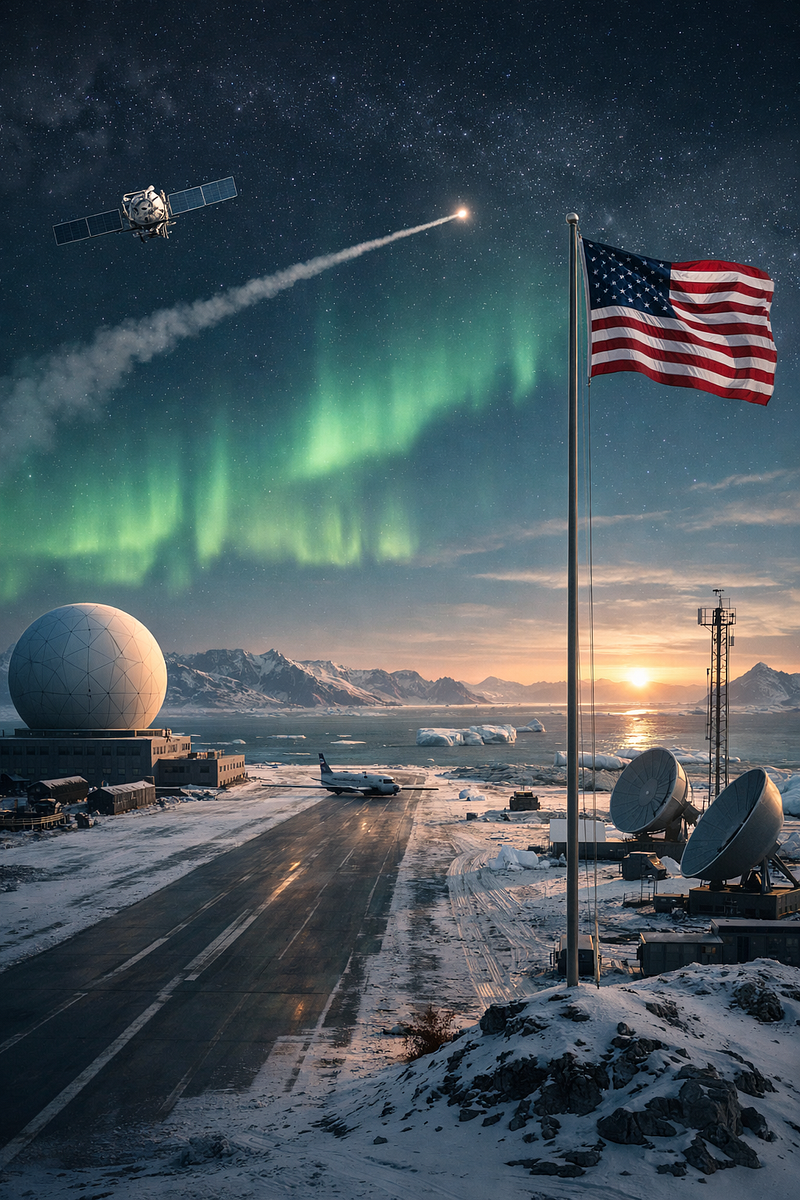
The silence above the ice
The runway appears before the horizon does.
A strip of reinforced concrete, more than three kilometers long, cut into permafrost that never fully thaws. No terminal. No civilian traffic. Only radar domes, fuel tanks, hardened hangars, and antennas pointed not at the sea, but at the sky.
This is Pituffik Space Base, in northern Greenland. Until 2023, it was known as Thule Air Base.
The renaming matters.
Since 1951, when Denmark and the United States signed their defense agreement, American forces have maintained a permanent military presence here. During the Cold War, Thule became a cornerstone of the U.S. Ballistic Missile Early Warning System. Radar installations were designed to detect Soviet launches crossing the pole. Command decisions depended on minutes gained here.
After 1991, the base was not closed. It was reclassified, modernized, and quietly integrated into space surveillance networks. What changed was not presence, but description.
Missiles do not travel east or west. They travel north.
Satellites do not orbit nations. They orbit latitude.
What appears empty on a political map has always been dense with function.
America did not arrive in the Arctic recently.
It stayed when others stopped looking.
Continuity disguised as calm
The popular story begins with surprise.
In 2019, and again after returning to office, Donald Trump spoke openly about Greenland as a strategic necessity. The media treated it as eccentric, even absurd. A provocation. A personality quirk.
That framing obscured a longer record.
American military infrastructure in Greenland spans three phases. First, wartime necessity during World War II. Second, Cold War integration through radar, airfields, and early-warning systems. Third, post-Cold War transformation into space and missile-defense architecture.
At no point was the Arctic abandoned.
Territory mattered less than trajectory.
Sovereignty mattered less than access.
Denmark retained formal authority. The United States retained operational control over what mattered most: airspace, radar coverage, orbital coordination.
No announcement was needed. Silence functioned as policy.
When the Arctic became visible again
Ice did not create interest. It revealed it.
As Arctic sea ice thinned, routes once considered theoretical became economically relevant. The Northern Sea Route reduced shipping distances between Asia and Europe by thousands of kilometers. Insurance firms began recalculating risk. Naval planners recalculated reach.
At the same time, Russia expanded its Arctic posture. Soviet-era bases on Franz Josef Land and Novaya Zemlya were reactivated. The Northern Fleet received priority funding. Nuclear-powered icebreakers became dual-use assets, capable of escort and enforcement.
China entered differently.
In 2018, Beijing declared itself a near-Arctic state. No territorial claims, no military bases. Instead, research stations, shipping investments, participation in satellite and cable projects. Presence without posture.
None of this was sudden.
What changed was attention.
And when attention shifts, silence fails.
When Allies Say “Absurd”
The word arrived quickly.
Absurd.
When Denmark’s prime minister used it, she was not rejecting a policy proposal. She was responding to a breach of diplomatic grammar. Something normally handled through procedure had been spoken in public language.
Trump did not invent America’s Arctic position.
He verbalized it without ceremony.
By saying we need Greenland for defense, infrastructure became necessity. Radar coverage, space tracking, missile trajectories were no longer technical arrangements. They were framed as security imperatives.
Security language does not argue.
It conditions.
Claims about Russian and Chinese ships did not require proof to function. They established a threat frame. Once something is defined as defense, the conversation leaves diplomacy and enters contingency planning.
Denmark heard threat.
Washington heard overdue clarity.
The reaction revealed asymmetry. Moral outrage remained possible. Structural leverage did not.
Greenland’s leaders objected on grounds of respect, not legality. They understood the implication more clearly. When territory is spoken of as defense infrastructure, sovereignty becomes symbolic.
First comes the word that sounds inappropriate.
Then the appointment of a special envoy.
Then the normalization of what already exists.
Allies call it absurd because accuracy would demand confrontation.
And confrontation is what alliances are designed to delay.
The Arctic as the New Mediterranean
Empires announce themselves through routes, not speeches.
For Rome, the Mediterranean was not water between lands. It was the medium through which grain, armies, and information moved. Control meant access, not ownership.
The Arctic now performs a similar function, with one decisive difference.
It connects systems, not cities.
Shipping lanes compress trade routes. Subsea cables shorten data latency. Polar orbits align satellites into uninterrupted surveillance paths. Missile trajectories flatten across the pole, bypassing legacy defense assumptions.
Maps still show margins.
Operational systems do not.
Empires do not fight for land first.
They secure the geometry that decides response time.
No one voted for this map.
Economic gravity beneath defense language
Shorter routes do not only save time. They redistribute power.
When shipping distances shrink, insurance premiums follow. Ports gain relevance. Others lose it. Trade gravity shifts northward, away from chokepoints that once defined leverage.
Defense language masks this transition. What is described as security is also market positioning. Control over routes determines who absorbs risk and who exports it.
Military infrastructure stabilizes economic expectation.
That is its quiet function.
Presence, control, and ceremonial sovereignty
Defense is often described as motive. It rarely describes method.
Control in the Arctic does not require annexation. It requires persistence. Runways capable of year-round heavy aircraft. Sensors integrated into global networks. Agreements that allow access without visibility.
This is not occupation.
It is institutional continuity.
Denmark governs Greenland politically. The United States governs its strategic function. The distinction survives as long as no one collapses it publicly.
That collapse is what caused discomfort.
Once function is named, sovereignty appears performative.
NATO as structure, not shield
NATO does not eliminate sovereignty. It reorganizes it.
Membership does not create equality of influence. It aligns procedure. Strategic assets are integrated, not owned. Decisions move upward, visibility moves downward.
For small states, NATO offers protection and predictability. For large systems, it offers access without annexation. Presence becomes collective. Control remains asymmetrical.
This is why objections remain rhetorical. NATO absorbs dissent as process. It provides legitimacy without leverage.
Sovereignty remains intact on paper.
Function migrates elsewhere.
Institutions as filters
What the public sees are statements.
What endures are procedures.
Bases are renamed. Missions are reclassified. Space surveillance is presented as neutral. Military integration is framed as cooperation. Media reduce structural shifts to personality-driven controversy.
Institutions do not lie.
They rename.
Renaming is quieter than force.
The Arctic did not become strategic because a president spoke. It became speakable because institutional groundwork was complete.
The north does not escalate. It accumulates.
There will be no invasion of Greenland.
None is required.
Power in the Arctic grows through layering. Additional sensors. Redundant systems. Deeper integration into networks that cannot be dismantled without global consequences.
Every satellite launch tightens dependency.
Every runway upgrade extends response horizons.
Every agreement framed as partnership deepens asymmetry.
The Arctic does not militarize suddenly.
It becomes indispensable.
Indispensability is the quietest form of dominance.
When systems stop needing explanation
Nothing announces itself.
No order is issued.
No decision is recorded.
No authority claims authorship.
Routes shorten because physics allows it.
Satellites align because orbits demand it.
Runways extend because load calculations permit it.
What functions does not argue.
Once infrastructure exists, it generates its own logic. Sensors require coverage. Coverage requires redundancy. Redundancy requires permanence. Permanence produces dependency.
At that point, intent becomes irrelevant.
No one needs to want control.
Control emerges as a byproduct of continuity.
Silence was never absence.
It was synchronization.
As long as procedures aligned, nothing needed to be said. The system moved beneath language, beneath politics, beneath consent.
Visibility interrupts that equilibrium.
When words enter, they do not change direction. They only reveal that direction was already fixed.
What follows is not escalation, but completion. Not conquest, but closure of remaining variables.
The system does not accelerate.
It stabilizes.
And once stabilized, it becomes indistinguishable from necessity.
The movement that was already finished
America is not moving north.
It is acknowledging a movement completed long ago.
What changed was not strategy, but tone. Silence gave way to bluntness. Diplomacy gave way to necessity. Etiquette failed under the accumulated weight of infrastructure.
Greenland did not become important when the ice melted.
It became visible when silence stopped working.
Maps will continue to show white space.
Systems will continue to cross the pole without asking.
And allies will continue to say absurd, because admitting continuity would require confronting how long the arrangement already existed.
The Arctic was never empty.
It was simply quiet.
And now, the quiet no longer holds.
Related from The Manifest Archive