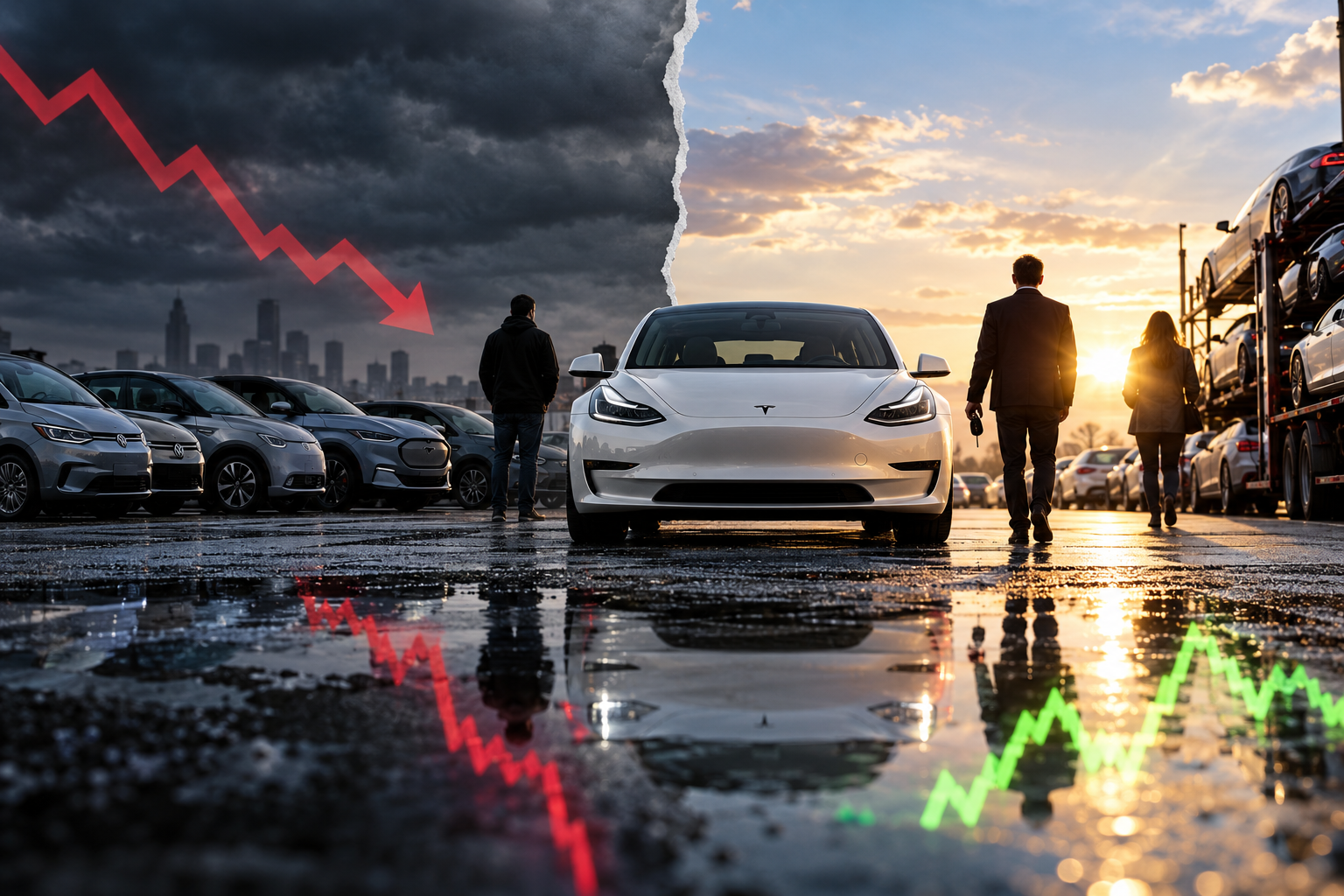
The number that decides how much an electric car costs its owner is printed nowhere on the car. It depends on two things the depreciation tables leave out: the price the first buyer really paid, and the name on the title on the day the new model got cheaper. I did not set out to find that. I set out to check whether a reader had caught me making a mistake.
Last week I argued that used electric cars lose value because the new ones keep getting cheaper. A reader wrote back with a simpler explanation. Maybe this is mostly a Tesla story: Elon Musk's politics drove buyers away from the brand, Tesla cut its own prices again and again, and because Tesla is so much of the used electric market, its troubles look like a law about all electric cars.
I liked the objection more than I wanted to. Half the numbers in my piece were Tesla numbers. The car in my own driveway is a 2019 Model 3. If the reader was right, I had described one company's bad years and called it a mechanism.
There is a plain way to find out. Take Tesla out of the data and see what is left.
Two Objections in One
The reader's explanation holds two different claims, and they predict different things.
The first is about the brand. If buyers turned away from Tesla because of its chief executive, used Teslas should fall faster than other used electric cars, and the others should be more or less fine.
The second is about price. If Tesla's cuts to its new cars pulled the used market down, every electric car should fall, with Tesla leading. If that is what happened, removing Tesla from a table would not remove its effect on the other cars. That second claim is close to what I wrote last week, so it cannot count against me. The first one can.
Spring 2025: The Reader Is Right
For about six months in 2025 the brand claim fits the data well.
In March of that year, Reuters reported Edmunds figures showing that Teslas from model year 2017 or newer made up 1.4 percent of all cars traded in during the first half of the month, against 0.4 percent in March 2024. Jessica Caldwell, Edmunds' head of insights, named "Elon Musk's increasing public involvement in government" among the reasons owners were "feeling disconnected from the brand." At that point Edmunds still said used Tesla prices had fallen in line with electric Fords, Kias and Hyundais.
By summer they no longer had. An iSeeCars comparison of June 2025 with June 2024, reported by Fortune, put used electric cars as a group down 4.8 percent while used petrol cars rose 5.2 percent. Inside the electric group the Teslas fell hardest: the Model S by 15.8 percent, the Model X by 15.5, the Model Y by 13.6. In Britain, the listing site Motors found used Tesla values down 22 percent in the year to February 2025, against 13 percent for used electric cars overall. New cars told the same story. Across the EU, the EFTA countries and Britain, Tesla registered 238,656 cars in 2025, which was 26.9 percent fewer than the year before, according to ACEA figures as reported in the trade press.
A Reuters report from May 2025, which I return to below, quotes a Vermont transportation planner, Marshall Distel, who leased a Model 3 in 2023. "I love the car, I just don't like what has been going on at the top with the CEO," he said. "I don't want to be associated with that any more."
So for that window the reader is right, and I should say it without hedging. Something specific to Tesla pushed its used cars down faster than everyone else's.
After September 30, 2025
Then the federal tax credits for electric cars, new and used, ended on September 30, 2025, and the pattern turned over.
Between that September and January 2026, iSeeCars found, the average used Tesla rose from $30,040 to $31,329, a gain of 4.3 percent. All other used electric cars, leaving out the Porsche Taycan, fell from $24,629 to $23,738. Karl Brauer, the firm's executive analyst, had done the reader's test before either of us thought of it. "But when you remove Tesla models from the used EV market," he said, "there's a substantial drop in EV prices."
The next study made the gap wider. Comparing the first quarter of 2026 with the first quarter of 2025, across 6.7 million used cars between one and five years old, iSeeCars found used Teslas down 0.1 percent and used petrol cars down 2.8 percent. Used electric cars without a Tesla badge were down 10.3 percent, from $31,928 to $28,649. They also sat on the lot for 60 days on average, against 32 for a Tesla. When used EV prices rebounded in the spring, as petrol prices climbed during the war with Iran, all four Tesla models were among the biggest risers, and the used Model 3 was 13.5 percent dearer in June 2026 than a year earlier.
Between the first quarters of 2025 and 2026, taking Tesla out made the fall steeper.
Two cautions belong here. The first is about measurement: these are average listing prices, which also move when the mix of cars on offer changes. The second is about cause: the turn has an explanation that has little to do with how anyone feels about Tesla. The rivals' used cars were competing with new ones that had just lost a $7,500 subsidy and were being discounted to make up for it. Brauer's own reading was that Tesla buyers had shown "little reliance on the credit." I cannot separate a brand that recovered from rivals that lost a subsidy. The data moves them together.
February 2024: The First Crash, Model by Model
The reader's objection is really about the earlier crash, the one in 2023, so I went back to it.
In iSeeCars' year-on-year table for February 2024, used electric cars as a group had lost close to a third of their value. The Chevrolet Bolt was down 30.4 percent, the Nissan Leaf 29.1, the Kia Niro EV 27.1 and the Hyundai Kona Electric 24.7. The steepest Tesla model in that table, the Model X, was down 24.6. Read by model, four cars with no Tesla badge had fallen further than any Tesla in the table, though the Kona only by a tenth of a point, and the table does not list the Model Y. Read by brand, the same study has Tesla down 28.9 percent, which is more than the Niro or the Kona and less than the Bolt or the Leaf.
That is a mixed picture and I would not lean on it either way. What it does show is that in the year the crash was at its worst, a Bolt and a Leaf fell at least as far as any Tesla model the table lists.
Europe gives a rougher check, because I could not find a European series that separates Tesla from the rest. In J.D. Power's figures for early 2026, a three-year-old battery-electric car in Germany with 60,000 kilometres on it kept about 37 percent of its list price. Petrol and diesel cars kept about 48 percent, and full hybrids slightly less. An eleven-point gap looks too wide for one brand to be producing it. I cannot show that from the data itself, so I offer it as a reason to doubt the brand claim and nothing more.
Five Years, Ten Models
A single year can mislead, so the longer measure matters more. iSeeCars' latest depreciation study covers more than 950,000 five-year-old cars sold between March 2025 and February 2026. Ten electric models are in it. Against its list price, the Tesla Model 3 lost 54.6 percent of its value in five years, the least of the ten by a tenth of a point over the Porsche Taycan. The Hyundai Kona Electric lost 56.5 percent, the Kia Niro EV 57.3, the Tesla Model Y 57.8, the Ford Mustang Mach-E 60.8, the Tesla Model X 61.2, the Model S 62.0, the Volkswagen ID.4 62.1 and the Nissan Leaf 63.1. The average for all vehicles of every kind was 41.8 percent.
On that table the reader's brand claim fails. The Teslas are spread through the list from best to nearly worst, and every electric car in it loses far more than the average car.
There is one thing this test does not do, and the reader's second claim depends on it.
Taking Tesla out of the dataset does not take Tesla out of the cause.
On January 30, 2023, a few weeks after Tesla cut the Model Y by up to $13,000, Ford cut the Mustang Mach-E by an average of about $4,500. "We are responding to changes in the marketplace," said Marin Gjaja, the chief customer officer of Ford's electric business. Brauer put the chain in one sentence a year later: Tesla's repeated cuts "kept pushing used Tesla prices down, which spread to all electric vehicles." By that account the Kona and the Leaf fell partly because of a price list in Texas. That is the reader's price claim, and it stands. It is also what I argued last week, with the largest seller as the channel: a used car is priced against its replacement, and in electric cars the replacement keeps getting cheaper.
$7,500 That Nobody Lost
While checking the five-year table I ran into something I had missed in the first piece, and it turned the table over.
iSeeCars measures depreciation against the manufacturer's list price, adjusted for inflation. Its method note does not mention the federal tax credit. But a buyer of a new Leaf, Kona, Niro, ID.4 or Mach-E in 2020 or 2021 could claim up to $7,500 back from the Treasury. A buyer of a new Tesla could not, because Tesla had passed the sales cap and its credit ran out at the end of 2019. The IRS list of qualifying vehicles for those years shows the full $7,500 against each of the five, and zero against every Tesla from January 1, 2020.
So I took the credit off. For each model iSeeCars publishes a percentage and a dollar loss. Dividing one by the other gives the list price its model implies. I subtracted $7,500 from that price, subtracted the same $7,500 from the loss, and worked out what share of the money actually paid was gone after five years.
| Model | Lost against list price | Dollar loss | Implied list price | List price less full credit | Lost against price paid |
|---|---|---|---|---|---|
| Hyundai Kona Electric | 56.5% | $18,581 | $32,887 | $25,387 | 43.6% |
| Kia Niro EV | 57.3% | $22,742 | $39,689 | $32,189 | 47.4% |
| Nissan Leaf | 63.1% | $17,743 | $28,119 | $20,619 | 49.7% |
| Ford Mustang Mach-E | 60.8% | $22,976 | $37,789 | $30,289 | 51.1% |
| Volkswagen ID.4 | 62.1% | $28,010 | $45,105 | $37,605 | 54.5% |
| Tesla Model 3 | 54.6% | $20,213 | $37,020 | no credit | 54.6% |
That comes close to reversing the ranking. Measured against what buyers paid, four of the five subsidised cars lost clearly less than the Tesla, the ID.4 came out level with it, and the Kona lost barely more than the average car of any kind.
The table also shows why the effect is so uneven. A fixed $7,500 is a quarter of the price of a Leaf and a sixth of the price of an ID.4. The cheaper the car, the more of its published depreciation was never the owner's money. Working the sum backwards, the Leaf would need a list price near $40,000 before its owner lost as large a share as the Model 3 owner did, and its implied price is $28,119. The ID.4 would need about $45,400, and its implied price is $45,105. The Leaf's result is safe. The ID.4's hangs on three hundred dollars.
This is my own arithmetic, and it is too rough to publish any of those five percentages as a finding. The direction is harder to dismiss, because the same step is applied to five cars and all five move the same way, four of them by a wide margin. The limits are these. It sets a credit in 2021 dollars against list prices that iSeeCars restated in 2026 dollars, and with that mismatch corrected the wrong way the ID.4 would tip just above the Model 3. The list price I work back to is the one implied by iSeeCars' model, which is not the same thing as a sticker. It assumes every buyer got the full $7,500, when the credit could only be used against tax actually owed. And it uses list prices, although Leafs were often sold at a discount and Teslas were not.
It leaves me with two things I did not expect. Part of what the tables call electric depreciation was paid by the Treasury on the day of sale, and no owner lost it. And the Tesla buyers, who had no subsidy and then watched Tesla cut the price of the new car, lost at least as large a share of their own money as the buyers of any of those five. On the five-year measure the reader has a better case than the list-price table gives.
Who Was Holding the Car
That brought me to the sentence I had wanted to write when I started this piece: that the electric transition moved the cost of technical progress from the carmakers onto the owners. Faster improvement in each new model, a faster fall in the value of each old one, and the owner absorbs the difference.
It did not survive the question of who the owner is.
In the United States, in the last quarter of 2022, only 9.2 percent of new electric cars were leased, according to Experian figures reported by WardsAuto. Those buyers owned their cars outright or on a loan when the 2023 cuts arrived, and they took the hit themselves. Edmunds found that electric cars traded in with negative equity in the second quarter of 2024 were on average $10,326 under water, against $5,469 two years earlier. That number covers only the trade-ins that were under water, so it does not say how many early buyers were. For those it does cover, my sentence is true.
Then people stopped owning. The leased share of new electric cars was 31.2 percent a year later, on the WardsAuto figures, and more than half by the end of 2024. In the third quarter of 2025 Experian put it at more than 56 percent. Part of that had nothing to do with resale values. Leased cars could get the federal credit under looser rules than purchased ones, an arrangement WardsAuto called a loophole, so a lease was often simply the cheaper way into the car. Whatever the motive, the effect on the residual was the same. A lease hands the car back at the end, and whatever it is worth by then is the lessor's problem.
Tesla had gone further than anyone. At an investor event in California in April 2019, Musk explained why a Model 3 lease would give the customer no right to buy the car at the end. "You don't have the option of buying," he said. "We want them back." The cars were meant for a fleet of self-driving taxis, and he promised more than a million of them on the road the following year. Tesla extended the rule to all its models in April 2022 and dropped it for new leases on November 27, 2024.
Joe Mendenhall, who runs a marketing business in Indianapolis, leased a Model Y for three years under that rule. He told Reuters, in a report published in May 2025, that Tesla staff said when he signed and again when the lease ran out that the company needed the car back for the robotaxi fleet. He handed it in. Then he learned that Tesla had sold it, at auction by his account. "Lies about not being able to buy out my lease," he wrote to Musk on X. Tesla did not answer Reuters' questions. According to the same report, the company had leased more than 314,000 cars since 2019, about 4.4 percent of everything it delivered, and four people familiar with its retail operations said returned cars were resold to new customers with paid software added. The robotaxi plan matters less here than the contract it produced, which kept the residual with the carmaker.
In Europe the owner was rarely a household to begin with. In the sixteen European markets where Dataforce can identify fleet registrations, 60 percent of new electric cars go to company fleets and commercial buyers, Reuters reported in 2024. In the Netherlands the leasing association VNA counted 66 percent of new electric cars in 2024 as lease cars. In Britain, the carmakers' association SMMT said that in the first half of 2024 fewer than one in five went to a private buyer. The same depreciation can therefore show up as a household loss, a corporate loss or a future lease cost, depending on the contract around the car.
So the loss fell on leasing companies, and they said so. In February 2024 Bloomberg reported that Ayvens, which it called the biggest multi-brand leasing firm, had already received cheques from carmakers to make up for sliding used values, according to its chief executive, Tim Albertsen. "Manufacturers today need to keep selling EVs," Albertsen said on an earnings call. "We then need some kind of protection from the manufacturers in terms of their future pricing." A McKinsey partner told Bloomberg in the same report that all electric carmakers were by then offering leasing firms buyback guarantees. In Britain the combined pre-tax profit of the fifty largest leasing companies fell from £1.39 billion to £122 million in a year, a drop of 91.2 percent, and one in five of them reported a loss, according to the 2025 FN50 survey as reported by AM Online. "Used EV values are falling relentlessly, destroying value on an epic scale," said Toby Poston, chief executive of the British leasing association BVRLA, in July 2025.
The lessors did not swallow it quietly. They raised prices. Reuters, citing Germany's Center Automotive Research, reported that the lease on a 45,000 euro electric car went from 284 euros a month in August 2021 to 621 euros three years later, while the lease on a comparable petrol car went from 473 euros to 468. Interest rates rose over those three years as well, though they rose for the petrol car too, which suggests rates alone do not explain the gap. Reuters ties the increase to falling residual values. The reading that the customer of 2024 paid part of the bill for the cars that came back in 2023 is mine.
The bill went from the lessor back to the carmaker, and from the lessor forward to the next customer.
The Second Owner
Somebody is on the other side of every one of these losses, and I am one of them.
In May 2025, Auto Trader's British price index put a three-to-five-year-old electric car at £18,266 and a petrol car of the same age at £18,731. In the Netherlands, VNA says 88 percent of lease cars with a plug, hybrids included, stay in the country when their lease ends and pass into the private used market. I assume that is roughly how a seven-year-old Model 3 came to cost what I paid for it, though I have not traced my own car's first owner. The money a leasing firm lost on that kind of car is, more or less, the money a second buyer did not have to spend. One balance sheet's depreciation is another buyer's discount. Philippe Houchois, an analyst at Jefferies, gave Bloomberg the accounting in one line: "In the end it is the difference between new and used price that is the real cost of a car."
I do not think this was arranged by anyone. Carmakers cut prices because battery costs fell and rivals forced them to, lessors set residual values on the evidence they had, and governments paid subsidies to move cars. The effect of the three together was that new electric cars were bought by companies with a subsidy, and private buyers got them three years later at a discount the first holder had not planned to give. Nobody had to design the transfer for the transfer to happen.
The Fair Objection
The strongest case against this reading accepts all of these figures and says the owner still pays. Lessors are not charities. Their losses come back as higher monthly rates, so the next lessee, often an employee with a company car, carries them. The early American buyers of 2022 owned their cars and lost real money. In Germany, Dataforce counted about 195,000 private buyers among 545,142 new electric cars last year, which is 36 percent, and close to half once the roughly 143,000 cars that makers, dealers and rental firms registered to themselves are left out. And the second-hand discount is not permanent: in the United States, Cox Automotive put the average used electric car in August 2026 at 7.8 percent above the average used combustion car, so the American buyer of this autumn is getting no bargain.
All of that is right, and it narrows what I can claim. I cannot say what share of the loss each party carried, because no dataset I found splits it between households, lessors, rental firms and carmakers. What I can say is that the loss did not travel in one direction. It moved to whoever held the car when the new price dropped, and after 2023 that was less and less often a household. The American figures I have for that stop in late 2025, and the tax rules for leased cars were pushing the same way, so I would not call it a settled trend.
There is a way this reading could be wrong, and it is worth stating plainly. If someone publishes transaction prices for those five models and the subsidised cars turn out to have lost as large a share as the Tesla, the credit finding goes. If American lease shares fall back now that the credit is gone, the loss returns to households and my last section describes three unusual years.
By the end I was measuring three different things: published depreciation, which sets list price against resale price; economic loss, which sets the price actually paid against what the car fetched; and residual risk, meaning who was holding the car on the day its value moved. Those are not the same question, and they did not give the same answer. The reader was right about 2025 and about the price cuts, and once the subsidy is taken off, more right about five-year losses than the published table shows. Between early 2025 and early 2026 the other electric cars fell further than Tesla did. On my own sentence about owners paying for progress, the data went against me.
Residual risk belongs to whoever holds the car when the replacement gets cheaper. Depreciation measured from money the buyer never spent can overstate what the buyer actually lost.
Most of the cars this applies to have not come back yet. By Cox Automotive's estimate, electric cars were 4.4 percent of the leases that ended in the United States in 2025. For 2026 it estimates 9.9 percent, and for 2028, 18.4 percent. Who ultimately carries the loss on those cars has not been decided yet.
Evidence Map
Facts, interpretations, forecasts, and disconfirming signals.
Core claim. Used-EV depreciation is not mainly a Tesla brand effect. How large the loss looks depends on the price it is measured against, and who carried it depends on who held title when new prices fell.
Evidence level. Facts, high: iSeeCars price and depreciation studies, the IRS list of qualifying vehicles, Experian lease shares as reported by WardsAuto, Reuters and Bloomberg reporting on Tesla leases and lessor losses, the FN50 survey as reported by AM Online, Edmunds, Dataforce and Cox Automotive figures. Interpretation, medium: the after-credit table is my own calculation from published figures and only its direction is claimed; the reading of higher lease rates as passed-on losses is inference. Forecast, speculative: Cox Automotive's lease-return shares for 2026 and 2028.
What would confirm this. Transaction-price data showing subsidised models lost a smaller share than Teslas; lessor accounts through 2027 showing further residual write-downs as lease returns grow.
What would disprove this. Transaction prices that erase the after-credit gap; a dataset showing households carried most of the post-2023 loss; American lease shares falling back sharply after the credit ended.
Watchlist. iSeeCars quarterly studies, Experian lease share from the fourth quarter of 2025 onward, FN50 2026, Cox Automotive lease-maturity estimates through 2028.
Related from The Manifest Archive
- Why You Should Drive an Old Mercedes Diesel, Not a Tesla
- The Ownership Illusion: License vs Ownership in the Digital Age
- When Physical Skill Becomes Software: The Hidden Economics of Humanoid Robots
- Everyone Is Watching the 5.34% Treasury Yield. Nobody Is Watching When America Has to Pay It.
Jerry van der Laan writes The Manifest Archive, Forensic Narrative Intelligence Writing on the systems beneath power, money, and history. He traces the structures beneath them.