Gao Bo is in her fifties and lives in an apartment in Shandong province, in eastern China. For six hours a day she films herself cooking, doing laundry and cleaning. She is paid 20 yuan an hour, about three dollars. The work lets her stay home with her teenage son, and it has had one side effect she did not expect: her apartment, she told the reporter Viola Zhou of Rest of World in June 2026, is spotless, because she cleans it again every day. "No one had paid me to cook and do laundry before," she said.
Nobody is paying her to cook, exactly. The meals and the laundry are by-products. What is being bought is the record of how a human body does these things: how a hand closes on a wet shirt, how far a wrist turns to empty a pan, how a person corrects when a stack of plates starts to lean. Most of this is knowledge its owner does not experience as knowledge. Gao Bo could not write it down if she were asked. Her body simply knows it, the way it knows how to climb stairs. The footage goes into datasets used to train robots, and she is not alone. In the city of Suqian the e-commerce company JD.com is working with the local government on a "data collection neighborhood" where residents are paid to film their chores, with a target of 10 million hours of robot training data over two years.
Six thousand miles east, Tesla pays people to do something similar. Its job listing for a "Data Collection Operator, Optimus" has offered up to $48 an hour to people of roughly average height who can walk for more than seven hours a day while wearing sensors and carrying loads. In November 2025 Business Insider described dozens of these workers in a glass-walled lab at Tesla's engineering headquarters, acting out the motions of ordinary life, lifting a cup, wiping a table, opening a curtain, over and over, with five cameras on a helmet and a heavy pack on their backs. At the Fremont car plant, the magazine reported, data collectors had sorted vehicle parts and worked along conveyor belts wearing the same equipment.
Somewhere in the last few years, the humanoid robot quietly changed category. It stopped being something shown on a stage and became something counted. Units delivered, units per week, average selling price, factory capacity, hours of training data: the vocabulary around it is now the vocabulary of any industrial product, and it reads as easily as a quarterly car sales figure. A reader from 1995 would stop at the first line and ask what exactly is being manufactured by the thousand. We no longer stop. Technologies become hardest to see at the moment their vocabulary becomes ordinary, and the humanoid has reached that moment before anyone knows how good, how general or how useful these machines will turn out to be.
The usual way to write about them is to watch the robot: whether it walks, whether it can hold an egg, how slowly it folds a shirt. This piece looks at what those people in helmets and kitchens are producing. A human skill has always had to be learned again by every human who needs it. The question now being tested, in Shandong and in California, is whether a physical skill can be learned once by a model and then shared by every machine that runs it. The answer is more limited than the marketing suggests, and stranger than the skeptics allow.
Fremont, May 2026
On the weekend of 9 May 2026 the last Model S and the last Model X came off the line at Tesla's factory in Fremont, California. The cars had been built there for fourteen and eleven years. According to Electrive, the production staff signed the bodywork of the final black Model S. On 20 May Tesla held a farewell delivery event, where the company's chief designer, Franz von Holzhausen, recalled designing the original car in a tent in a back corner of SpaceX and pushing the clay model through the factory and outside every Friday so the team could evaluate it with Musk. Lars Moravy, Tesla's vice president of vehicle engineering, put it plainly: "With Tesla, there's always a new, better car tomorrow, but for the Model S and Model X, there is no tomorrow."
By then the decision about the space had already been made. On the earnings call of 28 January, Elon Musk said Tesla would "take the Model S and X production space in our Fremont factory and convert that into an Optimus factory with a long-term goal of having a million units a year." In July a Tesla manufacturing account posted a video of the old line being torn out in 46 days: robot arms removed, pits cleared, concrete poured again. Tesla's own shareholder letter of 22 July said it had "decommissioned the manufacturing lines for Models S & X at our Fremont Factory" and was "installing the first-generation lines for Optimus, where we expect to start production soon."
That much is on the record. The story of Optimus is usually told in three registers blended together, and they need to be pulled apart.
The first register is what Tesla has confirmed: a car line removed, a robot line under construction, listed in the July letter with no capacity and the status "Construction." Tesla has not published how many robots it has built, its annual report still calls Optimus a humanoid robot "in development," and in January Musk said it was "not in usage in our factories in a material way." The second register is what has been reported. In late September The Information, citing unnamed people familiar with the program, said production had climbed from a few dozen robots a week in the spring to several hundred in August, with more than a thousand a week targeted by year-end, and that the robots still cannot reliably handle a wide range of tasks. Tesla has not confirmed any of it. The third register is intention: a Fremont line designed for a million robots a year, a Texas line Musk calls "aspirationally" capable of ten million, and a milestone in his pay package of one million "Bots" delivered.
Calibration matters. In January 2025 Musk said Tesla aimed to build roughly 10,000 Optimus robots that year. It did not come close. By July 2026 he was calling Optimus "the hardest product to scale manufacturing that we've ever made at Tesla."
None of this makes the Fremont conversion less significant; it makes it more precise. A company does not tear out a car line in 46 days and pour a new floor to stage a demonstration. What that commitment is for is the question the rest of this piece tries to answer, and the answer does not depend on whether Tesla builds three hundred robots a week or three thousand.
A fleet made of people
To see what Tesla is building, start with how it says Optimus learns.
For years the method was the obvious one. A human operator wore a motion-capture suit or a virtual-reality headset and moved, the robot followed the motion, and the recordings became training data for its model. The same technique let people steer the robots in public. At Tesla's "We, Robot" event in October 2024, Bloomberg reported, employees stationed elsewhere oversaw many of the robots' interactions with guests, something Musk did not mention on stage. In mid-2025, according to Business Insider, Tesla shifted its emphasis toward video: workers with camera rigs on their heads and backs recording ordinary tasks, so that the model could learn from what a human sees and does rather than from a suit. Milan Kovac, who ran the program until he left in June 2025, had already described the goal in May of that year: to have Optimus "learn straight from internet videos of humans doing tasks," with new skills "run by a single neural network on the bot." The shift was not total. The Information reported in September 2026 that Tesla has more than 500,000 hours of training data has set up training hubs in Colorado, Arizona and Florida, and still collects data with both camera rigs and motion-tracking equipment.
The most revealing description came from Ashok Elluswamy, who now leads Tesla's AI work, on the earnings call of 22 July 2026. "Just like FSD," he said, referring to Tesla's driver-assistance software, "we have access to a broad fleet of humans giving us data from all of the workers at our factory."
The sentence is easy to read past. For a decade Tesla's argument about self-driving rested on its fleet of cars: millions of vehicles on the road, each one a sensor, sending back the situations the software could not yet handle. When Elluswamy reaches for the same word for Optimus, the fleet he describes is not made of robots. It is made of people. On Tesla's own account, then, its first advantage in humanoid robotics lies less in the machines it can build than in the humans it employs doing physical work inside buildings it controls, work that can be recorded.
The first Optimus fleet walks on human legs.
What Tesla says comes next is still in the future tense. On the same call, Elluswamy described a "second flywheel": "when we have a large number of Optimus robots practicing their tasks in what we call the Optimus Academy," the robots would attempt tasks, fail, and learn from both. Musk had sketched the idea in February on the podcast of Dwarkesh Patel, with ten thousand or more robots in self-play and millions more in simulation. Tesla's July letter says the first robots from the Fremont line will go to that academy for "training data collection." No figure has been published on how much robot-generated data exists or what it has improved.
So the loop that would make Optimus a self-improving system, in which the robots' own attempts, together with human corrections, are used to retrain one central model that is then sent back to all of them, exists at Tesla as a plan. Other companies have published working versions. Physical Intelligence, a San Francisco start-up, reported in November 2025 that a method combining demonstrations, corrections from human operators and the robot's own attempts more than doubled throughput and roughly halved failures on its hardest tasks, including making espresso and folding laundry. Where Tesla differs is in having the factory, the workers, the data teams, the computing and the robot production line inside one company.
One set of weights, sixteen robots
Here is the property that makes all of this different from earlier automation, and it is worth stating slowly.
A human welder who has spent twenty years at the trade carries that skill in his hands and his eyes. When he trains an apprentice, the apprentice still has to learn, and learning takes years. When the welder retires, the part of the skill he never managed to pass on retires with him. Every body starts close to zero. That is not a flaw in how people work; it is the ground rule of human labor, and it has shaped everything from apprenticeship to wages to the way companies value experienced staff.
A robot controlled by a learned model does not have to follow that rule. What the model has learned is stored as numbers, its weights, and weights can be copied. Google's RT-1 learned from 130,000 demonstrations collected by a fleet of 13 robots over 17 months, and one model absorbed all of it. Figure AI says its Helix model runs with "identical Helix model weights" on two robots at once. In April 2026 the company said it could now deploy new behaviors and upgrades to its entire fleet at once. A 2026 paper from AgiBot and the Shanghai Innovation Institute describes one model running 16 two-armed robots: their attempts and human corrections feed a central learner, which repeatedly sends the updated model back to the whole fleet. The sixteenth machine does not have to begin its training where the first one did.
The effect can even cross between kinds of robots, within limits. When twenty-one research groups pooled data from twenty-two types of robot, the pooled model helped most on the robots with little data of their own, succeeding about 50 percent more often, and did worse on robots that already had plenty, until a much larger model was used. At the end of July 2026 Google DeepMind said the on-device version of its Gemini Robotics 2 model could be fine-tuned to a new two-armed robot in a few hours with fewer than two hundred examples: a small cost for each new kind of body, but not zero.
The clearest example is already on the road. A new Waymo arrives knowing how to drive, because it carries what the fleet has already learned. Every car runs the same driving software, and when engineers retrain and release a new version, the whole fleet receives it. By the end of June 2026 Waymo's cars had covered 271.3 million miles with no human driver; in March the company said it was giving 500,000 paid rides a week, and by mid-September, when Las Vegas opened, it was operating in fifteen American cities, with Munich and Tokyo planned for 2027. The nuance matters. Each new city still needs mapping, validation and some local refinement, though Waymo says it needs less with every city it adds: a shared core, and a local cost that shrinks.
Waymo shows the other side as well. The cars are not unattended. In February 2026 the company said it had about 70 remote assistance agents on duty worldwide at any moment, roughly half of them in the Philippines, for a fleet of about 3,000 vehicles. They do not drive the cars. They answer questions the software sends them, and the software decides whether to use the answer. A shared skill, in other words, still leans on people at its edges, and the edges are where the hard cases live.
Eight millimetres at the foot
If that were the whole story, the conclusion would be simple and dramatic: teach one robot, and a million robots know. The evidence does not support that, and the places where it breaks are where the real shape of the change becomes visible.
The first limit is physical. Two robots built to the same design are not identical. Their joints are assembled with small errors, their cameras sit a few millimetres from where the drawings put them, their motors wear at different rates. A 2026 study by researchers at Wuhan University and AgiBot notes that joint offsets of less than a degree can produce centimetre-level errors at the foot of a humanoid; on one AgiBot model, its calibration cut the foot-height error in held-out tests from 8.03 millimetres to 1.43. Another 2026 paper found the cameras on one AgiBot humanoid sitting six to eleven millimetres away from their designed positions, and, in a simulation with deliberately introduced joint errors of one to two degrees, showed that correcting them cut foot-positioning error from about 28 millimetres to under 3. The model can be copied. The body it runs on has to be measured first, one body at a time.
This is an old problem in a new form. Industrial robots have long been able to repeat a position to within a tenth of a millimetre, yet their absolute accuracy is typically ten times worse or more, around a millimetre and in older estimates up to fifteen, which is why programs written in simulation or copied from one robot to another have traditionally needed to be touched up by hand on the floor. The fix was calibration: once each arm was measured precisely, programs could be moved between machines, and a broken robot could be swapped for another with little disruption. Calibration is cheap compared with training a human, but it is never free.
The second limit is the one that matters more. A copied skill is only as general as the model that holds it. Tesla's own analogy points the same way: for its driving software, Musk said in April 2025 it seemed "increasingly likely" that some regions would need a localized parameter set, and in 2025, with Chinese data rules keeping its fleet data inside the country, Tesla trained its China software on internet video. One study of robot learning found that a model's ability to handle new situations grows roughly as a power law with the number of different environments and objects in its training data; beyond a point, more examples of the same place add little, and variety is what counts. Performance on fine work remains uneven. DeepMind's own figures for its newest model put success at screwing in a light bulb at 36 percent (unscrewing one: 92) and using a dustpan at 32. According to The Information, Optimus still needs several days of training to learn even a basic new task, and behaves unpredictably in situations it has not been trained on. Rodney Brooks, a founder of iRobot and one of the field's most experienced builders, argued in September 2025 that learning dexterity from video alone collects the wrong data, because a human hand relies on around 17,000 touch receptors that no camera sees. He expects profitable deployment of humanoids to be more than a decade away.
So the honest version of the claim is narrower than the dramatic one. Improvements to a shared model can be copied across a fleet. The cost of acquiring a skill can be spread across every machine that uses it rather than paid again by each. But the skill still has to be learned task by task and setting by setting, and every body has to be calibrated before it can run the shared model.
One laboratory reports about ten minutes of computer processing to calibrate the camera rig on a humanoid's head from two minutes of walking, but I could not find a published figure for the whole procedure on a production line, or for how much performance varies between two robots built to the same design. We do not yet know how general a copied physical skill can become, and that is the boundary this whole argument sits on. If calibration and adaptation stay expensive for every new body and every new site, the difference from older automation will shrink to something modest. If they fall the way software costs usually fall, the difference will not be modest at all.
Every copy of a skill arrives in a body that has to be measured first.
Unitree's price fell 72 percent
If Tesla's advantage is the loop between factory, workers, data and model, the obvious test is to look at companies that are scaling without it. They exist, and they are mostly Chinese.
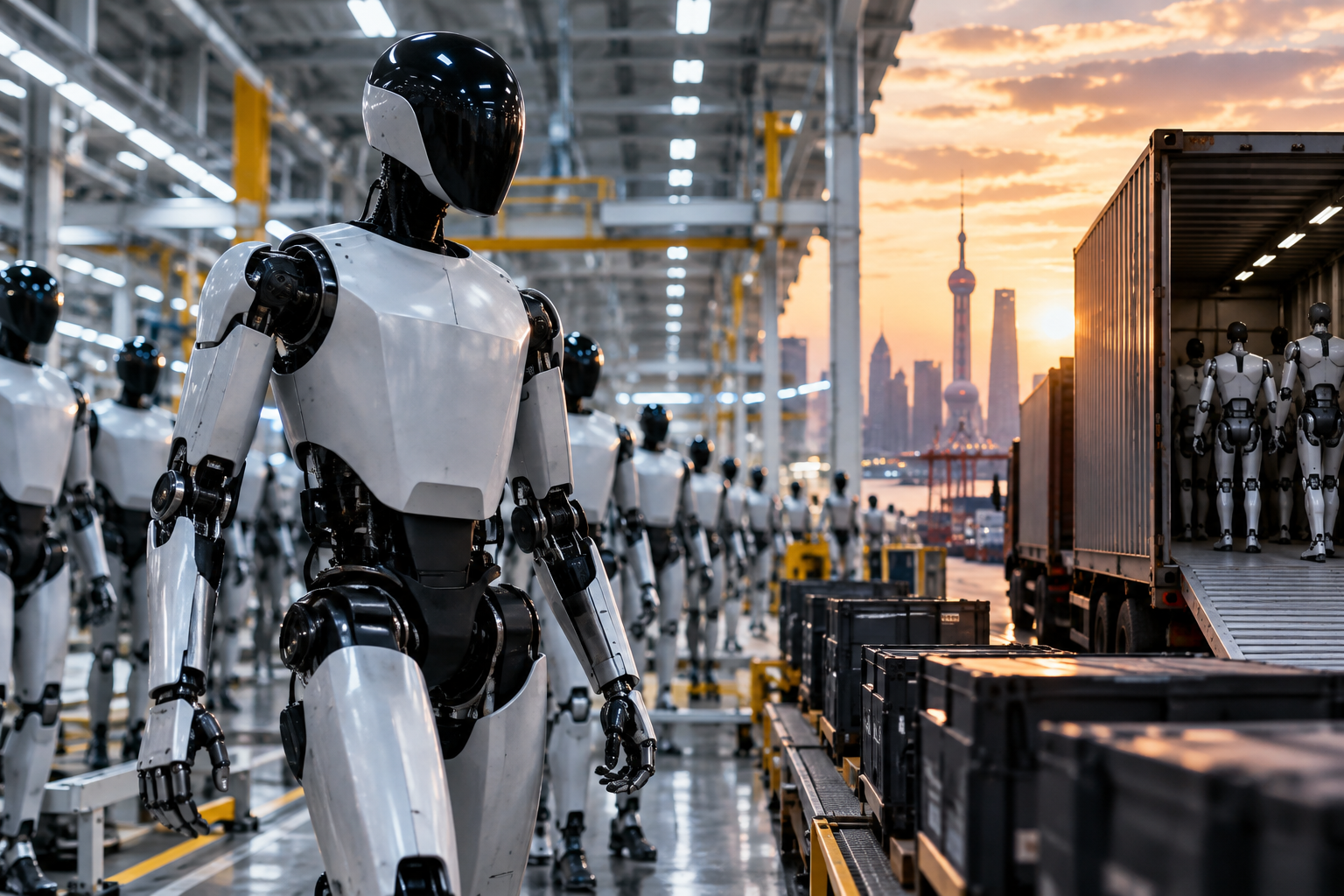
It is often said that Optimus is the first humanoid robot in mass production. It is not. Unitree, based in Hangzhou, sold five humanoid robots in 2023 and 412 in 2024, according to its stock-market prospectus. In 2025 it delivered more than 5,500 and produced more than 6,500. AgiBot, in Shanghai, rolled out its 5,000th robot in December 2025 and its 15,000th in June 2026, although those totals include wheeled and half-size models. UBTech, in Shenzhen, reported selling 1,079 full-size humanoids in 2025 and 921 in the first half of 2026. Research firms disagree on the totals, putting world shipments in 2025 between about 13,000 and 18,000 and for the first half of 2026 one firm put Chinese makers at more than 97 percent of the roughly 19,000 shipped worldwide, while IDC put China's own market at about 78 percent of nearly 25,000. The International Federation of Robotics, counting only full-size humanoids taller than 140 centimetres, found about 7,000 sold worldwide in 2025, and noted that most uses still often require human teleoperation. On every count, China is shipping most of the world's humanoid robots, and Tesla has not yet started volume production. Read the sentence again with the noun in mind. A company in Hangzhou manufactured more than six thousand machines in the shape of a person last year, and it was reported in the same register as a quarterly delivery count.
The curve that matters most in the prospectus is price. Unitree's average selling price for a humanoid fell from 593,400 yuan in 2023 to 167,600 yuan in the first nine months of 2025, a drop of about 72 percent in two years, while its humanoid gross margin in 2025 was about 63 percent. That is what manufacturing scale does to a physical product. It also complicates the tidy version of this article's idea. The body, far from being a fixed cost waiting for software to catch up, is getting cheaper fast.
What the Chinese companies are mostly not doing yet is putting those bodies to general work. About 74 percent of Unitree's humanoid revenue in the first nine months of 2025 came from research and education. The robots are bought by universities, laboratories, and developers who will write their own software for them. The skill side of China's effort is being built somewhere else: in more than forty state-owned data collection centers announced by the end of 2025, about twenty-four of them already operating, where workers in headsets and arm exoskeletons repeat motions hundreds of times a day. One of them, a man Rest of World called Kim, spent a week in a Shanghai office pretending to open the door of a microwave. "We call ourselves cyber-laborers," he said. "It's a fine gig, though a bit boring." AgiBot opened its own data facility of about three thousand square metres in 2025, where nearly a hundred robots are guided through tasks by human instructors.
So two industrial models are visible, though they do not split neatly by country. One starts from the body: build cheaply, build many, sell into research and let the ecosystem write the skills, while the state organizes the data. The other starts from the skill: collect human work inside your own factories, train one model, deploy it on robots you build yourself, and let the robots feed the model. Tesla is the clearest case of the second. China is the clearest case of the first, with elements of the second growing inside it.
The comparison answers one question and raises another. It shows that Tesla's loop is not necessary to manufacture humanoids at scale. China already does that. What it cannot yet show is whether bodies without a strong shared skill are worth much outside the laboratory. If the Chinese path wins, the scarce thing will turn out to be hardware and supply chains. If Tesla's path wins, the scarce thing will be the model and the data that feeds it. The first answer would make humanoids resemble smartphones. The second would make them resemble something closer to an operating system with legs.
From 1899 to Phoenix
A robot that needs days to learn to sort a bin of parts invites a particular kind of judgment: this is primitive, so it will stay small. The history of general-purpose technologies suggests treating that judgment with care.
In 1990 the economic historian Paul David pointed out that electric motors supplied less than five percent of the mechanical drive in American factories in 1899 and passed half only around 1920, and that the productivity gains came only after factories were rebuilt around them: single-storey, laid out in lines, a small motor at each machine. For decades the motor had been judged inside buildings designed for steam.
Robotaxis followed a similar arc. Waymo's project began in 2009 and opened fully driverless rides to the public in Phoenix in 2020, after years as a curiosity that passers-by filmed and mocked when it stalled. Paid rides went from about 50,000 a week in May 2024 to about 500,000 in March 2026, and the co-chief executive, Tekedra Mawakana, expects a million a week by the end of the year. It took seventeen years, one narrow skill, a fenced map and a small staff of remote helpers for a driverless taxi to start becoming ordinary, which is the moment a technology stops being science fiction.
Both examples warn against judging a technology by its first clumsy form, and both show how much of the path consists of rebuilding the world around the machine rather than improving the machine itself.
That is where the humanoid makes its most interesting bet. The electric motor needed the factory rebuilt. The industrial robot needed a cell built around it, fenced off, with parts presented in exactly the right place. Waymo needed a mapped city and a single task. The humanoid is designed to reduce that requirement. Stairs, doors, shelves, workbenches, tools, delivery vans and kitchens were all built for an adult human body with two hands, and a machine in roughly that shape can, in principle, use them as they are. McKinsey made the point in October 2025: in older sites designed for humans, the humanoid's human-like footprint is an advantage. We have spent two centuries building machines around the places where people work. The humanoid is an attempt to build a machine around the place people have already built.
52.8 percent
Economists have been measuring what happens when machines take over human tasks for a long time, and the findings set a baseline that any new claim has to beat.
Daron Acemoglu and Pascual Restrepo found that each additional industrial robot per thousand American workers reduced the employment-to-population ratio by about 0.2 percentage points and wages by about 0.42 percent. Labor's share has been sliding: in the second quarter of 2026 the part of output paid to workers in the American nonfarm business sector stood at 52.8 percent, the lowest since the series began in 1947. For most of the postwar period it was between 60 and 66 percent.
The idea that labor becomes capital is not new either, and it has a fiscal edge. In 2018 the legal scholars Ryan Abbott and Bret Bogenschneider warned that the tax system "no longer works once the labor is capital," because "robots are not good taxpayers." In the Netherlands, personal income taxes and social security contributions bring in about 54.6 percent of all tax revenue; in the United States, 63.6 percent. Rich countries finance themselves largely out of personal income and payrolls, while American equipment and software were taxed at around five percent after the 2017 reform, against 25.5 to 33.5 percent on labor, by an estimate from Acemoglu and his colleagues.
What the copyable skill adds is a different cost structure. A company that hires a person pays for the skill every hour it is used, and pays again for every newcomer who must learn it. A company that deploys robots pays to build each body, but the cost of learning a skill can increasingly be spread across every machine that runs the model. Some per-hour cost comes back as remote assistance and human correction, and some suppliers already rent humanoids by the month instead of selling them: Agility Robotics charges $8,500 a month for a Digit. Gao Bo is paid for her six hours once. The skill her footage helps to teach, if it is ever learned well enough, can be used by any number of machines, as many times as they run.
That raises a question economists have barely applied to physical skill. When skill was carried by workers, it moved when they moved, and some of its value went with them as wages. My reading is that when skill is carried by a model, it stays where the model is, unless the model is released openly, as some already are. Whoever controls the model controls a library of physical abilities that grows with every new kind of place and object it is shown, and that can potentially be deployed across every compatible machine. The debate about robots has mostly been about how many jobs they will take. The question that follows from the evidence here is who will control the skills.
I cannot say how large that effect will be; it depends on the limits described above. What can be said is that the mechanism differs from the one economists have been measuring. Industrial robots replaced particular tasks inside environments built for them. A humanoid running a shared model is an attempt to replace capability that moves between tasks, inside environments built for us.
The strongest objection
The strongest counterargument to this reading does not dispute any of these facts. It says that none of them amounts to a break. Factories have automated for two centuries, and a robot arm's welding program has been copyable for decades. Each wave of automation was expected to eliminate work on a vast scale; each time new tasks appeared, and measured shifts in labor's share proved smaller and more contested than predicted, with economists such as David Autor tracing much of the recent decline to activity shifting toward a few dominant firms with low labor shares, rather than to falling labor shares inside firms. Specialized machines may stay cheaper than humanoids for most industrial jobs, and Brooks expects the successful "humanoids" to end up on wheels. And a shared model is not a business: Alphabet's Everyday Robots, which ran more than a hundred learning robots, was shut down in February 2023 without reaching a commercial product.
This objection is serious, and much of it may prove right. If the claim here were that humanoids will replace most physical labor, or that the labor share will collapse, the objection would win on the evidence available today. The claim is narrower. It is that general-purpose humanoids running shared models change where the cost of physical skill sits: from each worker, paid by the hour and relearned by every newcomer, toward a model trained centrally, retrained continuously, and adapted per body and per site. That change can happen even if humanoids spread slowly, even if Tesla misses its targets, and even if most factories keep their specialized machines. What the objection cannot yet absorb is generality. Older automation copied programs that work only where the cell reproduces the exact conditions they were written for. What the next decade will test is how far a learned skill can travel beyond the conditions it was trained on, and what it costs to bring each new body and site up to it. The boring explanation and the stranger one can both be true, at different speeds, for different tasks.
The end-of-line zone
Go back to Fremont. The site has changed hands once before. From 1984 it was NUMMI, a joint venture of General Motors and Toyota, famous for teaching American workers Japanese production methods. The last car it built, a red Corolla, left the line on 1 April 2010. About 4,700 people lost their jobs. "I saw a whole lotta men crying in there when things started going quiet," David Guerra, who had worked there for 25 years, told a reporter. Tesla bought most of the plant that year for $42 million. In June 2012 about a thousand people, most of them Tesla employees, gathered there to watch the first Model S cars delivered.
Fourteen years later the last Model S came off that line with the signatures of the people who built it written across its paint. Then the line was taken apart in 46 days, and the floor was poured again. According to one account of the farewell event, by the site Not a Tesla App, in May, Tesla said it planned to hand over its first Optimus robots at the same spot where the last cars had rolled off: the former Model S and Model X end-of-line zone.
Every part of this can be described without a villain. A car line that had outlived its product was replaced by one for a product the company believes in. Workers who wore the cameras were paid by the hour for work they agreed to do. A woman in Shandong earns money at home that she did not earn before. Each actor made a reasonable decision inside its own frame, and none of them decided the whole.
The whole is this. For as long as there have been factories, much of the physical skill that made the product still lived in the people on the floor, and it left with them at the end of the shift. On the floor where those signatures were written, a company is now installing a line for bodies that will be measured rather than taught, because what they need to know is meant to arrive in the model.
The signatures are still on the car. The skill is going into the model.
Evidence Map
Facts, interpretations, forecasts, and disconfirming signals.
Core claim. Humanoid robots running shared AI models change where the cost of physical skill sits. The body must still be built and calibrated one at a time, but improvements to a learned skill can be copied across a fleet. Tesla's Fremont conversion is the clearest attempt to put factory, workers, data and robot production inside one company around that property.
Evidence level. Facts (high): the Fremont conversion, Optimus status and capacity targets from Tesla's Q2 2026 update and the Q4 2025 and Q2 2026 calls; the pay-package milestone (SEC DEF 14A); Unitree's volumes and prices (Unitree, prospectus via Rest of World); fleet and cross-robot results (RT-1, Open X-Embodiment); per-unit calibration (arXiv 2609.02306, arXiv 2609.19582); industry count of full-size humanoids (IFR, 30 Sept 2026); Waymo remote assistance (letter to Sen. Markey, Feb 2026); Waymo mileage (Waymo); labor share (BLS); tax structure (OECD Revenue Statistics 2025: personal income tax, social security contributions and payroll taxes as a share of total tax revenue, 2023). Reported, unconfirmed (medium): Optimus weekly production and training difficulties (The Information via Electrek). Interpretation (medium, marked): that the copyable skill shifts control of physical capability toward whoever controls the model. Company claims (low until shown): the Optimus Academy, the million-robot line.
What would confirm this. Tesla or a competitor publishing fleet-level results showing a skill learned on some robots deployed to many others without retraining; falling per-unit calibration and per-site adaptation times; humanoids moving from research sales into paid industrial work at scale.
What would disprove this. Evidence that each deployed humanoid needs substantial individual retraining for new sites or tasks; shared models failing to generalize beyond narrow, fixed settings; specialized machines consistently undercutting humanoids on cost wherever both can do the job.
Watchlist. Tesla's Q3 2026 update (around 22 October) and whether it confirms any Optimus production number; the Optimus V3 reveal; Unitree and UBTech full-year results; published calibration and generalization benchmarks; Waymo's progress toward a million weekly rides.
Jerry van der Laan writes The Manifest Archive, Forensic Narrative Intelligence Writing on the systems beneath power, money, and history. He traces the structures beneath them.