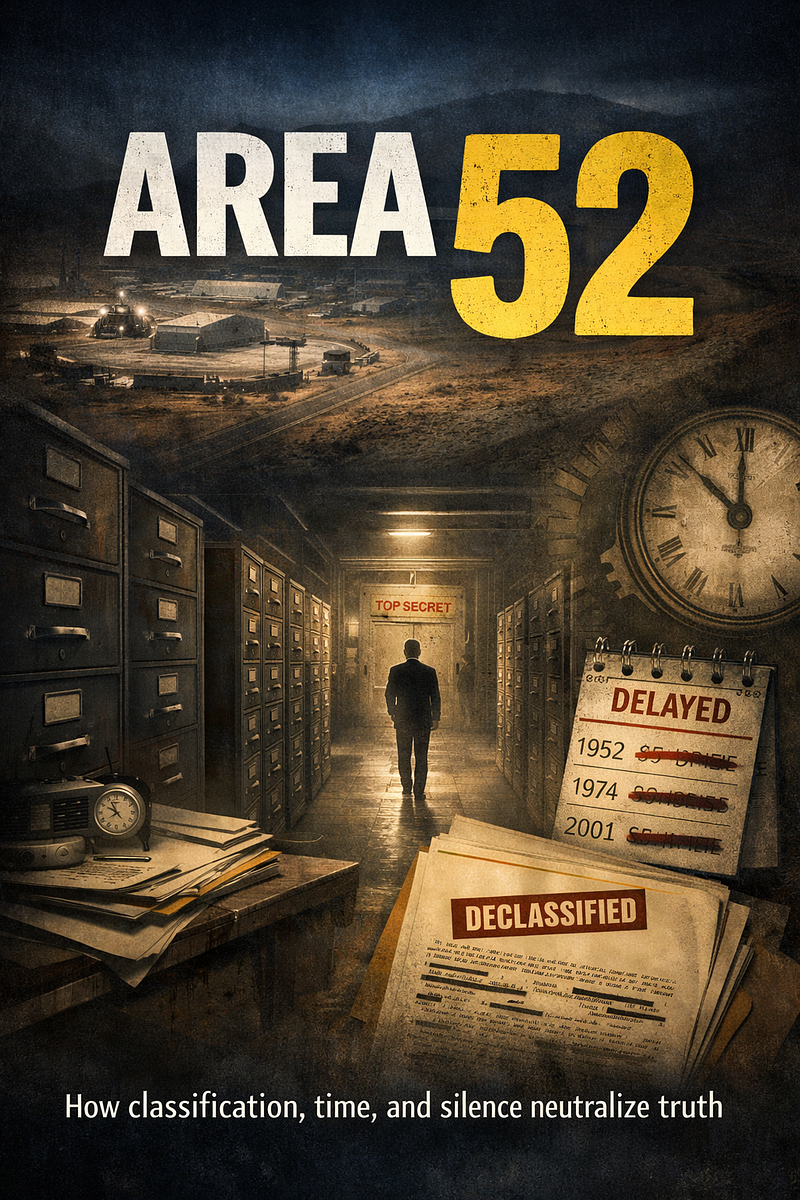
Area 52 is not a secret base hidden deeper in the desert.
It is a phase.
This chapter examines what happens to knowledge that cannot be denied, but cannot be allowed to act. Not through censorship or destruction, but through classification, delay, and time.
What follows is not a theory about hidden places, but an anatomy of how truth is neutralized without ever disappearing.
No, this is not a typo.
We are going to talk about Area 52. Not Area 51.
Area 51 is known. Familiar in the way only something overexposed can be. A name that no longer requires investigation or seriousness. It entered popular culture at the exact moment when it no longer posed a problem.
Visibility came late.
And by the time it arrived, the danger had already passed.
Area 51 became a reference point, a genre, a joke. A place that could be named precisely because naming it no longer mattered. Attention moved endlessly around it while relevance quietly collapsed. The more it was referenced, the less it explained.
Area 52 does not share this fate.
It is not familiar.
It does not circulate.
It is not quoted.
Not because it is better hidden, but because it performs a different task.
Where Area 51 absorbs curiosity, Area 52 absorbs consequence.
Where speculation is allowed to expand, classification quietly begins.
What cannot be denied, but cannot be allowed to function, does not disappear. It is reassigned.
This chapter is not about a base, a fence, or coordinates. It is about a function inside systems of power. A phase that appears whenever knowledge threatens to exceed what systems can absorb without changing themselves.
The term “Area 52” is used here descriptively, not geographically, to name a function rather than a facility.
Before Anything Needs to Be Hidden
Long before secrets exist, systems learn to anticipate disturbance.
This anticipation does not announce itself. There is no discovery yet, no anomaly on record, no report requiring classification. What exists instead is a subtle narrowing of possibility. An institutional sense, distributed rather than centralized, that certain questions may lead somewhere difficult.
Nothing has happened yet.
And precisely because nothing has happened, everything is still possible.
Funding priorities begin to shift almost imperceptibly. Not enough to provoke resistance, just enough to guide momentum elsewhere. Research that once seemed promising becomes “premature.” Directions that might require explanation later are quietly deprioritized now.
Language adjusts in parallel. Certain terms lose currency without ever being banned. Others suddenly appear more appropriate, more fundable, more responsible. No decision is announced. No justification is required.
Nothing is forbidden.
Nothing is denied.
This phase does not silence. It conditions.
What emerges here is not control, but orientation. A gentle alignment of inquiry away from zones that might later require intervention. Governance before governance becomes visible. Power before power has to act.
At this stage there is nothing to classify. There is only a future that needs to remain manageable.
This is not censorship.
It is pre-emptive coherence.
The system learns to feel where tension might accumulate and releases pressure early, quietly, before it can harden into fact.
The Decoy Everyone Recognizes
Anticipation does not always succeed.
Some questions persist. Some observations repeat. Some curiosities resist redirection. When early steering fails, systems turn to a different instrument. Not suppression, not denial, but exposure.
This is where visibility enters.
Area 51 did not emerge as a secret kept too well. It emerged as something allowed to be seen too often. Its name circulated. Its outline leaked. Its existence was acknowledged in half-smiles, irony, and carefully timed admissions. It became familiar without becoming precise.
Familiarity did the work secrecy once did.
The more visible Area 51 became, the less functional it was as a site of inquiry. It absorbed curiosity without allowing consequence. Speculation expanded endlessly, while relevance slowly collapsed. Questions attached themselves to it and went no further.
Visibility, when carefully managed, does not reveal. It distracts.
Area 51 became a container for everything that could safely be wondered about. By hosting those questions, it ensured that other questions never fully formed.
It was not designed to lie.
It was designed to hold attention in place.
And for a time, it worked.
When Visibility Stops Working
By the late 1940s, cracks began to appear.
Certain observations did not fade. They did not behave like rumor or misinterpretation. They repeated across contexts. They accumulated in reports that did not align, yet could not be dismissed individually. The sheer volume made silence impractical.
Anticipation had not prevented them.
Visibility had not neutralized them.
What emerged was not panic, but discomfort. A growing recognition that neither early steering nor controlled exposure could absorb what was now circulating internally. Something had crossed a threshold.
It was not hostile.
It was not actionable.
It was not useful.
It simply existed.
And existence, when it cannot be framed, creates pressure.
1952: The Administrative Turn
Between 1947 and 1952, systems tasked with managing classified knowledge encountered a structural limit.
Denial no longer worked.
Ridicule no longer worked.
Visibility no longer worked.
By 1952, a different logic took hold.
Classification replaced denial as the primary instrument of control.
This shift did not announce itself as policy. It appeared as a reconfiguration of procedure. Committees multiplied. Responsibilities fragmented. Terminology adjusted just enough to absorb tension without resolving it.
What could not be erased was rerouted.
What could not be explained was reorganized.
Reports did not disappear. They multiplied. Each revision reduced implication. Each reclassification narrowed consequence. What remained was intact, but no longer dangerous.
This was the moment when control became administrative.
The function later described here as Area 52 was born at that moment. Not as a place, but as a response to failure.
Area 52 as Procedure
Area 52 is not an icon. It is not mythological. It does not require fences or spectacle.
It is a process.
Between discovery and narrative.
Between observation and explanation.
Between fact and meaning.
What enters this phase is not destroyed. It is processed. Not denied, but reorganized. Not buried, but disconnected from consequence.
Reports are rewritten without being falsified. Language shifts without drawing attention. Disciplines absorb fragments without acknowledging the whole.
Power rarely destroys knowledge. Power archives it.
This is where danger dissolves. Not because truth disappears, but because it loses the ability to act.
When Discovery Has No Category
Not every discovery is dangerous because it is threatening. Some are dangerous because they have no category.
They are not enemies.
Not weapons.
Not technologies ready for application.
They simply exist. And they do not fit.
Systems are built on coherence. What cannot be ordered creates instability.
Some discoveries are dangerous because they cannot be framed.
Area 52 exists for that moment.
Filing Reality Away
There is no spectacle here.
A transfer.
A new file number.
A revised classification.
What was once a discovery becomes an administrative object.
Power does not silence. It reorganizes.
Knowledge Without a Home
Universities present themselves as engines of discovery. They are also engines of placement.
Knowledge must belong somewhere. What cannot be placed cannot move forward.
Departments act as borders. Methods function as filters. Legitimacy becomes a secondary classification system.
A grant application is deferred without explanation.
A submission is returned with the suggestion that the question lies outside the journal’s scope.
No rejection is issued.
No argument is required.
Legitimacy does not determine truth. It determines circulation.
Area 52 does not silence ideas.
It leaves them nowhere to go.
Delegated Judgment
Modern systems increasingly delegate classification.
Artificial intelligence does not decide what is true. It decides what is statistically normal. What does not align is not rejected. It is reduced.
A dataset is excluded during preprocessing.
The decision is logged, but no human review follows.
The system does not lie. It averages.
Anomalies dissolve into probability.
The Archive Is Not Memory
Archives are not passive.
They are instruments of time.
The archive is not about memory. It is about timing.
What is archived is delayed. Removed from the present.
Release without context does not restore power. It disperses it. By the time something is officially known, it no longer has the capacity to reorganize the world around it.
Time as the Final Filter
Information is rarely suppressed forever. It is delayed.
A document released decades later explains the past without disturbing the present.
Delay is not an accident. It is a design principle.
Time is not a neutral background here. It is the final administrative instrument.
Area 52 extends beyond rooms and files into calendars and schedules. It governs not only what is known, but when knowing is allowed to matter.
When Control No Longer Needs to Act
Eventually, even management becomes unnecessary.
Knowledge classified long enough loses its remaining tension. It becomes safe not because it was disproven, but because it aged.
This is where something like Area 53 emerges.
Not as a place.
As a condition.
Truth remains.
Relevance does not.
Time completes what classification began.
Closing Reflection | After Classification
After classification, nothing appears broken.
Procedures function.
Archives are full.
Explanations are available.
Nothing seems missing.
What disappears is direction.
Not truth, but urgency.
Area 52 does not erase facts.
It ensures facts arrive without force.
Area 52 was never the destination.
It was the hinge.
By the time knowledge reaches what could be called Area 53, no decision is required anymore.
Related from The Manifest Archive