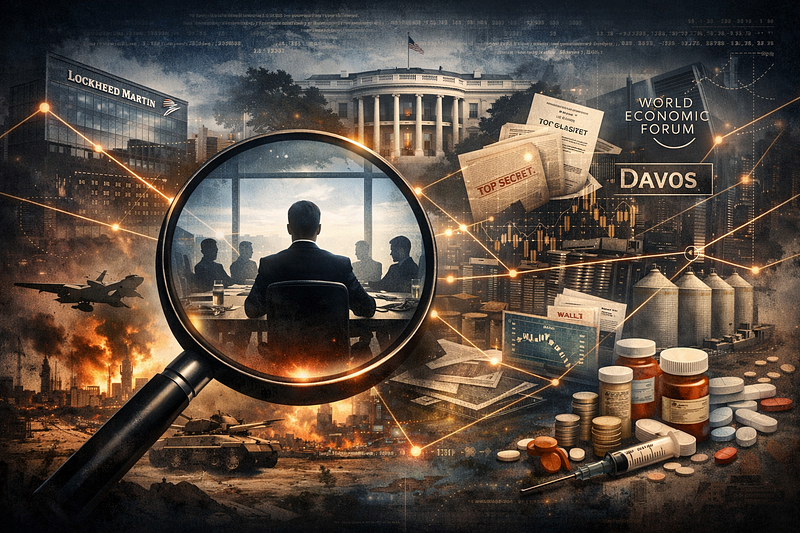
April, 2003. The bombing of Baghdad has been running for twelve days. On the fourth floor of Lockheed Martin’s headquarters in Bethesda, twelve miles from the Capitol, a television is on. The precision guidance systems on the screen, destroying bridges, relay stations, power infrastructure in real time were designed in this building. The contracts authorizing their production were signed here, in earlier years, by men who do not appear in the coverage playing on the screen.
The executives do not appear in the news. They are not politicians. They have not been elected, appointed, or confirmed. No one voted for the infrastructure they built.
But they built the architecture that made this war possible. Quietly. Legally. Over decades.
Their names, their companies, their contracts are documented in congressional records and SEC filings. What is not documented, anywhere, is the connection between their profit and the decision to invade. That connection exists. It is not classified. It is invisible because no one draws the line.
This archive draws the line.
The Invisibility
Control systems are not hidden. They are visible in plain sight to anyone who knows how to look.
What makes them invisible is not secrecy. It is structure. The way eight separate systems, each appearing to operate independently, reinforce each other so completely that their coordination looks like coincidence.
Your medication costs more than your rent. That is visible.
Your wages have not kept pace with your rent in forty years. That is visible.
The investment fund that owns your medication also owns shares in the company that finances your mortgage. That connection is invisible. The policy framework that allows both to charge what they charge was written by advisors who previously worked for both companies. Also invisible. The World Economic Forum Annual Meeting in Davos, where executives from BlackRock, Pfizer, Cargill, and JPMorgan share closed-session panels with the regulators who oversee them, is documented, attended, photographed, and systematically unreported as the coordination event it is.
This is not conspiracy. Conspiracy requires secrecy. This requires only that no one draws the connections.
This is architecture. And architecture can be read.
The Architects
The architects are not hidden either.
In 1954, Edward Bernays, hired by United Fruit Company, arranged for the American government to overthrow the democratically elected president of Guatemala. Bernays did not use weapons. He used newspapers. He convinced American journalists that Jacobo Árbenz was a communist threat. The CIA executed the operation. United Fruit recovered its nationalized land. Bernays sent an invoice.
The infrastructure already existed: a government willing to act, a media willing to print, a corporation willing to pay. Bernays connected them. The architecture was already there. He read it. Then he used it.
In 1972, Henry Kissinger authorized the destabilization of Chile. The formal justification was communist containment. The financial reality was that Salvador Allende had nationalized copper mines owned by American corporations. Kissinger wrote, in a memo now declassified:
“I don’t see why we need to stand by and watch a country go communist due to the irresponsibility of its own people.”
Study that sentence carefully. Democratic choice becomes “irresponsibility.” Violent intervention becomes “not standing by.” The architecture of the language is doing more work than the architecture of the policy.
In 2000, Lawrence Summers, Robert Rubin, and Alan Greenspan successfully blocked Brooksley Born’s attempt to regulate derivatives. Born, then chair of the Commodity Futures Trading Commission, had identified the systemic risk. She was overruled. Eight years later, the unregulated derivative market collapsed. The cost to the global economy was $22 trillion. Summers became a senior economic advisor to the Obama administration the following year.
These are not separate stories. They are one story, told three times across three decades.
The story is this: there are people who build the systems that govern your life, who are never elected, rarely named, and structurally unaccountable. They operate through institutions that appear neutral, through language that appears technical, and through arrangements that appear inevitable.
None of it is inevitable. All of it was built.
The Objection
The strongest objection to everything written above is this: you are projecting architecture onto coincidence.
Bernays, Kissinger, and Summers did not coordinate. They did not meet and decide to build a system together. They were rational actors responding to incentive structures that happened to align. The Guatemala coup served American corporate interests. The Chile destabilization served Cold War containment logic. The derivative deregulation served financial sector growth. Each decision was made by different people, in different decades, for different reasons that produced similar outcomes.
There is no architecture. There is only alignment.
That objection deserves a direct answer, because it is the correct objection to make.
The answer is this: alignment without coordination is not evidence against architecture. It is evidence of a more durable architecture than one requiring coordination. A system that maintains itself through distributed rational self-interest has no single point of failure. There is no conspiracy to expose, no smoking gun, no individual who can be prosecuted and replaced to restore integrity to the structure. The system survives because every participant is acting rationally within it, and rational actors do not need instructions.
This is precisely why the architecture must be read structurally rather than individually. Not “who coordinated this” but “what incentive structure makes this the rational outcome for every actor involved.” Not “who is guilty” but “what would have to change for a different outcome to become rational.”
The objection proves the thesis. Emergence without coordination is a more sophisticated form of control than conspiracy, because it immunizes the system against the exposure of any individual actor. There is no one to arrest. There is only a structure to see.
Why I Write
I write because once I saw the architecture, the old explanations stopped working.
“The market decided” stopped making sense. Markets do not decide. People with enough capital to move markets decide, and they decide in rooms with other people with enough capital to move markets, after conferences where the decisions have already been made. The market then reflects those decisions. Calling this “the market deciding” is narrative substitution: a real story replaced by a story that protects the architects from visibility.
“Human nature” stopped making sense. Scarcity is not human nature. Scarcity is policy. Forty percent of global food production is controlled by four companies: Cargill, ADM, Bunge, Louis Dreyfus. They did not inherit this position. They built it, acquisition by acquisition, lobbying effort by lobbying effort, regulatory capture by regulatory capture, over one hundred and fifty years. The scarcity that results from their coordination is not natural. It is engineered.
“That’s just how things are” became the most dangerous sentence in the language. Things are how they are because someone built them that way. Every system that appears permanent was designed. Every design has architects. Every architect left traces.
I write to follow the traces.
The Method
The framework I use has six detection layers. Not theories. Tools. Watch what happens when you apply the first three to the same moment.
April 2003. Bethesda.
Temporal forensics shows the Lockheed contracts were signed before the authorization for war. Infrastructure reading shows the revolving door between the Pentagon and defense contractors had been institutionalized across decades before any individual decision was made. Incentive cartography shows that rising defense budgets made the invasion financially rational for a specific set of actors before it became politically inevitable for anyone else.
Three lenses. One moment. The architecture becomes visible before the first bomb falls.
The remaining three lenses, semantic pressure testing, absence mapping, narrative substitution, show what was done to keep it invisible. Each is explained in full in the next article.
The Stakes
The stakes for learning to look are not abstract.
The eight control systems this archive documents are integrating at an unprecedented pace. Digital surveillance infrastructure is merging with financial systems. The same analytical platforms now deployed by intelligence agencies to identify targets abroad are deployed domestically to identify welfare fraud, immigration violations, and political dissent. The architecture is identical. Only the declared purpose changes.
Food systems are consolidating toward a point of control that has no historical precedent. Four corporations managing seventy-five to ninety percent of global grain trading while simultaneously holding commodity derivatives positions means they profit from price rises regardless of cause. The incentive architecture makes artificial scarcity rational. The vocabulary of “supply chain disruption” makes it invisible.
Institutional capture is not a new phenomenon. It is a mature one. Between 2001 and 2010 alone, 219 former SEC officials took positions in the financial sector they had previously overseen. The movement of personnel between regulatory agencies and the industries they regulate is now so systematic that the boundary between regulator and regulated has effectively disappeared. This is documented in thousands of individual career records. It is rarely assembled into the pattern it forms.
These systems appear indestructible because they are mutually reinforcing. The pharmaceutical system profits from the same population the food system has made metabolically vulnerable. The media system functions most effectively when the education system has not produced populations capable of reading the coverage critically. The financial system’s accumulation depends on the political system maintaining the regulatory framework that protects it. Each layer stabilizes the others.
Integrated systems, however, have a structural weakness. They depend on invisibility. A system seen cannot be legitimately defended. It can only be maintained by force, which is expensive and unstable.
Visibility is the intervention.
Back to Bethesda
The Lockheed executives in that fourth-floor room are not the story. That framing is the wrong framing, and the system is comfortable with it. Villains can be prosecuted. Villains can be replaced. The architecture continues without them.
The story is who built the procurement system that makes their contracts structurally inevitable. Who wrote the defense authorization bills that require replacing munitions after use. Who designed the revolving door between the Pentagon and defense contractors that makes the relationship self-perpetuating. Who funded the think tanks that produced the intellectual framework for the doctrine of preemptive war that justified the invasion that consumed the munitions that fulfilled the contracts.
Those people have names. Those decisions have dates. Those documents are public record.
What is missing is not the evidence. What is missing is the architecture that connects the evidence into a visible structure.
This archive is that architecture.
What You Will See
Read this archive completely and you will not become convinced of anything. Conviction is the wrong goal. Conviction produces believers. Believers defend their beliefs rather than continuing to look.
You will become capable of seeing.
You will read the next financial crisis differently, recognizing the deregulation sequence before the collapse arrives. You will read the next war differently, looking for the contracts signed before the first strike, for the executives who do not appear in the coverage, for the infrastructure that made the decision rational before the decision was announced. You will read the next health emergency differently, asking who holds the patent, who funded the trial, what competing treatment was not funded and why.
This is what the archive produces. Not a different set of conclusions. A different capacity for seeing.
The architecture was built by humans, using human systems, for human profit.
That does not guarantee it can be dismantled. Systems built over generations have survived precisely because they absorb opposition, fund it, and eventually make it serve the architecture. Movements become institutions. Institutions get captured. The cycle is documented.
What it means is something smaller and more precise: a system seen cannot be legitimately defended. It can only be maintained by force, which is expensive and unstable, or by manufacturing new invisibility, which requires the same mechanisms this archive documents and therefore accelerates the contradictions that fracture systems built on concealment.
There is no promise here. Only an observation.
Visibility is the condition. What happens after is not determined.
That seeing begins here.
Begin.
This is the Medium version. The full Substack version includes two additional sections: The Financial Architecture and The Geographic Asymmetry. Read the full version on Substack
Related from The Manifest Archive