Introduction | The Rooms That Remember
Berlin, April 1945.
The city no longer looked like a city. Walls stood open. Streets felt hollow. Smoke moved without urgency, as if even fire had grown tired of the task.
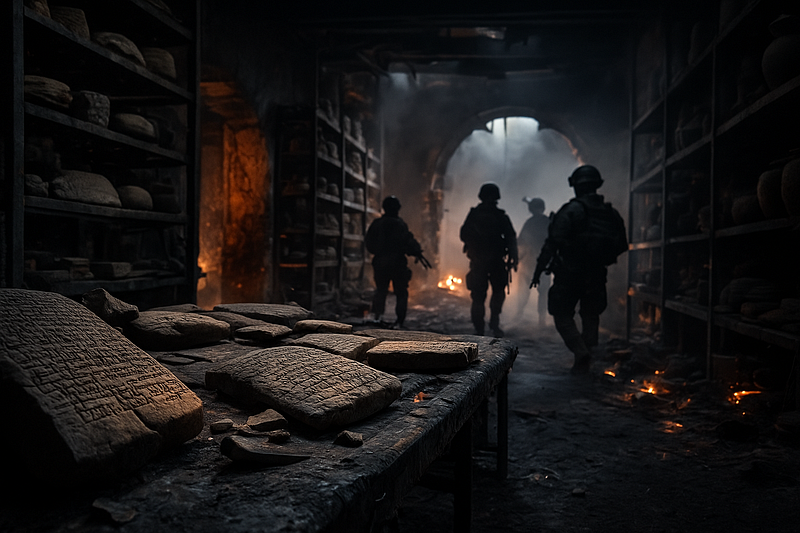
Inside Museum Island, a group of soldiers moved differently.
Not cautiously.
Not aggressively.
Deliberately.
They passed collapsed staircases and ignored shattered statues. They did not search offices. They did not inspect vaults.
They walked straight to a locked door at the back of the Pergamon complex.
Inside, the air changed.
Anyone who has worked with ancient material knows the smell. Dry clay. Old dust. Time that has settled rather than decayed. Rows of shelves held tablets pressed by hands long erased from language.
A Soviet officer unfolded a slip of paper.
Four room numbers.
No explanation.
He nodded once.
Outside, the war was ending.
Inside, something older was being reassigned.
Baghdad, April 2003.
Missiles tore across the sky. Ministries burned. The city convulsed under the choreography of invasion.
Yet the first armored vehicles that reached the city center did not stop at palaces or broadcast stations.
They went to the National Museum.
Straight to the sealed rooms.
Rooms most curators never entered alone.
Hours later, the doors stood open.
The shelves were bare.
Two wars.
Two empires.
Two museums.
The same silence followed.
Every modern war claims to secure the future.
Its first operation always targets the past.
Why Empires Move Toward Memory
Wars are explained through familiar language. Territory. Security. Resources. Ideology.
Those explanations are sufficient.
They are also incomplete.
When armies move, their priorities betray a different logic.
They move toward archives.
They move toward museums.
They move toward storage rooms without windows.
This is not symbolic.
It is procedural.
A relic does not function as an object.
It functions as stored memory.
Clay tablets outlive dynasties.
Carved diagrams outlive famines.
Encoded myths outlive religions.
A relic that contradicts a timeline becomes a liability.
Not to science.
To authority.
Because authority depends on sequence. On origin stories that align. On a past that behaves predictably.
Stone does not negotiate.
It remembers.
What Is Taken, And Why
What disappears first is rarely what draws attention.
Not the largest statues.
Not the most valuable gold.
Not what tourists recognize.
What vanishes are objects without fixed provenance.
Artifacts whose dating remains provisional.
Materials that resist clean classification.
Items that sit uneasily in catalogues.
These are not removed because they are powerful.
They are removed because they are unresolved.
An unresolved object forces revision.
Revision forces admission.
And admission destabilizes authority.
What Relics Actually Contain
Relics are not sacred.
They are not supernatural.
They are fragments of an older information system.
Geometry survives fire.
Stone survives language.
Stars survive nations.
Ancient builders encoded cycles modern humanity no longer perceives. Forces that require patience rather than dominance.
Relics do not offer power.
They offer alternatives.
And alternatives are dangerous.
Inventory Without Origin
The room was small.
No windows.
No signage.
No names on the door.
A folding table stood in the center. On it, a single object wrapped in grey archival paper. Clay. Cracked at the edges. Older than the building that held it.
A civilian contractor adjusted his glasses and opened a laptop.
He did not photograph the object.
He opened a form.
Category: Material artifact
Condition: Stable
Origin: (field pending)
He paused.
There was a box for Discovery Location.
Another for Cultural Attribution.
Another for Chronological Period.
He left them blank.
Instead, he scrolled down and typed into a smaller field near the bottom.
Temporary Storage.
Classification Deferred.
He assigned a number.
Not a name.
Not a place.
A number that meant nothing outside the system.
The object was placed into a container marked for transfer.
No destination was listed.
Only a status update appeared on the screen.
“Item secured.”
Nothing in the form asked what the object contradicted.
Nothing asked why it had been removed.
Nothing asked who would decide when temporary ended.
The contractor closed the laptop.
The room returned to silence.
Somewhere else, a timeline remained intact.
I am aware that even the word relic is misleading.
It suggests something dead, finished, resolved.
What sits in these rooms is none of that.
It is unfinished memory, paused rather than lost.
At this point, it would be reasonable to assume this is a story about stolen objects.
It is not.
What is being removed here is not the past.
It is the range of futures that past would allow.
The artifact is only the carrier.
The restriction is the function.
Knowledge That Cannot Be Allowed to Return
What is kept from circulation is not only material.
It is technique.
Ways of building that require no supply chain.
Ways of measuring time that reveal repetition instead of progress.
Ways of producing energy that do not pass through ownership.
Such knowledge does not threaten power because it is mystical.
It threatens power because it works.
A population that understands cycles needs fewer explanations.
A society that remembers technique requires less permission.
The Pattern Is the Evidence
These omissions do not require intent to be real.
They repeat across cultures that never coordinated.
The same kinds of techniques disappear.
The same forms of knowledge lose institutional shelter.
The same dependencies remain.
A pattern does not argue.
It accumulates.
And when accumulation points in one direction, denial becomes the least economical explanation.
The Reich and the First Modern Relic War
Nazi Germany is remembered for conquest and extermination. Less examined is its parallel obsession.
Memory.
The Ahnenerbe was not a fringe curiosity. It was staffed by linguists, archaeologists, physicists, surveyors. People trained to read continuity across collapse.
They searched Tibet for cosmology.
Scandinavia for runic persistence.
The Andes for star-aligned stone.
The Middle East for antediluvian fragments.
They were not hunting treasure.
They were hunting confirmation.
If you control the oldest knowledge, you control the limits of what humanity believes is possible.
When the Reich fell, that premise did not.
Paperclip Was Not a Rescue. It Was a Transfer.
Operation Paperclip is described as a talent import. Engineers. Rocket scientists. Specialists.
That description is incomplete.
What crossed borders was not expertise alone.
It was an unfinished method.
NASA inherited the sky.
The CIA inherited the archives.
DARPA inherited the unanswered questions.
The logic remained intact.
Only the flag changed.
The Steppe as Archive
Russia sits atop a continent-sized archive.
The Pontic Steppe.
Siberia.
The Altai.
Regions described as empty by those who do not know how to read land.
Scythian gold buried with astronomical alignment.
Cave paintings older than agriculture.
Ritual mounds oriented to cycles modern calendars ignore.
The steppe is not a battlefield of land.
It is a battlefield of beginnings.
Rome and the Management of Time
Rome never ruled by territory alone.
It ruled by chronology.
What did not fit was renamed.
What resisted alignment was archived.
What threatened continuity was deferred.
The most effective censorship does not erase.
It reorganizes.
Rome mastered this early.
Every empire since has learned from it.
Why Memory Is the Real Weapon
Territory can be seized.
Money can be printed.
Weapons can be manufactured.
Memory cannot.
A society can censor speech.
It cannot censor geology.
That is why relics disappear quietly.
That is why inventories never close.
That is why provenance becomes vague.
Closing Reflection
Somewhere in Rome.
Somewhere in Virginia.
Somewhere in Beijing.
Somewhere in Moscow.
Shelves of clay that remember.
Gold that suggests forgotten forms.
Symbols repeating across oceans without explanation.
They wait.
Not for belief.
Not for ideology.
For a decision.
Will humanity build its future on forgetting again,
or will it risk remembering in full?
That question lies beneath every war.
Every archive.
Every museum door forced open in darkness.
Does humanity dare remember what it once knew?
Related from The Manifest Archive