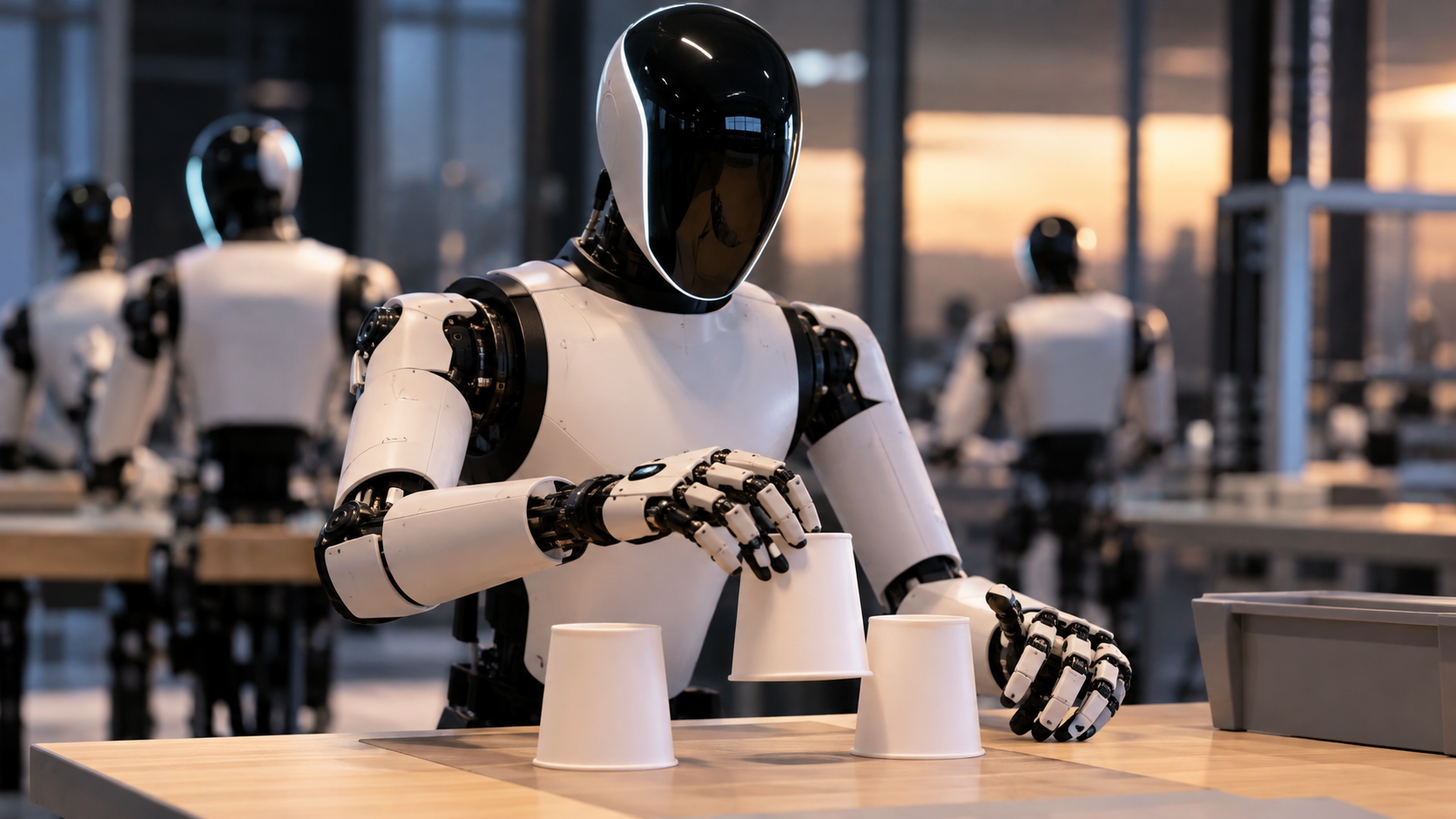
Fan Jingkang is twenty years old, and when a reporter from NPR found him in September 2026 he was throwing away paper cups. He did it with a virtual reality headset slung around his neck and a controller in each hand, and the hands that actually touch the cups belong to a robot: a wheeled machine of black and white plastic with camera lenses for eyes and five-fingered hands. The room is made up to look like a café. Fan guides the robot to pick up the cups and drop them into a bin. A colleague plucks them out and puts them back on the counter. Fan does it again, in the reporter's words, "again and again and again."
The building, in Deqing, a couple of hours west of Shanghai, covers some 86,000 square feet and is full of rooms like this one. In another, a person on a raised chair uses a remote control to make a humanoid open cabinets. In another, a man picks up fake eggs one at a time with a two-pronged grabber meant to stand in for a robot hand, while a small camera records everything for the database. There is a mock hotel room, and a robot torso learning to sand wood. Next to Fan, a laptop tethered to the robot saves what happens.
The company that runs the site, Wuwen AI, does not make robots. What it makes is the record of robots being shown what to do, and that record, NPR reported, "will be used to program other robots." When the reporter took the controls and nearly crashed the machine, Fan deleted the data. "We wouldn't want future robots learning the wrong thing," the reporter noted.
I kept coming back to that small act of deletion. Nobody in the café is paying for cups to be thrown away. Nothing the robot did that day was worth anything except as a lesson, and a bad lesson had to be erased, because the lesson is the product.
NPR added a line that, if it is right, describes an entire industry: most of the tens of thousands of humanoid robots sold in China, it said, "have gone to places like Wuwen AI for training." The reporter did not give a source for it. I set out to check it, and to answer the question behind it. Tesla, UBTech, Unitree, AgiBot, Figure, Agility and, in China alone, more than 150 companies are building humanoids by the thousand. Building anything by the thousand assumes that somebody will pay for it. The usual answer is that factories and warehouses will, because they cannot find enough people. I wanted to see the invoices.
20,000 built, one in ten at work
The first surprise is that nobody counts the same thing.
Interact Analysis, a British market research firm, estimates that more than 20,000 humanoids were produced in 2025, up from fewer than 2,000 the year before. Omdia, which counts shipments, put the 2025 figure at roughly 13,000, led by AgiBot with 5,168. The International Federation of Robotics, whose annual census is the reference the industry quotes, counted about 7,000 full-size humanoids, taller than 140 centimetres, sold for commercial and professional use. Its definition leaves out robots bought for research, which turns out to matter a great deal.
Then Interact adds a fourth number, an estimate rather than a count, and it is the one that changed the direction of this investigation. Only around ten percent of the units produced in 2025, the firm reported in June, were deployed in real-world applications. "The vast majority were used for research, data collection, and entertainment."
Side by side, the numbers look like a staircase:
Built: more than 20,000. Shipped: about 13,000. Sold for professional use: about 7,000. At work: by one estimate, one in ten.
It should not be read as a real staircase. The steps come from three firms counting different things, not the same robots at successive stages. A robot can work in a laboratory without ever being sold, be sold and never switched on, or do a real job and still lose money. The numbers measure the capacity to build, the act of handing over and the ability to do a task. None measures what a factory buyer cares about: whether the robot pays for itself.
The industry counts what it builds, what it ships and what it sells. How many robots earn their keep is the number nobody publishes.
The federation comes closest. Humanoid applications "often require remote control by humans," its press release said, and the sector suffers from "the lack of a compelling business model," particularly in industrial settings. Its own count cuts slightly the other way: if about 7,000 full-size humanoids went to professional, non-research buyers, more robots reached paying customers outside the lab than Interact's one in ten suggests. But sold is not deployed, and the federation describes those buyers as still "on the verge of making the leap from laboratories to pilots."
The best window into who is buying comes from the company that sold the most. Unitree, based in Hangzhou, says it delivered more than 5,500 humanoids in 2025. Its stock market prospectus breaks down where its humanoid revenue came from in the first nine months of that year. Research and education accounted for 73.6 percent. What the filing calls commercial consumption, largely demonstration and display, took 17.4 percent. Industrial customers took 9 percent.
So NPR's line held up, at least in outline. Most of last year's humanoids went to places where the work is learning, showing or teaching, and the money that bought them was paying for that. Tesla, it turned out, had already written the same thing about its own robots.
The first Optimus robots go to school
No sale of the most watched humanoid in the world has yet been disclosed.
Tesla's quarterly update for the second quarter of 2026, filed with the Securities and Exchange Commission in July, says that the company is "installing the first-generation lines for Optimus, where we expect to start production soon." The next sentence is the one that matters here: "The initial Optimus builds will be used in our Optimus Academy for training data collection."
The first robots off the line, in other words, go to school, like the one in Fan's café.
The scale of the ambition is in the filing before. In its update for the first quarter, Tesla wrote that "the first-generation line, designed for 1 million robots a year, will replace the Model S and Model X lines in Fremont." A million robots a year is a design figure, and the capacity table in the July update still lists both planned Optimus lines, in California and Texas, under "Construction." Tesla has published no production number for Optimus.
What the company has not said, others have reported. According to The Information, as summarised by Electrek in September 2026, Optimus output rose from a few dozen a week in the second quarter to "several hundred a week in August," with a target of more than a thousand a week by the end of the year. The same report says Tesla plans to "lease, not sell" the robots, to a short list of companies "whose factories and warehouses look like its own," and names none of them. At Davos in January, Elon Musk put the public on a timetable: "By the end of next year, I think we'll be selling humanoid robots to the public."
Underneath the robot sits a shrinking car company. Tesla's deliveries fell from 1.81 million vehicles in 2023 to 1.64 million in 2025. In the second quarter of 2026 its operating margin was 1.4 percent, while capital spending rose 142 percent, and Tesla expects to spend more than 25 billion dollars this year.
The bridge between those two lines is a story about value, and Musk has told it plainly. At the start of September 2025 he wrote on X that about 80 percent of Tesla's value would be Optimus. Analysts disagree about how much of Tesla's roughly 1.5 trillion dollar market value rests on the robot: Morgan Stanley has put Optimus at about 60 dollars a share, while Piper Sandler leaves it out and argued in May that, at 400 dollars a share, investors "can buy Optimus for free." Either way, the share price is a bet on future cash flows, and the robot carrying part of it will, by Tesla's own account, spend its first months collecting data about itself.
Companies build test fleets before they sell, so none of this is unusual in itself. What made me keep going was that what Tesla does inside one company, China was doing as national policy.
On 3 June, Beijing calls it training
On 3 June 2026 the general offices of two Chinese state bodies signed a notice. The Ministry of Industry and Information Technology and the State-owned Assets Supervision and Administration Commission, which oversees the country's largest state companies, told every central state-owned enterprise to select no fewer than ten key scenarios in its own industry where humanoid robots and embodied AI could be put to use.
Its title announces a "real-scenario training special action." The word it uses, 实训, means practical training, the kind an apprentice does on a shop floor. The programme's stated purpose is to build datasets from real working environments, across more than a hundred high-value scenarios, and by the end of 2026 to complete validation and "routine deployment" in representative settings.
The state, in other words, has asked its largest companies to open their operations to robots so that the robots can learn first and be deployed later. Replacing workers is not the first step it asks for.
Local governments have gone further, with their own money. In November 2025 UBTech, a Shenzhen robot maker listed in Hong Kong, announced three orders worth 566 million yuan, about 80 million dollars, from a humanoid data collection centre in Zigong, in Sichuan, a data collection and training centre in Jiujiang, in Jiangxi, and, largest at 264 million yuan, a data collection and testing centre in Fangchenggang, the port city where Guangxi meets Vietnam. The Fangchenggang robots got real jobs: guiding travellers at the border crossings, managing passenger flows, patrolling, and later inspecting nearby steel, copper and aluminium plants. As I read it, each robot there does a job and produces a dataset at once, and the dataset is what its buyer is named for. The reports give no breakdown, and I could not establish who owns the three centres.
In Liuzhou, also in Guangxi, Reuters visited a training centre with more than a hundred humanoids, supplied by UBTech under an 18-million-dollar tender from the Guangxi regional government. The centre aims to sell robot-training data to factories. Reuters called the project subsidy-dependent; staff saw no clear path to profitability, with operating costs high and data prices low. A novice trainer might get one usable movement out of 300 attempts. National, provincial and local governments in China, the agency found, spent at least 230 million dollars buying humanoids and related items in the first half of 2026, up from 62 million a year earlier. Government entities, Reuters wrote, "are at once major financiers and customers of the same robots," which it said was "artificially boosting demand."
Public money buying robots to train robots looks like manufactured demand, and Beijing's planners have noticed the speed. At a briefing in November 2025, Li Chao, a spokeswoman for the National Development and Reform Commission, said that more than 150 companies in China were making humanoids, warned against "too many similar products" flooding the market, and offered a line since quoted around the world: "Speed and bubbles have always been issues that need to be grasped and balanced."
That was the first explanation that seemed to fit everything.
Unitree and the bubble that would not hold
The bubble explanation is attractive because it explains the staircase in a sentence: money was available, so robots were built, and training centres are where robots go that were never going to find work.
For a few days I thought that was the answer. Then I read Unitree's accounts.
Unitree, the company most of whose humanoid revenue comes from research and education, makes money. In 2025 its revenue reached 1.70 billion yuan, up from 392 million the year before, and it reported a net profit attributable to shareholders of 278 million yuan. Its average selling price for a humanoid fell from about 593,000 yuan in 2023 to about 166,000 in 2025, yet the gross margin on its humanoids was 63 percent. Universities, laboratories and robotics teams pay real money for its machines, and the company profits from selling to them.
That settles one question: a paying market for research robots exists. It does not show that this market will outlast the investment cycles and state programmes that fund many laboratories, and it says nothing about industrial demand or about valuations.
So the bubble explanation does not disappear. It splits. There may be a speculative bubble in valuations. There may be a temporary surplus of production capacity, as more than 150 makers of a product that shipped about 13,000 units last year would suggest. There is, demonstrably, a real market for research equipment. And there is a market for humanoids as productive workers, which remains unproven. All four can be true at once. What fails is the simple version, in which the robots are built for nobody. At the company that builds the most, somebody is paying.
The workers who were supposed to be missing
A profitable trade in research robots still says nothing about whether factories need humanoids. That is the second explanation, and it is the one the industry gives itself. Factories and warehouses cannot find workers, populations are ageing, and a machine that can walk into a building designed for people will fill the gap. On this view the robots are being built ahead of demand only in the sense that the demand is certain and the robots are not yet ready.
The numbers for now do not show it. American manufacturing had 522,000 job openings in August 2026, about half the peak of April 2022. In China, unemployment among 16 to 24 year olds outside education was 18.9 percent.
The long-term case is stronger. The Manufacturing Institute and Deloitte project that about 1.9 million American manufacturing jobs could go unfilled by 2033, China's workforce is ageing, and youth unemployment says little about whether a given plant can hire a technician. A shortage in 2033 is a reasonable thing to build for. It does not explain the volume in 2026, and it hides a comparison that turned out to be more revealing.
The robot has more than one competitor. In a warehouse it competes with people, and also with conveyor belts, shelf-carrying mobile robots and fixed arms, machines bought by the hundred thousand because they do one thing cheaply and reliably. If a humanoid's case is that it replaces labour, the question is whether it does so better than the machines already built to replace labour.
I looked for a credible published comparison of humanoids against those machines, on cost per task, uptime or throughput, and did not find one. That is a gap in what the market discloses, not proof that the humanoid loses. What I found instead were comparisons with people. Agility Robotics, whose Digit robot moves totes for the logistics company GXO and the manufacturer Schaeffler, rents its robots as a service at what its registration statement calls "a discount to a customer's fully burdened labor cost." UBTech's Walker S2 has been reported to reach 30 to 50 percent of a human worker's productivity. In every comparison I found, the benchmark was the human.
The strongest answer to the comparison with conveyors is flexibility. A conveyor does one thing and requires a building rebuilt around it. A humanoid could, in principle, do many things in a building that already exists. So the fairer question is not whether a humanoid can move a box more cheaply than a conveyor, but whether one humanoid can do enough different jobs to justify its complexity. The research firm IDTechEx estimates that a humanoid could pay for itself in about six months if used intensively and about fifteen if used moderately, while warning that a short payback "should not be interpreted as guaranteed profitability." Makers of wheeled robots with arms, Interact Analysis has noted, argue the other way: their machines, they say, already offer "the same flexibility as a humanoid with tested and proven products."
The most telling evidence comes from a buyer. GXO, one of the world's largest contract logistics firms and an early customer of Agility, has run some 45 humanoid pilots. On a call with analysts, its chief executive, Patrick Kelleher, was blunt: "In production, zero will be humanoids this year." Humanoids, he said, had not yet earned a return; at a conference in September he named speed and dexterity as what they still lack.
So the shortage explains why someone might want humanoids in 2033, and leaves open who is paying for them in 2026.
How the chip began, 1962 to 1967
The third explanation, the one I came to respect most, says there is nothing to explain. Every important technology was first bought by people who did not need it to be cheap, and their purchases drove costs down until ordinary customers could afford it. On this view the staircase is simply the start of a learning curve.
The best case for this view is the integrated circuit. When Texas Instruments and Fairchild began selling chips in the early 1960s, almost nobody outside government had a use for them. The economist John Tilton, and later Richard Nelson, recorded what happened next. Measured by value, the United States government bought all of the monolithic integrated circuits shipped in the country in 1962. In 1965 it still bought 72 percent. In 1967 its share fell to 43 percent, and for the first time most chips went to commercial customers. Over the same years the average price of an integrated circuit fell from 50 dollars in 1962 to about 3 dollars in 1967.
The transition left visible marks before it was complete. Besides the falling price, commercial customers began designing the chip into their own products: RCA's Spectra 70 computers in 1965, then machines from Burroughs and Scientific Data Systems in 1966, were among the first commercial mainframes built with integrated circuits.
That is demand before the market, financed by the state, and it worked. Seen through that history, much of what I had found stopped looking strange. The Chinese state paying for robots to be trained resembles the Pentagon paying for chips. The falling price is the learning curve at work: Goldman Sachs reported in early 2024 that the manufacturing cost of a humanoid had declined 40 percent in a year, where its analysts had expected 15 to 20. If I had to give a verdict on this explanation alone, it would be that it accounts for most of the pattern.
The difference lies in the buyer, and it is a difference of degree. The chip industry also spent heavily on research and on improving its own production, but the Pentagon did not buy chips in order to make better chips. It bought them because a Minuteman missile needed a guidance computer light enough to fly, and Apollo needed one to reach the moon. Those jobs existed independently of the technology. For humanoids, the scale of independent demand of that kind is still hard to establish. At Wuwen AI's café, at Tesla's Optimus Academy, in the centres in Liuzhou, Zigong, Fangchenggang and Jiujiang, in the state's training programme and in the laboratories that account for most of Unitree's humanoid revenue, the main thing the robot is bought for is learning: producing data, research or teaching, much of it aimed at making humanoid robots better.
The chip's history also gives a test. Its transition was marked by two signals: a share of sales to commercial buyers that crossed fifty percent, and commercial products redesigned around the new part. The equivalents for humanoids would be a majority of sales going to buyers who neither make robots nor train them, and operators who take humanoids out of pilots and redesign their work around them. Neither signal is visible yet. Both can be watched.
The lesson as a product, at 500 yuan an hour
One more possibility could turn the whole argument around. What if the lesson itself is the market?
A training centre need not be a waiting room. It could be a business selling the datasets every robot maker needs and none can easily produce alone, in which case the robots in Deqing are already serving their customers.
The evidence is better than I expected. Chinese reporting in June 2026 described Wuwen AI itself as holding orders worth several hundred million yuan and expecting more than 100 million yuan of revenue this year, from clients that include robot start-ups and ByteDance. Another data firm, Lightwheel, said it had signed 550 million yuan of new orders in the first quarter. Real-robot data was selling in China for 500 to 1,000 yuan an hour, according to an AgiBot partner quoted by the business newspaper Yicai. In the United States, start-ups pay gig workers to film their own chores. These are company figures, unaudited, but they describe buyers, prices and contracts. A market for physical AI data exists.
The buyers, though, are mostly robot makers and AI companies whose own revenue depends on the future the data is meant to bring about, many of them financed by venture capital or state tenders. The prices are already under pressure: Yicai reported that data collected without a robot is expected to settle at a third to a half of the price, and firms described their margins as "not as high as imagined." In Beijing's E-Town development zone the state hands out vouchers to buy data, so public money now sits on the demand side as well as the supply side. And Liuzhou, the only state centre whose finances have been described, sees no clear path to profit at current data prices.
So the data market widens the loop rather than breaking it. The lesson is a product with real buyers, and for now they are mostly the industry itself.
That sharpens the question in the title. If the early money flows from states and investors to robot makers, from robot makers to training centres and from there back to robot makers, the real question is who absorbs the loss if the final customer never arrives. Who owns the data is less clear. Rest of World reported that local governments usually build the centres and companies run them, with the stated aim that the data be shared across the industry. I found no published terms that say who owns it.
The clause in Musk's pay award
If an industry trains itself for years, someone eventually has to say when a development programme has become a business. The clearest attempt I found to write that moment down was made by Tesla's board in 2025, in a document about Elon Musk's pay.
Tesla's shareholders approved the 2025 CEO Performance Award on 6 November 2025, by roughly 1.89 billion votes to 0.56 billion. It can give Musk up to 423.7 million additional shares in twelve tranches, each requiring a stock market value milestone, from 2 to 8.5 trillion dollars, and one of twelve operational milestones. One of those is a million robots.
The award agreement defines its terms with lawyerly care. A "Bot" is "any robot or other physical product with mobility using artificial intelligence manufactured by or on behalf of the Company, including Optimus". The milestone is reached when Tesla has "cumulatively Delivered at least one (1) million Bots." And "Delivered" has a definition of its own:
"(i) when the control of a Bot or Tesla Vehicle transfers for the first time to a third party, (ii) when a Tesla Vehicle is placed into commercial operation for the first time by the Company as a Robotaxi or (iii) such other similar measure consistent with those implemented by the Company in its financial statements from time to time to recognize such transactions."
Read slowly, the definition separates two numbers that the rest of the industry runs together. The route through commercial operation inside the company applies only to Robotaxis. For a robot, the route is the first one: it counts when its control passes to someone else. The robots in Tesla's Optimus Academy do not count, and nor does a robot that Tesla builds, keeps and uses in its own factories.
The definition is also more modest than it first appears. It speaks of control, not of sale, so a lease could count. The term "third party" is not defined anywhere in the filing, and nothing in the award excludes companies connected to Tesla or to Musk; SpaceX, which now includes xAI, bought 318 million dollars of Tesla's Megapack batteries in the second quarter of 2026 alone. The board's administrator has "final authority to interpret, count and calculate" whether a milestone has been met. A transfer of control is not proof that someone outside the Musk companies wanted the robot.
The clause thus yields two measures of the same programme. One is technological scale: how many robots Tesla can build and use. The other is a first step toward commercial scale: how many robots come under the control of someone who is not Tesla. Every figure attached to Optimus so far, the million-robot line and the reported thousand a week, belongs to the first. For accounting purposes, Tesla currently judges the second unlikely to reach a million within the award's term: its quarterly report for the second quarter of 2026 treats every operational milestone except 20 million vehicles as "not probable" of achievement.
I make no claim about why the clause was written as it was. Boards define milestones in terms auditors can check, and a transfer of control is easier to check than useful work. But it is the only document I found, in an industry of twenty thousand robots, that draws a line between a robot built for oneself and a robot that someone else took. Even that line, if it is one day crossed, will show that robots have changed hands. Whether they earn their keep will still have to be shown.
The customer who buys the company
One more party has been paying for all of this without buying a robot: the people who buy the companies. Their money reaches the factory floor as capital, and it pays for the expectation that someone else will one day buy the robots. In the United States, where no ministry tells companies to open ten scenarios, it is the most visible way humanoids are financed before their market exists.
Figure AI, a California company, raised more than a billion dollars at a valuation of 39 billion in September 2025 and has not published its revenue. BMW, its best-known customer, calls the first stage of their work a pilot: an earlier Figure model spent about eleven months loading sheet-metal parts at the Spartanburg plant in South Carolina before it was retired, and a newer model began working in the plant's logistics in mid-2026, in numbers neither company has disclosed. Brookfield, an asset manager that invested in the round, also agreed to let Figure film inside homes, warehouses and stores in its portfolio to gather training data. Even the capital arrives partly as access to data.
Agility Robotics, the maker of Digit, is going public through a merger that values it at about 2.5 billion dollars. Its registration statement shows net sales of 1.78 million dollars in 2025 and an operating loss of 140.2 million, which puts the valuation at roughly 1,400 times sales. In the first half of 2026, according to the amended filing, net sales came to 174,000 dollars, 72 percent less than a year earlier, and the operating loss reached 362.7 million, most of its growth non-cash stock-based compensation. Of those sales, 1.13 million, almost two thirds, were to related parties, "primarily driven by sales of Digit robots to one investor." The filing describes a customer committed to deploy 300 million dollars of robots, 1,000 of them over three years, subject to milestones and specifications, with warrants issued to the purchaser. In a separate passage it describes a related-party customer that will receive warrants if it sources at least 1,000 robots. It does not say whether the two are the same, and it names neither.
Unitree, the profitable exception, shows most clearly what investors are paying for. It priced its shares in Shanghai at 150.80 yuan, valuing the company at about 61 billion yuan, roughly 36 times its 2025 revenue. When trading opened on 19 August 2026 the shares were up 629 percent, valuing the company at about 445 billion yuan, roughly 260 times what it had sold the year before. By the close they had settled at 845 yuan, still about 200 times sales. Between the offer and the first trade, only the price of the robots' future had changed.
Whether those prices are reasonable depends on growth, margins and time that nobody can yet check. Two earlier booms show why that is a different question from whether the technology succeeds.
In the 1840s Britain invested about 250 million pounds in railways, a sum the mathematician Andrew Odlyzko puts close to half the country's annual output. The result was what he calls the world's most extensive, modern, and effective transportation infrastructure. Its investors still lost about a third of their money, because revenue in 1852 came to roughly 15 million pounds against the roughly 60 million their share prices had assumed.
Around 2000 telecom companies laid fibre-optic cable on the belief that internet traffic doubled every few months. By 2002 only about 2 to 5 percent of America's fibre was lit, according to the Federal Deposit Insurance Corporation, and about two trillion dollars of telecom market value had gone. The traffic did come, growing roughly a hundred percent a year rather than doubling every ninety days, and the cable went on to carry the next decade's internet.
Neither story predicts what will happen to humanoids. Together they show only that a technology can be right about the future while its investors are wrong about the date and the price.
No single decision
By this point none of my three explanations had survived intact.
I tried a last test: I listed every early buyer of humanoids I could document and asked what each was paying for. Tesla's Academy, the centres in Zigong, Jiujiang and Liuzhou, the state programme and Unitree's research customers all came out the same way: they pay for learning. Fangchenggang pays for work and data at once. China Mobile's record tender, 124 million yuan split between AgiBot and Unitree, did not say. On the other side, robots paid for because of the work they do, I could put the robots in BMW's plant, Agility's robots at GXO and Schaeffler, and the 9 percent of Unitree's humanoid revenue that came from industry. The list is incomplete, since most buyers are never disclosed, but it leans the same way as the staircase.
What I can document is a set of separate decisions, each with its own logic. Tesla needs data to develop a product it believes in. Its shareholders, and the investors in Figure, Agility and Unitree, are buying an option on a market that could be enormous. Laboratories want the newest machine. Whoever backs the centres in Zigong, Fangchenggang and Liuzhou presumably expects jobs and prestige.
Beijing did decide something. In 2023 the industry ministry set a goal of batch production of humanoids by 2025 and scaled-up industry by 2027. Beijing city aims to put about ten thousand embodied robots into use by 2027; Shenzhen wants a related industry worth more than 100 billion yuan by 2027. These are targets for building an industry. None of the documents I read sets a production volume against the work the robots would be able to do.
What I infer is that the industry's total scale is less the product of a single decision than the sum of many, made for different reasons, each financed by someone who expects someone else to be the buyer. I cannot establish that nobody planned the total; absence from the documents I found is not proof of absence. But the explanation does not need a central plan, and I found none.
How each country fills the gap turns this into a contest between them. China bridges the gap through the state: ministry notices, city targets, local centres buying robots with public budgets and vouchers for buying data. The United States bridges it mainly through private capital, and since 28 July 2026 through protection as well. On that date the Federal Communications Commission put foreign-produced "advanced robotic devices," a category whose definition, adopted from a Department of War determination, names "humanoid robots" explicitly, on its Covered List, which bars new equipment authorisations unless a producer wins a conditional approval from the Department of War. The test is where a robot is made, not who owns the company. Both countries mix public and private money. Where they differ is in who would carry the first loss if the final customer never arrives: in China mainly the governments that, as Reuters found, both finance and buy the robots, followed by the makers whose revenue rests on their tenders; in the United States mainly the shareholders who bought the companies.
Which system can wait longer matters less than which one can tell, while it waits, that the market is not coming. A state can keep buying for its own reasons long after investors would have asked for returns, as the Pentagon did with chips, and those reasons can outlast the evidence. Capital markets can raise far more money far faster, and can also withdraw it in a single season, as the railway mania and the fibre boom showed.
I do not know which way this goes. The industry could become a vast and profitable one. The technology could succeed while many of today's investors lose money. Humanoids could settle into specialised niches. The data market could prove more valuable than the robots. Or conventional automation could stay cheaper in most of the places humanoids are aimed at. What would tell these outcomes apart is the number this investigation kept running into and could not find.
21 October and 30 November
The question this piece started with will not be settled by argument. It will be settled by a number that nobody publishes yet: the share of humanoid robots bought by customers who are neither making robots, nor training them, nor investing in them, and who pay because the robot does work they would otherwise pay someone to do.
Two dates in the coming weeks will show something about whether that number has started to move, and neither will show all of it.
On 21 October Tesla reports its results for the third quarter. If it names an outside customer, or reports robots whose control has passed to someone else, the second of its two measures will have begun to count. It will not show whether those robots do profitable work.
On 30 November China's central state-owned enterprises and provincial industry departments are due to submit the results of the real-scenario training programme to the two ministries, including how many scenarios moved from training into routine deployment. The notice does not require those results to be published, though the ministries say they will publicise selected cases.
Until then, in Deqing, the cups go back on the counter.
Evidence Map
Facts, interpretations, forecasts, and disconfirming signals.
Core claim. Humanoid robots are being produced at scale before independent economic demand for their work has been shown. The industry measures production, shipments and sales; it does not publish how many robots are economically productive. The visible early buyers (Tesla's own Optimus Academy, Chinese data collection and training centres, a state programme framed as training, research laboratories) mostly pay for learning, and the market for training data that has grown around them sells mainly to robot and AI makers. States and investors finance the gap, and in China the same government bodies are both financiers and customers. The industry's total scale appears to be the cumulative result of separate decisions rather than of one plan.
Evidence by level.
- A, primary documents checked directly: Tesla's Q1 and Q2 2026 updates (Academy sentence, line design capacity, "Construction" status); the 2025 award agreement (definitions of Bot, Delivered, third party undefined, administrator's authority) and the shareholder vote; Tesla's Q2 2026 10-Q ("not probable"); the MIIT and SASAC notice (scenarios, routine deployment goal, internal 30 November submission); FCC DA 26-786; Agility's S-4 and S-4/A (sales, loss, first-half 2026 results, related-party share, the 1,000-robot commitment and warrants); Tesla's earnings date.
- B, independent reporting: the Wuwen AI scene (NPR); the Liuzhou centre, government spending and the financier-customer quote (Reuters); UBTech's three centre orders (36Kr, SCMP); Optimus output and leasing plans (The Information via Electrek); GXO's 45 pilots and the CEO's quote; Figure at BMW and the Brookfield data arrangement; Unitree's prospectus figures as reported (The Robot Report, Gasgoo, Rest of World); data prices (Yicai); the IC series (Tilton, Nelson) and early commercial mainframes (Computer History Museum).
- C, industry estimates: Interact Analysis (production above 20,000; about ten percent deployed); Omdia (about 13,000 shipped); IFR (about 7,000 sold for professional use, excluding research); IDTechEx payback; Goldman Sachs cost decline; analyst values for Optimus.
- D, claims by interested parties: Unitree's delivery figure; Wuwen AI's and Lightwheel's order books; Agility's pricing and payback; Musk's "80 percent"; Figure's account of its BMW pilot.
- E, my own inference, marked in the text: that the Fangchenggang buyer pays mainly for data; that the industry benchmarks humanoids against people rather than existing machines; that the data market widens the loop rather than opening it; that no single plan set the industry's scale.
What would weaken or break this. A large share of the humanoids produced in 2025 and 2026 shown to be in economically productive use; independent industrial customers placing repeat orders at scale; a like-for-like study showing humanoids cheaper than conventional automation for comparable tasks; training centres shown to be profitable on sales to buyers outside the robot and AI industry; current production volumes shown to rest mostly on contracted end demand; Tesla reporting deliveries at scale to customers unconnected to Tesla or Musk.
Watchlist. Tesla's third-quarter results (21 October 2026); the MIIT and SASAC submissions (30 November 2026) and any published cases; Unitree's and UBTech's next results and Unitree's industrial share; Agility's listing and the identity of its large customer; GXO's first humanoid in production; China's rare-earth export-control suspension (ends 10 November 2026).
Sources. NPR, Reuters via Insurance Journal, Tesla (Q2 2026 update, Q1 2026 update, award proxy, vote, Q2 2026 10-Q), Electrek, Fox Business, Axios, Piper Sandler via Yahoo Finance, MIIT and SASAC notice, MIIT 2023 guidance, Beijing action plan, Interact Analysis, IFR, AgiBot/Omdia, The Robot Report on Unitree, Gasgoo, 36Kr on UBTech, 36Kr on data firms, Yicai on data prices, MIT Technology Review, Rest of World, SCMP, SCMP on the NDRC, TechSpot, A3 on GXO, IDTechEx, Interact on flexibility, Agility S-4 and S-4/A, The Robot Report on BMW and Figure, The Logic, FCC DA 26-786, Tilton via IDA, Nelson, Computer History Museum, Odlyzko, FDIC, Starr, BLS, Manufacturing Institute, Goldman Sachs. Where figures diverge, this has been noted.
Jerry van der Laan writes The Manifest Archive, Forensic Narrative Intelligence Writing on the systems beneath power, money, and history. He traces the structures beneath them.
Related from The Manifest Archive
- When Physical Skill Becomes Software: The Hidden Economics of Humanoid Robots
- How AI Training Data Gets Selected (And Why That Matters)
- The Memory Wall: Why the AI Boom Is Decided by Three Factories, Not the Models
- Deere's Autonomy Kit Starts at Model Year 2020. A Rival's Kit Fits Deere Tractors From 2014.