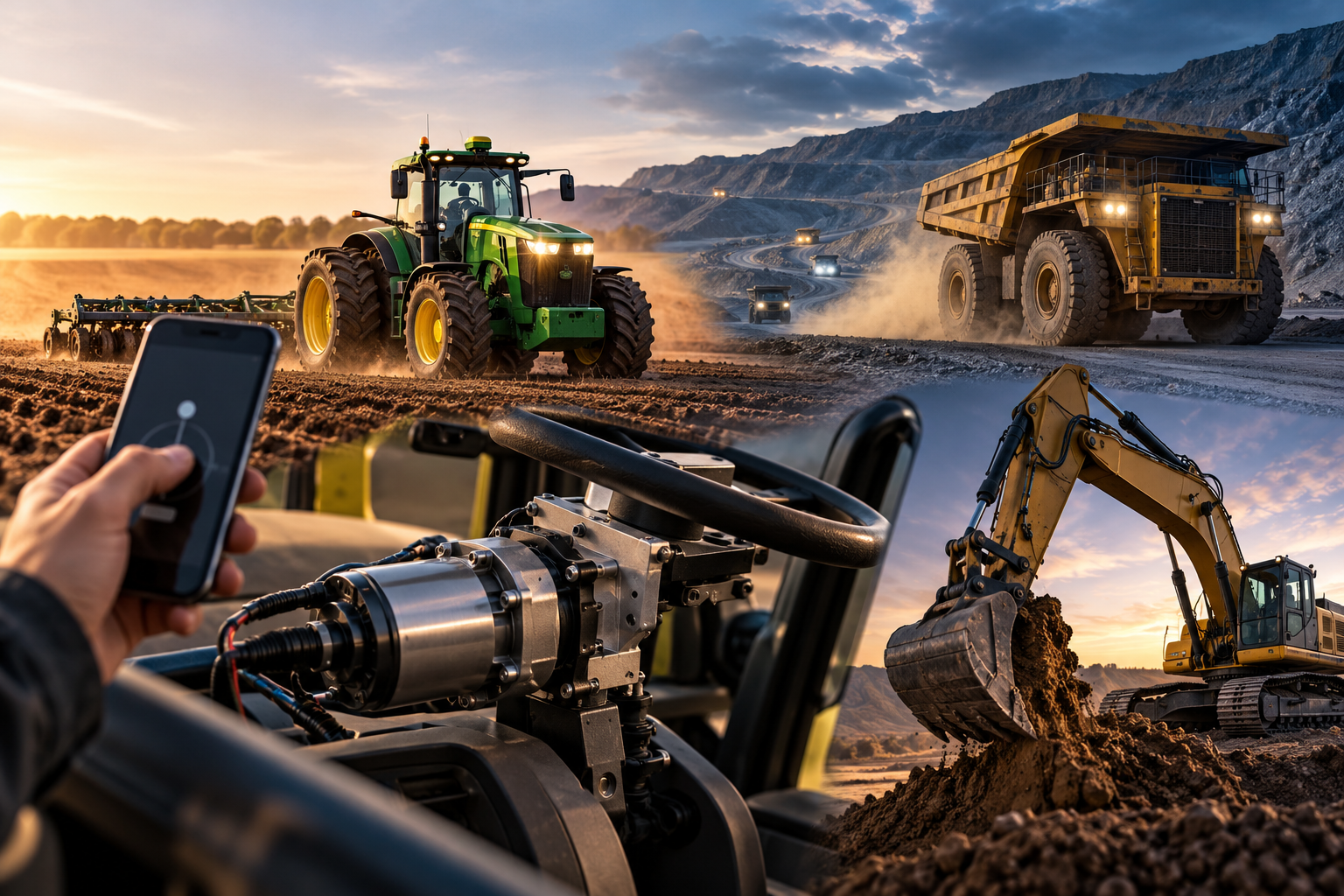
Doug Nimz is a fourth-generation farmer who grows corn and soybeans near Blue Earth, Minnesota. In January 2022 John Deere showed a video of him at its press conference at the Consumer Electronics Show in Las Vegas, operating a tractor from his phone. He described the first time he took the machine to a field: "swipe my phone, watch the tractor start with no one in the cab." It did the tillage, he said, as well as he could have done it himself. "I never thought I would see an autonomous tractor in my farming career," he said at the event. What excited him most was "not being locked in the tractor cab all day."
Three years later, on the same stage, Deere announced the second generation of that system. It had sixteen cameras where the first had six pairs, and it came with a promise aimed at every farmer who was not Doug Nimz. The technology would be sold as a kit for tractors already on the farm. "Farmers should not have to buy a new tractor to experience autonomy," said Willy Pell, the chief executive of Blue River Technology, the Deere subsidiary that builds the perception system. Deere's chief technology officer, Jahmy Hindman, put it as a matter of logic: "The natural place to start is to make the equipment farmers already own have an autonomous capability."
The same announcement lists which equipment that is. The kit fits 9R and 9RX tractors of model year 2022 and newer, and 8R and 8RX tractors of model year 2020.5 and newer.
The United States counts its farm machinery every five years. In the most recent count, for 2022, the Department of Agriculture found 3,784,743 tractors on American farms. Of those, 3,343,915 had been built before 2018.
There is a third fact, and it changes the meaning of the first two. PTx Trimble, a company majority-owned by Deere's competitor AGCO, sells an autonomy kit of its own. Its product page lists the tractors it fits.
"John Deere 8R (2014+)."
What lies between those three facts matters far beyond farming. In 2026 the conversation about artificial intelligence in the physical world is a conversation about robots. Tesla is installing a production line at its Fremont plant, in the space where it used to build the Model S and Model X, and Elon Musk has set a long-term goal of a million humanoids a year from it. The research firm Omdia counted about 13,000 humanoid robots shipped worldwide in 2025, most of them Chinese. The phrase for all of it is physical AI, and the picture that goes with the phrase is a machine with two arms and two legs.
Almost all the physical work in the economy is done by machines that already exist: tractors, excavators, haul trucks, loaders, forklifts. They were bought to last, and their owners intend to keep them. Whether software reaches those machines is a different question from how good the robots are. It turns on two things that rarely make the news. One is whether the machine's controls can be commanded at all. The other is the position of whoever is selling the kit.
Model year 2020.5: which tractors Deere's kit fits
The fine print of Deere's kit is worth reading slowly, because every clause narrows the word "existing."
The tractor has to be one of two series, the 8R or the 9R, with their tracked versions. It has to be recent: mid-2020 or later for the 8R, 2022 or later for the 9R. The implement behind it has to be a John Deere tillage tool, at launch one from 2017 or newer, and it needs its own kit, with lights, a satellite receiver mast and a wiring harness. "Today," the farm trade site AgWeb reported from the launch, "the system is only compatible with John Deere tillage implements with the autonomy kits installed." The tractor's kit is a set of cameras, a computer and a harness, and according to the trade paper Farm Progress hydraulic braking components are added to the rear axle. The work it does is tillage, the slow, repetitive pass that breaks up soil after harvest. A limited number of kits went to dealers in 2025, with a full launch planned for 2026. Select tractors of model year 2025 leave the factory, in Deere's phrase, "autonomy ready."
Deere has not explained why the line sits where it does. Its own customer magazine, The Furrow, described the plan in March 2025 in an interview with the company's autonomy marketing manager: "We plan to offer an upgrade kit to enable autonomy in earlier models, going back to the 2020 model year for the 8R series." The focus was on the two largest series, and Deere "will work to expand compatibility to other model lines over time." A dealer's guide from December 2025 shows the same floor, and I found nothing published since that moves it. On a podcast in January 2026, Tyler Zima of RDO Equipment, a Deere dealer group, repeated it, "your 20.5 and newer," and offered a practical reason why age matters: "the older you get, obviously the more labor intensive it gets to install" the kit. His group's customers, he said, ran seven autonomous tractors in the fall of 2025 and covered 13,000 acres that year.
There is a fair engineering reading of the line. Deere restyled the 8R and gave it a new, larger cab for model year 2020, and its kit is more than a pair of eyes: it adds brakes and a camera system meant to let a tractor work with nobody in the field. The floor may simply mark the platform on which that system was proven.
That is one manufacturer's line for one manufacturer's system. It would be easy to take it for something more, the year in which the tractor became controllable by software. Two other companies' product lists say otherwise.
A John Deere from 2014: the rival's retrofit kit
OutRun is the autonomy kit of PTx Trimble, the joint venture in which AGCO holds 85 percent. AGCO paid about $2 billion for that stake in the agricultural business of Trimble, a leading maker of aftermarket guidance systems. In June 2024, at an AGCO technology event, the trade reporter Matthew Grassi summarised the company's pitch: as long as the equipment is ten years old or newer, you can bolt the kit on. AGCO calls the approach "retrofit-first."
OutRun turns a tractor into a driverless grain cart hauler at harvest, the tractor that shuttles between the combine and the truck. When AGCO announced its commercial release to investors in March 2025, the kit worked on one family of machines: John Deere 8R and 8000R tractors with Deere's continuously variable transmission. A version for AGCO's own Fendt tractors was promised for 2026. PTx Trimble's product page now gives the range as John Deere 8R from 2014 onward, and the trade press adds a condition the page omits: the tractor needs that transmission. Grain cart work is available and tillage is listed for 2026. In March 2026 the farm paper Grainews reported that the tillage version becomes commercially available on Fendt 900 tractors this year.
AGCO's autonomy kit, in other words, went on sale first for its competitor's tractor, a choice Grainews called somewhat surprising, and on that tractor it reaches six model years further back than the competitor's own kit.
It was not even the first to do so. In May 2021 Raven Industries, a precision farming company that the tractor maker CNH bought later that year, launched a driverless grain cart kit called OMNiDRIVE. The trade service DTN gave its range at launch: "currently compatible with John Deere 8Rs Powershift and IVT (2010 to current models)."
The kits do different jobs. Deere's system does tillage with nobody in the field, using sixteen cameras and added brakes. The grain cart kits began with a narrower job, a tractor shuttling at harvest under the eye of the combine operator. Deere's floor of 2020.5 marks how far Deere has taken its own, more demanding system. It does not mark the year the 8R became commandable by software, because other companies were selling kits that drove 8Rs from 2010 and 2014.
This is not to claim that Deere is holding its kit back. No company has stated a reason, and the engineering reading above may be the whole of it. The positions of the two companies are a matter of record, though, and they differ in one respect. Deere can bring autonomy to one of its own customers with a kit, or by selling that customer a new tractor that arrives ready for it. AGCO has no way to sell a replacement for a Deere that a farmer intends to keep. For AGCO, the tractor already in the yard is the only route to that farmer. The difference in position is a fact; the record does not show whether it explains the difference in reach.
The maker has two ways to put software in its tractor. Its rival has one.
A third example sits in the cane fields of Florida. In May 2026 U.S. Sugar announced that five John Deere tractors, four 8R and one 9R, were working its land with automation from another company, Autonomous Solutions Inc. The kit, the announcement said, "integrates with the tractors' existing drive-by-wire system." The tractors were bought new from a Deere dealer, Everglades Equipment Group, which also supported the project. The case concerns new machines, and what it shows is that a company other than Deere can command a Deere.
3,784,743 tractors: the age of America's fleet
The farm census is the best count of an installed base that exists for any class of working machine, because the government asks every farm what it owns and whether each machine was built in the previous five years.
In 2022 there were 3,784,743 tractors on American farms, down from 4,038,099 five years earlier. Of the whole fleet, 440,828 had been manufactured from 2018 through 2022. That is 11.6 percent. The rest, 88.4 percent, were older. The tractors that do the heavy field work are the ones of 100 horsepower and more, and there were 1,252,844 of those. Of them, 153,129 were built from 2018 through 2022, which is 12.2 percent, and 1,099,715 were built before 2018. Five years earlier the same question had produced a higher share of young machines among the large tractors: 180,741 of 1,246,592, or 14.5 percent. Between the two counts, the fleet that does the field work got older. At the rate new tractors arrived on farms in those five years, about 88,000 a year, replacing the whole stock would take roughly 43 years. That figure is arithmetic and no kind of forecast, since old tractors are also sold off, parked and scrapped, but it gives the order of magnitude: the fleet turns over on the scale of a working life.
Set Deere's floor against that table. Every large tractor built before 2018 falls outside its kit by at least two and a half model years, whatever the brand. That is 87.8 percent of the large tractors counted in 2022. The number needs three cautions. The census is three years older than the kit; the manufacturers' association counted about 27,000 large tractors sold in the United States in 2024 alone, so the share of old machines is a little lower today. The figure covers every brand from 100 horsepower up, while the kit fits two Deere series at the upper end of that range. And any kit limited to the last five model years would produce the same percentage, so what it measures is the age of the fleet. How many tractors can actually take Deere's kit, I could not establish. Deere has published neither that count nor the number of kits sold. The nearest thing to a deployment figure is older and smaller: in January 2025 a Forbes contributor who covers vehicle automation wrote that only several dozen of the autonomous tractors Deere announced in 2022 were in daily operation with farmers.
One more caution runs the other way. A share of tractors is a different thing from a share of the work. Large farms own the newest and biggest machines and cover most of the acres. When the Department of Agriculture's Economic Research Service studied automatic steering, it found the technology on 73 percent of the largest corn farms in 2016 and on 10 percent of the smallest. A kit that fits a small share of tractors could, in principle, till a far larger share of American cropland. The census tells us how much of the machinery is out of the leading kit's reach, and nothing about how much of the farming is.
Nine years on paper: why the fleet looks young
There is a second number that makes the installed base hard to see, and it comes from the place where economists normally look for it.
The Bureau of Economic Analysis keeps the national accounts for the United States, including a table of the average age of the country's private equipment. In that table American business equipment is strikingly young, and has been since the 1950s. The average age of private non-residential equipment was 6.9 years in 1950 and 7.1 years in 2025. Agricultural machinery stood at 6.7 years in 2025, construction machinery at 5.6. In its depreciation schedules the Bureau assigns a farm tractor a service life of nine years.
Nine years, against a fleet in which nearly nine tractors in ten are older than five and the implied replacement time is over forty. Both figures are correct, because they answer different questions. The Bureau weights each age by its share of the remaining value of the stock, so a new tractor counts heavily and a thirty-year-old one, written down to almost nothing, hardly counts at all. A tractor that is worth nothing on paper still pulls a planter.
The national accounts measure what the stock is worth. The census counts what is standing in the yard.
This matters for the argument about artificial intelligence because the two clocks are so far apart. Epoch AI, which tracks the inputs to machine learning, estimates that the computing power used to train the largest language models has grown about fivefold a year since 2020. Five years at that rate is a multiplication of some three thousand. In the five years the census measured, 2018 through 2022, 11.6 percent of American farm tractors were replaced. The periods do not line up, and computing power is an input while a fleet is a stock, so this is an illustration of two clocks and no more. It shows why "the equipment farmers already own" is the right phrase to fight over. If autonomy could only arrive with a new machine, it would arrive at the speed of the census.
A motor on the steering wheel
Below the big row-crop tractors, the kits reach further still, and they show what it takes to cross from a machine that accepts instructions to one that does not.
Sabanto, a company with offices in Illinois and Iowa, sells a kit called Steward for mid-sized tractors. In November 2024 the British magazine Farmers Weekly listed what it takes. The price was $65,000 installed, plus $10,000 a year. The kit existed for twenty tractor models, among them John Deere's 5E, 5M and 6E ranges, the Kubota M5 and the Fendt 700. Sabanto's engineers work out the messages each model sends across its internal network, the CAN bus, so that their software can send messages of its own. That takes about three months per model, and the company will do it for a new model if someone orders at least five. Its compatibility page states the conditions: an electronic shuttle, the control that switches between forward and reverse, and a factory grill guard. The gearbox itself can be mechanical. On those tractors, the magazine reported, the one thing beyond the kit is a mechanical gear change. About 300 kits were running in North America at the time.
Three days before that article, the same reporter, Oliver Mark, had described a different answer. Bluewhite, an Israeli company working mostly in the orchards and vineyards of the American west coast, concentrates on what he called "sub-100hp machines with little in the way of electronics." Where the tractor offers nothing to talk to, the kit supplies hands. It uses "a little motor to turn the steering wheel," and linkages that physically push the brake pedals and the lever for the power take-off. The hardware and installation cost $35,000, and the annual subscription $30,000. The company's main job is spraying permanent crops, slow work in straight rows. In January 2024 it reported 50,000 hours of autonomous operation across 150,000 acres. It has not published a count of tractors, and Farmers Weekly could say only that it had "a ruck of machines" at work. In the spring of 2026 Bluewhite was bought by a unit of Elbit Systems, the Israeli defence company.
This is the old idea of the robot operator in its least glamorous form. Nobody built a humanoid to sit in the seat. They built the parts of one that the job required, a wrist for the wheel and a foot for the pedal, and bolted them to the cab.
The same approach has reached the building site. The first kit Bluelight Machines installed went on a "beat-up, old Cat CS54B" roller that a customer handed its chief executive, Dick Zhang, with a request to make it go by itself. The Pittsburgh company, formed in 2023, now sells kits that turn soil compactors and articulated dump trucks into unmanned machines, and the parts list includes a steering motor. Zhang told Equipment World that about 200 kits are installed on active subscriptions, at roughly $50,000 to $60,000 each.
So the picture has three rings. The maker's own kit covers its newest large tractors. Kits from other companies follow the electronic controls further back, to 2014 and earlier on a Deere 8R and to some twenty mid-sized models with an electronic shuttle. And at the edge, on machines doing slow and simple work, a kit can move the controls by force. What lies outside all three is the machine that is large, old and asked to do something complicated: the older high-horsepower tractor, which is most of what the census counts, and the older excavator.
Brockman 4: driverless haul trucks by retrofit
There is one industry where the retrofit has been done at scale, and it shows the conditions under which it works best.
In December 2017 the mining company Rio Tinto announced that it would convert 48 of its existing haul trucks in the Pilbara iron ore region of Western Australia to run without drivers: 29 Komatsu trucks at a mine called Brockman 4, starting in early 2018, and 19 Caterpillar trucks at Marandoo from the middle of that year. About a fifth of its roughly 400 trucks in the region already had autonomous capability. The company said each autonomous truck had worked on average about 1,000 hours more in the previous year than a conventional one, at a load-and-haul cost 15 percent lower. Rio signed agreements with both manufacturers to do the conversions.
Everything about that case favours the kit. The trucks belonged to one owner, who had bought them from two suppliers and could bring both to the table. They ran on private roads inside a closed site with no public traffic, where the owner also controlled every other vehicle. And the party doing the conversion was the company that had designed the truck. Mining is also the case that cuts against any simple story about outsiders. Here the makers converted their own older machines, and I know of no outside kit that reached further.
Mining has since become the largest fleet of driverless heavy machines in the world, and it is still small against the stock. Komatsu, which put the first commercial autonomous haulage system into service in 2008, commissioned its thousandth autonomous ultra-class truck in April 2026, at a gold mine in Nevada. The research firm GlobalData counted 3,832 autonomous haul trucks at surface mines worldwide in July 2025, up from 2,080 a year earlier, most of the jump in China, from 562 to 2,090; no source I found says how many were conversions. It had counted about 94,000 active surface mining trucks of all kinds in 2023. The years do not match exactly, so the ratio is approximate: around four percent, seventeen years after the first commercial deployment.
The excavator that kept its hydraulics
A tractor from 2014 and a mining truck behind a fence are the easier cases. The hardest is the old excavator: can it be made to dig by itself?
Technically, yes. In 2020 three engineers from Husco International, a maker of hydraulic controls, presented a paper at a fluid power conference in Dresden. They had taken a 21-ton excavator with conventional pilot controls, the kind in which the operator's joysticks push low-pressure oil that in turn moves the main valves, and added electrohydraulic valves, sensors and a controller so that software could drive it. They kept the original hydraulic system and left the operator's joysticks working. Aftermarket automation of bulldozers and graders, they noted, had already "driven a conversion of machines to electro-hydraulic (EH) implement control."
Commercially, the record is thinner than the venture funding suggests. Built Robotics, founded in 2016, sold an autonomy system for excavators of 15 to 60 tons. The trade magazine Equipment World described how it handled the two generations: on late-model machines the system worked through the electronics, and on older ones the company installed its own manifold to control the pilot hydraulics. For excavators, that is the only autonomy kit I found that documented support for the unwired machine. In 2023 the company narrowed its business to solar farms, where it now builds a pile-driving robot on a single modified excavator model.
Teleo, a California company, has gone furthest back in age. In October 2023 it said the machines it was converting for customers, from Caterpillar, Komatsu, John Deere and Volvo, ranged in model year from 2005 to 2022. What it automated first was the simplest part of the work, driving a load from one point to another, with a remote operator handling the dumping. It said 42 machines would be deployed across 17 job sites.
Bedrock Robotics, started by former Waymo engineers and backed with $350 million, aims at the hardest part, the digging itself. It describes its product as a same-day installation that requires no permanent changes to the machine. In August 2026, when it announced its first deployments with nobody in the cab, the trade site The Robot Report added a detail: for now the company deploys only new equipment that it has outfitted and tested at its own headquarters. It expects to run on its partners' machines by the end of the year, and its design "will eventually enable retrofits of existing late-model excavators."
The easy task reaches old machines. The hard task starts on new ones.
The other route to the old machine is the one that leaves it untouched: a whole robot shaped like an operator, sitting in the seat. Japanese engineers put a remotely controlled humanoid at the levers of a backhoe in 2002. Twenty-four years later I have found no humanoid operating a working machine autonomously at working speed. Tesla, whose robot is the most watched, said in January 2026 that Optimus was "not in usage in our factories in a material way." For heavy equipment the humanoid is the candidate for everything the three rings leave out, and so far it is only a candidate. Bluewhite's steering motor is a reminder that the job may be done first by something much less than a body.
Who owns the autonomy retrofit
If the kit is the bridge between software and the existing fleet, the next question is who owns it. The evidence is clear about ownership and silent about money.
The independent companies that set out to build autonomy for other people's machines have largely been absorbed. Bear Flag Robotics, founded in 2017 to retrofit self-driving technology onto existing tractors, was bought by Deere in August 2021 for $250 million; its work is part of the kit Deere now sells for Deere tractors. Trimble's agricultural business went to AGCO, and Raven to CNH. SafeAI, which converted mining and construction trucks, was sold in July 2025 to its rival Pronto for what a source described to TechCrunch as "the millions." Bluewhite went to a defence contractor.
Caterpillar shows the same move as AGCO from the other side of the fence. On its earnings call in January 2026 it said it had agreed to supply the Brazilian miner Vale with an autonomy system for a mixed fleet of more than 90 trucks. For a manufacturer, a kit that fits a competitor's machine is a way into a customer who has already bought from someone else. The retrofit, which began as a way for outsiders to reach machines without their makers, is becoming a way for makers to reach into each other's fleets.
The bridge has other gatekeepers besides its owner. In California, workplace safety rules require self-propelled equipment in motion to have an operator stationed at the controls, with a narrow exception for slow, furrow-guided machines. In the European Union, from January 2027, whoever substantially modifies a machine in a way its maker did not foresee, and in a way that affects its safety, is treated as its manufacturer, with the duties that come with that. And a kit priced in the tens of thousands of dollars pays back more easily on a large farm than a small one, which is also where automatic steering took hold first. Regulation, liability and payback shape the reach of a kit alongside the wire.
Who earns from this cannot yet be shown. Deere reports no revenue from autonomy and no number of kits. Caterpillar gives a count of trucks, 827 at the end of 2025, and no income attached to it. Sabanto and Bluewhite are the only sellers whose prices I found in print. According to trade press coverage of a J.P. Morgan note in January 2024, Deere planned to price its kit low and charge for use, by the acre or by the unit. PTx Trimble advertises a one-time hardware price and an annual fee. Every seller is reaching for a recurring payment on work the machine already did for its owner, and none has published what it collects. The adapter is a point of control, and nobody outside these companies can measure what it earns.
Toyota, model year 2022: when the wire gets a lock
The outsiders depend on one thing they do not control: the machine has to accept a message from a device its maker did not install. A different industry shows what happens when it stops doing so.
A small American company called comma.ai sells a device that adds driver assistance to ordinary cars. It plugs into the car's internal network, reads the messages the car's computers exchange, and sends its own to the steering and the accelerator. Its software, openpilot, lists more than 350 supported vehicles from 27 brands. It works for the same reason the outsiders' tractor kits work: modern cars steer and brake by electronic command, and the commands travel on a network that an added device can join.
In recent Toyotas the device can no longer join. Toyota began shipping cars that use Secure Onboard Communication, an industry standard that attaches an authentication code to messages on the car's network. A component accepts a steering command only if it carries a code computed with a secret key. The security researcher Willem Melching, who wanted to run openpilot on a 2021 RAV4 Prime, described the effect precisely in March 2024: the mechanism "prevents devices that have no knowledge of the secret AES key to communicate with the rest of the vehicle," and so it "also prevents the owner of the vehicle to install any third-party devices." He and a former colleague got the key out of that car by attacking the power steering computer with deliberate voltage glitches and then exploiting its bootloader. Community documentation lists a growing number of Toyota and Lexus models as unsupported, beginning with some 2021 and 2022 cars and reaching the Camry in 2025.
Nothing I have read says Toyota adopted message authentication in order to keep aftermarket devices out, and there is a straightforward security reason to authenticate steering commands. The effect is what matters here. Once the messages are authenticated, the electronic route into the machine belongs to the maker alone. From then on, autonomy by wire can come only from the company that built the machine, or from someone holding its key.
The outsider's window opens when a machine gets a wire and closes when the wire gets a lock.
For farm tractors, only the first half of that sentence is documented. I found no tractor maker using authentication, warranty terms or a lawsuit to stop an autonomy kit, and a Deere dealer sold the tractors that another company automated in Florida. The long fight between farmers and Deere over repair, which ended in July 2026 in a settlement with the Federal Trade Commission and five states, was about the right to read fault codes and reprogram parts, which is diagnosis. Europe's Data Act, which has applied since September 2025, gives the owner of a connected machine access to its data and no right to send it commands. If tractor networks were locked the way Toyota's are, the middle ring would close, each maker's own floor would become the edge of what software can reach by wire, and the census shows how much of the fleet sits behind a floor like Deere's.
Construction has one case, and the lock in it is legal. On 10 June 2026 Caterpillar's paving division sued Bluelight Machines in federal court in Delaware, alleging that its kits infringe five Caterpillar patents and asking for a permanent halt to their sale. According to the complaint, as Equipment World reported it, the kits "initially only worked on Caterpillar machines." Zhang calls it a "no-merits set of allegations" and says the kits rest on open-source software and steering technology that has existed for about twenty years. The case is undecided, and a patent claim is a different thing from a claim about access to a machine. It is still the first instance I know of in which a heavy-equipment maker has asked a court to stop a kit built for its own machines. The technical lock, authentication, remains an expectation drawn from cars, and I mark it as one. The Bluelight case is a reminder that a motor on the steering wheel does not put a kit beyond a maker's reach.
Less than five percent in 1899: the electric motor
The pattern has happened before, and the earlier case is uncomfortable for anyone who thinks the retrofit is the whole story.
In 1990 the economic historian Paul David asked why computers were everywhere except in the productivity statistics, and went looking for a precedent in the electric motor. In 1899, he found, electric motors accounted for "less than 5 percent of factory mechanical drive" in American manufacturing. According to Warren Devine's study of the same transition, the share passed half around 1919. The effect on productivity did not show until the early 1920s, some four decades after the first central power station opened.
The part of David's account that matters here is how the first half of that electrification was done. Factories built for steam or water power had a single large engine turning long overhead shafts, with leather belts running down to each machine. The cheap way to electrify such a plant was to leave all of that in place and replace the engine with electric motors that turned sections of the same shafting. The arrangement was called group drive. David describes it without sentiment: "the retrofitting of steam- or water-powered plants typically entailed adding primary electric motors to the original stock of equipment." The factory was now electric, and it was also the same factory, with the same shafts, the same belts and the same layout dictated by where the shafts ran.
The gains came with unit drive, in which each machine had its own motor and the factory could be laid out in the order of the work. It mostly required a new plant, and David attributes the delay to "the unprofitability of replacing still serviceable manufacturing plants."
As an interpretation, and no more than that: the autonomy kit is the group drive of this technology. It puts a new source of control on the original stock of equipment. It raises the count of autonomous machines, and it leaves in place a tractor with a cab, a seat, a steering column and a size chosen around what one person can drive in a day. If the precedent holds, the kit is an opening stage, and the larger change belongs to machines designed from the start with no operator in mind. The precedent may not hold. Electric motors were a new source of power, and autonomy is a new source of control, which may be easier to add to an old design than a new kind of power was.
The strongest objection
The strongest counterargument accepts every number above and says there is no story here beyond a launch schedule. Deere began with its newest and most uniform tractors because that is where engineering is cheapest and the customers are largest. It has said in its own magazine that compatibility will expand to other model lines over time. Its system does more than the grain cart kits do, on a tractor platform that changed in 2020, so a later floor is what careful engineering looks like. And the other companies chose the 8R for the dullest of reasons, that it is where the customers are. Meanwhile every new large tractor leaves the factory ready for autonomy, and the big farms that buy new tractors are the ones that cover the acres.
There is a precedent on the objection's side, and it is a good one. Automatic steering reached farms as an add-on. The Economic Research Service found it on 5.3 percent of corn acres in 2001 and 58.4 percent in 2016, and noted that such systems "come equipped in farm machinery or can be purchased separately and integrated with existing equipment." In those fifteen years, at the pace the census implies, something like a third of the tractor fleet was replaced. An add-on outran the machines it sat on. Both precedents can hold at once: an add-on can cover most acres and still leave a tractor built around a seat.
This objection is serious, and on the question of acres it may simply be right. If the claim here were that autonomy will stay confined to a small part of American farming, the steering precedent would defeat it. If the claim were that Deere is holding its kit back, there is no evidence for that at all. The claim is narrower. How far back software reaches into an installed base differs by seller on the same machine: the maker, which can also sell a replacement, has so far taken its own system back five model years, and companies that cannot sell that replacement have taken theirs back to 2014 and 2010. That is one tractor series, and kits that do different jobs. It is enough to show that the maker's eligibility list is not a map of what is technically possible, and not enough to show a rule. Mining points the other way: there the makers themselves converted older trucks, and no outsider reached further.
What would change my mind is easy to state. If Deere extended its own kit to 8R tractors from the middle of the last decade, the gap would be shown to be a matter of schedule. If other companies' kits turned out to reach no further than makers' kits on most machine types, as in mining, the Deere case would be an exception. And if a published count showed kits working in numbers on large old tractors or excavators without electronic controls, the outer ring I described would not be the edge.
The phone in Blue Earth
Doug Nimz swiped his phone in a field in southern Minnesota and a tractor moved. It moved because that tractor already steered and shifted by electronic instruction. Deere still had to build perception, computing and added brakes around it, but the machine underneath already knew how to obey a digital command. The camera could show the swipe, while the thing that made it possible had been installed years earlier, in the tractor's controls.
Those controls are in far more tractors than Deere's kit covers. A competitor is already using them on Deere's own machines, a third company is using them in Florida, and where they are missing altogether somebody has bolted a motor to the steering wheel. What is left after all of that is the large old machine doing complicated work. Nobody has reached it at scale, and none of the robots now being built by the thousand has reached it yet.
The census will count the tractors again for 2027.
Sources: USDA census 2022; Deere via AgWeb, Farm Progress, The Furrow and RDO; PTx Trimble; AGCO; DTN on Raven; U.S. Sugar; Farmers Weekly on Sabanto and Bluewhite; Equipment World on Bluelight and Built; Teleo; Bedrock; Husco; BEA; Rio Tinto; GlobalData; Melching on Toyota; Cal/OSHA; EU Machinery Regulation; Paul David; USDA ERS.
Jerry van der Laan writes The Manifest Archive, Forensic Narrative Intelligence Writing on the systems beneath power, money, and history. He traces the structures beneath them.
Evidence Map
Facts, interpretations, forecasts, and disconfirming signals.
Core claim. How far back an autonomy kit reaches into the existing fleet differs by seller. Deere's own kit covers its large tractors from model year 2020.5; other companies' grain cart kits have fitted the same Deere series from 2014 and from 2010; smaller kits drive mid-sized tractors with mechanical gearboxes, and kits with a steering motor drive small tractors and construction rollers. At least 87.8 percent of the large farm tractors counted in 2022 predate Deere's floor. The evidence thins sharply where old, mechanically controlled machines are asked to do complex autonomous work; no deployment at scale was found there.
Evidence level. Facts (high): the census counts; the published eligibility of Deere, PTx Trimble, Raven, Sabanto and Bluewhite; the Rio Tinto conversions; the mining counts; the acquisitions; the Toyota authentication case; the filing of Caterpillar v. Bluelight. Reported by the company only (medium): Bluewhite's hours, Bluelight's 200 kits. Interpretation (medium, marked in the text): that the difference in reach matches each seller's alternatives; that the kit resembles group drive. Not established: any intent behind Deere's floor, how many tractors are eligible, how many kits are sold, who earns, and whether any maker restricts outside kits by technical means.
What would confirm this. Outsiders' kits continuing to reach further back than makers' own kits on other machines; makers selling kits for competitors' fleets; autonomy growing mainly through factory-ready machines among makers' own customers.
What would disprove this. Deere extending its own kit to 8R tractors from the mid-2010s; other companies' kits reaching no further than makers' kits on most machine types, which is already the picture in mining; a published count of autonomy kits working at scale on large old tractors or excavators without electronic controls.
Watchlist. Deere's first published kit numbers after the 2026 full launch; the outcome of Caterpillar v. Bluelight; whether Bedrock runs on partners' existing excavators by the end of 2026; the 2027 Census of Agriculture; the EU Machinery Regulation from 20 January 2027 and how it treats a retrofitted machine; any authentication on heavy-equipment control networks.
Related from The Manifest Archive
- When Physical Skill Becomes Software: The Hidden Economics of Humanoid Robots
- The Ownership Illusion: License vs Ownership in the Digital Age
- More Than One in Five New Cars in Europe Is Electric. 92 Percent of Its New Trucks Are Diesel.
- Everyone Is Watching the AI Boom. Nobody Is Watching the Transformer That Can't Be Built in Time.