A farmer in western Kansas wakes before dawn, and before his boots touch the field the economic reality of his season has already been decided somewhere he will never go.
He is a fourth-generation grower. His grandfather stored grain in a wooden elevator that still stands at the property line, except the elevator now belongs to a subsidiary of a company headquartered a thousand miles away, whose executives he will never meet and whose trading desks set, overnight, the value of everything he will harvest. He opens a laptop. On the screen is the December futures price for corn. It moved while he slept. It will move again before he reaches the field. The number was set in Chicago, through instruments he does not own and cannot audit, and by the time the sun clears the tree line the season's outcome is already priced into markets on the far side of the planet.
He still grows the crop. He no longer governs its reality.
This is a story about the distance between those two facts, and about what fills it. It is usually told as a story about four companies, and the four companies are real and they matter. But they are the visible layer, and beneath them lie two deeper ones, and the deepest is not a company at all. It is a chemical reaction, running on natural gas, that keeps roughly half the people on earth alive. Almost no one who eats has ever heard its name.
The visible chokepoint: the four
Start where the story is usually told, because it is true as far as it goes.
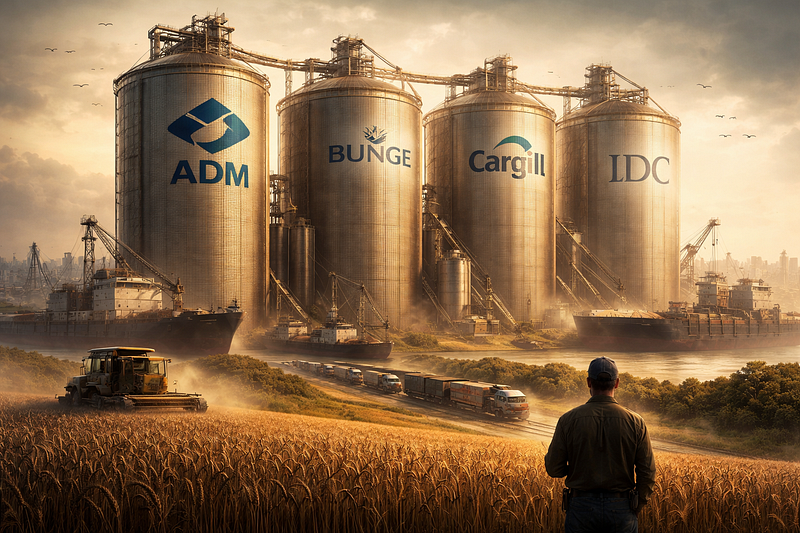
Four private firms stand between most of the world's farmers and most of the world's eaters. Archer Daniels Midland, Bunge, Cargill, and Louis Dreyfus, known in the trade as the ABCD, move the grain that crosses borders. The estimates of their share vary with the method and the year, from a long-cited seventy to ninety percent of internationally traded grain down to a more conservative sixty percent of global cereal and oilseed volume by recent tonnage. Whatever the exact figure, the shape is not in dispute: the staple calories that move from where they are grown to where they are needed pass, overwhelmingly, through four sets of hands.
What those hands hold is not a single monopoly. Each of the four competes with the others. What they hold instead is infrastructure: the elevators at the rail junctions, the export terminals at the ports, the barges and the contracts and the trading desks, built up over a century and a half until the company and the plumbing of the global grain trade became the same thing. Cargill began in 1865 with a single grain warehouse at an Iowa railroad junction, on the simple insight that every bushel moving east had to pass through someone's system. They spent the next hundred and sixty years making sure the system was theirs. Cargill is today the largest privately held company in the United States, owned still by the descendants of its founder, which means the firm that sits at the center of how the world is fed answers to no shareholders, files no public accounts of the kind a listed company must, and discloses what it chooses on the schedule it chooses. The most important grain trader on earth is, in the most literal sense, a family secret. No fifth firm has built a parallel one, because the capital required now runs to the hundreds of billions, and capital at that scale does not enter a market already owned. Their position is protected not by any law but by time.
And the four are no longer only traders. They sell the farmer his seed. They buy back his crop. They ship it, store it, and process it. They lend him the money to plant, and they sell him the insurance against the very prices they help to move. They are buyer, processor, shipper, financier, and risk manager at once, taking a margin at every step. When prices are stable they earn the spread. When prices convulse they earn far more. The direction does not matter to them, because they do not bet on the weather. They are the table.
Power, here, never arrived as domination. It arrived as infrastructure, which is why it was never voted on and is rarely even seen.
One layer down: the seed
But follow the chain backward, before the grain reaches any trader, and a second chokepoint appears that is tighter than the first.
Before there is a harvest there is a seed, and the seed has been quietly enclosed. Across the 2010s a wave of mergers collapsed the global seed and agrochemical industry into a handful of giants. Bayer swallowed Monsanto for sixty-three billion dollars. Dow and DuPont merged and spun their farm business into Corteva. The state-owned China National Chemical Corporation bought Switzerland's Syngenta. When the dust settled, studies of the merged market, including a 2018 OECD analysis of seed concentration, found that just three of these firms controlled around sixty percent of the world's patented seeds and around sixty-four percent of its pesticides. The share of the global seed market held by the largest four firms had climbed from roughly a fifth in the early 1990s to well over half.
The word patented is the load-bearing one. For most of agricultural history a farmer kept part of his harvest to plant the following year; the seed was a commons, renewed for free. The modern seed is intellectual property. It is engineered, patented, and sold under contracts that forbid saving it, so that every season the farmer must buy again, often a seed paired with the same company's herbicide, so that the purchase of the seed pulls the purchase of the chemical behind it. The oldest self-renewing resource in human civilization has been converted into an annual subscription, owned at the source by fewer firms than there are traders downstream.
So the four who move the grain are not even the narrowest point. Beneath them sit three or four who own the beginning of the chain, the genetic instructions for the crop itself. The visible power moves the food. The deeper power decides what the food is allowed to be before it is planted.
The dependency was designed in
There is a reason the seed and the fertilizer travel together, and it was built on purpose, by people who believed they were saving the world and largely were.
In the middle of the twentieth century the agronomist Norman Borlaug bred new dwarf varieties of wheat that yielded far more grain than the old tall landraces, and parallel work produced the high-yield rice of the same era; the Green Revolution they launched together is credited with sparing perhaps a billion people from famine. But the new seeds carried a condition written into them. They produced their miracle yields only when fed heavy doses of synthetic fertilizer and water; starved of inputs they did no better than the old seeds, and sometimes worse. The package was indivisible. The high-yield seed, the fertilizer, and the irrigation came as one system, and to adopt the seed was to adopt a lifelong dependence on the inputs that made it perform.
That is the deep architecture of the whole arrangement, and it is why the layers lock together. The seed firm sells a seed that requires the fertilizer. The fertilizer requires the gas and the rock. The trader moves the grain the system produces and finances the inputs the system demands. Each layer was a genuine advance, and each advance deepened the dependence, until a way of farming that fed billions could no longer be left by anyone inside it. You cannot return to saving seed and feeding the soil with manure and still grow what eight billion people now eat. The Green Revolution did not only raise the ceiling on how many people the earth could hold. It bound that many people to the system that raised it.
The floor beneath everything: nitrogen
Go down one more layer, the last one, and you reach something that is not a company at all, and that turns out to hold up more of the world than any firm ever could.
Take nitrogen. Plants need it to grow, and although the air is almost four-fifths nitrogen, the plant cannot use it in that form; it must be fixed into a compound the soil can feed on. For all of history that fixing was done slowly, by bacteria and lightning, and it set a hard ceiling on how much food the earth could grow and therefore how many people it could hold. Then, in the years around 1910, two German chemists, Fritz Haber and Carl Bosch, worked out how to pull nitrogen from the air and force it into ammonia at industrial scale. The Haber-Bosch process broke the ancient ceiling. Synthetic fertilizer poured into the world's soils, yields multiplied, and the human population, which had taken all of history to reach under two billion, passed eight.
Here is the fact almost no one carries in their head, established by the analyst Vaclav Smil, who has spent a career counting what civilization actually runs on. Close to half the nitrogen in your body, in the protein of your muscles and the cells of your brain, passed at some point through a Haber-Bosch reactor. By his estimate roughly half the people alive today are fed only because of synthetic nitrogen. Without it, by the most cited calculation, somewhere around three to four billion people could not be fed at all.
And that reaction runs on natural gas. Gas supplies the hydrogen that combines with nitrogen to make ammonia, and gas supplies much of the heat to drive the process; making the world's fertilizer consumes several percent of all the natural gas humanity burns. This is the floor under everything else. It lies beneath the seed. It lies beneath the trader. It lies beneath the farmer, and beneath the price glowing on the Kansas laptop. Half of humanity is fed by a single industrial reaction that eats fossil gas, and the price of bread in every importing country is, at one remove, the price of gas.
That is the determining variable the four-company story never reaches. Everyone watches the harvest. A few watch the traders. Almost no one watches the gas, and the gas is holding up half the world.
The farmer in Kansas is not thinking about Fritz Haber when he buys his nitrogen by the ton in the spring. He is thinking about the price, which has roughly doubled, and about whether to cut his application rate and gamble on the yield. He does not know that he is standing on the same chemical floor as a rice grower in Punjab and a mother counting coins for bread in Cairo. But he is, and when the price of gas moves in a country none of the three of them could find on a map, the floor shifts under all of them at once, and only one of them will be told why.
The other two nutrients, and the map
Nitrogen is the most famous of the three things a crop must be fed, but it is not the only chokepoint, and the other two are concentrated even more brutally, by geography, because unlike nitrogen, which can be pulled from the air wherever there is gas, they have to be dug out of specific holes in specific countries.
Phosphorus, the second letter on the fertilizer bag, comes from phosphate rock, and more than seventy percent of the world's known reserves sit in a single country, Morocco, together with the disputed territory of Western Sahara that Morocco controls. One state company there processes a large share of what the world's farms will eat, and there is no synthesizing phosphate from the air, no second Morocco to turn to. Phosphorus has no substitute. When that rock runs short, or that country decides, every field on earth feels it.
Potassium, the third nutrient, tells the same story in a colder geography: the world's potash comes overwhelmingly from a short list of producers led by Canada, Russia, and Belarus, so that a sanctions decision or a closed border among three northern countries reaches quietly into soil on every continent.
So the floor beneath the food supply is not one chokepoint but a set of them, and they are not corporate but geological and chemical: one reaction for nitrogen, one country for phosphorus, three countries for potassium. The four trading firms where the story usually stops are sitting on a base far narrower than themselves.
The cascade, and the delay that hides it
Once you can see the floor, the way a shock travels through the building becomes legible, and so does the reason it is so hard to trace.
In late 2021 and into 2022, European natural gas prices spiked, first on supply tightness and then on the war in Ukraine. Gas is the feedstock of fertilizer, so fertilizer followed: across Europe, ammonia plants throttled back or shut down because the gas to run them cost more than the product would fetch, and the world price of nitrogen fertilizer roughly doubled and in places more. Farmers planting the next season faced input costs they had never seen, and many did the only thing they could, which was to apply less. Less nitrogen means lower yield. Lower yield, harvested months later and sold months after that, means higher food prices a year or more downstream, in countries that had nothing to do with European gas. The global food price index hit its highest level on record in early 2022.
Now notice the cruelest feature of the chain, which is its timing. By the moment the price reaches a market stall in Cairo or Nairobi, the event that set it moving, a gas crisis on another continent a year earlier, is long out of the news and invisible to the person paying. Delay launders causality. The distance in time between the shock and the suffering is wide enough that almost no one connects them, and a cost that can be traced to no visible cause is a cost no one can organize against. Time is the most overlooked layer of control, because a system whose effects arrive a year after their causes is a system that never has to answer for them.
The experiment no one meant to run
If you want to know what synthetic nitrogen actually holds up, look at the one recent case where a country tried to remove it, not slowly, but overnight.
In April 2021 the government of Sri Lanka banned chemical fertilizer across the whole country, intending to become the world's first fully organic farming nation. The aim was idealistic and the execution was instantaneous, and the result was a controlled experiment in the dependence this essay has been describing. Within a single growing season rice harvests fell by roughly a third. A country that had fed itself for decades was forced to import rice. Tea exports, its great earner, collapsed. The agricultural shock poured into an economy already failing and helped bring the government down. The ban was reversed within seven months, but a lost harvest cannot be un-lost, and there was no gentle return to an older way of farming, because the older way could not feed the people the new way had allowed the country to have.
Sri Lanka strips the argument to the bone. It is easy to mistake the fertilizer system for an optional excess of industrial agriculture, a thing a wiser society could simply choose to do without. Sri Lanka chose to do without it and discovered, in a single season, that the choice was not on offer, that the inputs were not a luxury bolted onto the food supply but the thing holding a third of it up. Remove the floor and the building does not become more natural. It comes down.
How the architecture was built
None of this was decreed in a single stroke. It was assembled, defensibly, decision by decision, and three of those decisions show how an architecture of dependence gets built without anyone ever proposing one.
The first was a grain sale. In 1972 the Nixon administration arranged the sale of a vast quantity of American grain to the Soviet Union, brokered through the private trading houses, on terms that let those houses buy from American farmers at low pre-announcement prices and sell into the spike that followed once the deal was public. Bread prices at home rose sharply within months, and a later congressional inquiry found that officials had shared market-moving information with the companies before the public saw it. No one was charged. The episode is remembered, when it is remembered, as a scandal. The more important thing it was is a demonstration: that the firms sat at the one point in the system where information and grain both passed, and that the point was worth more than any single trade.
The second was a deregulation. On the last full day of the Clinton administration, in December 2000, the Commodity Futures Modernization Act exempted whole classes of derivatives, including agricultural ones, from oversight, removing position limits and transparency requirements from the markets that price food. Money poured in. By one widely cited count the value held by commodity index funds in agricultural derivatives rose from around thirteen billion dollars in 2003 to over three hundred billion by 2008, the year food prices convulsed and food riots broke out across dozens of countries. Whether that financial flood caused the 2008 spike is, in honesty, genuinely contested: serious economists attribute the surge variously to biofuel mandates, high oil prices, export bans, and real supply and demand, and the speculation thesis remains disputed rather than settled. What is not contested is the structural change underneath the argument. The share of wheat futures held by commercial users who actually handle grain fell, a United States Senate investigation later found, from the high eighties in the mid-1990s to the mid-thirties by 2008. The market that sets the price of food had been opened, decisively, to people who would never touch any.
The third decision was a subtraction. Through the latter twentieth century the major producing powers held public grain reserves, buffers that could be released to blunt a shortage. One by one they were run down, on the argument that government stockpiles distorted efficient markets. By the 2010s world grain stocks relative to consumption sat near multi-decade lows. The buffer did not vanish, exactly. It was privatized: the trading firms hold large stocks as part of their operations, but those stocks are managed to maximize trading profit, not to stabilize a hungry country in a bad year. The public insurance was removed, and the people who removed it called it reform.
Who prices the world, and who lives inside the price
The result is a planet sorted, quietly, into two kinds of country.
Some countries sit upstream, with the land, the surplus, the storage, and the infrastructure, and they set terms. Others sit downstream and import their daily bread at whatever price the system upstream has already decided. Egypt, the world's largest wheat importer, buys more than half its wheat from abroad, priced off Chicago futures, financed through intermediaries, carried in ships hedged through the trading houses, and unloaded at terminals the houses own. At no link in that chain does Egypt set a term. The price is made elsewhere, the logistics are arranged elsewhere, the financing is imposed from elsewhere, and Egypt's role is to pay and to absorb whatever arrives. When the bread price in such a country jumps because of a gas crisis a continent away, the government that takes the blame is the one with the least power over the cause.
This is what the gentle vocabulary of global integration conceals. Integration, for the country downstream, means depending on a system it does not control, run by people it will never meet, in markets it cannot influence, with consequences it has no choice but to swallow. Some countries price the world. Others live inside the price.
And the states with real power are no longer pretending it is only a market. China, which must feed a fifth of humanity on under a tenth of the world's arable land, has spent years quietly hoarding grain; by various estimates it now holds, depending on the year, something in the range of forty to fifty percent of the world's stockpiled wheat and a clear majority of its corn, a national buffer built precisely because Beijing has no intention of living inside a price set by four firms and three nutrient-exporting regions it does not control. It was a Chinese state company that bought Syngenta, one of the seed and chemical giants, for forty-three billion dollars, pulling one of the genetic gatekeepers of the world's crops inside the Chinese state. The countries that see the chokepoints clearly are treating food not as a market but as a thing to be owned. The countries downstream are still being told it is a market, and instructed to trust it. In the end it is the farmer that needs the trader, and the trader that needs that farmer, and only one of the two ever sets the price.
The honest case for the system
The strongest objection to all of this deserves its full weight, because the case for the architecture is real and a fair account has to grant it.
It runs like this. These firms are not bandits; they perform a genuine and enormously difficult service. Moving billions of tonnes of perishable calories from scattered fields in surplus regions to distant cities in deficit ones, year-round, at scale, is a feat of logistics that did not exist for most of history and that no government has shown it can do better. The concentration is not a plot but the natural result of brutal economies of scale in storage, shipping, and finance, the same force that leaves any capital-heavy global business in few hands. Synthetic nitrogen is not a trap but very possibly the most important invention in human history, the thing that let the world feed its billions instead of starving them. And by the longest measures, the system works: a smaller share of humanity goes hungry today than at almost any time on record, and food is cheaper relative to income than it has ever been. To call this architecture sinister is to forget how much worse the alternatives have been.
All of that is true, and none of it should be waved away. The traders do move the food. The chemistry does feed the billions. The abundance is real. But notice what the defense does not touch. It is an argument about efficiency, and efficiency is not the same as resilience, or accountability, or who bears the risk when the efficient system meets a shock. A structure can be the best way yet found to feed the world in a normal year and still be dangerously fragile in a bad one, still concentrate the gains in a few private hands while socializing the losses onto the poorest importers, still leave the survival of half the species resting on a gas-fed reaction and a four-firm trade that no public body fully watches. The case for the system is a case for how it performs. The case against it is about what happens when it does not, and to whom.
The one thing that could move the floor
If the floor is natural gas, then the only thing that genuinely changes this architecture is a way to make nitrogen without it, and that, for the first time, is being attempted at scale.
Green ammonia, fertilizer whose hydrogen is split from water with renewable electricity instead of stripped from fossil gas, would cut the deepest chokepoint in the whole structure, the one that ties the world's food to the world's gas price and to the handful of regions that hold the gas. A genuinely cheap, distributed, electricity-based route to nitrogen would do to the fertilizer chokepoint what no antitrust case could: it would dissolve it, because it would let a nitrogen plant run anywhere there is sun or wind, rather than only where there is gas. This is the real disconfirming signal to watch, and the honest place to grant that the architecture is not eternal. It is not a law of nature. It is a law of the current energy system, and energy systems change.
But notice the scale of what that requires, and the time. Green ammonia today is more expensive than the gas-fed kind, the build-out is measured in decades, and even if the nitrogen chokepoint loosens, the phosphate in Morocco, the potash in three northern states, the patents on the seed, and the infrastructure of the four traders all remain exactly where they are. The floor can be replaced. The building above it cannot, easily, be rebuilt. Which is the whole lesson of the architecture: any one layer might be reformed, and the structure as a whole still stands, because it was never held up by any single thing that could be removed.
What the architecture asks of us
Return to the farmer, closing his laptop in the Kansas dark.
The number he saw will not cover his costs, which is not unusual; American farm debt has climbed to record highs, weighted onto exactly the mid-sized operations too big to step outside the commodity system and too small to bend it. The county he farms held eleven grain elevators a half-century ago and holds a handful now. The consolidation was not imposed by any government and forbidden by no law. It was accomplished the way the whole architecture was, through accumulation and capital and the patient absorption of everything that once stood between a seed in the ground and a price on a screen in Chicago. At ground level, efficiency looks like this: fewer choices, deeper dependence, and a thinning margin at the one point in the chain where food is actually grown.
The architecture of food control is what you get when survival comes to rest on a few private institutions operating in markets no government fully monitors, atop a chemistry almost no one understands. It is not a conspiracy. It is a structure, built in the open, defensible at every step, and compounded over generations into something far larger than any of the people who built it. The wars and the energy shocks of recent years did not create it. They only lit it up for a moment, the way a power cut reveals how much of a city ran on a grid no one was looking at.
A civilization that wants to remain in charge of itself has to be willing to see the systems it depends on, even the ones it has been taught are too large or too technical to examine. We can see the harvest. We can almost see the four firms. We have trained ourselves not to see the gas. The question the architecture leaves us is not whether it has failed, because most years it does not. The question is whether a species can stay safe inside a machine that feeds half of it through a single reaction, traded by a handful of hands, and understood by almost no one who lives or dies by it.
Evidence Map
Facts, interpretations, forecasts, and disconfirming signals.
Core claim. Global food security rests on a three-layer chokepoint that descends from the visible to the invisible: four trading firms (ADM, Bunge, Cargill, Louis Dreyfus) move most internationally traded grain; beneath them three or four firms own most of the world's patented seeds and agrochemicals; and beneath everything sits the Haber-Bosch process, which feeds roughly half of humanity with synthetic nitrogen made from natural gas. The determining variable beneath the visible "four companies" story is the physical substrate of nitrogen and gas, and the system's danger is not normal-year performance but shock-year fragility and the privatization of the buffers that once absorbed shocks.
Evidence level. Facts (high): ABCD share of traded grain (commonly cited 70-90%, more conservative ~60% by recent volume); the 2010s seed/agrochem mergers (Bayer-Monsanto, Dow-DuPont/Corteva, ChemChina-Syngenta) leaving ~60% of patented seeds and ~64% of pesticides with three firms; Haber-Bosch feeding roughly half the global population (Smil) and depending on natural gas; the 2021-2022 gas-to-fertilizer-to-food cascade and the record 2022 food price index; the 1972 US-Soviet grain sale and its congressional findings; the 2000 Commodity Futures Modernization Act and the rise of index-fund money in agricultural derivatives; the run-down of public grain reserves. Interpretation (medium, marked): the three-layer determining-variable reading; the emergent-not-designed (concentration by infrastructure economics and time) account; the "delay launders causality" point. Contested (marked): whether financial speculation caused the 2008 food price spike is genuinely disputed among economists (biofuels, oil, export bans, and real supply and demand are competing explanations); the essay does not treat the speculation thesis as settled.
What would confirm this. Continued or rising concentration at the seed and trade layers; fertilizer and food prices tracking natural-gas prices through future energy shocks with the same lag; the absence of public buffers amplifying the next shortage.
What would disprove this. Evidence that traded-grain concentration does not affect prices or resilience; a decoupling of fertilizer and food prices from gas (for example through green ammonia at scale); the emergence of effective public reserves or new entrants breaking the chokepoints; a showing that synthetic-nitrogen dependence is readily substitutable at current population.
Watchlist. Green-ammonia and electrified fertilizer scaling; antitrust action at the seed and trading layers; the rebuilding or continued absence of strategic grain reserves; fertilizer prices through the next gas shock.
Related from The Manifest Archive
- Taiwan: The Chokepoint That Breaks Everything
- Everyone Is Watching the AI Boom. Nobody Is Watching the Transformer That Can't Be Built in Time.
- Everyone Is Watching the Cloud. Nobody Is Watching the Cables on the Seabed.
- Everyone Is Watching NATO's Troops. Nobody Is Watching the Railway to the Baltics.
Jerry van der Laan writes The Manifest Archive, daily forensic essays on power, language, and the systems that shape what we are allowed to see as reality. He traces the structures beneath them.