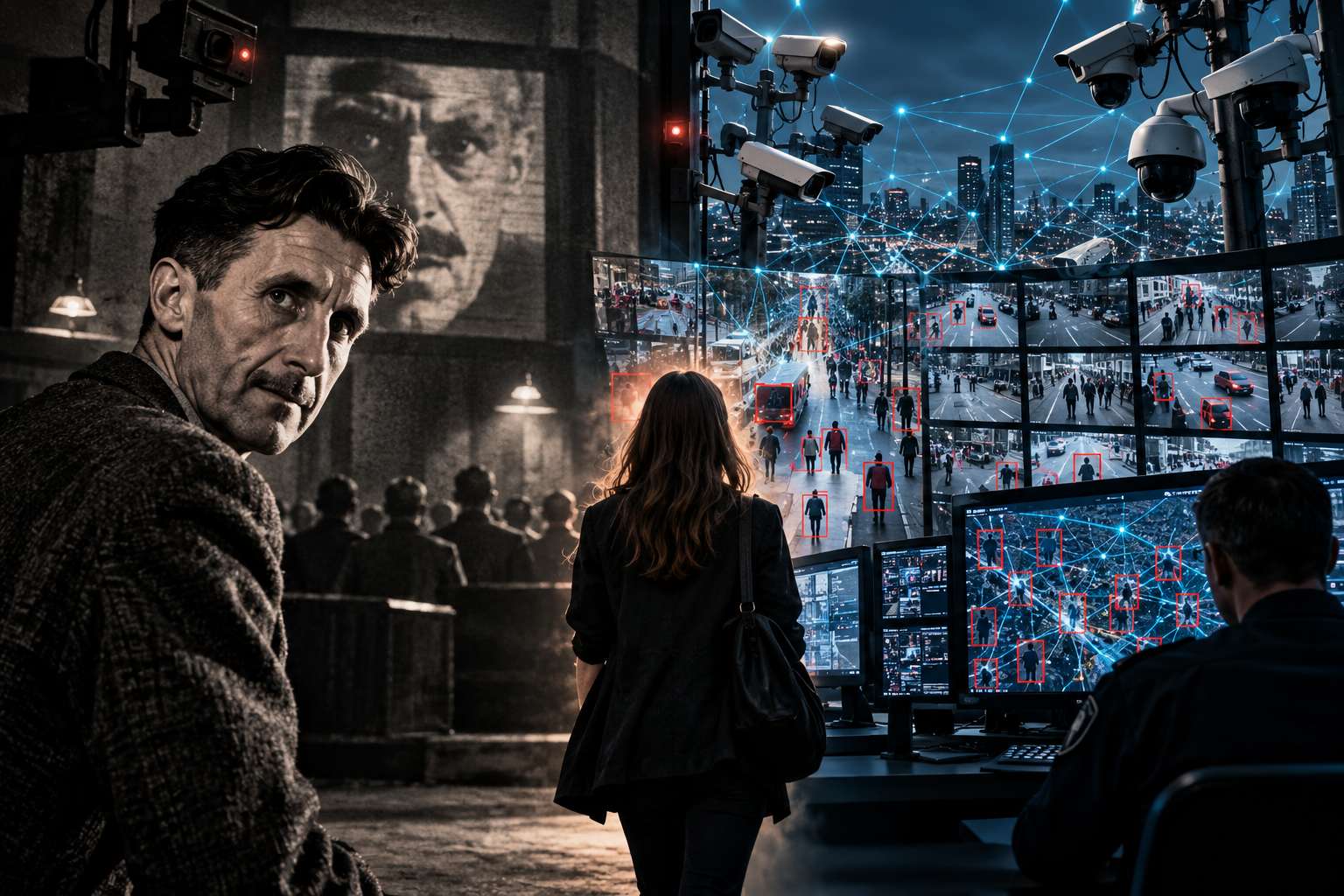
On 9 May 2025 someone at the Johnson County Sheriff's Office in Texas opened a search form and filled in the field that asks for a reason. The entry read: had an abortion, search for female. The search ran across 6,809 camera networks and 83,345 cameras, covering a month of recorded license plates. An earlier and smaller one had covered 1,295 networks.
The sheriff later said it was a welfare check on a woman whose family feared for her. Flock Safety, the company whose system carried the search, said she was sought as a missing person and never as a suspect. The Electronic Frontier Foundation, which obtained the records, said the file was opened as a death investigation. I cannot settle that dispute, and this piece does not need it settled. The database ran the same search whichever of those nouns is placed around it.
What held my attention was something none of the three parties disputes. The sheriff's office did not own 83,345 cameras. They sat in 6,809 separate networks, bought one contract at a time by towns, police departments and other customers, each for its own reasons, none of which was finding this woman.
I had been asked a simple question: how close is 2026 to Nineteen Eighty-Four? So I went back to the novel to find the page that describes what happened in Johnson County.
It is not there.
Part One, Chapter 1: what the telescreen could and could not do
George Orwell published Nineteen Eighty-Four on 8 June 1949, seven months before he died. It follows Winston Smith, a minor clerk in the one-party state of Oceania, whose job is to rewrite old newspaper articles so that the past matches whatever the Party says today. The Party watches its members through a device in every room, the telescreen, which arrives in the third paragraph, described more precisely than its reputation suggests. The instrument "could be dimmed, but there was no way of shutting it off completely." It "received and transmitted simultaneously." Then comes the sentence the whole book rests on:
"There was of course no way of knowing whether you were being watched at any given moment. How often, or on what system, the Thought Police plugged in on any individual wire was guesswork. It was even conceivable that they watched everybody all the time. But at any rate they could plug in your wire whenever they wanted to."
Read it slowly and the engineering shows. Somebody has to plug in. The telescreen is a live wire to a human being. Orwell never says how many watchers there are, and he allows that everyone might be watched all the time. The design does not need that to be true, because doubt covers whatever gap exists. A citizen who cannot know when he is observed will behave as if he always is. The uncertainty does the work, and the screen is only where it is mounted.
Three other details in the text are usually left out of the comparison. The first is who gets watched. The proles, the working mass outside the Party, are "85 per cent of the population of Oceania," and the novel says plainly that "the great majority of proles did not even have telescreens in their homes." The Party slogan is that proles and animals are free. Orwell's surveillance state is aimed at a minority: the clerks and officials who run the machinery. The second detail is who can escape it. When Winston visits O'Brien, a member of the Inner Party, O'Brien switches his telescreen off. "We can turn it off," he says. "We have that privilege." The third is how the watching is done. Winston learns in the Ministry of Love that "for seven years the Thought Police had watched him like a beetle under a magnifying glass." They kept sound recordings and photographs. But it took seven years, an agent posing as a junk-shop owner, a second agent posing as a conspirator, and a telescreen hidden behind a picture to do it. Elsewhere in the book the watching is done by neighbors and by children. Parsons is turned in by his own daughter.
So the system on the page is narrow, expensive in human attention, and pointed at the administrative class. Nothing in it resembles a search across the recorded past of everyone, run by one clerk in an afternoon.
That gave me a first answer, and I liked it more than I should have.
The table everyone draws
The first answer is the table. Anyone who has read the novel can draw it in ten minutes, and it is hard to resist.
The telescreen becomes the smartphone. The Pew Research Center found in 2025 that 91 percent of American adults own one. The Thought Police become the analysis of online behavior, the Ministry of Truth becomes ranking and moderation, the memory hole becomes de-indexing, and Newspeak becomes the vocabulary a platform will tolerate. The Two Minutes Hate becomes the outrage cycle.
Every row has a counterpart, and every counterpart comes with the same caveat. There is no single device, no single ministry, no single doctrine. That caveat leads to the line that seems to finish the argument: Orwell imagined a state that forces a screen into your home, and we bought ours. We queue for it and pay extra for the better camera.
For a few hours I thought that was the piece.
"Too expensive": the purchase was already in the book
It fails on two counts. The first is that it is not new, and the reader deserves to know how old it is.
Aldous Huxley wrote to Orwell on 21 October 1949, four months after publication, to say he doubted the method. He believed the lust for power could be satisfied "by suggesting people into loving their servitude." Neil Postman built a book on the same contrast in 1985: "Orwell feared that what we hate will ruin us. Huxley feared that what we love will ruin us." And in 2018 the historian Henry Cowles published an essay whose title is the whole argument: Orwell knew: we willingly buy the screens that are used against us.
Cowles also found the passage that undoes the neat contrast. In Part One, Winston asks the old shopkeeper Charrington why his upstairs room has no telescreen. "I never had one of those things," Charrington says. "Too expensive." Charrington is lying about nearly everything, since he is a Thought Police agent and there is a telescreen behind the engraving. The lie, though, only works if it is plausible in Oceania that a telescreen costs money. The price tag is already in the book.
So "we bought the telescreen" is a frame with seventy-seven years of history, and Orwell had half of it himself. Repeating it would add an article and no knowledge.
The second failure matters more, because the purchase story does not explain Johnson County. Neither the woman being searched for nor the sheriff's office bought 83,345 cameras. Flock sells to towns, to police forces and to homeowner associations, and a camera bought to deter car break-ins can end up inside a search with the word abortion in the reason field. Voluntary purchase explains why the records exist. It says nothing about who can reach them, or how cheaply.
I went looking for a better explanation in London, because London had just produced a number.
London Bridge, 2026: half a million faces, one alert
On 11 February 2026 the British Transport Police began a six-month trial of live facial recognition, starting at London Bridge station. The cameras compare each passing face with a watchlist. In late September, Liberty Investigates and The Guardian published the results from a freedom of information document. Between February and July there were 18 deployments. More than half a million faces were scanned. The system produced one alert, and the alert was an incorrect identification. No arrest resulted from a facial recognition alert. The cost was £320,786.
By then the trial had already been extended. The force announced in August that it would run four more months, through November 2026, and move into the Underground.
That looked like the mechanism I wanted. An infrastructure that produces nothing and grows anyway is an infrastructure whose existence has become the point. Orwell would have recognized it, since his telescreens also worked whether or not anyone was plugged in. I wrote that sentence down. Then I checked it against the force next door.
Three million faces and 962 arrests
The Metropolitan Police runs the same kind of system across the same city. Its own report for the year to September 2025 gives 203 deployments, 3,147,436 faces scanned, 2,077 alerts and 962 arrests, more than a quarter of them for violence against women and girls. Ten alerts were false. Two fixed cameras on a single high street in Croydon produced 173 arrests in six months, with one false alert.
For the second time I thought I had the answer, and for the second time the numbers took it away.
Those are police figures, and critics read them differently. Big Brother Watch calculated that facial recognition arrests were 0.57 percent of all Met arrests over the period it examined. Of the ten false alerts in the Met's year, eight involved Black people. Those objections are serious, and none of them rescues my sentence. On the evidence available, the claim "this technology does not work, and is kept for its own sake" is false for London as a whole.
What survives is much smaller. One trial, with a watchlist the transport police describe as deliberately limited, produced nothing and was extended. Asked about it, the force pointed to arrests its officers made while standing at the deployments, and added that because these "did not result directly from an LFR alert, they are not included within LFR performance data." The extension was announced when six months of scanning had produced no arrest from an alert. That is a fact about one evaluation, too small to carry a theory of surveillance.
Two explanations down. The second one left something behind, though, and it was a man.
23 February 2024: a man who was not his brother
Shaun Thompson was walking near London Bridge station when a Metropolitan Police camera matched his face. According to the High Court judgment that later described the afternoon, he was stopped, detained and questioned. The system had matched him to his brother, who was on bail on suspicion of having inflicted grievous bodily harm on Thompson himself. When Thompson declined to give his fingerprints, he was threatened with arrest. The officers let him go once they had checked the Police National Computer and he had shown them a photograph of his passport.
The photograph was on his phone.
I read that detail several times. A man misidentified by a camera he never agreed to proves who he is with the device from the first row of the table, the one we are all supposed to have bought into our own captivity. Two record systems disagreed about one face, and a citizen was carrying the tiebreaker in his pocket.
Thompson and Silkie Carlo of Big Brother Watch took the Met to court. On 21 April 2026 the High Court dismissed the claim, finding that the force's policy met the legal test of being in accordance with the law. Whether scanning millions of faces is necessary or proportionate was not the question before the court. A briefing from Parliament's own research office, published thirteen days earlier, notes that there is "no primary legislation specific to FRT or how the police should use it." A program that scanned more than three million faces in a year runs on a police policy document, and a court has confirmed that this is lawful.
The sober reading of that is the one the Home Secretary would give: a tool that finds wanted people, tested in court, with a false alert rate the Met puts at 0.0003 percent. Which brought me to the question I had been postponing. Perhaps the plain answer to "how close are we to 1984" is that we are not close at all.
84 out of 100
I tried to make that case as strongly as the evidence allows, and it is strong.
Freedom House scores internet freedom in 72 countries. In its 2025 report the Netherlands, where I live, received 84 out of 100 and the status Free. The United Kingdom received 76 and the United States 73, both Free. China and Myanmar received 9. It recorded people arrested or imprisoned for online expression in at least 57 of the 72 countries. Orwell's model has not expired. In the places at the bottom of that table it describes daily life with little adjustment, and a writer in Europe should be careful about using the word for his own inconveniences.
In the countries at the top, the machinery that Winston Smith lacked is visibly working. Consider one long list of events, all of them recent. In 2018 the United States Supreme Court held in Carpenter that the government generally needs a warrant to obtain a person's historical cell-site location records. On 29 June 2026, in Chatrie, it held that obtaining a man's location data from Google through a geofence warrant was a search under the Fourth Amendment. Since 2 February 2025 the European Union's AI Act has prohibited real-time remote biometric identification by police in public spaces outside narrow exceptions. By NPR's count at least thirty American localities had cancelled Flock contracts by February 2026, and later reports put the number higher. In August 2026 Flock announced that it would cut its default retention of plate data from thirty days to seven.
None of that can happen in Oceania. There is no court to rule against the telescreen, no town council to cancel it, no newspaper to obtain the trial results. On the question as it is usually asked, the conventional answer wins, and I do not think that is a close call. We do not live in Nineteen Eighty-Four. The democracies examined here keep passing that test.
I could have stopped there. But the list above has a shape, and it took me a while to see it. Read the two Supreme Court cases again. Both are about the government obtaining something from a company by legal compulsion. Then look at the reason field in Texas. Nobody was compelled to hand over anything.
27 January 2022: the door that stayed open
On that date a senior advisory group delivered a report to the Director of National Intelligence on what the intelligence agencies call commercially available information. It was declassified in June 2023. Its central finding is written in the flat style of people who do not expect to be quoted:
"CAI includes information on nearly everyone that is of a type and level of sensitivity that historically could have been obtained, if at all, only through targeted (and predicated) collection."
The report gives an example. Such data "could be used, for example, to identify every person who attended a protest or rally based on their smartphone location or ad-tracking records." It also records how one agency reads the law. The Defense Intelligence Agency, the report notes, "does not construe the Carpenter decision to require a judicial warrant endorsing purchase or use of commercially-available data for intelligence purposes."
Put that beside the court rulings and the shape appears. If the state demands your location history from a phone company, that is a search, and a judge stands in the doorway. If the state buys a comparable history from a broker who assembled it out of advertising data, the transaction is a purchase. In March 2026 the FBI director told the Senate Intelligence Committee: "We do purchase commercially available information." The House of Representatives passed a bill to close this route, the Fourth Amendment Is Not For Sale Act, on 17 April 2024. It did not become law.
There is a third route, and it is the one Johnson County used. Flock states that its customers own the data their cameras collect and that sharing is switched off by default. Each customer, the company told NPR, "has sole authority over if, when, and with whom information is shared." That account is disputed: Fortune reported in October 2026 that Customs and Border Protection had searched more than 80,000 Flock cameras, in one case without the owning department's knowledge. Taken at its word, though, the company is describing a system with nobody at the center. Thousands of owners each make a small, reasonable decision to share with other police forces, and the sum of those decisions is a national lookup that no legislature designed and no single official commands.
That growth needs no plan, only ordinary bookkeeping. A town that buys cameras weighs its own stolen cars against its own budget. A lookup that reaches other towns' cameras is worth more to every force that joins it, so each new customer makes the next sale easier. The cost falls on drivers recorded in places that never asked them, and they are party to none of the contracts. I offer that as a reading of the incentives. I have not seen Flock's sales figures, and nothing here depends on what the company intends.
The same lookup has been used in ways no town budgeted for. The Washington Post reported in August 2026 that at least fifty officers had been accused of, charged with or convicted of using the network to follow former partners and other private targets.
So there are three ways a record reaches the state.
It can be compelled.
It can be bought.
Or it can be borrowed.
The courts have spent eight years narrowing the first. The other two stayed largely open through all of it, and the reason is not mysterious. Our law of surveillance, like our fear of it, was shaped by the image of a government that takes.
The safeguards are aimed at the hand that reaches into your home. The records now sit somewhere else, and they are for sale or on loan.
That sentence is my interpretation. The documents establish the three routes and their different legal treatment. They do not establish that anyone arranged things this way, and I do not think anyone did.
What a question costs
Why should two open routes matter more now than they would have in 1949? Here the novel helps, once it is used as a measuring instrument and no longer as a prophecy.
In Oceania, as I read it, the scarce resource is attention. The novel leaves open whether everyone is watched, but everything it shows is costly in people: a watcher who has to plug in, children who inform, seven years spent on one clerk. Uncertainty is how the Party stretches that attention across a population.
In 2026 that scarcity is no longer the binding constraint. Recording is a byproduct of things done for other reasons. A phone tells the network which tower it is near so a call can reach it, and its apps pass its location to advertisers. A camera reads plates so a town can find stolen cars. A doorbell films a porch so its owner can see a parcel arrive. The car I drive has eight exterior cameras on it, and I chose every one of them along with the rest of the car. Nobody in that chain is running a surveillance state. The records simply accumulate across the systems that produced them.
What remains scarce is the right to ask. The decisive act in Johnson County was a question typed into a form, and its price was a few words in a box. Surveillance used to be limited by the cost of watching. It is now limited by the cost of asking, and in Johnson County that cost was one line of text.
One test of whether this reading is right is to look at where the fights of 2026 actually landed. After the reporting on misuse, Flock announced that searches would require a case number and that it would assist with audits. The bill introduced in the House on 24 September would require a warrant before a federal agency can access plate-reader data. The retention cut shortens the past that a question can reach. These are arguments about the query. The older argument, over whether the cameras should exist at all, has not gone away: towns have cancelled contracts, and Europe has banned one use outright. But where the cameras stay, this is where the fight has moved. The people closest to the system seem to have located its control point in the same place.
A federal judge has now gone there too. In the first days of October 2026, Judge Sara Hill of the Northern District of Oklahoma suppressed the evidence from a traffic stop that began with a warrantless Flock search by a Tulsa County deputy, whose stated ground was a California license plate. The evidence included 91 pounds of methamphetamine. She called the practice "a type of indiscriminate mass surveillance." The ruling binds no other court, nearly all courts that have examined plate-reader searches have upheld them, and Flock expects this one to be overturned. It is still the first sign I have found of the borrowed route being treated the way the compelled one is.
I am not sure it can be held there. A rule on asking is only as strong as the audit behind it, and the records it protects already exist in thousands of hands. One summer of reforms shows only that the limit is now being argued over in the right room.
The strongest objection
The strongest counterargument accepts every one of these documents and says the conclusion is ordinary. European data protection law has regulated the use of personal data, and not merely its collection, for decades; purpose limitation is written into the General Data Protection Regulation. American privacy scholars have argued for years that the aggregation of harmless records is where the harm lies. On this view I have rediscovered a principle that lawyers already own, and dressed it in Orwell.
That objection is largely correct, and it should lower the reader's estimate of how new this is. I would call it a synthesis of known pieces. The claim I am making is narrower than "nobody understood this." It is that the public test, the one word a citizen reaches for when a camera goes up, still measures collection by a central state. That test returns a truthful no in the free countries examined here. And a truthful no has an effect whether or not anyone intends it: it clears whatever arrives by purchase or by sharing agreement, because those do not look like the thing we were taught to fear.
The principle the objection points to exists. Its enforcement at the point of the question is still being built, and the British case shows how thin it can be: a force's own policy, and no statute.
The privilege of turning it off
There is one thing Orwell got exactly right, and it is the detail people skip. In his world the meaningful distinction between citizens is who can switch the screen off. O'Brien can. Winston cannot.
In December 2025 Amazon's Ring launched a feature called Familiar Faces, which lets a doorbell recognize up to fifty people. It was not offered in Illinois, in Texas, or in Portland, Oregon. Ring's own support page gives the reason in three words: "due to specific legislation." Nothing about the hardware differs. The switch is a statute, and whether you have one depends on your address.
Orwell also thought the masses would be left alone because they did not matter. That part has inverted. When recording is a byproduct, the default is everyone, and being left out becomes the thing that takes effort, money or a favorable jurisdiction. The Inner Party's privilege survives as a matter of where you live and which settings you know about.
The box on the form
I started with a question about distance: how far is 2026 from 1984? After two failed explanations I think it measures the wrong quantity. It asks whether a state is watching. It does not ask who may put a question to the records everyone else has already made, what the question costs, and who checks the reason.
That reason field in Texas is still the best picture I have of it. It was a free-text box. It accepted had an abortion, search for female, and it would have accepted anything else.
The British Transport Police trial runs through November 2026.
Sources: George Orwell, Nineteen Eighty-Four (1949), quoted from the Project Gutenberg Australia text; Electronic Frontier Foundation records on the Johnson County search; Liberty Investigates and The Guardian on the British Transport Police trial; Metropolitan Police and Parliamentary Office of Science and Technology figures; R (Thompson and Carlo) v Commissioner of Police of the Metropolis [2026] EWHC 915 (Admin); Office of the Director of National Intelligence, report on commercially available information (27 January 2022); Freedom House, Freedom on the Net 2025.
Jerry van der Laan writes The Manifest Archive, Forensic Narrative Intelligence Writing on the systems beneath power, money, and history. He traces the structures beneath them.
Evidence Map
Facts, interpretations, forecasts, and disconfirming signals.
Core claim. Nineteen Eighty-Four describes surveillance limited by the cost of watching. In 2026 records are a byproduct held by many owners, and a decisive limit is the cost of asking. Most safeguards address a state that compels data, and say less about data that is bought or shared.
Evidence level. Facts (high): the novel's text; the Johnson County search logs; the British Transport Police and Metropolitan Police figures; the Carpenter and Chatrie holdings; the 2022 intelligence report. Interpretation (medium, marked in the text): that "is this 1984?" works as a test which clears purchase and sharing. Not established: any design or coordination behind that outcome.
What would confirm this. Further reforms that target the query (warrants for access, mandatory case numbers, audits) while camera and device numbers keep rising.
What would disprove this. A law that puts purchased data under the same warrant rule as compelled data, followed by audits showing misuse falling. Evidence of a central authority directing cross-network searches. The transport police ending the trial for lack of results.
Watchlist. The outcome of the transport police trial after November 2026; the Fourth Circuit's handling of Chatrie on remand; any appeal of the Oklahoma Flock ruling; the federal plate-reader and data-purchase bills; the Met's Croydon evaluation.