The House passed the bill this week. More than a billion dollars in security and reconstruction aid for Ukraine, another eight billion in defense loans, passed over the objections of Republican leaders. The vote was the story. The number was the headline. Supporters called it a lifeline and opponents called it a blank check, and both sides argued as if the question that mattered had just been decided.
It had not. The money was never the constraint. A vote can move eight billion dollars in an afternoon. It cannot move a single ton of explosive that does not yet exist, and explosive that does not yet exist is what the war actually runs on. The appropriation is the part of the system that can change in a day. Everything that determines whether the appropriation matters changes on the timescale of a decade, and most of it changed, in the wrong direction, decades ago.
The number that decides is not in the bill
The figure that determines what happens at the front is not measured in dollars. It is measured in rounds per month. In early 2022, the United States produced about 14,000 155mm artillery shells a month. By late 2024, after two years of emergency investment, that had risen to roughly 40,000. The target is 100,000 a month, and that target has already slipped, from October 2025 into 2026, and may slip again.
Europe tells the same story in its own numbers. The European Union built a program called the Act in Support of Ammunition Production, put 500 million euros behind it, and set a goal of two million 155mm shells a year by the end of 2025. The money moved. The deadline did not hold, and the two million target slid into 2026, where it sits now, almost reached, repeatedly almost reached.
Hold those numbers against the war they are meant to supply. At the height of the fighting Ukraine has burned through shells faster than the entire Western alliance could make them, and Russia has out-produced that alliance for most of the war. A single active sector of the front can consume in a week what a factory needs a month to make. The aid vote does not change the production rate. The production rate was set years earlier, by decisions about factories that take years to reverse. The bill funds a war whose supply was decided before the bill was written.
This is the move the headline misses every time. The visible story is the appropriation. The determining variable is the line. And the line does not read the news.
The exchange ratio is a production ratio
There is a way to feel these numbers that no budget figure conveys. On an active front, artillery does most of the killing, and the side that can fire more shells shapes more of the ground. When one army fires several rounds for every round the other can answer, the imbalance is not a statistic, it is the daily physics of who can advance and who must dig in and wait. For long stretches of this war the side firing more was not the side with the larger economy or the larger aid package. It was the side with the larger propellant base.
That is the quiet inversion under the whole conflict. The West measures its commitment in money, because money is what its institutions produce and vote on. The front measures the commitment in shells, because shells are what the front consumes. The two measures were assumed to be the same thing, a dollar of aid converting cleanly into a round at the front, and for most of the war they have not been, because the conversion runs through a production base that no dollar can expand on the timescale of a battle. The exchange ratio on the ground is, at bottom, a production ratio, set years earlier, in factories most of the donor governments do not own and cannot command. The front is not supplied by the budget. It is supplied by the chemistry the budget forgot to keep.
The bodies are not the problem
When people imagine an ammunition shortage, they picture steel. Empty shell casings, forging presses, machined bodies stacked in a yard. The steel is the easy part. Any industrial economy can press a shell body, and if the body were the bottleneck the West would have solved this in a season. The constraint sits one layer down, in the chemistry that makes the shell more than a heavy paperweight, and that chemistry is where the West quietly disarmed itself while believing it was saving money.
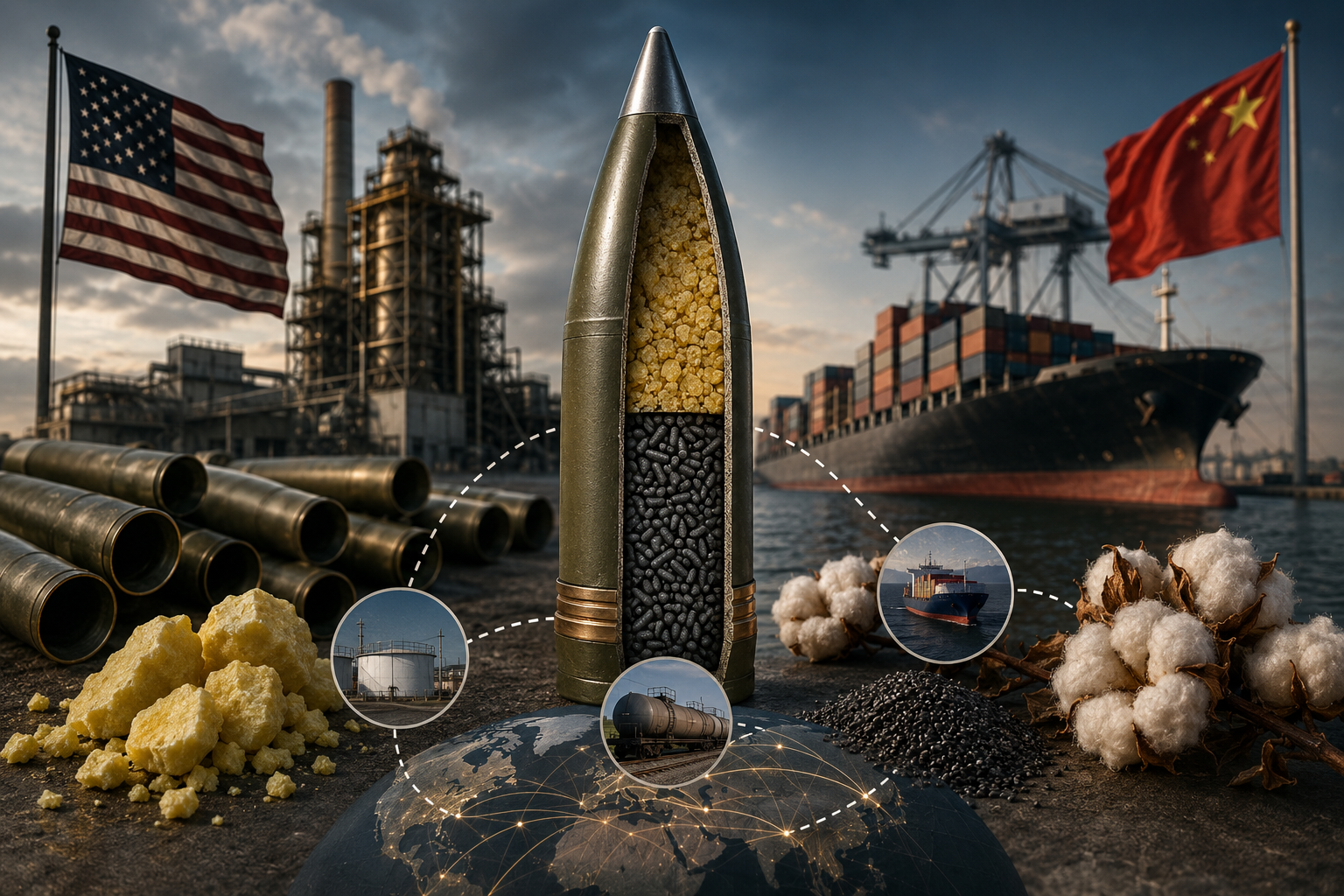
A finished round is really three problems wearing one skin. There is the body, which is metallurgy. There is the explosive filler, which is energetic chemistry. And there is the propellant charge that throws the round out of the barrel, which is a different energetic chemistry again. The body is sovereign. The other two are not. Both the filler and the propellant depend on a supply chain the West spent thirty years handing to other people, and you cannot tell that from looking at the shell. The dependency is invisible until the day someone tries to scale, and then it is the only thing that matters.
A nation that can press a million shell bodies and fill none of them does not have a million shells. It has a million tubes.
One plant in Poland
Begin with the explosive. The filler in a standard artillery shell is TNT, and the United States, the largest military power in history, does not make its own. It stopped. The last American TNT came out of the Radford Army Ammunition Plant in Virginia, the only domestic plant capable of producing it, and that line shut down in the mid-1980s after an accident, around 1986. For roughly four decades the United States has filled its shells, bombs, and grenades with TNT bought abroad, and for most of that time nobody in a position to care considered it a problem, because for most of that time nobody was firing at scale.
The European picture is the same picture, drawn larger. At the end of the Cold War there were seven major TNT plants in Europe. Today there is one. A single factory, operated by a company called Nitro-Chem in Bydgoszcz, Poland, now anchors the explosive supply for a continent and supplements the explosive supply for the United States on top of it. When the American military went looking for TNT to refill its stockpile, the place it found was that one Polish plant. Nitro-Chem signed a contract worth roughly 310 million dollars to deliver 18,000 tonnes of TNT to a United States intermediary between 2027 and 2029, explosive destined for American artillery shells and aerial bombs.
Read the sentence slowly, because it is the whole essay in miniature. The United States will fill its shells, in the back half of this decade, with explosive made in one factory in Poland. Not as a stopgap. As the plan. The superpower that can vote eight billion dollars to a war in an afternoon cannot, this year or next, make the explosive that goes inside the shells the eight billion is supposed to buy. The arsenal of democracy is a purchase order addressed to a single plant in Bydgoszcz.
The United States Army has noticed, which is the part that proves the point rather than refuting it. It has committed about 404 million dollars to build its first new domestic TNT plant since the 1980s, in Kentucky. That is the right decision. It is also a building. It has permits, precursors, contractors, and a construction timeline, and a plant announced now does not fill a shell now. The money to fix the dependency exists. The dependency persists anyway, for years, because the fix is physical and the physical world does not accept appropriations as a substitute for time.
The cotton nobody mentions
The deeper layer is stranger, and it is the one almost no coverage reaches. The propellant that throws the shell out of the barrel is made from nitrocellulose, and nitrocellulose is made, at the quality artillery requires, from cotton. Specifically from high-grade cotton fibers, the short linters left after ginning, processed with acid into the substance that has propelled artillery since the nineteenth century. Each propelling charge for a standard shell needs around twenty pounds of dry nitrocellulose. Multiply by a hundred thousand shells a month and the cotton stops being a quaint detail and becomes a strategic input measured in thousands of tons.
The West outsourced that supply chain too. Europe moved nitrocellulose production to China, Turkey, the Balkans, and Ukraine, and the raw cotton behind it comes largely from China. American plants reach abroad for the precursors as well. So the propellant base of Western artillery runs, at its root, through the country most closely aligned with the adversary the artillery exists to deter.
Read that as a system, not an irony. The West's ability to fire shells at Russian positions depends on a propellant whose feedstock is grown and processed inside Russia's most important partnership. The aid vote sends money to Ukraine. The propellant supply runs through Beijing. You can sanction an economy and still be buying the cotton for your own gunpowder from its closest ally.
No legislature voted for this arrangement. No one designed it as a vulnerability. It accumulated, one efficient outsourcing decision at a time, each rational on its own, each saving a little money in a year when nothing was being fired, until the cheapest place to buy the input was inside the other side's bloc. That is how the most important constraints are almost always built. Not by plan and not by betrayal, but by the slow logic of cost, until the logic reverses in a crisis and the cheapest supplier turns out to be the one who can switch you off.
And all of it has to be shipped
Even this understates the exposure, because every link in the chain has to move. The Polish TNT crosses borders to reach an American filling line. The Chinese cotton and the foreign precursors travel by sea before they ever reach a propellant plant. A supply chain this thin is not only a production problem. It is a transport problem, and transport runs through the quiet layer the Manifest has tracked at every chokepoint: shipping, freight, and the small number of underwriters who decide what cargo is movable, on what route, at what premium. A cargo that cannot be insured does not sail, whatever its price, and insurability is not set by the buyer.
So the West could rebuild every plant and still find its energetics base threading through lanes it does not control and cannot insure on its own terms. The bodies can be forged anywhere. The chemistry has one of everything, and each one has to be carried across water that somebody else can close, or simply make uninsurable with a single change in the war-risk listings. A supply chain with one of everything is not a supply chain. It is a row of switches, and the switches are abroad.
The shortage is wider than the war
There is a reason to care about this even with no interest in artillery, and it reveals how deep the dependency runs. The same explosives that fill shells do civilian work. Mining runs on industrial explosives. Copper, the metal under every grid and every wire and every electric motor, is blasted out of the ground with them. When the explosive base tightens, the effect does not stay inside the defense sector. Analysts have begun warning that an explosives shortage could raise the cost of ordinary things, from the copper in a phone to the energy in a wall socket to the materials in a house, because the chemistry that breaks rock and the chemistry that fills shells draw on the same narrow industrial base.
That is the tell that this is a civilizational constraint, not a military one. The West did not only demobilize its ability to wage a long war. It thinned the chemical foundation underneath its own economy, and called the thinning efficiency. The same shortage that slows the shells raises the price of the wire, because the wire and the shell were always made of the same chemistry.
Russia's advantage is chemical, not financial
The standard Western framing is that Russia out-produces because it spends a larger share of its economy on war. That is true, and it is not the mechanism. Russia out-produces because it kept the chemistry. Nitrocellulose sits behind the bulk of Russian firepower, and Russia retained the energetics base that the West let atrophy. It never closed the plants, never outsourced the propellant, never treated the explosive line as a cost to be shed in a quiet decade. Money did not give Russia that advantage. Continuity did.
This is why the funding frame misleads even when the funding is real. Western governments can now spend faster than Russia. They cannot make propellant faster, because the constraint is not the budget line, it is the energetics line, and energetics lines were the thing the budget stopped paying for thirty years ago. A larger appropriation buys more of a thing that is already at its ceiling, and a thing at its ceiling does not respond to money. The West kept the money and lost the powder. Russia kept the powder and never needed the money.
Built in fifteen months, full in 2027
The West has noticed, and the noticing produces a paradox that is worth holding up to the light, because it is the mechanism in its clearest form. Rheinmetall built a new 155mm ammunition plant at Unterlüss in Germany, the largest in Europe, in fifteen months, for around 500 million euros. Fifteen months is genuinely fast for heavy industry. The headlines treated it as proof that the West had finally turned the corner.
Read the second sentence, the one under the headline. The plant reaches its full production capacity, around 350,000 rounds a year, only in 2027. The company aims to make up to 1.5 million shells a year by 2027. Europe as a whole, if the lines now under construction come in, might reach something like 2.4 million shells a year by 2026, an eightfold increase in four years, which is a real industrial achievement and still arrives years after the demand that called it forth. The building goes up in fifteen months. The capacity arrives years later. And the chemistry to fill what the new lines press still runs back to the one plant in Poland and the cotton in China.
The fast-build headline and the slow-capacity reality are not in tension. They are the same fact seen from two distances. You can pour a factory quickly. You cannot pour the years of qualified output, the energetics supply, and the trained throughput quickly, because those are not construction, they are accumulation, and accumulation has a rate that money does not set. A plant is built in months. A capacity is grown in years. The headline reports the building. The war is decided by the capacity.
Even finished capacity is not finished output
There is a further delay buried inside the build time, and it is the one that surprises people who assume a finished plant means finished shells. Energetics are not like other manufacturing. A new propellant or explosive line does not produce usable military output the moment it switches on. Its lots must be qualified, tested across temperature, age, and storage, matched to the specific weapons that will fire them, and certified before a single round goes to a front where a defective charge can burst a barrel and kill the crew around it. Qualification is measured in years, not weeks, because the failure mode is catastrophic and the testing cannot be rushed without inviting exactly the disaster it exists to prevent.
So the lead time is not one delay but a stack of them. First the decision. Then the permits and the build. Then the qualification. Then the trained throughput, the long ramp from first article to full rate. Each stage has its own clock, and the clocks run in sequence, not in parallel. The 404 million dollar TNT plant in Kentucky is at the front of that stack, not the end of it. The Rheinmetall line at full rate in 2027 is the output of a process that began years before the headline that announced the building.
This is why money is such a weak lever here. Money compresses the first stage, the decision, almost to zero. It barely touches the others. You can fund a plant the day you decide to, and you still wait years for a qualified round, because the physical and safety reality of energetics does not negotiate with the size of the appropriation. The money is instant. Every stage it is meant to accelerate is not.
Where the reassurance is right, and where it ends
It would be easy to end here, to say the West has noticed, the plants are rising, and the chemistry will scale, so the shortage is temporary and the vote is part of the cure. That reassurance is not wrong, and it deserves its strongest form before it is set aside. The plants are real. The funding is real. In three or four years the West may well make its own TNT and its own propellant at volume, and the dependency on one Polish town and one foreign cotton crop may ease into something a planner can live with.
The architecture holds anyway, because the war is fought on the timescale the chemistry cannot meet. A propellant plant announced today does not fire a shell today, or this year. The decision window at the front opens and closes in months. The build time for energetics opens and closes in years. By the time the new lines run, the period they were meant to supply has already been decided, on the old lines, at the old rate. Funding the cure does not change the patient's condition during the illness. It changes who is healthy for the next one.
The peace dividend that disarmed the chemistry
None of this was hidden, and none of it was sudden. It was a choice, made in the open, celebrated at the time. When the Cold War ended, the West collected what it called a peace dividend. It closed plants, consolidated suppliers, and let the energetics base shrink, because in a world without a peer war the chemistry of artillery looked like an expensive relic. Seven European TNT plants became one. The American TNT line at Radford fell silent and stayed silent. Propellant and its feedstock drifted to whoever made them cheapest, which was increasingly the rising industrial power in the east. Every step was rational inside its decade. Each was a small, defensible economy in a year when the saving was visible and the risk was not.
The consolidation even had a date and a dinner. In 1993, at a meeting the defense industry came to call the Last Supper, the Pentagon told the major contractors gathered at the table that there was no longer room for all of them, and that they should merge. They did. Dozens of prime contractors collapsed into a handful over the decade that followed, and the same logic that merged the assemblers shed the unglamorous base beneath them, the explosive and propellant plants that no peacetime balance sheet wanted to carry. The visible defense industry consolidated into a few famous names. The invisible industry underneath it, the chemistry, simply thinned until a continent's TNT ran through one Polish town.
And concentration pays the survivors. The plants that lived through the cull did not merely survive, they inherited a market with no alternative. A single TNT source and a handful of prime contractors now hold what the open market took away from everyone else: pricing power and strategic indispensability. The same scarcity that starves the front enriches whoever owns the last line. No one needs to want the shortage for the shortage to have beneficiaries, and the beneficiaries are the ones a buyer in a hurry cannot go around.
The risk was not absent. It was deferred, loaded into a future that arrived in 2022 and has not left. The capacity a society does not maintain in peacetime is not capacity it can summon in wartime, because the lead time to rebuild it is longer than the window in which it is needed. The peace dividend was real. It was also a loan against exactly this moment, taken out by governments that would not be the ones repaying it. The bill for thirty years of efficiency came due in a single supply chain, and it is being paid in the one currency a vote cannot print, which is time.
The loop
The alliance lets its explosive and propellant base atrophy in peacetime. The dependency stays invisible because nothing is firing. A war starts. Demand spikes past the surviving capacity. Governments vote money. The money cannot buy chemistry that takes years to build, because the plants, the energetics, and the feedstock all sit on the far side of a lead time. The front is supplied at the old rate while the new rate is still under construction. That is not a budget problem. That is a lead time, and a lead time cannot be appropriated away.
The form of the response survives precisely because the function arrives late. A vote that funded instant capacity would end the shortage. A vote that funds capacity years out funds the next war while losing the supply argument in this one, and reports itself, in the meantime, as decisive action. The smoother the appropriation, the more carefully its timing is worth checking against the timing of the thing it buys.
What the vote decided
The vote will be reported as the thing that decided Ukraine's supply. It decided almost nothing about the supply. The supply was decided by a TNT line that closed at Radford in 1986, by a single surviving plant in Bydgoszcz, by twenty pounds of nitrocellulose per charge drawn from cotton grown inside the other bloc, by the shipping lanes that carry all of it, and by thirty years of letting the cheapest supplier become the only supplier. The eight billion dollars is real, and it changes who is solvent. It does not change who has powder this year.
Everyone counted the dollars in the bill. The dollars were never the number that was missing. The shell lines were, and the shell lines do not appear in any vote. The chamber that passed the bill has a seat for every actor in the story except the one that decides it. The line is not in the room. It never is. It is in Bydgoszcz, and in a cotton field, and in a construction schedule that ends in 2027, and none of those have a vote.
Evidence Map
Facts, interpretations, forecasts, and disconfirming signals.
Core claim. The visible story is the aid vote; the determining variable is the propellant line, the atrophied Western energetics base behind 155mm shell output.
Evidence level. Facts: high (Western output below the 100,000-per-month target, single- or foreign-sourced TNT and nitrocellulose, the peace-dividend drawdown of the energetics base). Interpretation: medium (the energetics line as the binding constraint). Forecast: speculative (the production-window timing).
What would confirm this. Western 155mm output staying below the 100,000-per-month target despite new funding; TNT and nitrocellulose staying single- or foreign-sourced, with no Western-controlled line breaking the dependency on schedule; Russia retaining a shell-firing advantage at the line of contact.
What would disprove this. Western monthly output reaching the 100,000 target and a domestic, allied-controlled TNT or nitrocellulose line coming online within the window; or the front-line firing-rate gap closing through supply rather than through a fall in Russian demand.
Watchlist. 180 days, and the end-of-2026 production reports.
Jerry van der Laan writes The Manifest Archive, a continuous investigation into how institutions, language, and systems shape what people are permitted to see as reality. He does not report events. He traces the structures beneath them.
Related from The Manifest Archive
- Everyone Is Watching the AI Boom. Nobody Is Watching the Transformer That Can't Be Built in Time.
- Everyone Is Watching NATO's Troops. Nobody Is Watching the Railway to the Baltics.
- The Architecture Cannot Move: How Energy, Defense, and Currency Locked Themselves Into Permanent Tension
- Putin Made His Position Clear in 2007. He Made It Formal in 2021. The West Called Both a Threat. The Invasion Followed Two Months After the Second.