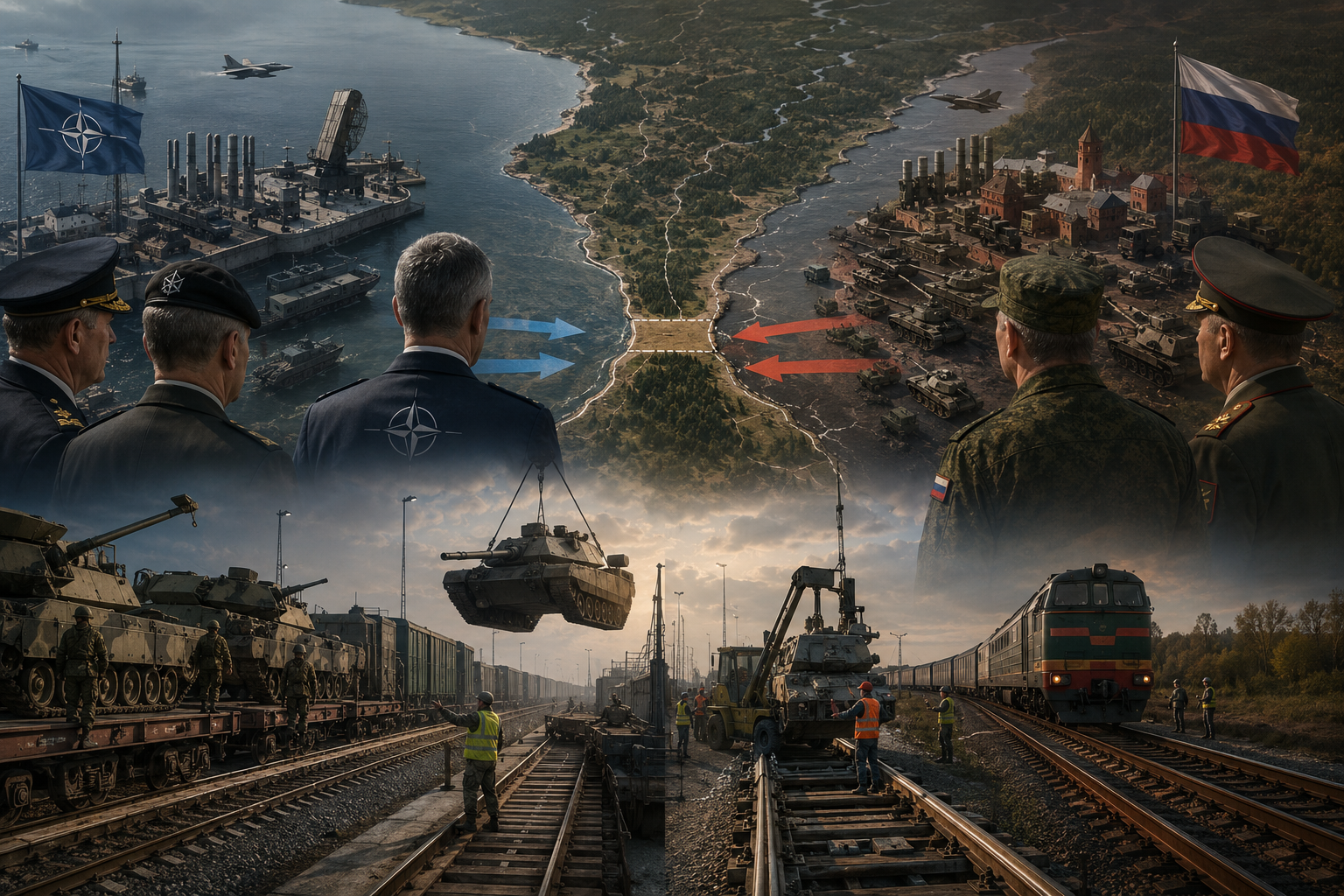
The defense of the Baltic states was never going to be settled by resolve. The debate is always conducted in the language of will: whether the alliance has the political nerve to honor Article 5, whether thirty-two nations would actually fight for Narva, whether the guarantee is credible. That argument runs in capitals and on panels, and it misses the part that would actually decide the outcome. If it ever came to a real defense of Lithuania, Latvia, and Estonia, the binding question would not be whether NATO wanted to send heavy forces. It would be whether it could get them there fast enough, and that is not a question of will. It is a question of a corridor and a railway track.
Look at the map the way a logistics officer does, not the way a politician does. The three Baltic states connect to the rest of the alliance by land through a single seam roughly sixty-five kilometers wide, the Suwałki Gap, pinned between the heavily militarized Russian exclave of Kaliningrad on one side and Belarus, Moscow's ally, on the other. And the railways inside the Baltics do not even run on the same gauge as the railways of the allies who would have to reinforce them. The visible story is the size of the armies and the firmness of the promise. The determining variable is whether steel can move east across a gauge break and through a sixty-five-kilometer bottleneck before it is too late.
The two questions that are not the same
Start with the distinction the coverage collapses, because everything follows from it. There is the question of whether NATO would defend the Baltics, and there is the question of whether NATO could, in time. The first is about intention and is endlessly debated. The second is about physics and is almost never discussed. They are not the same question, and a defense fails just as completely from arriving late as from not coming at all.
Deterrence rests on the credible promise of reinforcement. The forward forces in the Baltics are a tripwire, not a wall; the actual defense depends on heavy forces flowing east in the opening days of a crisis, the tanks and artillery and armored vehicles that decide a land war. So the real measure of the guarantee is not the number of brigades NATO possesses. It is the speed at which those brigades can arrive where they are needed. A guarantee that cannot arrive in time is not a guarantee. It is a sentiment with a deadline.
This is the layer the resolve debate never reaches. The cameras follow the summit and the communique, the part that is about willingness. The variable that would actually decide the defense sits one level down, in the physical capacity to move mass across distance, and that capacity runs into two walls that no amount of political will can move.
The first wall is sixty-five kilometers wide
The Suwałki Gap is the only land connection between the Baltic states and the rest of NATO. It is a stretch of the Polish-Lithuanian border roughly sixty-five kilometers across, and it is the entire land bridge. Everything that reinforces the Baltics by road or rail from the European heartland has to pass through it, because on either side of it lies territory that in a war would not be available: Kaliningrad to the west, bristling with air defenses and missiles, and Belarus to the east.
That geometry is the vulnerability. A corridor that is the sole land route is also the single point at which the route can be cut, and military planners have spent years pointing out that Russia could attempt to squeeze the gap from both sides at once, from Kaliningrad and from Belarus, and sever the Baltics from their allies by land in the opening hours of a conflict. The planning literature puts the stakes plainly: holding the Suwałki corridor could be the difference between defending the Baltics and losing them in a matter of days. It has been called, without much exaggeration, the most dangerous place on earth.
Hold what that means for the guarantee. The defense of three member states funnels through one narrow seam, and the adversary knows exactly where it is. A frontier with one door is not defended by the size of the house behind it. It is defended by the door. The aggregate strength of the alliance, the hundreds of billions in budgets and the thousands of vehicles, all of it has to come through sixty-five kilometers that an enemy is positioned on both sides of.
The squeeze is not hypothetical, and it has already been rehearsed in miniature in peacetime. In 2022, when Lithuania moved to restrict the rail transit of sanctioned goods across its territory to Kaliningrad, Moscow treated the interruption of that line as a grave provocation and threatened consequences, a reminder that the same corridor matters intensely to Russia in the other direction, as the umbilical to its exclave. The episode showed the gap is not a dormant abstraction but a live nerve, a place where a railway dispute can become a confrontation between nuclear powers. The corridor is contested in calm times over the movement of ordinary cargo. In a crisis it would be the first thing both sides reached for.
And the corridor cannot simply be skipped from above or around by sea, because the same exclave that flanks it also reaches over it. Kaliningrad is built as an anti-access bubble, dense with long-range air defenses and missiles that extend a threat far out over the Baltic Sea and the airspace a relief force would have to use. That is what closes the trap. The land route is a single narrow seam, and the obvious alternatives to the land route, flying the force in or shipping it across the Baltic, run straight through the reach of the guns that sit beside the seam. The corridor is not just the best way in. In a contested opening it may be, for heavy forces at scale, close to the only one.
The second wall is the width of the track
Suppose the corridor holds. There is a second wall behind it, and it is stranger and less visible than the first, because it is not geography but engineering inheritance. The railways of the Baltic states do not run on the same gauge as the railways of the allies who would reinforce them.
Heavy military equipment does not drive itself across a continent. Tanks and artillery and the bulk of an armored force move by rail, because road movement over those distances is slow, fuel-hungry, and destroys both the vehicles and the roads. And the Baltic rail network, a Soviet inheritance, runs on the Russian broad gauge of 1,520 millimeters, while the rest of Europe, including Poland and the forces that would come through it, runs on the standard gauge of 1,435 millimeters. Eighty-five millimeters of difference, less than the width of a hand, and it means the trains of the alliance cannot simply roll east into the Baltics. At the border the cargo has to be transshipped, unloaded from one gauge and reloaded onto the other, a slow, equipment-intensive operation that can cost a day or more and concentrates the entire flow at a handful of transfer points.
A day does not sound like much until you set it against a plan to seize the Baltics before reinforcements arrive. The whole Russian theory of the case, in every wargame that worries NATO, is speed: present the alliance with a fait accompli, take the ground before the heavy forces can cross, and dare NATO to mount a bloody counter-offensive to retake member-state territory. Against that clock, a day spent transloading tanks at a gauge break is not a logistical footnote. It is the margin. The defense of the Baltics can be slowed not by an army but by a difference of eighty-five millimeters.
Picture the gauge break as an actual place, because it is one. A train of allied armor rolls east and stops at the frontier yard. Every vehicle has to be unchained and lifted or driven off its wagons and onto wagons of the other gauge, or the cargo cranes have to swing each load across, under whatever threat the sky holds at that moment. The transfer demands specialized equipment, trained crews, and yard capacity, and it concentrates the entire eastward flow into a few locations where it must slow down and bunch up. A chokepoint is not only a line on a map. It is a place where a continent's worth of force is forced into single file, and a place forced into single file is a place that can be found and struck.
The gauge was a wall before it was a problem
There is a deeper irony in the track, and it is worth naming because it shows how a defensive feature becomes a vulnerability when the map flips. The Russian broad gauge was, by long tradition, understood as a frontier defense in its own right. A country whose railways do not match its neighbors' is a country an invader cannot simply roll into; the attacker's trains stop at the border and the attacker's logistics slow to the pace of transshipment. Whether by deliberate design or by the hardening of habit, the gauge difference functioned for generations as a passive shield on Russia's western edge, a wall made not of concrete but of standardization withheld.
The Baltic states inherited that wall, and now stand on the wrong side of it. The same eighty-five millimeters that once slowed an army moving east now slows the army that would move east to defend them, because the shield was built facing the other way. This is what makes the gauge such a pure example of structure over intention: nobody now alive chose it as an anti-NATO measure, and yet it operates as one, a piece of imperial engineering still shaping a military balance a century later. The wall does not care which direction history is pointing. It only knows the width of the track.
The fix exists, and it is not ready
NATO and the European Union know all of this, which is why the most important defense project on the eastern flank is not a weapon. It is a railway. Rail Baltica is a plan to build a continuous standard-gauge line from Warsaw through the Baltics to Tallinn, a track on which allied trains could run east without transshipment, on which, in the words of the people building it, a single forty-car train could replace a seven-kilometer military convoy and battle tanks could move from west to east without ever stopping to change gauge. It is a civilian project that NATO openly describes as one of major military significance. On paper it dissolves the second wall.
The reason rail matters more than any road is throughput. A standard-gauge line moves tens of thousands of tonnes and tens of thousands of people a day, the scale a mobilization needs and no convoy of trucks can match. A road march of armor is slow, strung out over kilometers, vulnerable along its whole length, and brutal on the vehicles, which arrive worn before they fight; rail delivers the same mass concentrated, fast, and fresh. Which is why the inability to run a train straight through is not a convenience lost but a capability missing. The army does not move the railway. The railway moves the army.
On the calendar it is not there yet. Rail Baltica has slipped from an original completion around the middle of this decade to roughly 2030, and its cost has not crept but exploded, from an early estimate near 5.8 billion euros to figures around 15 billion and, in some accounts, approaching 24 billion, while route disputes, contested funding, and management failures pushed the finish line years to the right. In January 2026 the European Court of Auditors called even first-phase completion by 2030 highly unlikely, and in September 2026 the three Baltic prime ministers moved the main line into the EU's 2028 to 2034 budget period. That is not the cost creep of a well-run project meeting inflation. It is the signature of a strategic necessity treated for years as an ordinary transport scheme and now rushed and repriced under a threat that will not wait for the budget cycle. The interim measure says the rest: a dual-gauge transshipment hub being built in Kaunas to do the slow reloading more efficiently. You do not build a careful machine for changing trains between gauges unless the gauge change is a problem you cannot yet make go away. The fix is real and the fix is late, and the years until it is done are exactly the years in which the gap is most discussed as a danger. The wall comes down in 2030 at the earliest. The risk is now.
Why the bottleneck outlived the warning
The obvious question is why an alliance that has worried about this seam for a decade still has not closed it. The answer is not negligence in the simple sense. It is the same structural reason heavy infrastructure always lags the threat it is meant to meet. A railway is a slow, expensive, multi-government project that pays off over decades, built by civilian ministries on civilian timelines, across three countries that had to agree on a route and a budget. Military urgency runs on one clock; infrastructure construction runs on another, and the second is measured in years no crisis can compress.
So the vulnerability persisted not because no one saw it but because seeing it and closing it are separated by a construction timeline. The gauge was inherited from an empire, the corridor was drawn by geography, and the cure is a decade-long capital project that only acquired its urgency after the threat was already acute. The warning was loud and early. The concrete is slow. A danger that everyone names and no one can quickly fix is the most honest kind of vulnerability there is.
Ukraine already taught this lesson
The war in Ukraine is the nearest and bloodiest demonstration that rail, not road, is the spine of modern heavy logistics, and that gauge is part of the geometry of the fight. Ukraine runs on the same broad gauge as Russia and the Baltics, a shared inheritance, and both armies have leaned on rail to move the tonnage that armored war consumes, while Western equipment arriving from standard-gauge Europe had to be transshipped at the Polish frontier before it could roll east. The early Russian advance on Kyiv is often read, in part, as a logistics failure, an army that outran what its supply lines could sustain once it left the rail it depended on. The lesson the planners drew was blunt: in a high-intensity land war, the side that can move mass by rail, fast, has an advantage the order of battle does not capture.
The people building Rail Baltica say their own urgency comes straight from that war. The Baltic states watched a neighbor invaded and understood that the abstract worry about gauge and corridor had become a concrete question about their own survival, and that the cure was a construction project they had not yet finished. Ukraine did not introduce the lesson that logistics decides. It only made the price of ignoring it visible.
What the bottleneck actually decides
Trace the consequence through and the mobility constraint reaches further than the Baltics. It shapes the entire logic of deterrence on the eastern flank, because deterrence is a calculation the other side makes about what it can achieve before the response arrives. If reinforcement is fast, the fait-accompli strategy is pointless and the aggression is deterred before it begins. If reinforcement is slow, the temptation to grab and hold becomes real, and the burden shifts onto forward forces and prepositioned stocks that have to hold alone for longer than anyone would like. The width of the corridor and the gauge of the track are therefore not logistics trivia. They are inputs into whether a war is attempted at all. A bottleneck in your own logistics is an incentive in your adversary's planning. The slow clock does not merely raise the cost of defending. It raises the expected payoff of attacking, which is the more dangerous of the two, because deterrence fails not when defense becomes expensive but when aggression starts to look like it could work.
And the same constraint governs the alliance's whole eastern military-mobility problem, of which the Baltics are the sharpest case. The gauge break is only the most legible link in a longer chain: permit regimes that can demand days of notice to cross a border, bridges rated below the weight of a modern main battle tank, tunnels with the wrong clearances, bottlenecked ports, and a scarcity of the heavy military railcars no peacetime economy keeps idle. A continent was built for commerce moving in all directions at a profit, not for armor moving one way against a clock.
This is why NATO and the European Union now talk about a "military Schengen," an effort to pre-clear permits so forces can cross internal borders as freely as trucks of goods. The need for it is the confession: today they cannot, not at the speed a fast war would demand. An alliance can possess more tanks than its adversary and still lose the opening phase if those tanks are parked behind a permit, a low bridge, and a gauge break. Deterrence is not the size of the army. It is the speed it can arrive, and speed is built, not declared.
The clock the attacker is counting on
Put the two clocks side by side and the danger becomes arithmetic. War games are models, not prophecies, freighted with assumptions about warning time and readiness, and they should be read as such. But across many of them a Baltic scenario lands in the same neighborhood: Russian forces reaching the outskirts of the Baltic capitals in something like thirty-six to sixty hours, by the most-cited estimate. That is faster than a heavy NATO relief could realistically transship its armor, clear the permits, and push it through the corridor under fire. A separate German war game in 2026 ran the scenario and landed in the same place from another angle, with simulated Russian forces seizing the Suwałki corridor within three days while the simulated allies hesitated to send relief. The estimates differ in the details and agree on the thing that matters: the ground can be lost faster than the heavy forces can arrive. That is the entire logic of a fait accompli: the attacker is not betting that NATO will not come. The attacker is betting that NATO will arrive to find the ground already taken and the political choice transformed from defending allied territory into invading to retake it. The mismatch between how fast the ground can be lost and how fast the heavy forces can arrive is the temptation, and the gauge and the corridor are what set the second number.
This is why the forward forces carry a weight out of all proportion to their size. The tripwire units stationed in the Baltics, including the permanent German brigade being established in Lithuania, are not there to win the war on their own. They are there to make the opening unsurvivable enough to deter it, and failing that, to hold long enough for the heavy forces to cross. Their whole purpose is to buy the time that the gauge break and the corridor would otherwise cost. A tripwire is a bet that someone will arrive before it is overrun, and the value of the bet is set by the speed of the relief. The forward brigade is only as strong as the railway behind it.
The strongest case against reading it this way
The strongest objection is not that the bottleneck is imaginary but that NATO is already closing it and that focusing on the gauge underrates everything else the alliance can do. Reinforcement does not depend on rail alone; there is airlift, there is sealift into Baltic ports, there are forces now forward-stationed in the Baltics rather than waiting in Germany, there are prepositioned stocks of heavy equipment, and there is Rail Baltica itself on the way. On this reading the corridor and the gauge are real frictions but not the determining variable, because a serious alliance routes around a single chokepoint with many other means.
That objection has to be taken seriously, and the answer is that every one of those alternatives is either contested in wartime or itself on the slow clock. Airlift cannot move the tonnage of an armored division at the speed and scale a land defense needs, and it flies into contested air defenses anchored in Kaliningrad. Sealift into the Baltic depends on a small, enclosed sea that the same exclave can threaten. Forward-stationing and prepositioning genuinely help and are the right response, but they are partial, expensive, and limited in mass, which is precisely why the heavy follow-on forces still have to come overland through the gauge break and the gap. And Rail Baltica, the real cure, is years away. So the claim is deliberately scoped: not that the Baltics are indefensible, and not that the gauge is the only thing that matters, but that through the window between now and roughly 2030, the speed of heavy reinforcement is the binding variable, and that speed is gated by the corridor and the gauge more than by any decision taken in a capital. The honest falsifier follows from that: if prepositioned heavy forces and an accelerated Rail Baltica make reinforcement speed a solved problem before the end of the decade, the bottleneck stops binding and this reading no longer applies. The argument rests on the claim that they will not arrive in time, and the day they do is the day it is wrong.
What the gap is really a measure of
Step back and the seam measures something larger than one frontier. An alliance reveals its priorities not in its declarations but in what it has actually built, and for decades the West built the visible furniture of deterrence, the summits and budgets and force totals, while under-building the physical plumbing that would have to carry a war. That pattern is not unique to NATO. Modern institutions are rewarded for the strength that can be announced and under-rewarded for the kind that can only be poured in concrete over a decade, so they look formidable in aggregate and turn out to be gated by some narrow, boring, physical thing nobody was promoted for fixing. The Baltic seam is the military case of a civilizational habit, funding the demonstration of capability and starving the infrastructure of it. A civilization shows what it truly values by what it is willing to build slowly, and for decades the West was not willing to build this.
What the guarantee is really limited by
The credibility of the Baltic guarantee will keep being argued as a question of will, of whether the alliance has the nerve, of what a given leader would or would not do. Watch the track under the politics. The thing that would actually decide a defense of the Baltic states is not the firmness of the promise but the speed of the steel, and the speed of the steel is set by a sixty-five-kilometer corridor an enemy sits on both sides of and by a change in the width of the railway that forces every tank to stop at the border and be lifted onto a different train.
Everyone is watching the troop numbers and the summits and the question of resolve. The promise is on every screen, in every communique, at the center of every argument about the alliance. The thing that decides whether the promise can be kept is a seam in the map and eighty-five millimeters of track, and a railway that will not be finished this decade. The defense of the Baltics is not, in the first instance, a test of how much NATO wants to come. It is a test of how fast it can, and that was decided long ago, by geography and by a gauge.
Evidence Map
Facts, interpretations, forecasts, and disconfirming signals.
Core claim. The real question is not whether NATO would defend the Baltics but whether it can physically reinforce them in time, gated by the Suwalki corridor and the Soviet-era rail-gauge break.
Evidence level. Facts: high (the 65 km corridor, the 1520-to-1435 mm gauge break, Rail Baltica's designation as a project of major military significance, the interim dual-gauge hub at Kaunas). Interpretation: medium (mobility lead time, not force size, as the binding constraint). Forecast: speculative (the now-to-2030 window).
What would confirm this. Through the late 2020s, alliance investment and anxiety concentrating on military mobility, transshipment, prepositioning and Rail Baltica rather than troop numbers; exercises rehearsing heavy movement east across the gauge break against the clock; the credibility debate tracking reinforcement speed over force totals.
What would disprove this. Heavy reinforcement proving fast without rail (airlift or sealift sufficient against contested access); prepositioned forces growing large enough that follow-on speed stops being decisive; or Rail Baltica completed on an accelerated timeline well before 2030.
Watchlist. Rolling through 2030 (the Rail Baltica horizon), with an interim read at 12 to 18 months on mobility, transshipment, and prepositioning investment.
Jerry van der Laan writes The Manifest Archive, a continuous investigation into how institutions, language, and systems shape what people are permitted to see as reality. He does not report events. He traces the structures beneath them.
Related from The Manifest Archive
- Everyone Is Watching the AI Boom. Nobody Is Watching the Transformer That Can't Be Built in Time.
- Everyone Is Watching the Ukraine Aid Vote. Nobody Is Watching the Shell Lines.
- The Architecture Cannot Move: How Energy, Defense, and Currency Locked Themselves Into Permanent Tension
- Everyone Is Watching the American Century. Nobody Is Watching the Machine It Inherited from the Reich.