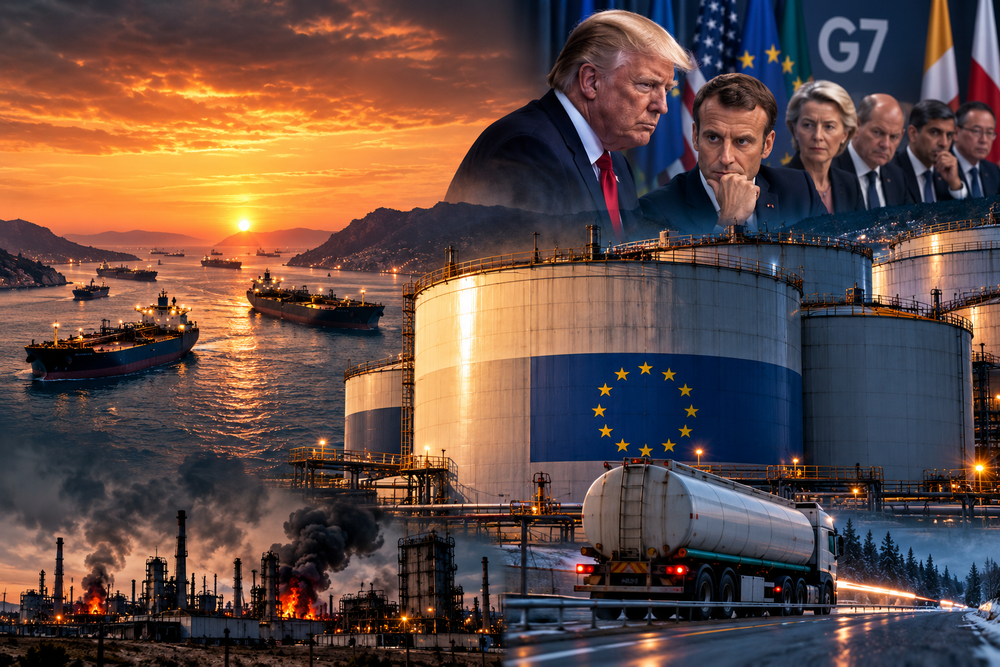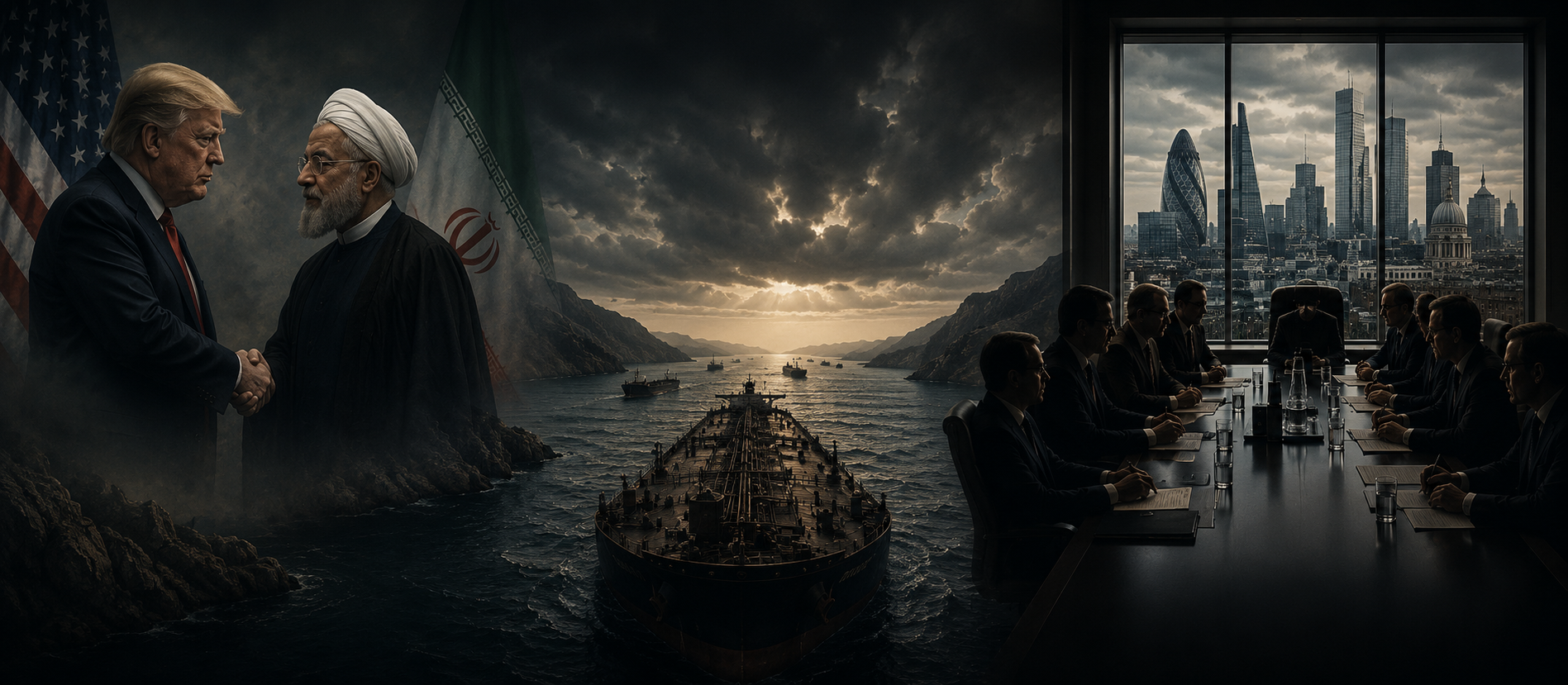
The agreement was announced on a Sunday, and by Monday morning the water had not changed at all. The cameras were ready for Friday. The framework was initialed, the language about a sixty-day ceasefire was circulating, the phrase reopening the Strait of Hormuz was in every headline. And out on the strait itself, in the twenty-one nautical miles of water through which a fifth of the world's oil passes, almost nothing moved. Tanker traffic had collapsed by roughly ninety-five percent during the war, and on the morning after the announcement it was still collapsed. The ships were waiting. They were not waiting for the presidents. They were waiting for a different signature entirely, one that no broadcast would carry, from a committee most of the people celebrating the deal had never heard of.
This is the part of the story that the announcement is designed to obscure. A peace deal is a political event, and political events are visible by construction. They happen in rooms with flags. They produce footage. But whether the oil actually moves through Hormuz is not a political event. It is a commercial one, and it is decided by people who sign nothing in front of a camera and who answer to no electorate. The determining variable in the reopening of the world's most important oil chokepoint was never the treaty. It was the price of insuring a single voyage through it, and that price is set by a market that does not take a government at its word.
The announcement and the water
Look first at what was actually agreed, because the gap between the document and the headline is where the whole mechanism lives. On the fourteenth of June the United States and Iran announced an agreement to settle a conflict that had run for roughly three and a half months, closed the strait, and sent oil markets into convulsions. The core of the agreement was a sixty-day extension of the existing ceasefire, with a formal signing expected at the end of the week and the reopening of Hormuz held out as the central prize. According to a fourteen-point draft reported by Iranian state media, the terms included the lifting of oil sanctions and an Iranian commitment to reopen the strait within thirty days, still pending approval from authorities in Tehran. Washington disputed that those were the agreed terms at all, which is itself part of the point: the two governments could not even agree on what they had agreed to.
Notice what is in that document and what is not. There is a ceasefire, which is a pause. There is a promise to reopen a waterway, which is a promise. There is sanctions relief to be negotiated. And there is, conspicuously, no resolution of the thing the war was ostensibly about. The fate of Iran's nuclear program and the disposal of its highly enriched uranium were not settled. They were deferred, handed to a sixty-day negotiating window that had not yet begun. The casus belli was not removed from the room. It was rescheduled.
A document that pauses a war for sixty days and defers its central dispute is not a peace treaty. It is a calendar. And a calendar does not move a tanker. What moves a tanker is the judgment, made vessel by vessel, that the voyage through the strait is now worth insuring at a price the cargo can bear. That judgment had not been made. It would not be made in a room with flags.
A captain does not sail on a press release
To see why the insurance market and not the treaty is the binding mechanism, follow a single ship. A tanker owner contemplating a transit of Hormuz during the crisis faced a wall that had nothing to do with diplomacy. Within forty-eight hours of the strikes that opened the war in late February, war-risk premiums on Gulf voyages surged roughly fivefold. By detailed accounts of the London market, some existing coverage was cancelled outright and rewritten at rates that ran, at the extreme, toward sixty times the pre-crisis level, and war-risk premiums rose over the conflict by something on the order of three hundred and forty percent, a surcharge running into the billions laid across the movement of global energy.
That surcharge is not an abstraction. It is a line item. The additional premiums charged for a single laden transit, through the mechanism of the International Group of Protection and Indemnity clubs, ran between roughly one hundred and fifty thousand and four hundred thousand dollars per vessel per call, depending on size and route. A shipowner does not need a treaty to be told the war is over. He needs that number to come down. Until it does, the arithmetic of the voyage does not close, and the cargo stays in port. The strait can be legally open, diplomatically open, rhetorically open, and commercially shut, all at the same time, because the gate is not the law. The gate is the premium.
This is the first inversion. The public imagines that shipping stops because a government closes a strait and resumes because a government opens it. In reality, during this war the strait was never formally closed to traffic in the way a border is closed. What changed was the price of risk. Ships did not stop because they were forbidden. They stopped because no one would underwrite them at a price that made the trip worth taking. The closure was financial before it was physical, and the reopening will be financial before it is physical too.
The committee that outranks the treaty
So who sets the number. Here the story narrows to a single institution that almost no one watching the peace deal will name, and it is worth naming precisely, because the asymmetry is the point. The body that effectively governs whether Hormuz is a war zone for insurance purposes is the Joint War Committee, a non-governmental committee of underwriting representatives drawn from the Lloyd's market and the International Underwriting Association of London. It is advised by independent security specialists. It maintains a list of what it calls Areas of Perceived Enhanced Risk. During the war it placed the entire Persian Gulf, the Strait of Hormuz, the Gulf of Oman, and the northern Arabian Sea on that list, one of the broadest Gulf designations in its history.
A listing does not forbid anything. It does something more revealing than a prohibition. It requires a shipowner to notify the war-risk underwriter before entering the area and to negotiate an additional premium for each transit, vessel by vessel, voyage by voyage. The decision to insure, and the price, remains with the underwriter. So the question of whether the world's most important oil artery is open is answered, in practice, by a private committee in London deciding when an area is no longer one of perceived enhanced risk, and by individual underwriters deciding what they will charge to be wrong about it.
Consider the scale of what hangs on that judgment against the size of the body making it. On one side, twenty million barrels of oil a day, a fifth of global petroleum liquids, the energy supply of much of Asia, a war that moved oil above one hundred dollars and rattled global growth. On the other, a committee of London marine underwriters and their security advisors, issuing a list. This is the recurring shape of real power that the Manifest keeps finding: not a hand on a lever but a small, dull, technical body whose narrow decision binds something vastly larger than itself. The treaty is signed by men who command armies. The list is maintained by men who command nothing but the price of being wrong. And it is the list that the tanker reads.
The premium moved first
If the insurance market were merely a thermometer, faithfully reporting a temperature set by politics, none of this would matter. The objection writes itself: underwriters lower premiums because a real deal lowers real risk, so the treaty is the cause and the premium only the readout. It is the strongest counter-argument, and the evidence does not support it cleanly, because the premium moved before the treaty existed.
By late March, months before the June framework, the additional war-risk premium for moving a tanker across the Gulf had already eased from around two and a half percent of hull value toward one percent. It eased, in the language of the market reports, as hopes emerged of an agreement to end the conflict. There was no agreement. There was no signing. There was a shift in the underwriters' reading of where the risk was heading, and the price fell to meet that reading. The same anticipation showed up in the oil market, which fell roughly twenty percent from its 2026 highs on optimism about a lasting ceasefire, and which jumped back above one hundred dollars whenever that optimism faded. The number that governs the strait was already in motion while the politicians were still arguing over a draft.
This is the second inversion, and it is the sharper one, so it is worth stating exactly as far as the evidence goes and no further. The claim is not that the underwriters secretly command the diplomacy. The claim is narrower and fully provable: the premium began moving before the treaty existed, and it moved on the underwriters' reading of the risk rather than on any document. The body that prices the war often shifts before the body that signs the peace, and the body that signs then arrives to take credit for a reopening the market had already begun to allow. That alone reorders who is reacting to whom. The price was in motion while the politicians were still arguing over a draft, which means the treaty, when it comes, will not be the cause of the reopening so much as the ratification of a verdict the market had started to reach on its own.
The strait that has no alternative
The reason the premium carries this much weight is geographic, and it is worth being concrete, because the chokepoint is the physical fact under the financial one. Roughly twenty million barrels of oil and petroleum liquids pass through Hormuz each day, about a fifth of the world's oil trade, through a shipping channel only a couple of miles wide in each direction within a strait twenty-one nautical miles across at its narrowest. There is no meaningful way around it. The pipelines built precisely to bypass it, Saudi Arabia's East-West line and the United Arab Emirates' overland route, can together carry only something between three and a half and five and a half million barrels a day at full stretch, barely a quarter of the normal Hormuz flow. More than half of everything that passes through goes to Asia, above all to China and India.
A chokepoint with no alternative is the textbook case of a single point of failure, the place where an entire system's resilience collapses to one fragile passage. And the insurance market is the instrument that prices that fragility in real time. When the risk at the single point rises, the premium rises, and because there is no alternative route to absorb the diverted traffic, the cost passes straight into the global oil price and from there into everything oil touches. The strait's lack of a backup is what gives the underwriters their leverage. If there were three good ways around Hormuz, the committee's list would be a minor inconvenience. Because there is no good way around it, the committee's list is, for practical purposes, a valve on the world economy.
The lever has a history
This is not the first time the price of insuring a voyage, rather than the decree of any government, decided who could use Hormuz. The pattern is old enough to have already pulled a superpower's navy into the Gulf once. During the Tanker War of the 1980s, as the Iran-Iraq conflict spilled onto the water, both sides attacked merchant shipping, striking more than four hundred vessels between 1984 and 1988. Traffic through the Gulf fell by roughly a quarter. Lloyd's of London raised its rates on tankers, and the cost of insuring a Gulf voyage climbed until, for some owners, it climbed out of reach.
What happened next is the tell. Kuwait, a non-belligerent whose tankers were being hit, did not primarily ask for a ceasefire. In late 1986 it asked for protection, because its ships were becoming commercially impossible to operate. The United States answered in 1987 by reflagging eleven Kuwaiti tankers under the American flag and escorting them through the strait in Operation Earnest Will, one of the largest surface-warfare operations since the Second World War. Read the causation carefully. The US Navy was not summoned to the Gulf by a treaty. It was summoned because commercial shipping had become effectively uninsurable, and the only way to restore the flow was for the state to step into the place the underwriter had vacated, to put a warship where private confidence used to be. The premium had failed, and a navy was the replacement.
What happened to that first convoy is worth seeing, because it shows the exact seam between a government's guarantee and an underwriter's risk. On the twenty-fourth of July 1987, three days out, the reflagged supertanker Bridgeton, four hundred and fourteen thousand tons under the American flag and escorted by three United States warships, struck a mine the Revolutionary Guard had laid in the channel west of Farsi Island. The mine was an old thing, a contact design dating to 1908. It tore the hull and the ship did not sink. The convoy sailed on, and then the warships fell in behind the wounded tanker, because the tanker's enormous hull was now better protection against the next mine than their own thinner ones were. Hold the image. The most powerful navy on earth, sent to make the strait safe enough to use, sheltering behind the very ship it had come to protect, because a mine older than the aircraft carrier had just demonstrated that an escort is not the same thing as safety. The state could restore the flag. It could not restore the certainty. And certainty is the only thing a premium is ever pricing.
That is the same hinge, swinging the other way. In the 1980s the insurance market's refusal to carry the risk forced a government to act. This week the question is whether a government's deal can persuade the insurance market to carry the risk again. In both cases the market is the variable the state is reacting to, not the other way around. The premium has been the hidden hinge of Hormuz for as long as Hormuz has been worth fighting over. The flags change. The hinge does not.
Iran never put the sword down
There is a further reason the underwriters will not simply follow the signature, and it comes from Iran's own description of what it is agreeing to. Tehran has not framed the reopening as a surrender of leverage. It has framed it as a loan of leverage, revocable at will. Iran's foreign minister has said the ceasefire applies on all fronts at once, including Lebanon, and that a violation on one front is a violation on all. On the strait, the framing is sharper still. He has said the passage will remain under Iranian and Omani sovereignty, and that its administration will be different than in the past. The unmistakable message beneath that language is that Tehran keeps its hand on the strait, that the reopening is a permission it grants rather than a right it surrenders. Only weeks before the framework, Tehran had broken off talks and threatened to close the strait completely.
Read that the way an underwriter reads it. The party that closed the strait is announcing that it retains the capacity and the asserted right to close it again, and is describing the reopening as a conditional, supervised arrangement rather than a return to the old freedom of navigation. For a security advisor pricing perceived risk, this is not noise around the deal. It is the deal. A reopening offered explicitly as reversible is, by definition, a higher-risk reopening than one in which the threat has been dismantled. The sword that remains poised is the sword the premium has to price. Iran did not have to hide its leverage to keep it. It announced it, and in announcing it, told the underwriters exactly why the premium cannot fall all the way back.
The same lever chokes Russia
The clearest proof that maritime insurance is the real enforcement layer of the oil order does not come from the Gulf at all. It comes from the response to Russia's war in Ukraine, and it is worth holding the two cases side by side, because they are the same mechanism pointed in opposite directions. Confronted with Russian oil exports it wanted to suppress, the Group of Seven did not try to physically stop the tankers. It did something quieter and far more telling. It forbade its own insurers from covering any Russian oil cargo sold above a price cap, set at first at sixty dollars a barrel. The sanction was not a blockade. It was an insurance rule.
The reason that rule had teeth is the same reason the Joint War Committee's list has teeth. The International Group of Protection and Indemnity clubs underwrites something close to ninety percent of world shipping. To be denied that cover is, in practical terms, to be denied the voyage. So the West discovered it could throttle a rival's oil exports without firing a shot, simply by controlling who was allowed to insure the cargo. Whoever holds the pen on maritime cover holds a valve on the global movement of oil. The instrument that can reopen Hormuz and the instrument that can choke Russia are the same instrument.
And the same case marks the limit of the mechanism, which is the honest boundary of this whole argument. Russia's answer to the cap was a shadow fleet, hundreds of aging tankers operating outside Western cover, kept afloat by an opaque tangle of state-backed and offshore insurance. Western insurers now describe the cap as largely unenforceable. The fleet kept the oil moving. The lesson is precise: the insurance gate is decisive only as long as there is no parallel, uninsured channel willing to carry the risk. Where a shadow fleet exists, the committee in London loses its switch.
Which is exactly why Hormuz is different. The crude that moves through the strait is mainstream oil on mainstream hulls bound for mainstream buyers, the kind of trade that cannot quietly disappear into a dark fleet without collapsing in volume. There is no shadow fleet large enough to carry a fifth of the world's oil in the dark. So at Hormuz the underwriters still hold the valve, and the question of whether the peace is real still routes through their judgment. The exception that frees Russian oil is the exception that does not yet exist for the Gulf.
Why the signature can lie and the premium cannot
Here is the deepest layer, the reason this is a mechanism and not just an irony. A government can sign a peace it does not fully intend to keep, or cannot guarantee, or knows to be fragile, and pay no immediate price for the gap between the words and the world. The signature is, in a precise sense, free. It commits the signatory to a performance, not to an outcome. The premium is the opposite. It is a sum of real money that someone must put at risk on the proposition that the voyage will be safe. If the underwriter misjudges the peace, the underwriter pays. That asymmetry is everything. The party that signs the peace does not have to be right. The party that prices it cannot afford to be wrong.
This is why the premium cannot simply track the announcement. It has to track the things the announcement leaves out: the infrastructure damaged across the Gulf during the war, the depleted inventories, the security of tanker traffic in waters where one side has made clear it retains the ability to close the strait again, the credibility of an enforcement mechanism that does not yet exist, the sixty-day clock with nothing behind it. Market analysts were already saying that even with a deal, only a partial reopening of the strait was realistic in the near term. That is the underwriters' verdict translated into oil-flow terms. They are not disputing that a deal was signed. They are pricing the distance between the deal and the water, and that distance is exactly the part the ceremony is built to make you forget.
It would be comforting, and it would be wrong, to call this a conspiracy of insurers, a cartel pricing war upward to skim the global economy. There is no such room. There is no committee that wants the war to continue. The underwriters would happily collect smaller premiums on a calmer sea. What governs the price is not a plan but a market, thousands of individual judgments about risk that no one coordinates and no one can override, including the governments whose treaty the market is quietly grading. That is what makes it powerful. A cabal can be exposed and broken. A price cannot. It simply keeps reporting, in dollars per transit, how much of the announced peace the people with money on the line actually believe.
Why the gate is in London
There is one more question, and it is the one that turns this from a story about a strait into a story about how the world was built. Why London. Why does a committee in the City of London, and not in Beijing or Houston or Dubai, get to decide when the Gulf is safe to use. The answer is not that London is neutral, or wiser, or fairer. The answer is that the apparatus was built three centuries ago and never taken down.
Marine insurance in its modern form grew up in a coffee house. By 1688, merchants, captains, and underwriters were gathering at Edward Lloyd's establishment in the City to trade shipping news and to write cover on voyages, and Lloyd's coffee house became the recognized place to obtain marine insurance. As London became the trading center of an expanding empire, it became the place where the empire's ships were insured, and Lloyd's grew to hold something like eighty to ninety percent of the marine market. London underwriting practice spread around the globe on the hulls of British trade, and London underwriters covered those hulls every league of the way. The pricing of maritime risk was, from the beginning, part of the machinery of empire.
Then the empire ended. The colonies became nations, the Royal Navy shrank, the maps were redrawn, and Britain stopped ruling the waves in any military sense at all. The apparatus that priced the waves did not go anywhere. London remains the leading international marine insurance and reinsurance market in the world, the place where a dominant share of the world's hull and war-risk cover is still written, long after the fleet that built that position sailed home. The flag came down. The risk desk stayed open.
This is the pattern the Manifest keeps finding wherever a system seems to collapse. The visible institution falls and the operational one survives, because the operational one was never the part anyone thought to dismantle. Decolonization dissolved the political empire and left the underwriting apparatus standing, still performing the function it was built for, now on behalf of a world that does not remember giving it the job. Nobody alive chose to make London the arbiter of whether oil moves through Hormuz. The arrangement was set by history, in a coffee house, before the United States existed. We did not choose this gatekeeper. We inherited it.
That is the deepest layer of the asymmetry. It is not only that a small committee outweighs a treaty. It is that the committee sits where it sits for reasons that have nothing to do with the present balance of power and everything to do with an empire that is supposedly gone. The real question is not who prices the risk. It is why the world was built so that this particular room, in this particular city, still holds the pen.
The insurer as the arbiter of peace
Step back and the general shape comes into view, the one that outlives this particular ceasefire. When a strait is contested, sovereignty over whether it is genuinely open passes, quietly, from the states that border it and the states that fight over it to the private institutions that price the risk of using it. The World Economic Forum's own analysis of the crisis described governments being pushed into the role of insurers of last resort, stepping in where the commercial market would not. Others called it the insurance weapon, risk pricing functioning as an instrument of pressure in its own right. Both phrases point at the same migration. The decision that looks political, is the strait open, is in its operative form a commercial one, is the strait insurable, and the body that answers it is not the body that signs the treaty.
The Manifest has traced this pattern before under a different name, the privatization of a sovereign function performed by an entity insulated from the accountability that function used to carry. A risk committee in London is not accountable to an Iranian fisherman, an Indian refiner, or an American voter. It does not need to be. Its authority does not come from legitimacy. It comes from the fact that no cargo moves until it speaks. The treaty has all the legitimacy and the cameras. The committee has the actual switch. The treaty announces a peace it cannot enforce. The premium enforces a peace it cannot announce. And in the distance between those two facts lives the entire difference between a peace that is declared and a peace that is real.
The rule beneath the strait
Lift the case off Hormuz and a more general law is left in your hand, and it is the part worth carrying. A system has not truly changed when its leaders announce that it has. It has changed when the people who lose money if the change is false begin to act as though it is true. Words are cheap because no one underwrites them. A price is expensive because someone has staked capital on it being right.
This is why the most reliable reading of any official reality is rarely the official statement. It is the behavior of whoever is financially exposed to that statement being wrong. A peace is real when underwriters lower the premium. A currency is trusted when lenders accept a thinner yield to hold its debt. A bank is sound when the other banks will still lend to it overnight. A pledge to defend a coastline is credible when the insurers who would pay for the flood reprice the houses behind it. In each case the announcement is the visible layer and the price is the binding one, and in each case the two can disagree for a long time while only one of them is telling the truth.
That is the transfer, and it is why this is not really a story about Iran. Hormuz is only the clearest instance, because the chokepoint is so narrow and the price so legible that you can watch the mechanism work in a single number. The rule runs underneath far more than a strait. Whenever you are told that a system has turned a corner, find the party that pays if it has not, and watch what they charge. Their number is the part of the story that cannot afford to lie.
So watch Friday's signing, by all means. Watch the handshake and the flags. But if you want to know whether the war is actually over, do not watch the men with the pens. Watch the number on the war-risk slip for a single tanker bound for Hormuz. When that number falls back toward where it sat before the first strike, the peace will have become real, and you will be able to date the moment precisely. It will not be the day the treaty was signed. It will be the day the underwriters decided to believe it.
The signature is free. The premium is not. Only what is not free is binding.
Evidence Map
Facts, interpretations, forecasts, and disconfirming signals.
Core claim. Whether the Strait of Hormuz actually reopens to oil traffic is determined not by the US-Iran signing but by the war-risk insurance market, above all the Lloyd's and IUA Joint War Committee's listing and the per-voyage premiums underwriters charge. The political signature can declare peace; only the insurance price makes the oil move, and that price tracks real residual risk, not the announcement.
Evidence level. Facts (high): the June 2026 ceasefire framework and deferred nuclear terms; Hormuz carrying roughly 20 million barrels a day, about a fifth of global oil; war-risk premiums rising roughly fivefold within 48 hours of the late-February strikes and around 340 percent over the conflict; per-transit additional premiums of roughly 150,000 to 400,000 dollars per vessel; the JWC's listing of the whole Gulf region; the premium easing from about 2.5 to 1 percent by late March on deal hopes; oil down about 20 percent from 2026 highs; Iran's stated retention of leverage over the strait. Interpretation (marked): that insurance pricing functions as the binding gate and the independent arbiter of the peace's reality, rather than as a passive thermometer of politics.
What would confirm this. Tanker traffic and oil flows stay depressed after the signing while war-risk premiums remain elevated; or premiums and traffic move on shifts in perceived risk (Iranian statements, security incidents) rather than on the diplomatic calendar, as they already did in March.
What would disprove this. If, within weeks of the signing, the JWC de-lists Hormuz, war-risk premiums fall to near pre-crisis levels, and traffic normalizes to roughly pre-war volumes, then the market treated the signature itself as decisive and the insurance layer was a thermometer, not an independent gate.
Watchlist. The next JWC Listed Areas update; the per-transit additional premium for Gulf voyages; the Brent price through and after the Friday signing; the sixty-day nuclear window and whether it produces anything binding; Iranian statements on the strait's administration.
Related from The Manifest Archive
- Everyone Is Watching the Iran War. Nobody Is Watching What It Is Breaking
- Everyone Is Watching the Iran War. Nobody Sees the Complete Picture
- Current Wars in the World, 2026: The Expanding Conflict Map
- How the AI Boom Is Throttled by Power Transformers and Steel Lead Times
Jerry van der Laan writes The Manifest Archive. He traces the structures beneath the events.