Eyes Wide Shut explained: a detailed analysis of the ritual scene, elite symbolism, secret society themes, and how Stanley Kubrick portrays insulated power.
Stanley Kubrick’s Eyes Wide Shut (1999) remains one of the most discussed and misunderstood films in modern cinema. Viewers continue to search for the meaning of the ritual scene, the symbolism of the masked ceremony, and whether the film portrays a secret society operating beyond public accountability.
At first glance, Eyes Wide Shut appears to be an erotic psychological drama about jealousy and marriage. But the film gradually shifts focus. The masked ritual scene does not depict chaos, decadence, or moral panic. It depicts order.
Kubrick does not show power collapsing when exposed. He shows power absorbing disturbance and continuing.
That difference explains why the film still unsettles audiences decades later.
And there is a final irony the film could not have scripted. The way it was handled after Kubrick’s death, quietly altered before release and then mined for decades by viewers hunting a hidden cabal, would end up proving its own argument, an audience looking straight past the mechanism it had been shown in plain sight.
What Is the Ritual Scene in Eyes Wide Shut?
The ritual scene in Eyes Wide Shut takes place in a secluded mansion outside New York City. Dr. Bill Harford, played by Tom Cruise, gains access to a private masked ceremony attended by wealthy and powerful individuals.
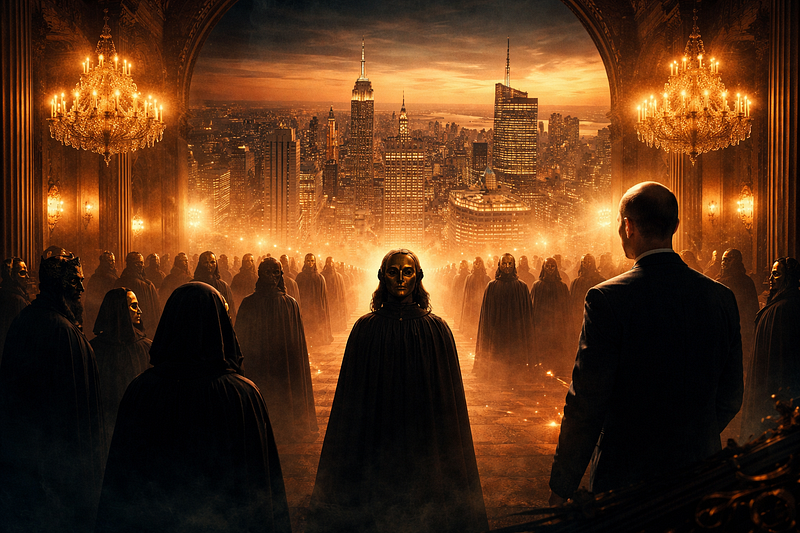
The setting is precise and controlled. A grand hall illuminated in red light. Participants wearing cloaks and Venetian masks. A central figure presiding over the ceremony with measured authority. Movement is synchronized. The atmosphere is disciplined.
This is not a chaotic orgy.
It is a structured ritual.
When Bill is exposed as an intruder, the most important detail becomes visible. The ceremony does not collapse. There is no panic. No violent outbreak. The leader calmly identifies deviation and restores order. Bill is surrounded, confronted, and reminded of his position.
The system does not tremble.
The ritual scene is not about shock. It is about hierarchy under control.
What Does the Masked Ceremony Symbolize?
The masked ceremony in Eyes Wide Shut has often been interpreted as representing a secret society. While Kubrick clearly uses imagery associated with elite secrecy, the symbolism is more structural than sensational.
The masks erase individuality. Personal identity becomes secondary to role. Hierarchy becomes visible precisely because faces disappear.
Ritual binds insiders through shared exposure. Those inside the ceremony share knowledge and vulnerability. That shared risk produces cohesion.
Bill does not share that risk. He has witnessed the ceremony, but he has not entered its binding.
Kubrick’s framing insists on the difference. The ceremony unfolds with composure. Transgression follows choreography. The tone remains procedural rather than emotional. Whatever binds this room, it is plainly not spectacle.
But what is it, then, and why does a hierarchy this exposed feel no need to enforce itself? The film stages the question with great precision and pointedly declines to answer it. The answer, as it happens, had been written down decades before the film was made.
Is Eyes Wide Shut About Secret Societies?
Many viewers ask whether Eyes Wide Shut is about real-world secret societies. The masked ritual scene certainly evokes imagery associated with elite gatherings, underground networks, and conspiracy interpretations.
However, Stanley Kubrick avoids naming any specific organization. The film does not connect the ceremony explicitly to government institutions, corporations, or known societies.
Instead, Kubrick focuses on insulation.
The ritual does not justify itself through ideology. There is no speech explaining its purpose. There is no external threat used as narrative cover. The hierarchy simply exists.
This absence of justification is central to the film’s meaning.
The power structure does not need crisis to sustain itself. It operates as maintenance.
In this sense the film withholds the very thing the genre usually hands over, the name of the society and the nature of its bond, and leaves the viewer with a sharper question instead: if not a conspiracy, then what holds such a structure together?
Stanley Kubrick and Elite Power
Stanley Kubrick consistently examined institutional power throughout his career.
In Dr. Strangelove, he satirized Cold War military command structures. In Full Metal Jacket, he exposed the psychological conditioning embedded in military training. In A Clockwork Orange, he explored state control over behavior.
With Eyes Wide Shut, Kubrick shifts from visible institutions to social elites.
The ritual scene portrays hierarchy without overt political context. There are no flags, no uniforms, no speeches about national security. Yet the structure is unmistakable.
Bill’s violation is not treated as a moral crime. It is treated as structural misalignment. He entered a space where he did not belong. The response is procedural correction.
Kubrick’s portrayal of elite power is restrained and clinical. There is no cinematic revolution. The hierarchy remains intact.
Why Kubrick, and why this film
It matters that this particular film was made by this particular director. Stanley Kubrick was famous for total control, shooting scene after scene dozens of times, governing every frame, and Eyes Wide Shut was the longest continuous shoot in film history at the time. He died in March 1999, days after delivering what was reported to be his final cut, so this is also a last statement, the most controlling director's final film, and its subject is control itself. The form mirrors the content. A film about a hierarchy that never loses its composure was made by a man who never relinquished his. That is not a coincidence to decode; it is why the depiction rings true. Kubrick was not guessing at how insulated power behaves. He was rendering, in a controlled system, the behavior of controlled systems.
How Hollywood Portrays Power Structures
To understand why Eyes Wide Shut stands apart, it is useful to compare it to mainstream Hollywood portrayals of institutions.
In many American films, intelligence agencies, military units, and political leaders are shown as flawed but necessary. Corruption may appear, but it is often individualized. The broader system survives.
Exposure typically leads to reform rather than collapse.
Hollywood productions frequently cooperate with institutions such as the U.S. Department of Defense. When filmmakers request access to military equipment, aircraft carriers, or operational locations, scripts are reviewed. Projects that align with institutional interests receive logistical support.
This dynamic does not require overt censorship. It functions through incentives. Access reduces cost. Lower cost increases production feasibility. Feasibility shapes narrative direction.
As a result, institutional power in mainstream cinema is often portrayed as reformable and stabilizing.
Kubrick’s Eyes Wide Shut does not follow this pattern.
The ritual scene does not seek public legitimacy. It does not present itself as necessary or protective. It simply persists.
The conspiracy reading, and its limit
The film invites a literal reading, and it is worth meeting at full strength: that the masked ceremony is a coded exposure of a real elite society, an Illuminati, a cabal, the people who actually run the world, and that Kubrick was telling us what he knew. That reading is not stupid; the imagery deliberately summons it. But it misses what the film actually does, which is the opposite of naming a cabal. Kubrick withholds every identification. No organization, no government, no corporation, no creed is ever named, and that withholding is not evasion, it is the argument. The point is not which secret group is in the room. The point is the form of the power, the insulation, the cohesion, the calm reabsorption of a threat, which would look the same whoever was behind the masks. The conspiracy reading wants a defendant. The film offers a structure, and a structure has no defendant, which is exactly why it endures. To insist on naming the society is to make the same mistake Bill makes: to think that seeing the ritual is the same as understanding the power, when the power was never in the spectacle.
Why the Ritual Does Not Collapse
The most important question in Eyes Wide Shut is not what the ritual represents.
It is why it does not collapse.
Bill sees the masked ceremony. He understands that elite power exists beyond his assumptions. Yet nothing in the film suggests that the hierarchy weakens because of his awareness.
The following day, life continues. Christmas lights glow. Traffic moves. Social rituals resume. Bill returns home.
There is no systemic rupture.
Kubrick denies viewers the comfort of believing that exposure alone destabilizes power.
Awareness, on its own, creates no leverage at all. The ritual persists, and the film declines to say why. To find the reason, we have to leave the cinema for the sociology the film was, knowingly or not, dramatizing.
The sociology the film dramatizes
What Kubrick staged as fiction, social scientists had described as fact decades earlier. In 1956 the sociologist C. Wright Mills published The Power Elite, arguing that the people who run the major institutions of a society, its largest corporations, its military command, its political executive, are not a random or rotating set but a relatively cohesive group, bound by similar origins, similar schooling, intermarriage, and a constant circulation between the top posts of each sphere. The same person moves from a corporate board to a cabinet office to a university trusteeship; the spheres interlock at the top. Mills was careful, and the care is the whole point: he did not claim a conspiracy. He claimed a structure. The cohesion comes not from a plot but from formation, from the fact that the people at the top of different institutions were shaped by the same places and recognize one another as members of the same world. That is exactly the relationship Eyes Wide Shut renders in a single room. The masked figures are not a cabal that meets to issue orders. They are a class that already moves together, performing the cohesion that their shared formation produced.
This is why the film feels truer than the conspiracy thrillers it superficially resembles. A thriller needs a command center because its theory of power is that someone decides. Mills, and Kubrick, offer a harder theory: that the most consequential coordination in a society happens without anyone deciding it, because the coordinators were made alike before they ever entered the room. Remove any one of them and nothing changes, because the cohesion was never lodged in the individual. It was lodged in the formation that produced them all.
Why shared secrecy binds
The masks and the ceremony are not decoration; they are a mechanism, and it is a documented one. More than a century ago the sociologist Georg Simmel analyzed the secret society as a distinct social form and identified what holds it together: shared possession of a secret, and shared exposure in keeping it. When a group knows something together that the outside world must not know, the knowing itself becomes the bond, and each member's safety depends on every other member's silence. Mutual vulnerability becomes mutual trust. This is why initiation rites across history involve a threshold of shared transgression or shared risk: once you have crossed it with the others, you cannot inform on them without exposing yourself. The secret is not the content. The secret is the glue.
Eyes Wide Shut isolates this mechanism with unusual precision. The crucial fact about the ceremony is not what happens at it but that everyone present has now seen everyone else present. They are bound by joint exposure. Bill's catastrophe is not that he witnessed something forbidden; it is that he witnessed it without being bound by it. He holds the secret but shares none of the risk, and so he is not a member but a danger, a man who knows without being implicated. The film's genuinely chilling insight is that the group does not need to silence him with violence. It only needs to make clear that he, alone, is exposed, while they, together, are not. Shared secrecy has made them safe and left him naked.
How elites are made to think alike
If the cohesion comes from formation rather than coordination, the next question is how the formation works, and here the sociologist Pierre Bourdieu supplies the documented mechanism. Bourdieu described how elites reproduce themselves not chiefly through inheritance of money but through the transmission of a habitus, a set of dispositions, tastes, manners, and unspoken assumptions absorbed in the right schools, families, and institutions, which functions as a form of capital and as a password. People formed in the same elite settings come to share not a program but a way of perceiving, so that they reach similar judgments independently and recognize one another instantly as the same kind of person. No memo circulates because none is needed. The alignment was installed long before any decision arose.
This is the answer to the question every conspiracy theory asks and answers badly: how do powerful people coordinate without being caught coordinating? The honest answer is that much of the time they do not coordinate at all, in the sense of meeting and agreeing. They were made coordinate. The Davos forum, the exclusive club, the elite university, the boards on which the same names recur, are not command centers issuing instructions; they are the institutions of formation and recognition, where the habitus is reinforced and the network maintained. They produce alignment the way a shared language produces mutual understanding, automatically and without a plan. Kubrick's ceremony is the dramatized, concentrated image of this dispersed, ordinary process: a room where people who were already aligned perform their alignment.
The real gatherings, and why they are not cabals
The film inevitably calls to mind the real exclusive gatherings of the powerful, and it is worth being exact about what those are and are not, because the exactness is the difference between analysis and conspiracy theory. Davos, Bilderberg, the old gentlemen's clubs, the elite reunions: these are documented and real, and they do matter, but their function is not the one the conspiracy frame assigns them. They are not boardrooms where the world's decisions are taken. They are sites of cohesion, where a transnational elite renews its acquaintance, calibrates its sense of what is thinkable, and reproduces the shared assumptions that let its members act in parallel afterward, each in their own institution. The output is not a directive. The output is alignment. That is both less sinister and more durable than a cabal, because a cabal can be exposed and broken, while a shared worldview cannot be raided. You can publish the guest list of Davos, and nothing changes, because the power was never in the meeting. It was in the formation the meeting maintains, which is precisely the point Eyes Wide Shut makes by refusing to let the exposure of its ceremony change anything.
Insulation: power beyond consequence
The single most disturbing beat of the film is the calm. When the intruder is discovered, the ceremony does not panic; it identifies the deviation and resumes. That composure is the depiction of insulation, the condition in which a power is not merely hidden but placed beyond consequence, and it has exact analogues outside the screen. Watch how real elite institutions absorb scandal. The exposure arrives, the headlines run, an inquiry is announced, a settlement is reached without admission of wrongdoing, a figure resigns with his fortune intact, and the structure continues unchanged. The revolving door turns. The prosecution that would reach the top is declined as not in the public interest. Nothing in the architecture is altered, because the architecture was built to absorb exactly this. Exposure, which in a healthy accountable system is a threat, becomes in an insulated one merely an event to be managed. The film shows a power that does not fear being seen because being seen costs it nothing, and that is the most accurate thing it says about how durable power actually behaves.
The mask and the office
There is one more reason the mask is the right symbol, and it reaches back to Max Weber's analysis of bureaucracy. Weber observed that modern power operates through the office rather than the person: the role persists while the individuals filling it are replaceable, and authority attaches to the position, not the human being. The mask is the visual form of exactly this. It erases the individual and leaves the role, which is why the ceremony can lose any single participant without weakening, and why no unmasking would expose anything that matters. To remove a mask is to find a person, and the person was never the point. This is the same principle that makes institutions so much more durable than the people who staff them, the principle that runs through this archive: that an apparatus, a class, or a structure outlives its members because it never depended on them as individuals in the first place. The mask does not hide a face. It announces that the face is irrelevant.
The password at the gate
Consider how Bill gets in, because the detail carries the whole theme. He does not belong. He has no invitation and no standing. He gains entry by learning a single word, the password Fidelio, and by renting the costume, the cloak and the mask, that lets him pass for a member. For a few hours the disguise works. He stands inside the room, sees everything, and believes that seeing is belonging. It is not. The password admitted his body; it did not make him one of them, because membership was never a word or a costume but a formation he does not have and cannot fake. The moment the group tests him, the disguise fails, not because he is unmasked but because he cannot answer for himself the way a real member can. The gate let him in. The cohesion kept him out. Everything the film says about power is already present in that threshold: access is not the same as belonging, and seeing the inside is not the same as being inside.
The research behind the image
Mills was not the last word; the empirical study of elite cohesion continued and sharpened after him, and it consistently found the same shape the film depicts. The sociologist G. William Domhoff, across decades of work under the title Who Rules America, documented the dense network of clubs, policy groups, foundations, and social institutions through which the American upper class maintains a shared outlook and a working unity, mapping the actual overlapping memberships rather than asserting a plot. The business scholar Michael Useem described what he called the inner circle, the relatively small set of senior figures who sit on multiple corporate boards at once and, through that overlap, come to act in the interest of their class as a whole rather than any single firm. The recurring empirical finding is interlock: the same people, the same boards, the same handful of binding institutions, producing coordination as a structural property of the network rather than as the output of a meeting. None of this research needs or finds a conspiracy. It finds a class that is organized by its own institutions, which is the documented, checkable version of the room Kubrick filmed.
Why a ritual, and not a memo
A reasonable viewer might ask why such a class would gather for a ceremony at all, rather than simply doing business. The answer reaches back to the founding insight of the sociology of religion. Emile Durkheim argued that ritual is not primarily about its ostensible content; its real function is to produce social solidarity, to make the group feel its own existence and renew its bonds through shared, charged, collective experience. Assembled bodies, synchronized movement, heightened atmosphere, a sense of the sacred: these manufacture cohesion directly, below the level of argument. This is why elites, like every durable group, maintain rituals, dinners, ceremonies, reunions, initiations, and not merely meetings. A memo transmits information. A ritual transmits belonging. Kubrick understood that to depict the deepest layer of elite power he could not show a negotiation; he had to show a rite, because the binding the film is about is produced by exactly the kind of charged collective performance Durkheim described, and by nothing as thin as a conversation.
The mask has a history
The choice of Venetian masks is not arbitrary either, and its history reinforces the reading. In the Republic of Venice the mask was for centuries a sanctioned social technology, worn during long stretches of the year, that allowed the patrician class to move, transact, and indulge while suspending individual identity and the accountability that comes with it. The mask let rank act without a name attached. It is one of history's clearest instances of a ruling class institutionalizing anonymity as a privilege, a way of exercising power and appetite while no one in particular could be held responsible. Kubrick reaches for precisely this tradition, and it does the same work in the film that it did in Venice: it converts identifiable individuals into an anonymous order, so that what happens in the room belongs to the structure and to no person who could be called to answer for it. The mask is an old instrument, and its oldest use was exactly this one.
The film that was altered, and then misread
The history of the film's own release quietly proves its thesis a second time. Kubrick died in March 1999, days after delivering his cut and months before the picture reached the public. For the American release, the studio digitally altered the central ceremony, inserting cloaked figures to obscure the scene enough to secure a commercial rating, so that the version most American viewers first saw had literally been edited to manage what could be shown. A film about an institution that controls what is seen was, on its way to the audience, subjected to a controlled adjustment of what could be seen. In the years since, the internet filled the interpretive vacuum with elaborate conspiracy readings, each trying to name the society and decode the plot, each missing that the director had withheld the names on purpose. The film's afterlife thus reenacts its argument: the structure managed the image, and the audience, searching for a hidden cabal, looked straight past the visible mechanism. The misreading is itself a demonstration of how reliably attention is drawn to the secret and away from the structure.
Insulation, in the real world
The film's calm has a real-world test case, and it is recent enough that most readers lived through it. The financial crisis of 2008 was the largest economic exposure in generations: institutions failed, trillions in wealth evaporated, the conduct that produced it was investigated at length and documented in detail. By the logic of an accountable system, the people at the top of the firms responsible should have faced the consequences. Almost none did. In the United States, no senior Wall Street executive went to prison for the conduct at the heart of the crisis; the cases were settled, overwhelmingly, with corporate fines paid by shareholders and without individual admission of guilt. The structure absorbed the largest shock it had produced in a lifetime and continued, its leadership intact, its arrangements substantially unchanged. That is the calm reabsorption of Kubrick's ceremony, transposed from a mansion to a banking system. The exposure was total, and it cost the top almost nothing, because the power was insulated from the consequence by design. The film did not predict 2008. It described the mechanism that made 2008's aftermath possible.
Power that no longer explains itself
One detail of the ceremony is easy to pass over and is in fact decisive: no one explains it. There is no speech, no creed, no stated purpose, no external enemy invoked to justify the gathering. The hierarchy simply exists, and expects no one in the room to ask why. This is the mark of a particular maturity of power. The philosopher Jurgen Habermas argued that political orders depend on legitimacy, on the production of reasons that make authority acceptable to those subject to it, and that systems fall into crisis when they can no longer generate those reasons. Eyes Wide Shut shows power at the stage beyond that anxiety, a power so settled that it has stopped explaining itself to anyone, because everyone who matters is already inside it and no one outside it is owed an account. A regime that must justify itself is still answerable. A power that has dropped the justification has concluded that it will not be called to answer. The silence at the ceremony is not an absence of meaning. It is the sound of a power that no longer believes it needs consent.
Why the film will not leave you
Finally, the discomfort the film leaves behind is structural, not accidental, and it explains the decades of obsessive interpretation. Almost every story about hidden power grants the audience a resolution: the conspiracy is exposed, the guilty are named, order is restored, and the viewer is released. Eyes Wide Shut withholds all of it. The intruder is warned off, the questions are never answered, the structure is never named or broken, and the film ends not with revelation but with a return to ordinary life, as if nothing could be done and little had changed. That refusal of closure is why it unsettles, and why audiences keep returning to it looking for the answer it deliberately denies. The unresolved ending is not a failure of the film; it is its final and most honest statement. Real structures of power do not offer third acts. They are not exposed and toppled in time for the credits. They absorb the disturbance, decline to explain, and continue, and the only honest ending for a film about that kind of power is the one that leaves the viewer exactly where it leaves Bill: having seen everything, and changed nothing.
The form is older than the film
It would be a mistake to treat any of this as a modern aberration, because the closed rite that binds a ruling group is one of the oldest social forms there is. The ancient world had its mystery cults, the Eleusinian rites among them, whose initiates were sworn to a silence so complete that their content is still not fully known, and whose power lay precisely in the shared, unspeakable experience that set members apart. The medieval world had its chivalric and religious orders, closed brotherhoods with their own oaths, signs, and ceremonies of admission. The modern world produced fraternal societies and, in the universities, the secret clubs whose alumni recur for generations in the upper reaches of finance and government. Strip away the period costume and the same mechanism runs through all of them: admission by ordeal or oath, identity subordinated to the group, a bond of shared secrecy, and a resulting cohesion that outlasts any individual member. This is the documented, anthropological backdrop against which the film should be read. Kubrick did not invent the masked rite of an insulated elite. He reached for an image as old as ruling classes themselves, because the thing he was describing is that old. The film feels archetypal because it is drawing on an archetype, the perennial way that those at the top have bound themselves to one another and shut the rest out, performed once more in a mansion outside New York.
The law the film reveals
Stripped to its principle, Eyes Wide Shut is a fiction that states a non-fiction law: the most durable power is the kind that does not depend on being seen, and that absorbs exposure rather than fearing it. A regime that rules through spectacle, that needs to be witnessed to be obeyed, hands its subjects something to refuse. A power that rules through cohesion and insulation offers nothing to refuse, because there is no performance to interrupt and no leader whose fall would matter. This is the same mechanism this archive traces outside the cinema: in how a defeated regime's apparatus quietly continues, in how financial constraint operates as anticipation rather than command, in how the oldest elites kept power by becoming unremarkable. Kubrick simply filmed it. The masks are not the secret. The composure is.
The Meaning of Eyes Wide Shut
The title Eyes Wide Shut suggests deliberate blindness. Bill moves through elite social circles assuming proximity equals belonging. He believes his professional status grants integration.
The ritual scene reveals the boundary.
He is close to power, but not part of its binding.
The film ends in a brightly lit toy store. Ordinary life continues. The insulated structure coexists with everyday normalcy.
Kubrick does not offer revolution. He offers recognition.
That is why Eyes Wide Shut continues to generate discussion decades after its 1999 release. The ritual scene is not spectacle for shock value. It is a depiction of insulated hierarchy.
The American instances, named
The film’s mansion has real, documented American counterparts, and naming them carefully is the difference between sociology and conspiracy. The sociologist G. William Domhoff devoted an entire study, The Bohemian Grove and Other Retreats, to the summer encampment in the California redwoods where, for more than a century, presidents, cabinet officers, financiers, and industrialists have gathered in private for a ritualized retreat that opens with a robed ceremony. Domhoff’s point was never that policy is dictated in the Grove; it was that such retreats are machinery for cohesion, places where the men at the top of separate institutions become known quantities to one another and renew the shared world that lets them act in concert afterward. The collegiate secret societies make the same point at the start of a career rather than the summit of one. Yale’s Skull and Bones, founded in 1832, is a documented institution whose initiates, bound by a closed rite and lifelong discretion, recur for generations in the upper reaches of finance, law, intelligence, and government, two presidents named Bush among them. These are not the secret rooms the conspiracy theorist imagines, where the world is decided. They are exactly what the film depicts, the ordinary institutions of elite formation and recognition, ritualized because ritual is what binds, and documented precisely because their power was never in the secrecy of their existence but in the cohesion of their membership.
That is finally why the film refuses to resolve, and why its own history proved it right. Altered before it reached the public and then decoded for decades by viewers certain a cabal was hidden inside it, Eyes Wide Shut watched its audience do precisely what Bill did, stare at the spectacle and miss the structure. The endless search for the secret society is the last and most reliable proof of the film’s thesis, because it is the mechanism working on us in real time, drawing the eye to the hidden room and away from the cohesion that never needed a room at all.
The Grove’s own opening rite makes the point vivid, and it is worth seeing rather than summarising. On the first night, at the edge of a lake in the California redwoods, men who run banks and ministries and newspapers put on hooded robes and gather in the dark before a roughly forty-foot concrete owl lit by fire. An effigy called Care is carried out and ceremonially burned, the worries of the workaday world consigned to the flames so that the members may be wholly among their own. Domhoff recorded it not as evidence of a plot but as a textbook instance of Durkheim’s law, a charged collective rite whose real product is solidarity. Some of the most powerful men in the country were, quite literally, standing in robes by firelight to perform their cohesion.
Evidence Map
Facts, interpretations, forecasts, and disconfirming signals.
Core claim. Eyes Wide Shut depicts, and the sociology of elites documents, a power that rests on cohesion and insulation rather than on a command center. The most durable elite power is made through shared formation and shared secrecy, absorbs exposure rather than fearing it, and therefore has no cabal to expose. The masked ceremony dramatizes a documented structure, not a literal conspiracy.
Evidence level. Facts (high): the film’s content and the documented alteration of the ceremony for the US rating; Kubrick’s death in March 1999; the sociological literature cited (Mills, The Power Elite, 1956; Simmel on secrecy; Bourdieu on habitus; Weber on the office; Durkheim on ritual; Domhoff, Who Rules America and the Bohemian Grove study; Useem on the inner circle; Habermas on legitimation); the 2008 outcome in which essentially no senior US executive was imprisoned for the crisis conduct. Interpretation (marked): reading the film as a depiction of this structure, and mapping it onto the documented sociology, is an analytical interpretation, not a claim about Kubrick’s private intent or about any real named society.
What would confirm this. Continued empirical findings of elite interlock and cohesion (overlapping boards, shared formation) without evidence of central coordination; continued reabsorption of exposure by insulated institutions.
What would disprove this. Evidence that elite coordination depends on an actual command center whose exposure collapses it, or that exposed elite institutions reliably face structural consequences rather than absorbing scandal.
Watchlist. Whether high-level accountability after major institutional failures becomes the rule rather than the exception; the persistence of the documented club-and-board networks.
Jerry van der Laan writes The Manifest Archive, where he examines power, language, and institutions. He traces the structures beneath them.
Related from The Manifest Archive